Somali Piracy Returns in a Deadlier Form, Researcher Warns at Accra Forum



Somali piracy has returned in a more violent and better-organised form than the wave that peaked a decade and a half ago, a leading researcher told the inaugural African Maritime Security Forum in Accra, warning that the naval presence that once suppressed it has thinned out just as the threat is growing again.
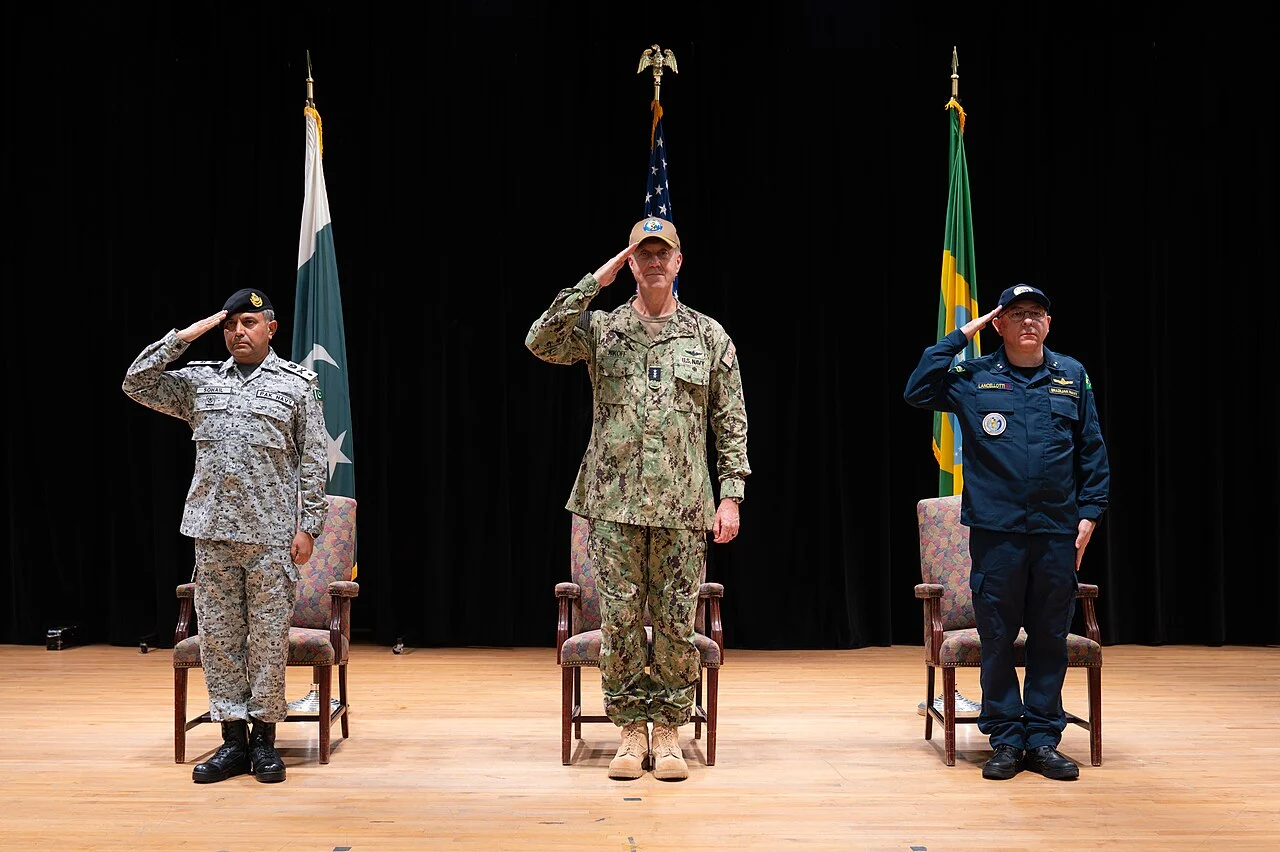
Photo: Pakistan Navy Commodore Sohail Azmie, outgoing commander of Combined Task Force 151, U.S. Navy Vice Adm. George Wikoff and Brazilian Navy Rear Adm. Marcelo Lancellotti at a CTF 151 change-of-command ceremony in Manama, Bahrain, August 2025. Credit: U.S. Navy photo by Petty Officer 2nd Class Iain Page, Public domain, via Wikimedia Commons
Speaking at the forum held this week at the Kofi Annan International Peacekeeping Training Centre (KAIPTC) in Accra, Ghana, Katja Lindskov Jacobsen, director of the Centre for Military Studies at the University of Copenhagen, said attacks off Somalia surged through 2026 after a smaller uptick in 2024, according to defenceWeb, which reported on her remarks. She described a pattern distinct from the 2005-2012 wave that made Somali piracy a global shipping crisis: pirate groups now operate for longer periods from hijacked dhows used as motherships, waiting undetected for merchant targets rather than launching opportunistic raids from the coast.
A deadlier pattern
Jacobsen’s research, conducted with the UN Office on Drugs and Crime (UNODC), found that pirate action groups active in 2026 are more violent and more willing to threaten hostages than their predecessors, defenceWeb reported. Many carry debts for the boats, weapons and fuel used to mount attacks, financial pressure she said pushes them toward riskier and more aggressive operations. She also pointed to evidence that former pirate kingpins from the earlier era are mentoring a new generation of organisers, and flagged possible links between some pirate networks and both al-Shabaab and Yemen’s Houthi movement, including signs of Yemen-based sponsorship.
At least six merchant vessels were seized or attacked off Somalia in 2026 alone: HONOUR 25 on 21 April, SWARD on 26 April, EUREKA on 2 May, ASANA on 17 July, LUTUF on 17 August and SEAMULL on 20 August, according to the incident list cited at the forum. More than 90 seafarers were taken hostage across these and related incidents during the year, with some ransoms reportedly paid before crews were released.
Why the naval shield thinned out
Jacobsen linked the resurgence to a string of policy and deployment shifts rather than any single cause. The International Maritime Organization’s Horn of Africa High Risk Area, which had required extra precautions for transiting ships, was removed; the industry’s own Best Management Practices for self-protection were relaxed; and a UN Security Council resolution that for years authorised international navies to enter Somali territorial waters to pursue pirates was not renewed. At the same time, warships that once patrolled the Gulf of Aden and the wider Indian Ocean approaches have been redeployed to the Red Sea and the Strait of Hormuz, where Houthi attacks on shipping have drawn in Western and allied naval assets since 2023.
The European Union’s own counter-piracy mission, Operation Atalanta, is now sailing with fewer frigates than during the peak response years, defenceWeb reported. The multinational Combined Task Force 151, which rotates command among contributing navies — Brazil took over from Pakistan in a 2025 ceremony in Bahrain — remains active in the wider region but is stretched across a broader set of maritime security tasks than counter-piracy alone.
Onshore, Jacobsen pointed to Somalia’s continuing political fragmentation, rising food, fuel and fertiliser costs, and the end of several US-funded development programmes as conditions that push coastal communities back toward piracy as a livelihood. Some of the toughest responses have come from local and partner forces rather than international navies: Turkish and Puntland maritime units involved in hostage-rescue operations have inflicted fatalities on pirate crews, a harder-edged approach than the capture-and-prosecute model that defined the previous decade’s international response.
Jacobsen’s central argument, as reported by defenceWeb, was that warships alone have limited effect on the financing networks and kingpins that sustain piracy, and that more attention needs to go to onshore disruption — targeting the loan arrangements, logistics networks and mentorship chains that let pirate groups keep operating between naval patrols.
A wider African maritime picture
The Accra forum, organised jointly by the Royal Danish Defence College, KAIPTC and the Security Institute for Governance and Leadership in Africa (SIGLA) at Stellenbosch University, replaced an annual Gulf of Guinea maritime security conference the three institutions had run since 2022, DefenceMENA reported when the event opened. Organisers framed the broader session, titled “The African Maritime Security Landscape in Times of Geopolitical Uncertainty,” around the idea that piracy risk is no longer confined to a single coast: West Africa’s Gulf of Guinea has seen a decline in piracy incidents even as its underlying drivers of crew kidnapping, fuel theft and illegal fishing persist, while the Cape sea route around Southern Africa is being discussed as ordinary shipping infrastructure rather than a crisis-only diversion from the Red Sea.
That regional spread matters for navies across the continent that are still building out basic maritime domain awareness and patrol capacity. DefenceMENA has previously tracked how Gulf of Guinea navies have sought patrol vessels to cover exactly the kind of threats — piracy, illegal fishing, oil theft — that Jacobsen’s East African case study describes in a different form, and how East African states have discussed a combined anti-piracy task force under the Djibouti Code of Conduct as a regional alternative to relying on distant naval powers whose ships keep being pulled toward other crises.
Why it matters for Africa
For East African states and the shipping companies that depend on the Gulf of Aden and the broader Indian Ocean approaches to the Suez Canal, a sustained piracy revival raises insurance costs, lengthens transit routes when ships divert around the Cape, and puts fishing communities and coastal economies back in the path of armed groups that profit from hostage-taking. It also tests the credibility of regional frameworks like the Djibouti Code of Conduct at a moment when the external navies that underwrote Indian Ocean security for most of the 2010s have moved their attention to the Red Sea and Gulf. For Gulf of Guinea states watching from West Africa, the lesson Jacobsen drew — that ships at sea cannot substitute for action against onshore financing and leadership networks — reinforces a case regional navies have already been making: patrol vessels and foreign task forces help, but durable security requires investment in coastal governance and intelligence-led policing, not naval presence alone.
Sources
- defenceWeb: “Somali piracy is back but with a different character”
- defenceWeb: “First African Maritime Security Forum getting underway in Ghana”
- U.S. Navy / Combined Maritime Forces, change-of-command imagery, Wikimedia Commons