JF-17 Thunder Family Explained: Every Block, and Who Flies It

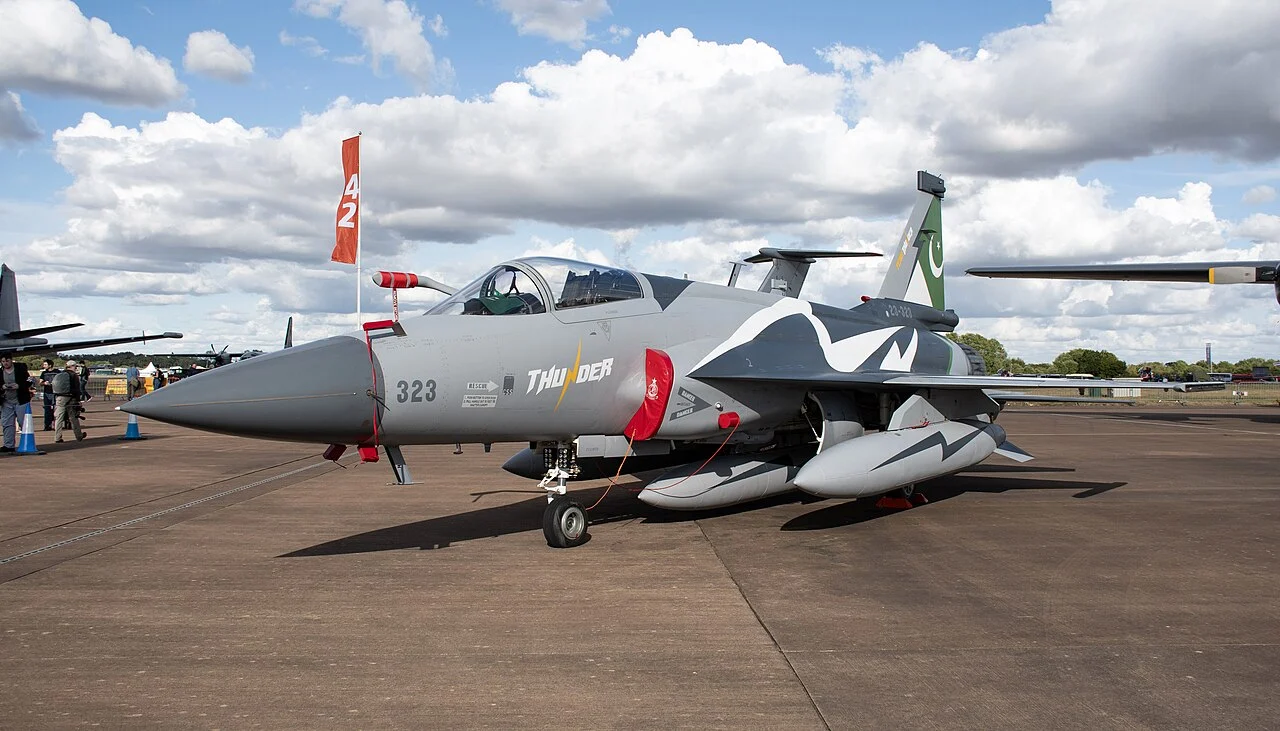


The JF-17 Thunder is a joint Chinese-Pakistani light multirole fighter built in four production standards plus a twin-seat trainer, now flown by five air forces on three continents. This piece walks through every major variant, what changed between them, and which block reached Africa’s only confirmed operator, Nigeria. Data as of October 2026.
DEFENCE AFRICA | Family Explained | Data as of October 2026
The JF-17 (designated FC-1 Xiaolong in China) is developed jointly by Chengdu Aircraft Corporation and the Pakistan Aeronautical Complex (PAC) at Kamra, and is powered throughout its production life by a single Russian-sourced Klimov RD-93 turbofan, a derivative of the MiG-29’s RD-33. It was conceived as an affordable single-engine replacement for Pakistan’s ageing Mirage III/5, F-6 and A-5 fleets, and entered Pakistan Air Force (PAF) squadron service with the first production standard, Block I, in 2007, according to a 2026 programme guide published by The Defense Post. Three further production standards followed — Block II, Block III and the twin-seat JF-17B — each adding capability rather than replacing the airframe outright, which is why all four remain in parallel front-line use today.
Outside Pakistan, the type has found a narrow but growing export market built on price rather than raw performance: Nigeria became its first African customer, Myanmar its first export customer of any kind, and Azerbaijan its newest and largest single order. No other African air force has a confirmed JF-17 contract; a long-running claim that Somalia had ordered the type remains unconfirmed, as this publication detailed separately in Has Somalia Bought JF-17 Fighters From Pakistan? What Is Actually Confirmed.
Key facts
- Four production standards in service: Block I (2007), Block II (c. 2013), Block III (December 2023) and the twin-seat JF-17B (December 2019) — Janes, The Defense Post.
- Single Klimov RD-93 turbofan on every variant; no re-engining has been confirmed for any block — The Defense Post.
- Nigeria’s three Block II aircraft, delivered 2021, remain Africa’s only confirmed JF-17 fleet — Military Africa.
- Azerbaijan’s order grew from a reported 12-16 aircraft in February 2024 to 40 Block III jets worth about $4.6 billion by June 2025 — Overt Defense, The Defense Post.
- Myanmar, the launch export customer, ordered 16 aircraft from 2015 at a reported $25 million each, including two JF-17B trainers delivered in December 2019 — Quwa, Army Recognition.
1. JF-17 Block I — the baseline that replaced Pakistan’s Mirage III/5
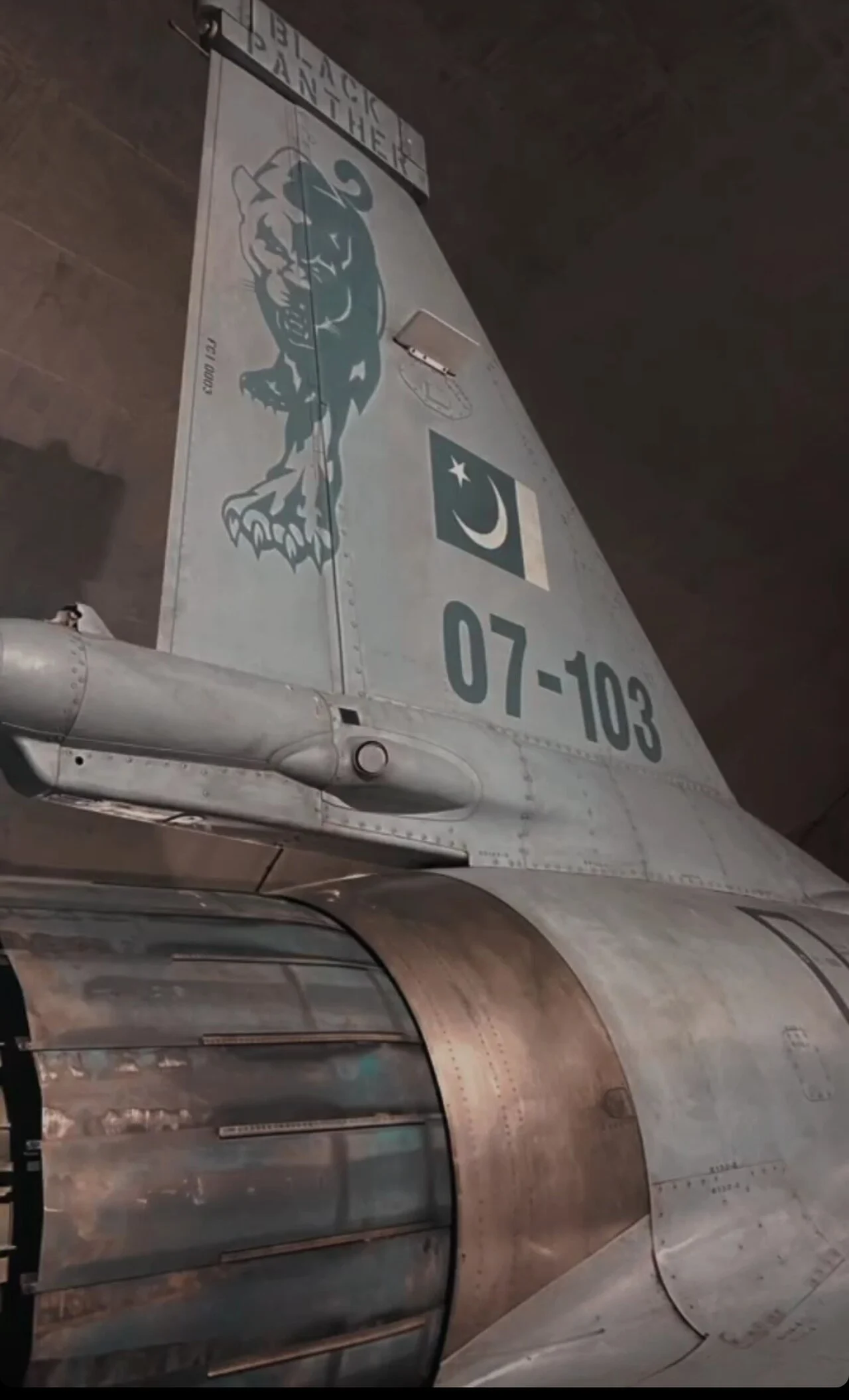
Block I entered PAF service in 2007 as the first production standard, intended to replace retiring Mirage III/5, F-6 and A-5 types in the ground-attack and point-defence roles, according to The Defense Post’s 2026 programme guide. It carries the pulse-Doppler KLJ-7 radar and is armed primarily for beyond-visual-range engagement with the SD-10 (PL-12) active radar-guided missile, alongside short-range PL-5/PL-9 missiles and a mixed air-to-ground loadout of unguided and precision-guided bombs. Block I lacks an aerial-refuelling probe, which limited its combat radius compared with later standards. Operators worldwide: Pakistan is the only confirmed Block I operator; most export customers received later blocks. Current status: operational with the PAF, being progressively supplemented rather than replaced by later blocks, per Janes equipment reporting.
2. JF-17 Block II — adds aerial refuelling, reaches Nigeria and Myanmar
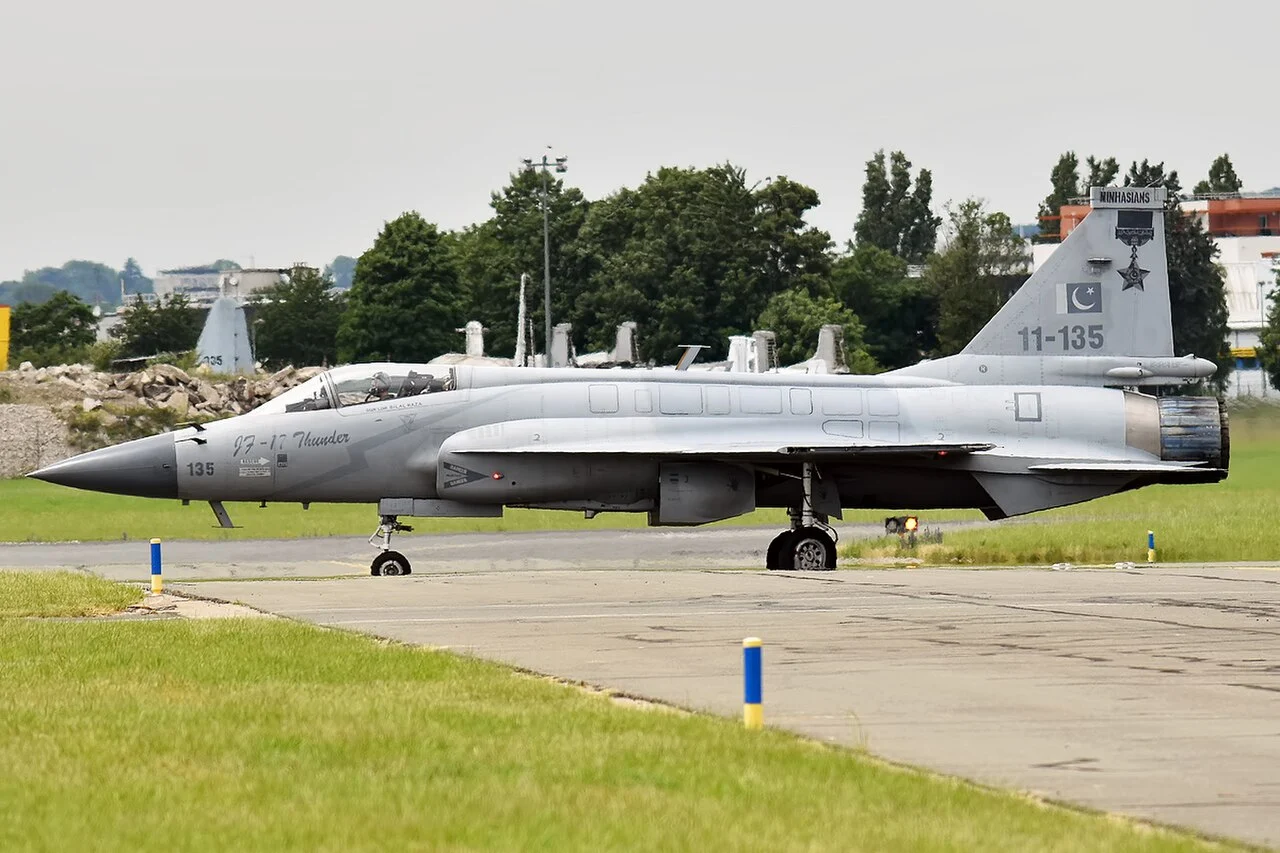
Block II, introduced from around 2013, added a removable hose-and-drogue aerial-refuelling probe, an upgraded KLJ-7 V2 radar, improved datalink and electronic-countermeasures fit, and structural refinements, according to Janes defence-equipment reporting and The Defense Post. It is the standard that both of the JF-17’s early export customers received: Myanmar, which ordered 16 aircraft from 2015 as the type’s launch export customer at a reported $25 million each (Quwa; Army Recognition), and Nigeria, whose three aircraft — part of a $184.3 million package that also included munitions — were handed over in a disassembled state and reassembled at Makurdi Air Base in 2021 (Military Africa; Overt Defense). Operators worldwide: Pakistan, Myanmar, Nigeria. African operators: Nigeria — three aircraft, delivered and operational, with an option for eight more that Pakistani and Nigerian reporting had not confirmed as exercised as of late 2021 (Military Africa). Current status: in front-line service with all three operators; still in limited production for export.
3. JF-17 Block III — AESA radar, helmet display, Azerbaijan’s choice
The PAF inducted its first Block III aircraft in December 2023, Janes reported at the time, in what it called the most significant upgrade in the programme’s history. Block III adds an active electronically scanned array (AESA) fire-control radar — reported by China’s state broadcaster CCTV and relayed by Janes as the NRIET KLJ-7A — a helmet-mounted display, a reduced radar cross-section achieved through greater use of composite structure, and compatibility with the longer-ranged PL-15 air-to-air missile, according to Janes’s reporting on the induction. It is the first block sold as a clean-sheet export standard rather than a PAF type later offered abroad: Azerbaijan signed an intergovernmental agreement in February 2024 for a reported 12 to 16 Block III aircraft (sources vary on the exact figure), then expanded the order to 40 aircraft in a deal worth about $4.6 billion announced in June 2025, according to Overt Defense and The Defense Post. Azerbaijan publicly displayed five Block III jets at a Baku military parade on 9 November 2025, and open-source tracking cited by Quwa puts at least nine airframes in-country with a newly raised 408 “Jaguar” Squadron, with full operational capability targeted around 2027. Operators worldwide: Pakistan, Azerbaijan. African operators: none confirmed. Current status: in active production at PAC Kamra; Azerbaijan’s order remains contracted, with only a small fraction of the 40 aircraft delivered so far.
4. JF-17B — the twin-seat trainer and combat variant
The twin-seat JF-17B first flew on 27 April 2017 and entered production as a dedicated conversion trainer, letting PAF pilots move onto the JF-17 without first qualifying on the F-16, Mirage or F-7P/PG, Air Recognition reported, citing the PAF’s chief of air staff. The Pakistan Aeronautical Complex rolled out the first batch of eight (of 26 ordered) on 27 December 2019, with a further 14 following in December 2020, per Quwa’s programme tracking. Relative to the single-seat jet, the JF-17B adds a dorsal spine housing extra fuel, a larger swept vertical stabiliser for the added side area of the rear cockpit, and a three-axis fly-by-wire flight-control system; its nose can accommodate an AESA set, though the PAF retained the pulse-Doppler KLJ-7 for its own trainers, according to Quwa. Myanmar also added two JF-17B aircraft (serials 1706 and 1707) to its fleet, commissioned on 15 December 2019 at Meiktila Air Base during the Myanmar armed forces’ 72nd Defence Services Day, according to Army Recognition, making it the only export customer confirmed to operate the twin-seat variant alongside Pakistan. Beyond training, observers including Quwa have noted a secondary strike and electronic-warfare potential for the type, though the PAF has described its primary role as conversion training. Operators worldwide: Pakistan, Myanmar. African operators: none confirmed. Current status: in service with both operators; production continuing at PAC against the original 26-aircraft PAF order.
Which variants are operated in Africa?
Nigeria is, as of October 2026, the only African air force with a confirmed JF-17 fleet, and it operates only the Block II standard: three aircraft, part of a $184.3 million package agreed in 2016 and delivered in 2021, reassembled at Makurdi Air Base after arriving disassembled aboard Pakistan Air Force Il-76 transports (Military Africa). An option within the original contract for eight further aircraft had not been confirmed as exercised in reporting as of late 2021, and no additional JF-17 deliveries to Nigeria, nor to any other African state, have been confirmed since. This publication examined the Nigeria deal’s terms and early results in Why Nigeria Bought the JF-17 Thunder: Deal, Cost and Results, and separately assessed unconfirmed reporting of a Somali order in Has Somalia Bought JF-17 Fighters From Pakistan? What Is Actually Confirmed. Block I, Block III and JF-17B aircraft remain confined to Pakistan, Azerbaijan and Myanmar respectively; none has reached an African operator.
| Variant | First flight / service entry | Key change | Confirmed operators |
|---|---|---|---|
| Block I | PAF service, 2007 | Baseline standard; KLJ-7 pulse-Doppler radar, SD-10 BVR missile | Pakistan |
| Block II | c. 2013 | Hose-and-drogue aerial refuelling probe; KLJ-7 V2 radar | Pakistan, Myanmar, Nigeria |
| JF-17B (twin-seat) | First flight April 2017; delivery from December 2019 | Two-seat conversion trainer; dorsal fuel spine, larger fin, fly-by-wire | Pakistan, Myanmar |
| Block III | PAF induction, December 2023 | AESA radar, helmet-mounted display, reduced RCS, PL-15 compatibility | Pakistan, Azerbaijan |
Why it matters for Africa
The JF-17’s appeal for African air forces is almost entirely about affordability and the absence of political strings rather than performance: Nigeria’s three-jet package, bundled with munitions, is reported at $184.3 million, a fraction of the cost of a comparable Western multirole fighter purchase, and came with none of the end-user restrictions that complicated Nigeria’s earlier attempts to buy US-made aircraft and attack helicopters. That affordability has a cost of its own: with only three airframes and a sustainment pipeline running through Pakistan and China rather than an established African or Gulf hub, Nigeria carries higher per-aircraft logistics risk than operators of more widely proliferated types, and has not yet confirmed exercising its option for eight more. For other African air forces weighing a first fast-jet purchase or a Mirage/MiG-21-generation replacement, the JF-17 programme illustrates both sides of that trade-off: a genuinely low entry price, set against a thin regional supply and support base compared with more established African fast-jet suppliers.
Sources
- The Defense Post — “JF-17 Thunder: Inside Pakistan’s Multirole Fighter” (2026)
- Janes — “Parting shot: PAF inducts JF-17 Block III aircraft” (December 2023)
- Army Recognition — JF-17B first batch rollout (December 2019)
- Army Recognition — First two JF-17B trainers handed over to Myanmar (December 2019)
- Quwa — “Why Is the Pakistan Air Force Procuring 26 JF-17Bs?”
- Military Africa — Nigeria JF-17 Thunder delivery and option status
- Overt Defense — Pakistan Air Force hands over three JF-17s to Nigeria (2021)
- Overt Defense — Pakistan-Azerbaijan $4.6 billion JF-17 deal (June 2025)
- Air Data News — Azerbaijan JF-17 Block III Baku parade display
- Quwa — Azerbaijan JF-17 Block III fleet status
- Quwa — Myanmar as JF-17 launch export customer