Türkiye Begins Building Rocket and Satellite Launch Site in Somalia



Türkiye says it has started building a rocket and satellite-launch facility in Somalia, a project its own industry minister says will also be used to test missiles — adding a new, more strategic layer to a decade-old military partnership built around training and drone warfare.
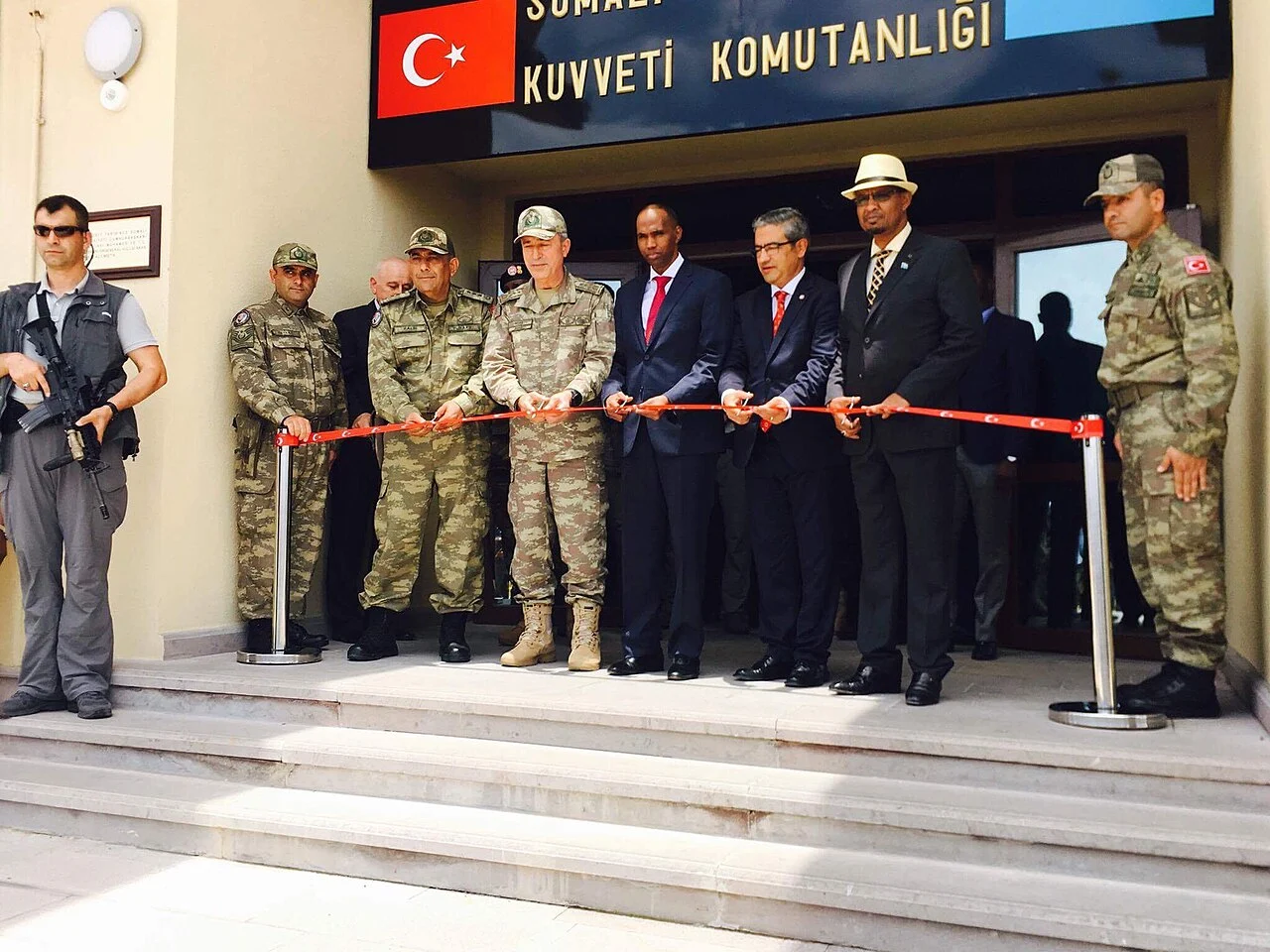
Photo: Camp TURKSOM, Türkiye’s largest overseas military base, in Mogadishu, Somalia. Credit: VOA, Public domain, via Wikimedia Commons.
Speaking at the opening of the 77th International Astronautical Congress (IAC) in Antalya last week, President Recep Tayyip Erdoğan said construction had begun on a Turkish spaceport in Somalia. Industry and Technology Minister Mehmet Fatih Kacır followed up by saying Ankara intends to use the site to launch its own rockets — and missiles — taking advantage of Somalia’s near-equatorial location, which is more efficient for orbital launches and keeps falling debris away from populated areas, according to Turkish officials cited by Daily Sabah.
At the same event, ASELSAN chief executive Ahmet Akyol said the company plans to launch the first satellite of its planned 198-satellite Astralink (Gökbağı) low-Earth-orbit constellation within two years, eventually linking more than a million ground terminals. Turkish officials have not formally tied the Somalia facility to the Astralink programme, but the two announcements, made days apart at the same congress, point to the same broader ambition: an independent Turkish space-launch capability that does not depend on foreign spaceports.
From training base to strategic launch site
Somalia has hosted Türkiye’s largest overseas military facility since 2017, when Ankara opened the roughly $50 million, 400-hectare Camp TURKSOM in Mogadishu to train Somali National Army soldiers against al-Shabaab. That mission has deepened over the past decade: Turkish officers have trained thousands of Somali troops, Turkish-operated Bayraktar TB2 and Akinci drones have flown strike missions against al-Shabaab, and a ten-year defence and economic agreement approved by Somalia’s parliament gave Ankara responsibility for building, training and equipping the Somali navy. Envanter Medya has reported separately on TURKSOM’s role equipping Somalia’s elite Gorgor commando force.
A rocket-launch facility would be a different order of commitment. Reports dating to 2024 had already described Turkish survey and construction work north of Mogadishu for what was then characterised as a ballistic-missile test site; Somali officials gave conflicting public accounts at the time, with the national security adviser declining to comment and a parliamentary defence-subcommittee chair saying he was unaware of any such agreement. Erdoğan’s statement at IAC Antalya is the clearest official confirmation yet that construction is actually under way, though Ankara has not released a location, size, budget or completion date for the site.
Why Somalia, and why now
Turkish officials frame the location in purely technical terms: sites closer to the equator let rockets use the Earth’s rotational speed more efficiently, reducing the fuel needed to reach orbit, while launching out over the Indian Ocean minimizes the risk to people and property from falling debris or a failed launch. Somalia’s eastern coastline offers both advantages without the diplomatic friction of launching from more contested Turkish-adjacent waters. For Ankara, which has built an increasingly independent defence-industrial base around ASELSAN, Roketsan and TUA, a sovereign launch site removes a dependency on foreign spaceports for both civilian satellite work and, per Kacır’s own comments, weapons testing.
Why it matters for Africa
A Turkish-run launch and missile-test facility on Somali soil would be the most consequential addition yet to Ankara’s presence in the Horn of Africa, turning a counter-insurgency partnership into something with a far larger geopolitical footprint. It gives Türkiye a strategic asset it does not have to negotiate with any other state to use, strengthens Mogadishu’s hand as the most important African partner in Turkey’s regional drone, naval and now space strategy, and is likely to draw close attention from Gulf and Western powers already competing for influence and basing rights in the Horn. For the wider continent, it is a reminder that Turkish defence and industrial engagement in Africa — already visible through Bayraktar TB2 sales to eleven African states and training missions across the Sahel — is shifting from exporting hardware toward building permanent, strategic infrastructure on African territory.
Sources
- Daily Sabah — Türkiye’s orbital ambitions, spaceport dominate talks at IAC summit
- Infodefensa — Turkey’s 198-satellite constellation and Somalia spaceport plan
- Dawan Africa — Erdoğan says construction of Turkey’s Somalia spaceport is under way
- Dawan Africa — Türkiye to use planned Somalia spaceport for rocket, missile launches