Which African Countries Operate Advanced Air Defence Systems

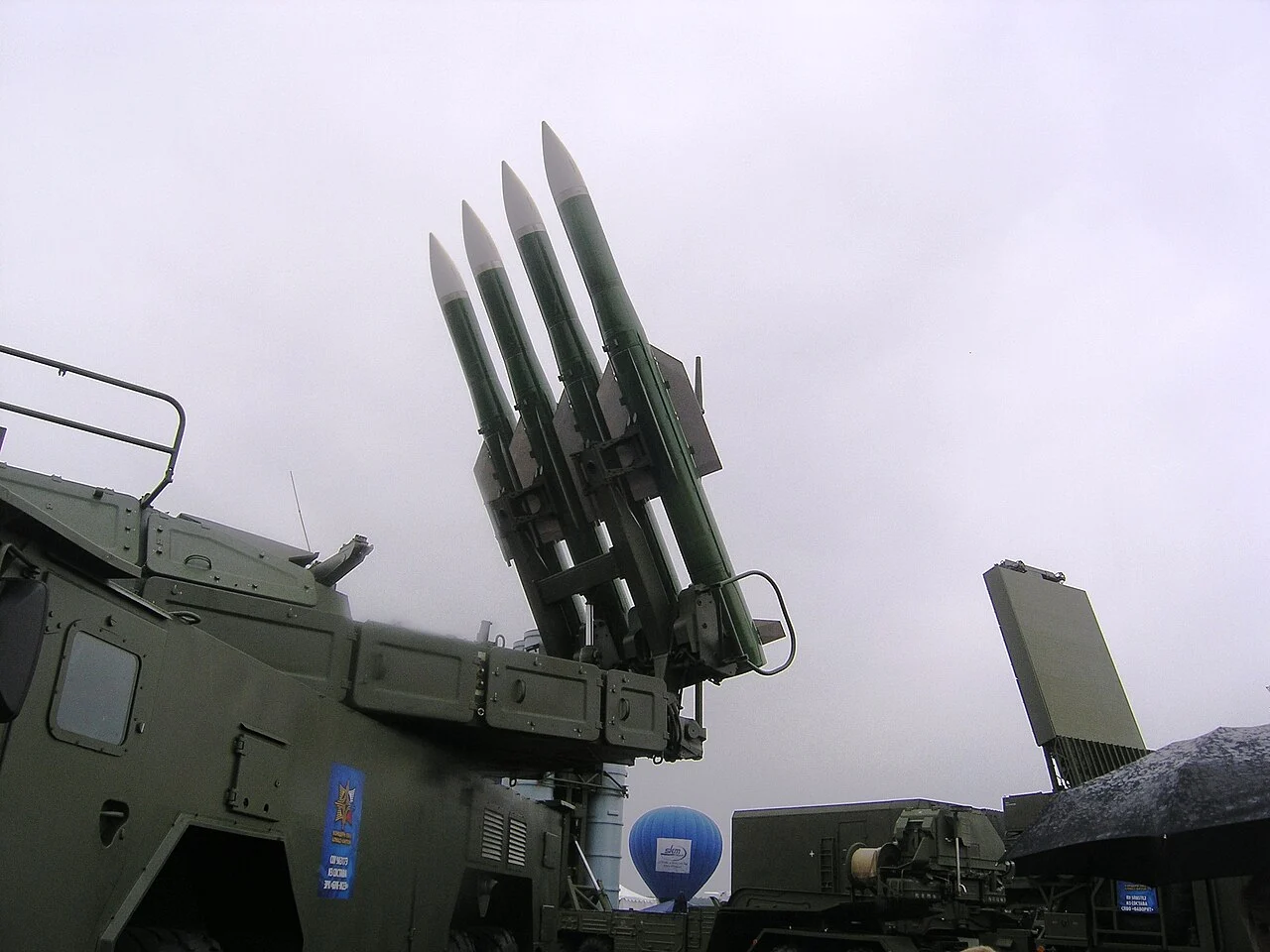


Four African air forces or air defence commands have documented, in-service medium- or long-range air defence systems: Algeria (S-300PMU2, Pantsir-S1, Buk-M2E), Egypt (Buk-M2E, Tor-M1/M2E, MIM-23 I-Hawk, MIM-104 Patriot), Libya’s Government of National Unity forces in Tripoli (MIM-23 Hawk, Korkut) and South Africa (Umkhonto, on its navy’s frigates). Morocco and Nigeria are at trial or evaluation stage with Patriot and Chinese systems respectively, with no confirmed contract yet. Several other reported holdings, including a Pantsir-S1 battery supplied to Khalifa Haftar’s forces in eastern Libya, are third-party-operated or unverified and are excluded from the confirmed count.
Photo: A Buk-M2 transporter-erector-launcher on display at the MAKS 2011 airshow near Moscow; the export Buk-M2E variant is the version confirmed in Algerian and Egyptian service. Credit: Vladimir Kuznetsov, CC BY 3.0, via Wikimedia Commons.
Direct answer
This article covers medium- and long-range ground-based air defence: systems built around dedicated search/track radar, command posts and missiles with ranges above roughly 20 km, such as the S-300 and Buk families, Patriot, Hawk and naval-origin Umkhonto. Man-portable and short-range point-defence systems (MANPADS, Mistral, Starstreak, FN-6, Pantsir-S1’s shorter-range use) are tracked separately on DefenceMena’s short-range air defence and MANPADS page; Pantsir-S1 appears on both pages because its 20 km missile and 30mm guns put it on the boundary, and because Algeria operates it as a point-defence layer around its longer-range batteries.
With that scope: Algeria and Egypt run the continent’s only confirmed multi-layered strategic air defence networks, both Russian- and American-equipped. Libya’s Tripoli-based GNU forces operate Turkish-supplied Hawk and Korkut systems. South Africa’s Umkhonto is operational at sea on its Valour-class frigates, but the army’s long-planned ground-based version has not been confirmed as fielded. Morocco (Patriot) and Nigeria (Chinese FK-3/Sky Dragon) are both in pre-contract evaluation. A separate, dedicated DefenceMena page covers the Pantsir-S1’s combat record in Libya, where UAE- and Wagner-operated batteries supported Haftar’s Libyan National Army rather than any single African state’s own air defence force.
Status count, 11 Oct 2026
- Operational (documented in-service use): 4 country entries (Algeria, Egypt, Libya–GNU/Tripoli, South Africa)
- Retired: 1 (South Africa – Cactus/Crotale)
- Ordered / under contract, awaiting delivery: 0 confirmed this week
- Reported, evaluated or third-party-operated (not counted as a national capability): 10 system entries across 6 countries (Morocco, Nigeria, Ethiopia, Sudan, Libya–east/Haftar, plus additional reported systems in Algeria and Egypt)
Ordered is not delivered. Delivered is not operational. Rumoured is not confirmed. Equipment operated by a foreign power on African soil is not a national operator.
Quick operator table
| Country | System | Variant | Quantity | Status | Order year | Delivery year | Contract value | Source | Last verified |
|---|---|---|---|---|---|---|---|---|---|
| Algeria | S-300 | S-300PMU2 (SA-20B) | UNKNOWN (at least one battalion by 2008; further batches reported, not independently itemised) | Operational | 2006 | 2008 (first battalion); later batches UNKNOWN | UNKNOWN | Bellingcat – Algeria’s Hardened S-300 Site Almost Complete | 11 Oct 2026 |
| Algeria | Pantsir-S1 | Pantsir-S1 | Up to 38 systems contracted (2006 package); number actually delivered UNKNOWN | Operational | 2006 | UNKNOWN | UNKNOWN | Defense Industry Daily – Algerian Arms Deal Brings Russia $7.5 Billion, Gas Market Leverage | 11 Oct 2026 |
| Algeria | Buk-M2E | Buk-M2E | At least one battery confirmed; total UNKNOWN | Operational | UNKNOWN (reported 2013 or 2016) | 2017 (used in Majd 2017 exercise) | UNKNOWN | North Africa Post – Algeria Acquires Buk Missile System | 11 Oct 2026 |
| Egypt | Buk | Buk-M2E (one source names Buk-M1-2 – see Quantity conflicts) | UNKNOWN | Operational | UNKNOWN | In service by 2019; redeployed Oct 2025 | UNKNOWN | The New Arab – Russian air defence system to protect Trump at Sharm el-Sheikh | 11 Oct 2026 |
| Egypt | Tor | Tor-M1 / Tor-M2E | UNKNOWN | Operational | UNKNOWN | In service by 2014; used in 2019 joint exercise | UNKNOWN | Military Periscope – Air Defense Forces Kick Off Joint Drill With Russia | 11 Oct 2026 |
| Egypt | I-Hawk | MIM-23B Improved Hawk | 12 batteries, 78 launchers (dated figure) | Operational | UNKNOWN | Legacy, in service since the Cold War | UNKNOWN | Nuclear Threat Initiative – Egypt Missile Overview | 11 Oct 2026 |
| Egypt | Patriot | MIM-104 PAC-3 | 32 fire units (reported) | Operational | 1999 | Early 2000s | US$1.3bn (reported, 1999 FMS case) | Nuclear Threat Initiative – Egypt Missile Overview | 11 Oct 2026 |
| Libya (GNU, Tripoli) | Hawk | MIM-23B Improved Hawk | UNKNOWN (multiple fire units at Mitiga and Al-Watiya) | Operational | UNKNOWN | 2020 (Jan, deployed by Turkey) | UNKNOWN | UN Panel of Experts on Libya, report S/2021/229 | 11 Oct 2026 |
| Libya (GNU, Tripoli) | Korkut | Korkut 35mm self-propelled AA gun | UNKNOWN | Operational | UNKNOWN | 2020 (Aug, Al-Watiya airbase) | UNKNOWN | Army Recognition – Turkish Army deploys Korkut 35mm SPAAG in Libya | 11 Oct 2026 |
| South Africa | Umkhonto | Umkhonto-IR / Umkhonto-R (naval) | 4 Valour-class frigates equipped | Operational | Early 2000s | 2005 (first live launch, SAS Amatola) | UNKNOWN | Naval Technology – Umkhonto surface-to-air missile | 11 Oct 2026 |
| South Africa | Cactus/Crotale | Cactus Mk1; Mk2 container system | 7 platoons originally delivered (1971-1973) | Retired | 1964 (contract) | 1971-1973 | UNKNOWN | South African Air Force Association – Cactus/Crotale SAM | 11 Oct 2026 |
Manufacturers: Almaz-Antey / Rosoboronexport (Russia) – S-300PMU2, Buk-M2E, Pantsir-S1; Raytheon / Lockheed Martin (United States) – Patriot, I-Hawk; ASELSAN / FNSS (Türkiye) – Korkut; Denel Dynamics (South Africa) – Umkhonto; Thomson-CSF/Thales (France) – Cactus/Crotale. UNKNOWN means no source reviewed gives the figure; nothing has been estimated to fill a cell.
Map: status by country
Each country is coloured by the highest verified status of any medium- or long-range system it operates; third-party-operated and unverified batteries are excluded.
Confirmed operators
- Algeria. The continent’s most layered network: S-300PMU2 batteries around Algiers and Mers El Kébir since 2008, Pantsir-S1 point-defence systems from a 2006 package of up to 38 units, and at least one Buk-M2E battery confirmed by the army’s own El-Djeich magazine in 2017. A 2026 report of a first S-400 live-fire exercise is not independently verified; see Quantity conflicts. Algeria’s wider missile inventory, excluding air defence, is covered in Algeria’s Missile Forces Explained.
- Egypt. Runs parallel Russian and American layers: Buk-M2E and Tor-M1/M2E batteries (one redeployed around Sharm el-Sheikh in October 2025 for the Gaza summit attended by Donald Trump), alongside legacy American MIM-23 I-Hawk and Patriot PAC-3 batteries dating to a 1999 foreign military sale. Egypt’s reported S-300VM/Antey-2500 purchase remains unconfirmed; see Quantity conflicts.
- Libya (Government of National Unity, Tripoli). Turkey supplied MIM-23 Hawk batteries and AN/MPQ-64 radar to Mitiga airport in January 2020 and Korkut 35mm self-propelled guns to Al-Watiya airbase by August 2020, documented by a UN Panel of Experts report as defending GNU-aligned airports against Haftar’s air force. This is distinct from the Pantsir-S1 batteries UAE and Wagner forces operated for Haftar in the east, covered separately.
- South Africa. The Umkhonto IR/R missile has armed the navy’s four Valour-class (MEKO A-200SAN) frigates since the mid-2000s, the only African-designed medium-range naval SAM in continental service. The army’s long-discussed ground-based Umkhonto launcher, under the Ground-Based Air Defence System (GBADS) project, has been tested at the Overberg range since 2013 but has no confirmed in-service date; it is listed under Reported but unconfirmed.
Ordered / awaiting delivery
No African country currently has a confirmed, under-contract order for a medium- or long-range air defence system awaiting delivery. Morocco’s Patriot and Nigeria’s Chinese-system talks are both still at the evaluation stage, short of a signed contract; they are covered under Reported but unconfirmed below.
Reported but unconfirmed
- Morocco – MIM-104 Patriot (EVALUATED). The US cleared a possible Patriot sale to Morocco in 2021 and the Pentagon approved a Lockheed Martin case that November, but no contract value, quantity or delivery date has been disclosed. Imagery reported in March 2025 showed Patriot launchers in Morocco for what analysts described as field trials, not a confirmed delivery. Sources: Morocco World News; Army Recognition.
- Nigeria – Chinese FK-3 / Sky Dragon (EVALUATED). A Nigerian Air Force delegation toured Chinese radar and air defence manufacturers, including CETC and NORINCO, in April 2025 and saw a Sky Dragon system demonstration; a later visit by the defence minister explored further cooperation. No order has been confirmed. Sources: Military Africa; Defence Blog. Nigeria’s broader Chinese equipment holdings are covered in Chinese Military Systems in African Service.
- Libya, Libyan Arab Armed Forces (east) – Pantsir-S1 (THIRD-PARTY OPERATED, not a national capability). The UAE supplied Pantsir-S1 systems from March 2019, and Wagner Group personnel reportedly operated Russian-supplied units from mid-2020, in support of Khalifa Haftar’s forces. At least six were visually confirmed destroyed by Turkish-backed GNA forces, mostly in May 2020. Full detail: Pantsir-S1 in Libya: What the Battlefield Record Revealed.
- Sudan – Pantsir-S1 (RUMOURED, origin unverified). An unverified November 2023 video appeared to show Rapid Support Forces fighters capturing a Pantsir-S1. No source confirms the Sudanese Armed Forces ever formally operated the system, and its route into the country (existing RSF holdings, or ties to Haftar-linked supply chains) is unclear. Source: Army Recognition.
- Ethiopia – Pantsir-S1 (RUMOURED, single source). A 2020 Sudanese newspaper report, relayed by Al Jazeera’s Arabic service, said Ethiopia had deployed a Pantsir-S1 to protect the Grand Ethiopian Renaissance Dam. No independent confirmation has followed in the six years since.
- Algeria – HQ-9B, HQ-17 and S-400 (RUMOURED, single-source press reports). Military Watch Magazine reported Algeria had added Chinese HQ-9B long-range and HQ-17 short-range systems to its existing Russian layers; a separate 2026 report claims a first Algerian S-400 live-fire exercise. Neither Algerian, Chinese nor Russian authorities have confirmed either claim.
- Egypt – S-300VM / Antey-2500 (RUMOURED since 2014, unconfirmed display reported 2026). Russian media reported in November 2014 that Egypt had agreed to buy the system; TASS denied two days later that any contract existed. A July 2026 report said Egypt publicly displayed the system for the first time, but this is sourced only to lower-tier outlets with no Egyptian Ministry of Defence statement. See Quantity conflicts.
- South Africa – Umkhonto Ground-Based Launcher / Army GBADS (EVALUATED, not fielded). Denel’s land-based Umkhonto launcher completed live-fire testing at Overberg in 2013 for the Army’s planned Ground-Based Air Defence System Phase 2. A 2025 industry report still describes army integration as “underway,” not completed.
Retired
- South Africa – Cactus/Crotale. Developed jointly with France’s Thomson-CSF from 1964 and delivered 1971-1973, the system defended South African airspace through the Border War. The South African Air Force Association’s own weapons page lists it as out of service; Wikipedia-derived accounts disagree on the exact final retirement date (late 1980s versus 1992 for the original Mk1, with an upgraded Mk2 container system reportedly used until 2002).
Quantity conflicts
- Algeria, Buk-M2E delivery date. StrategyPage and Algeria’s own El-Djeich magazine place delivery and first use around 2016-2017; a Spanish outlet, Defensa.com, separately reports a 2011 order received in 2014-2015 for about 48 systems. No primary source confirms either the 48-unit figure or the earlier timeline.
- Egypt, Buk variant naming. A Bharat-Rakshak forum compilation names Buk-M1-2 in Egyptian service; Military Periscope’s account of a 2019 joint Egyptian-Russian exercise and The New Arab’s October 2025 report both name Buk-M2E. This article follows the more recent, named-event sourcing (Buk-M2E) but flags the discrepancy.
- Egypt, S-300VM/Antey-2500 status. TASS explicitly denied a signed contract in November 2014, and no Egyptian government statement has followed. A single wave of July 2026 press reports describes a public display of the system “for the first time,” which would be inconsistent with a never-finalised 2014 deal unless a separate, later contract exists; this article treats the system as unconfirmed rather than upgrading its status on the strength of that reporting alone.
- South Africa, Army GBADS Umkhonto. An older industry account (Defense Industry Daily) describes a land-based Umkhonto as already part of the Army’s Project Protector; a 2025 trade report instead describes integration into the Army’s GBADS as still in progress. This article treats the ground-based role as not yet confirmed fielded.
- Countries checked with no evidence found. No independently sourced medium- or long-range SAM holding (beyond MANPADS and short-range systems already covered on the sibling page) could be confirmed for Angola, Kenya, Tunisia, Tanzania, Senegal, Ghana, Rwanda, Zambia or the Democratic Republic of the Congo; Angola’s commonly cited S-125 Pechora, 2K12 Kub, 9K33 Osa and 9K35 Strela-10 holdings trace back only to a Wikipedia table with no independently verifiable primary source and are not listed above as a result.
Procurement history
Algeria’s current layered network traces to a 2006 Russian arms package covering S-300PMU2, Pantsir-S1 and other systems, following an earlier, smaller S-300 delivery; Buk-M2E followed from the mid-2010s. Egypt’s Soviet-era air defence command, once one of the largest in the world with over 100 SAM battalions, modernised piecemeal with Russian Buk and Tor systems alongside a 1999 American Patriot and older Hawk purchases, reflecting Cairo’s long-standing dual-sourcing between Washington and Moscow. Libya’s Tripoli-based air defence is a product of the 2019-2020 war: Turkey rushed Hawk and Korkut systems to GNA-aligned airports as Haftar’s UAE- and Russian-backed Pantsir batteries approached the capital; most of the LNA’s Pantsirs were destroyed or withdrawn after the Turkish-backed counteroffensive. South Africa’s Umkhonto programme, the most mature indigenous African SAM effort, has remained naval-only in practice despite more than a decade of army ground-based variant testing. Morocco’s and Nigeria’s current evaluations, by contrast, are recent and reactive: Morocco’s Patriot interest follows Algeria’s own missile and fighter upgrades, and Nigeria’s Chinese-system talks follow years of relying on short-range and man-portable air defence against insurgent and militant drone and aircraft threats.
Variants
- S-300 family. Algeria fields the S-300PMU2 (NATO: SA-20B Gargoyle) export variant. Egypt’s reported, unconfirmed S-300VM/Antey-2500 (SA-23) is a distinct, Russian-army-derived design developed in parallel by a different design bureau, not an S-300PMU2 derivative.
- Buk family. Buk-M2E is the export version of Russia’s Buk-M2; Buk-M1-2 is an earlier export standard. Both are confirmed to African buyers, but current sourcing is more consistent for Buk-M2E in both Algeria and Egypt.
- Pantsir-S1. Algeria’s own batteries, on tracked chassis, are distinct from the UAE-supplied, MAN-truck-mounted Pantsir-S1s operated in Libya, which analysts identify by their non-standard wheeled chassis.
- Hawk. Egypt’s MIM-23B Improved Hawk and Libya’s Turkish-supplied MIM-23 Hawk batteries are the same missile family but entered service through entirely separate procurement channels decades apart.
- Umkhonto. The naval Umkhonto-IR (infrared) and Umkhonto-R (radar) rounds in South African Navy service have a shorter range than the Mk.2 round developed for Finland; the untested South African Army ground-based launcher variant would use the same missile family on a mobile vertical-launch platform.
African operational context
Advanced, radar-guided air defence remains concentrated in North Africa and Egypt, where it answers specific strategic rivalries: Algeria’s build-up versus Morocco’s, and Egypt’s layered Sinai and Red Sea posture, visible again when Cairo moved Buk-M2E batteries to protect the October 2025 Gaza summit. Libya is the one country split between two air defence identities, Turkish-supplied systems defending the west and foreign-operated batteries defending the east, which is why DefenceMena tracks its Pantsir-S1 history on a dedicated page rather than folding it into a single national entry. South Africa’s experience shows how far indigenous design can go without full fielding: Umkhonto is a genuine African-designed naval SAM in real service, but more than a decade of Army ground-based testing has not yet produced a fielded unit. Elsewhere on the continent, including across the Sahel and most of Sub-Saharan Africa, air defence remains limited to man-portable missiles and short-range systems such as Mistral, Starstreak-based Sable and FN-6, detailed on DefenceMena’s separate short-range and MANPADS page; Morocco’s and Nigeria’s current Patriot and Chinese-system evaluations are the clearest signal that more African states see a gap between that short-range layer and the handful of true strategic systems covered here.
Related alternatives
For man-portable and short-range systems, including Pantsir-S1’s point-defence role and South Africa’s Starstreak-based Sable, see Short-Range Air Defence and MANPADS for African Armies. For the Pantsir-S1’s separate, UAE- and Wagner-operated history in Libya, see Pantsir-S1 in Libya: What the Battlefield Record Revealed. Algeria’s wider missile forces, excluding the air defence systems covered here, are detailed in Algeria’s Missile Forces Explained. Nigeria’s and other African states’ Chinese equipment, including the reported FK-3/Sky Dragon talks, is covered in Chinese Military Systems in African Service. Readers tracking Africa’s wider defence-spending picture, including the budgets behind systems like these, may also find the Turkish sister publication Envanter Medya’s ranking of Africa’s ten largest defence budgets useful context.
FAQ
Which African country has the most advanced air defence system?
Algeria and Egypt both run multi-layered networks combining long-range (S-300PMU2 for Algeria; Patriot and reportedly S-300VM for Egypt), medium-range (Buk-M2E, Tor) and point-defence (Pantsir-S1, I-Hawk) systems. No independent source ranks one above the other with current, verified data.
Does any African country operate the Patriot missile system?
Egypt has operated Patriot PAC-3 batteries since a 1999 US foreign military sale. Morocco is evaluating a Patriot purchase, with field trials reported in March 2025, but no contract has been confirmed.
Is Libya’s Pantsir-S1 operated by a Libyan force?
The batteries documented in eastern Libya were supplied by the UAE and, from mid-2020, reportedly operated in part by Wagner Group personnel supporting Khalifa Haftar’s forces, not run as an independent Libyan national air defence capability. Western Libya’s GNU forces instead operate Turkish-supplied Hawk and Korkut systems.
Does South Africa have a national air defence missile system?
Yes, at sea: the locally developed Umkhonto missile arms the navy’s four Valour-class frigates. A land-based Army version has been tested since 2013 but has no confirmed in-service date.
Is Nigeria buying a Chinese air defence system?
Nigeria’s air force toured Chinese manufacturers, including NORINCO and CETC, in April 2025 and saw a Sky Dragon system demonstration, but no purchase contract for FK-3, Sky Dragon or any other Chinese air defence system has been confirmed.
Sources
- Bellingcat – Algeria’s Hardened S-300 Site Almost Complete
- Defense Industry Daily – Algerian Arms Deal Brings Russia $7.5 Billion, Gas Market Leverage
- North Africa Post – Algeria Acquires Buk Missile System
- StrategyPage – Air Defense: Algeria Takes Some Russian
- Military Watch Magazine – Algeria strengthens Chinese-origin air defence (HQ-17)
- Nuclear Threat Initiative – Egypt Missile Overview
- Military Periscope – Air Defense Forces Kick Off Joint Drill With Russia
- The New Arab – Russian air defence system to protect Trump at Sharm el-Sheikh
- INSS – Egypt’s Reported Acquisition of the S-300VM Air Defense System
- UN Panel of Experts on Libya, report S/2021/229
- Army Recognition – Turkish Army deploys Korkut 35mm SPAAG in Libya
- Army Recognition – Sudanese rebels capture Russian Pantsir-S1 air defense system
- Morocco World News – Pentagon approves Morocco’s purchase of Patriot air defense system
- Army Recognition – Morocco might be testing US-made Patriot system
- Military Africa – Nigeria looks to China’s NORINCO to bolster fledging air defence structure
- Defence Blog – Nigeria may buy Chinese air defense systems
- Naval Technology – Umkhonto surface-to-air missile
- Military Africa – Denel upgrades the Umkhonto surface-to-air missile
- South African Air Force Association – Cactus/Crotale SAM
Method: operators were checked against official statements, UN Panel of Experts reporting, defence-press coverage (Army Recognition, Military Africa, Defence Blog, Military Periscope, The New Arab) and specialist analysis (Bellingcat, Defense Industry Daily, Nuclear Threat Initiative, INSS); single-source and press-only claims are marked RUMOURED or EVALUATED above and kept out of the confirmed count. Wikipedia and GlobalFirepower were used only to locate leads, never as the cited figure.
Last updated: 11 October 2026