ASELSAN Cements African Push After AAD 2026 Showcase



ASELSAN, Türkiye’s largest defence company, says it hosted more than 30 foreign delegations at the Africa Aerospace and Defence exhibition in Pretoria and is widening its push into African markets, with Nigeria and Algeria singled out as priority growth hubs.
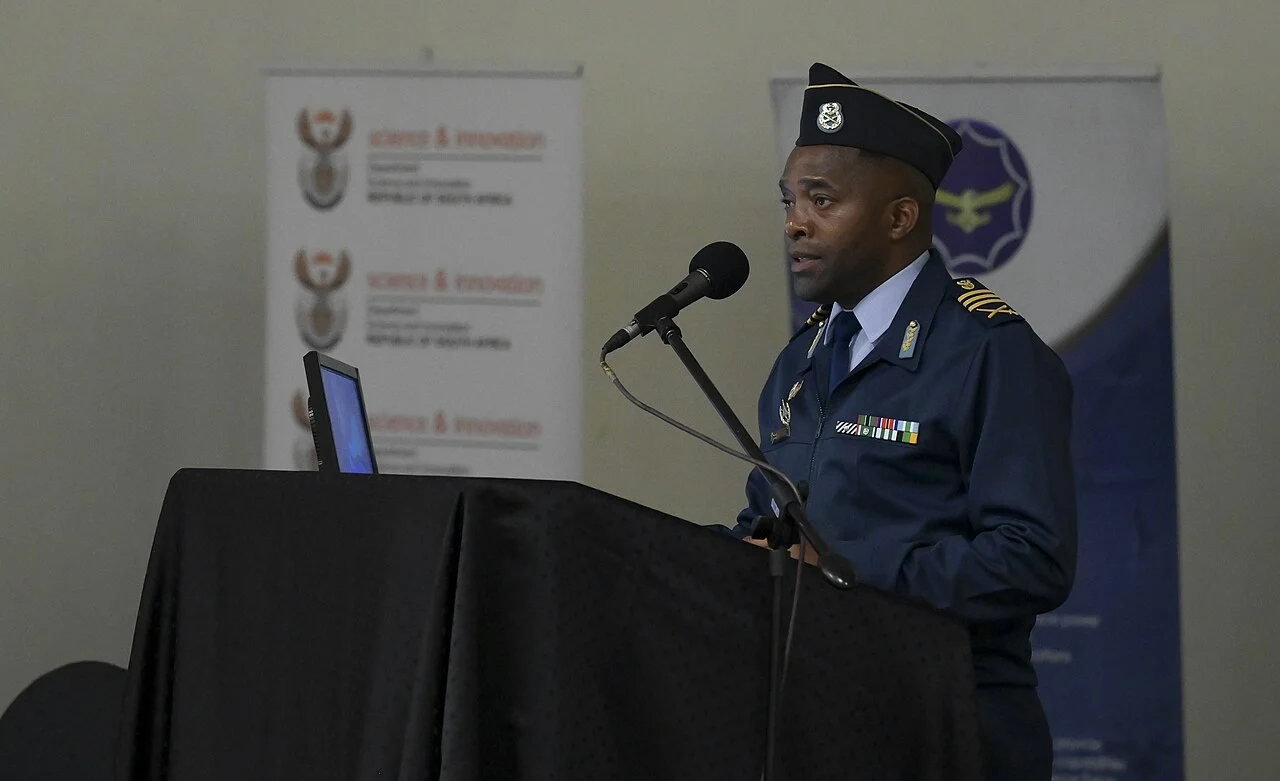
Photo: South African Air Force Lt. Gen. W.S. Mbambo speaks at the Air and Space Power Symposium, part of the Africa Aerospace and Defence (AAD) exhibition in Pretoria. Credit: U.S. Air Force photo by Master Sgt. Michael Battles, Public domain, via Wikimedia Commons
ASELSAN, which recorded $4.46 billion in revenue in 2025, used the September Africa Aerospace and Defence (AAD) exhibition at Air Force Base Waterkloof to showcase a wide product line and reaffirm a strategy it has pursued for more than 15 years in South Africa, defenceWeb reported. Speaking to media in Türkiye afterwards, chief executive Ahmet Akyol said the company sees the continent’s combination of economic growth, natural resources and security demand as an opening few competitors can match.
What ASELSAN showed in Pretoria
The centrepiece of ASELSAN’s stand was the integration of its sensors and weapons on Paramount Group’s Mwari light attack aircraft: the ASELFLIR-500 electro-optical turret and the TOLUN IIR guided bomb, alongside ASELSAN turrets fitted to armoured vehicles on display. The TOLUN IIR is a 250 lb (121 kg) INS/GNSS/imaging-infrared-guided weapon that the company says can be released at up to 80 km from 40,000 feet with roughly 3-metre circular error probable, using a KILIT 23T seeker with in-flight data-link updates.
ASELSAN also displayed its layered counter-drone line — the İHTAR modular anti-drone system, the GÖKBERK laser weapon, the EJDERHA jammer and the KORKUT 35 mm anti-aircraft gun — plus an airborne portfolio spanning the TOLUN-F, TOLUN-L and TOLUN-P precision-guided families, the ASELFLIR-410/500 gimbals, the MURAD 100 AESA radar and the ANTIDOT 2U electronic-warfare pod. The ASELFLIR-500, a 54 kg, 15-inch gimbal with mid-wave infrared, HD day TV and SWIR channels plus a laser designator rated to roughly 35 km, is already integrated on the Bayraktar TB2 and TB3 drones and, according to the company, has been exported to more than 20 countries.
On the ground side, ASELSAN brought the KORKUT 100/25 self-propelled air-defence gun, ATOM airburst ammunition in 25/35/40 mm calibres, the SARP remote weapon station, the ACAR surveillance radar and the PUHU electronic-warfare system, among other items. Readers tracking ASELSAN’s wider product line can follow its programme updates via Envanter Medya’s ASELSAN archive.
Nigeria and Algeria as entry points
ASELSAN opened a permanent office in Abuja last year, which it describes as its West African base, and is seeking a local manufacturing partner in Nigeria, including possible shipyard cooperation. “I believe there must be some local production,” Akyol said, adding that any Nigerian venture would focus mainly on counter-insurgency equipment. The Nigerian Air Force already operates six Turkish Aerospace T129 ATAK helicopters fitted with ASELSAN sensor gimbals, and President Bola Tinubu made a state visit to Türkiye in January 2026.
In Algeria, ASELSAN maintains a dedicated office, part of a wider web of Turkish defence engagement with Algiers that already spans drones and land systems.
Deepening the South African relationship
ASELSAN’s AAD delegation met South African Defence Minister Angie Motshekga and Turkish Deputy Minister of National Defence Salih Ayhan, and the company says it has engaged South Africa’s Border Management Authority and the SANDF over the past year, while Deputy President Paul Mashatile visited ASELSAN’s facilities in Türkiye. Pretoria and Ankara are expected to hold their first bilateral Military Dialogue in the coming months, which ASELSAN hopes will formalise more of this cooperation. ASELSAN will also exhibit at the inaugural Africa International Defence Exhibition (AFRIDEX) in Lagos from 26 to 29 October.
Why it matters for Africa
Turkish industry has already reshaped procurement patterns across the continent through platform sales — Bayraktar drones to more than a dozen African air forces, T129 attack helicopters to Nigeria — and ASELSAN’s push represents the next layer: sensors, guided munitions and counter-drone systems that plug into those platforms and into non-Turkish ones such as Paramount’s Mwari. For African air forces and border agencies facing asymmetric threats from insurgent and criminal drone use, layered counter-UAS systems like İHTAR and KORKUT fill a gap that Western suppliers have been slower to offer at an accessible price point. The emphasis on local manufacturing in Nigeria, if it moves beyond statements of intent, would also mark a shift from straightforward arms sales toward the kind of technology-transfer arrangements African governments have increasingly demanded as a condition of major contracts.
Sources
- defenceWeb: “Successful AAD 2026 for ASELSAN as it cements African presence”
- DefenceMENA: “ASELSAN Seeks Local Manufacturing Partner in Nigeria”
- DefenceMENA: “Nigeria Opens DICON to Foreign Defence Manufacturers Ahead of Afridex 2026”