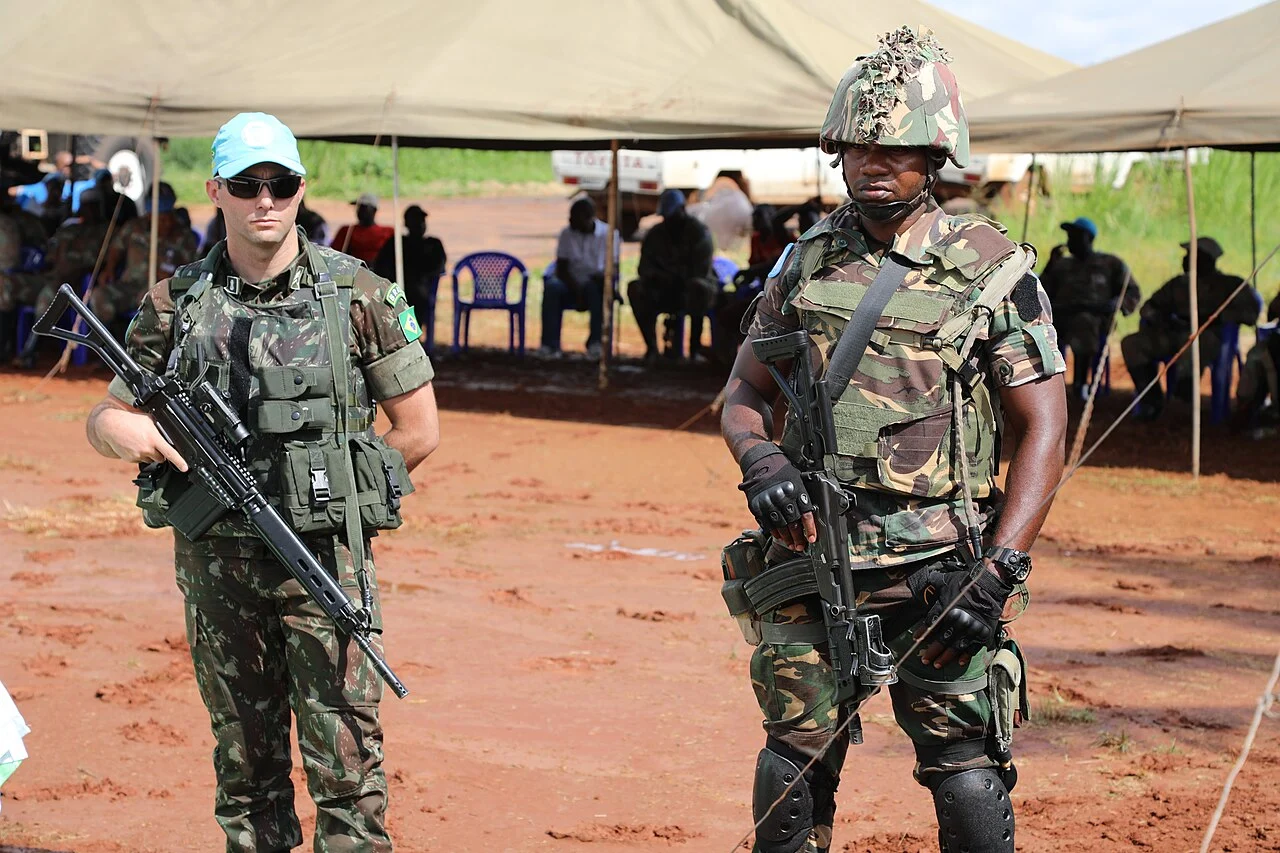
South Africa has formally ended 27 years of peacekeeping in the Democratic Republic of Congo, withdrawing its last soldiers under Operation Mistral after a mission that cost the lives of more than 50 South African troops.
Photo: South African Battalion soldiers on parade with MONUSCO peacekeepers in Beni, North Kivu. Credit: MONUSCO Photos, CC BY-SA 2.0, via Wikimedia Commons
A final “rear party” of 39 South African National Defence Force (SANDF) personnel left the DRC on 21 September 2026, completing handover duties after the bulk of the contingent, 324 troops drawn from 21 SA Infantry Battalion, 44 Parachute Regiment, a tactical intelligence unit and support elements, had already returned home in July, defenceWeb reported.
Major General Godfrey Thulare, General Officer Commanding Joint Operations Headquarters, described the departure as bringing “a dignified conclusion” to South Africa’s involvement in the Congo, a commitment that began with a single staff officer attached to the UN Organization Mission in the DRC (MONUC) in 1999 and grew, over nearly three decades, into one of the SANDF’s largest and most dangerous standing deployments.
From MONUC to a combat brigade
South Africa’s Congo mission evolved considerably over its lifespan. What started as individual staff officers and observers under MONUC expanded through the 2000s into mechanised infantry, artillery and aviation units serving first under the UN’s Force Intervention Brigade, then under the SADC Mission in the DRC (SAMIDRC), a regional force deployed from December 2023 to reinforce the struggling Congolese army (FARDC) against the Rwanda-backed M23 rebel group in North Kivu.
That later phase proved the costliest. In January 2025, 14 South African soldiers were killed in fighting around Goma as M23 fighters overran the city, one of the heaviest single losses suffered by the South African military since the end of apartheid. Equipment losses and the political fallout from the casualties, including sharp questioning in parliament over the SANDF’s readiness and mandate, hastened the shift from an offensive peace-enforcement posture back toward a smaller, defensive presence before the final withdrawal this year.
Over the full 27 years, defenceWeb’s reporting put South African fatalities in the DRC at just over 50, from combat, accidents, illness and other causes, a toll that has repeatedly fed domestic debate about the cost and clarity of Pretoria’s peacekeeping commitments.
Why the SANDF is pulling back
The Mistral withdrawal is not an isolated decision. It follows years of warnings from South African defence officials and parliament’s own defence committee about a hollowed-out SANDF: ageing transport aircraft, a navy with limited sea days, and a defence budget that has shrunk as a share of GDP even as deployment demands multiplied across the DRC, Mozambique and the country’s own borders. DefenceMENA has previously detailed the scale of South Africa’s army equipment inventory and its air force aircraft fleet, much of it increasingly difficult to sustain on extended foreign deployments.
At the same time, South Africa’s defence industry has been pushing to grow its export footprint rather than its expeditionary one: the country’s arms sales, which DefenceMENA reported nearly tripled to R10 billion in the most recent reporting year, point to a strategic preference in Pretoria for projecting influence through industry and equipment sales rather than boots on the ground in contested conflict zones.
What it means for the DRC and the region
South Africa’s exit leaves a gap in a force posture that was already under strain. SAMIDRC’s other troop contributors, Tanzania and Malawi, have faced similar pressure to reassess their own commitments after the Goma losses, and the departure of one of the mission’s more capable contingents, with armour, artillery and attack helicopter support, reduces the firepower available to back up the FARDC in North and South Kivu at a moment when M23 and allied forces still control significant territory despite periodic ceasefire announcements.
For the wider UN peacekeeping architecture in Central Africa, Mistral’s end also lands alongside the continued drawdown of MONUSCO itself, reinforcing a broader pattern of international troop contributors scaling back in the eastern DRC even as the underlying conflict, now well into its fourth decade in various forms, remains unresolved. Kinshasa has increasingly looked to private military contractors and bilateral arrangements to fill the resulting gaps, a shift that is likely to accelerate as traditional SADC and UN contributors reduce their footprints.
Why it matters for Africa
The end of Operation Mistral marks the close of South Africa’s longest continuous military deployment and a turning point in how Pretoria weighs continental solidarity against the readiness of its own force. For the DRC, it removes a seasoned, heavily equipped contingent from an already stretched regional effort against M23, at a time when the balance of power in North Kivu remains contested. More broadly, it is a signal to other SADC and African Union troop contributors that the political and military cost of open-ended peace-enforcement missions in the eastern DRC is rising, and that future stabilisation efforts in the region may have to rely more heavily on African-led forces with narrower mandates, better-defined exit points, or private and bilateral security arrangements rather than large multinational deployments.
The drawdown also shows up in South Africa’s own budget numbers: see DefenceMENA’s ranking of African defence budgets for how the Department of Defence’s FY2026/27 allocation reflects the end of Operation Mistral.