Egypt operates the largest tank-production line outside the United States, and its M1A1 Abrams has spent over three decades replacing the M60 Patton as the backbone of the Egyptian Army’s armoured corps. This piece compares the two systems role by role and traces the modernization now entering a new phase under a 2024 US-approved upgrade package. Data as of October 2026.
DEFENCE AFRICA | Old vs new | Data as of October 2026
Egypt fields one of Africa’s largest armoured fleets, built around two American tank families acquired a generation apart as part of a broader shift toward US-supplied equipment. The M60A3 Patton entered Egyptian service from the late 1970s as part of Cairo’s post-1973 pivot from Soviet to US equipment, while the M1A1 Abrams arrived from 1988 under a co-production arrangement that makes Egypt the only country besides the United States to build the Abrams on its own soil. Neither transition was instant: M60s remained in frontline formations for years after the first Abrams rolled off the line, and large numbers of both types are still catalogued in Egyptian inventories today.
This piece sets the M60A3 Patton against the M1A1 Abrams as operated by the Egyptian Army, and brings in the US State Department’s December 2024 notification to upgrade part of the Abrams fleet to the M1A1SA (Situational Awareness) standard, the clearest sign yet of where Egypt’s armoured modernization is headed next.
| Category | M60A3 Patton (old) | M1A1 Abrams (new) |
|---|---|---|
| Role | Second-generation main battle tank for armoured breakthrough and defence | Third-generation main battle tank, frontline armoured warfare |
| Generation | 1960s hull design, upgraded to A3 standard from 1978 | 1980s design; Egyptian line based on the baseline M1A1 configuration |
| Sensors | AN/VVG-2 laser rangefinder, no standard thermal gunner sight | Thermal Imaging System (TIS) gunner’s sight and laser rangefinder; M1A1SA upgrade adds an AN/VAS-5B Driver’s Vision Enhancer (General Dynamics Land Systems, DSCA notification, December 2024) |
| Weapons | 105mm M68 rifled gun, 7.62mm coaxial machine gun, .50 cal roof-mounted machine gun | 120mm M256 smoothbore gun, 7.62mm coaxial machine gun, .50 cal roof-mounted machine gun |
| Range | Approximately 480km road range on internal fuel (US Army technical data, via GlobalSecurity.org) | Approximately 426km road range on internal fuel (US Army technical data, via GlobalSecurity.org) |
| Performance | 750hp Continental AVDS-1790-2C diesel engine, governed road speed around 48km/h | 1,500hp Honeywell AGT-1500 gas turbine engine, governed road speed around 67km/h |
| Survivability | Rolled steel armour, no standard explosive reactive armour on Egyptian examples | Chobham composite armour in the export configuration supplied to Egypt |
| Networking | Analogue intercom, no digital battle-management system | No integrated digital battle-management system in the baseline M1A1; the M1A1SA upgrade adds sensor and display improvements but not a full networked fire-control suite comparable to the M1A2 SEPv3 |
| Maintenance | Diesel powertrain, straightforward to sustain, but spare parts for the type have grown scarcer since US production ended in 1987 | Gas turbine powertrain with higher fuel consumption; sustained locally through the Egyptian Tank Plant in Cairo, which also performs the M1A1SA refurbishment under General Dynamics Land Systems oversight |
| Operational relevance | Still recorded in Egyptian inventories as a secondary-line type behind the Abrams | The Egyptian Army’s principal main battle tank, operational, with roughly 1,130 in the fleet as of the mid-2020s (Wikipedia, citing DSCA and industry data, 2011/2024) |
What capability existed before?

Egypt’s M60 fleet traces back to the country’s shift toward US suppliers after the 1973 war. Conversions and new orders arrived in several waves: roughly 700 M60A1s brought up to A3 standard from US Army Europe surplus stock in Germany between 1979 and 1988, a further 94 M60A3s ordered in May 1985 for US$165 million and delivered from existing CONUS inventory by 1986, and additional A3-standard batches acquired into the early 2000s, including stock drawn from Austrian Army surplus (Wikipedia’s compiled operator data, citing contemporary defence-industry reporting). Published figures vary: one tally places Egypt’s M60A1/A3 holdings at roughly 850 M60A3s and 300 M60A1s, while an older compilation credits Egypt with 1,716 upgraded M60A3s as of 2015 (Wikipedia, “M60 tank” and “Non-U.S. operators of the M60 tank”).
The M60A3 gave Egypt a modern-for-its-era rifled 105mm gun, a laser rangefinder and improved ballistic computer over the M60A1, but it kept the type’s 1960s-era rolled-steel hull and a diesel powertrain rated well below what the next generation of Western tanks would offer. It remained Egypt’s most capable tank until Abrams deliveries began in volume in the 1990s, and sub-fleets are still carried in open-source inventories today, generally in secondary or reserve roles behind the Abrams.
Why was replacement or modernization needed?
Three factors drove Egypt toward the Abrams. First, firepower and protection: the M60A3’s 105mm gun and conventional steel armour were falling behind composite-armoured, smoothbore-gunned tanks entering regional service by the 1980s. Second, industrial policy: Cairo wanted a tank programme that built domestic manufacturing capacity rather than one that only bought finished vehicles, and the Abrams co-production deal, championed by Field Marshal Abd al-Halim Abu Ghazala and agreed with General Dynamics in 1984 for a US$150 million factory financed through US security assistance, offered exactly that (Wikipedia, “M1A1 tank coproduction program in Egypt”). Third, parts and sustainment: M60 production in the United States ended in 1987, meaning Egypt’s Patton fleet faced a shrinking spares base just as the Abrams programme was coming online.
The transition was gradual rather than a clean swap. Egyptian production of M1A1 kits began in 1988 at what became the Armored Production and Repair Factory in Cairo, now generally referred to as the Egyptian Tank Plant, and the programme had assembled approximately 1,130 Abrams tanks by the early 2010s (Wikipedia; DSCA, December 2024 notification). A period of suspended US security assistance in 2013-2015 slowed deliveries and co-production work for a time, illustrating how dependent the programme remains on the health of the US-Egypt defence relationship.
What does the new platform add?
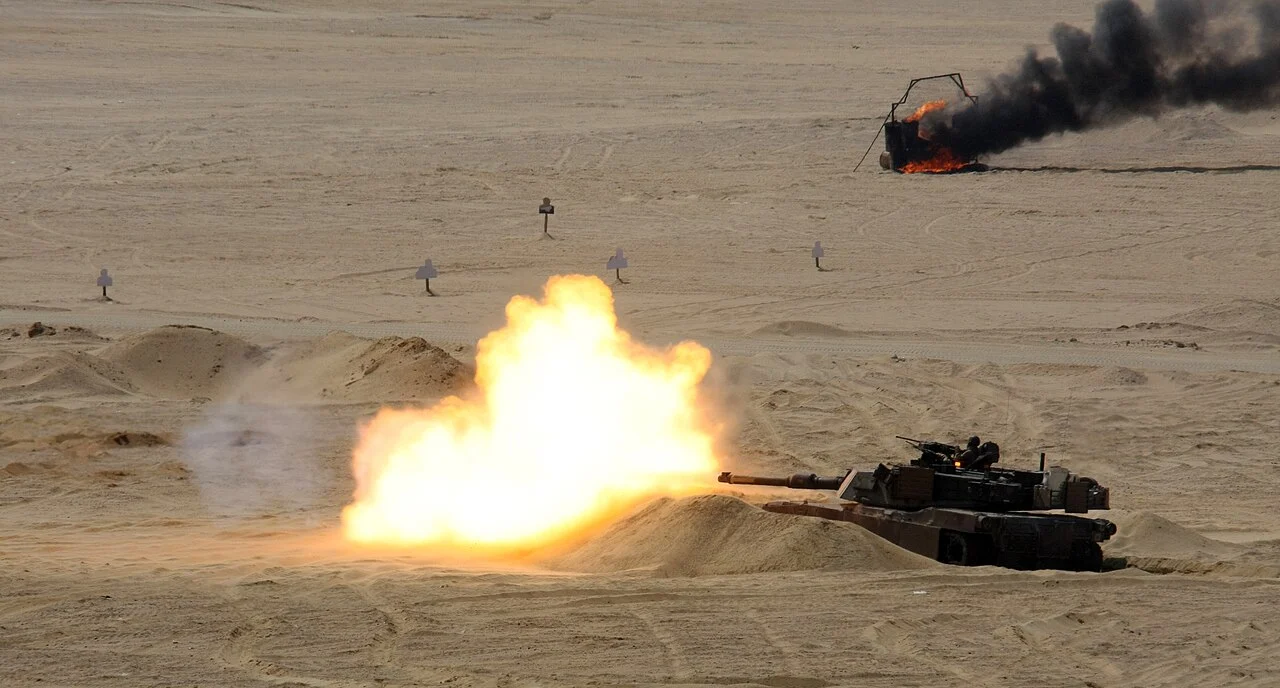
The M1A1 Abrams gives Egypt a 120mm M256 smoothbore gun firing modern kinetic and shaped-charge ammunition, Chobham composite armour in place of rolled steel, and a 1,500hp AGT-1500 gas turbine that lifts governed road speed from roughly 48km/h to about 67km/h over the M60A3 (US Army and manufacturer technical data, via GlobalSecurity.org). The Egyptian line’s output is also operational: with some 1,130 Abrams tanks now recorded in Egyptian service, it is the Egyptian Army’s principal main battle tank and the largest Abrams fleet outside the US Army and US Marine Corps.
A further layer of modernization is now selected, following a US Defense Security Cooperation Agency notification to Congress on 20 December 2024: Egypt requested, and the US State Department approved, a possible US$4.69 billion Foreign Military Sale to refurbish and upgrade 555 of those M1A1 tanks to the M1A1SA configuration, adding Driver’s Vision Enhancer kits, new thermal gunner sights, M250 smoke grenade launchers, AGT-1500 engines and X-1100 transmissions (DSCA notification, 20 December 2024, as reported by Military Africa). That is a congressional notification of a possible sale, not yet a confirmed signed contract; General Dynamics Land Systems is named as the prospective prime contractor, with the refurbishment work planned for the Egyptian Tank Plant in Cairo.
What capabilities remain unchanged?
Despite the generational jump, several constraints carry over from the M60 era into the Abrams programme. Egypt’s industrial participation remains partial: US officials have estimated that Egyptian industry can indigenously manufacture only around 19 percent of Abrams components, with Washington withholding the composite armour package, fire-control electronics and engine technology that make up the tank’s most sensitive systems (Wikipedia, “M1A1 tank coproduction program in Egypt”). The baseline M1A1, like the M60A3 before it, also lacks a fully networked digital battle-management system; the M1A1SA package improves sights and driving aids but does not bring Egypt’s Abrams fleet to the networked fire-control standard of the US Army’s M1A2 SEPv3. And crew structure is unchanged: both tanks use a four-man crew (commander, gunner, loader, driver), so the step up in firepower and protection has not altered how Egyptian armoured units organise at the vehicle level.
Why it matters for Africa
Egypt’s tank modernization is a rare case on the continent of a sustained, decades-long local production programme rather than a one-off import, and it shows both the benefits and the limits of that model. Co-production has kept an Abrams-building workforce and a tank plant running in Cairo since 1988, built relationships with General Dynamics Land Systems that now extend into refurbishment work, and given Egypt a path to field a Western-standard main battle tank at a scale few African forces can match. At the same time, the programme remains tied to US technology-release decisions and to the state of Washington-Cairo security cooperation, a dependency that resurfaced when assistance was suspended in 2013-2015. For African militaries weighing local assembly or co-production deals of their own, Egypt’s experience, set out in full in our broader look at Egypt’s military strength, is a concrete example of what sustained industrial participation can deliver, and of the political and technological strings that typically come attached to it. The M1A1SA notification also signals that Egypt’s Abrams fleet, rather than being replaced outright, is being incrementally modernized in place, a path other large, aging Abrams or Western-tank fleets on the continent may eventually follow.
For the company behind the Abrams and its wider links to Egypt and Morocco, see our General Dynamics company profile.
Sources
- US Defense Security Cooperation Agency, notification to Congress on Egypt Abrams tank refurbishment, support and equipment, 20 December 2024, as reported by Military Africa
- M1A1 tank coproduction program in Egypt, Wikipedia (compiling DSCA, GlobalSecurity.org and contemporary defence-industry reporting)
- GlobalSecurity.org, M1A1 Abrams tanks in Egyptian service
- M60 tank, Wikipedia (Egyptian orders and fleet figures)
- Non-U.S. operators of the M60 tank, Wikipedia