Germany sold Egypt four Type 209/1400mod submarines, four MEKO A200 frigates and a layered IRIS-T air-defence package, and in a single year, 2021, German arms exports to Egypt hit an absolute record of €4.34 billion. By 2023 that figure had collapsed to €40.3 million. This is how Germany became the quiet second supplier behind Egypt’s French and American hardware, what it actually delivered, and why Berlin then throttled the pipeline back.
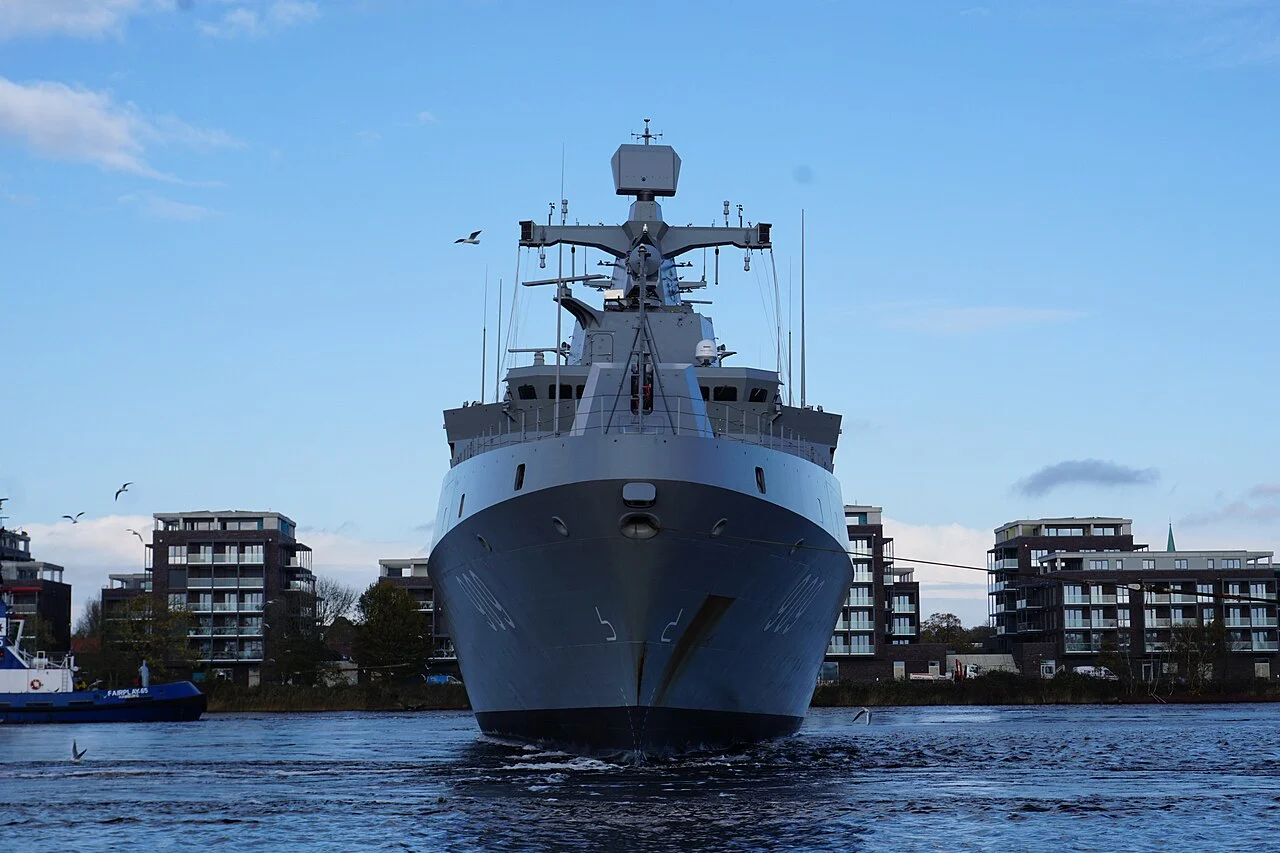
Photo: Egyptian Navy frigate Al-Qadeer, the third German-built MEKO A200, at the magnetic measurement facility in Wilhelmshaven before commissioning, November 2023. Credit: Ein Dahmer, CC BY-SA 4.0, via Wikimedia Commons
SIPRI’s March 2026 arms-transfer figures put Germany at 30% of Egypt’s major arms imports in 2021–25, second only to France (39%) and ahead of Italy (18%). Unlike the French line, which is built around a visible fighter jet, Germany’s share sits almost entirely below the waterline: four submarines and four frigates that give Egypt’s navy its only indigenous underwater and most modern surface combat capability, plus an air-defence system whose deliveries were partly diverted to Ukraine. The full inventory is in the Egypt military profile; this piece follows only the German line, programme by programme, and labels each with the standard status vocabulary. An approved export licence is not a contract, a contract is not a delivery, and a delivery is not a confirmed operational unit.
How the relationship formed
Germany’s defence-industrial relationship with Egypt is newer than France’s and runs through a single company, ThyssenKrupp Marine Systems (TKMS, formerly HDW). The submarine programme is the origin point: Cairo and Berlin discussed a Type 209/1400mod order from around 2011, and Israel’s then-concerns about the deal becoming public in 2014 confirmed that German officials regarded the sale as politically sensitive even before Egypt’s 2013 political transition reshaped its procurement priorities. The first boat was handed over in December 2016, the second in August 2017, the third in April 2020, and the fourth and final boat in July-August 2021, giving Egypt a four-boat submarine arm built entirely in Germany.
The frigate line followed a similar path. Egypt ordered four MEKO A200EN-class frigates from TKMS in a deal reported at around €2 billion in November 2018, and the German government formally approved export licences covering the vessels in 2019. Unlike the submarines, only the first three hulls were built in Germany; the fourth, Al-Jabbar, was assembled under licence at Alexandria Shipyard, the same yard that also builds France’s Gowind corvettes for Egypt. Alongside the frigates, Cairo contracted a package of German IRIS-T air-defence systems across three variants, approved in the same Merkel-government period that critics later called a “last-minute” surge of export licences before the 2021 elections.
What followed was not one deal but a bundle of naval and air-defence programmes approved within a few years of each other, then a sharp political correction. The table below lists every programme in date order.
Anatomy table: German programmes in Egypt
| System | Manufacturer | Contract / announcement | Quantity | Delivery | Current status | Source |
|---|---|---|---|---|---|---|
| Type 209/1400mod submarines | ThyssenKrupp Marine Systems (HDW) | Talks from around 2011; contract value reported at about €1 billion for four boats | 4 | S41 Dec 2016; S42 Aug 2017; S43 Apr 2020; S44 Jul–Aug 2021 | Delivered; in service | Army Recognition; Military Africa; Defense.info |
| MEKO A200EN frigates | ThyssenKrupp Marine Systems, with Alexandria Shipyard for hull 4 | Ordered Nov 2018, reported about €2 billion; German export licences approved 2019, reported up to €2.3 billion including options | 4 | Al-Aziz Oct 2022; Al-Qahhar May 2023; Al-Qadeer Dec 2023; Al-Jabbar launched Alexandria Dec 2023, delivery reported for late 2025 | Delivered (first three); fourth hull Under delivery (Reported) | Naval News; defensa.com; Military Africa |
| IRIS-T SLM medium-range air defence | Diehl Defence | Part of a package reported in 2018–19 covering SLM, SLS and SLX variants | 7 batteries reported contracted | First batteries delivered mid-2021; 400 missiles recorded by SIPRI as delivered | Delivered; in service (paraded at Ismailia, Oct 2024) | SIPRI Arms Transfers Database; Army Recognition; Military Africa |
| IRIS-T SLS short-range air defence | Diehl Defence | Same reported package | 6 batteries reported | Not confirmed delivered | Status unclear | Military Africa; DM data store cross-check |
| IRIS-T SLX long-range ground-based air defence | Diehl Defence | Same reported package | 10 batteries reported | Not confirmed; some IRIS-T consignments bound for Egypt were redirected to Ukraine from 2022 | Reported (unconfirmed) / Status unclear | Eurasian Times; Army Recognition |
| Self-propelled howitzer parts and armoured-vehicle ballistic protection | Not named in the source reviewed | Part of 2025 individual export licences, 20 approvals | Not disclosed | Not disclosed | Contracted (licences approved); delivery not confirmed | German federal export report coverage, 2025 |
Naval: the submarine arm and a new frigate class
The submarines are Germany’s most consequential export to Egypt because they gave the navy a capability no other supplier was offering at the time: all four Type 209/1400mod boats were delivered between December 2016 and August 2021 and remain the backbone of Egypt’s underwater fleet, alongside a handful of older, doubtfully operational Romeo-class boats. Each boat was reported at roughly €250 million, for a programme value of close to €1 billion, though neither government has published a full breakdown.
The frigates are the more visible programme. Al-Aziz, the first MEKO A200EN, was delivered in October 2022; Al-Qahhar followed in May 2023; Al-Qadeer, pictured above, was handed over in December 2023 after sea trials at Wilhelmshaven. The fourth ship, Al-Jabbar, was launched at Alexandria Shipyard in December 2023 under a technology-transfer arrangement with TKMS, and reports at the time of launch put its delivery around October 2025; DefenceMENA has not found a confirmed handover date beyond that report, so the fourth hull’s status is treated here as under delivery rather than confirmed in service. The ships give Egypt a modern air-defence and anti-submarine frigate class to sit alongside its French FREMM and Italian Bergamini-class frigates.
Air defence: IRIS-T and the Ukraine diversion
Egypt’s IRIS-T order is the clearest case in this file of the gap between what was contracted and what arrived. Reporting from 2018–19 describes a package covering seven IRIS-T SLM medium-range batteries, six IRIS-T SLS short-range systems and ten IRIS-T SLX long-range ground-based air-defence batteries, which would have made Egypt one of the largest IRIS-T operators anywhere. SIPRI’s database records seven SLM systems and 400 associated missiles as delivered, and an SLM unit was shown publicly at a parade in Ismailia in October 2024.
The SLX and, to a lesser extent, the SLS components of the order have a different story. From 2022, as Russia’s war on Ukraine escalated demand for Western air-defence systems, Germany redirected IRIS-T consignments that trade press had linked to Egypt’s order toward Kyiv instead, a reallocation reported without an official Egyptian or German statement confirming which specific units were affected. DefenceMENA treats the SLX batteries as status unclear and the SLS batteries as not confirmed delivered until a primary source states otherwise.
Sustainment, local production and financing
The technology-transfer story on the German side runs through Alexandria Shipyard, which built the fourth MEKO A200 hull under TKMS licence, the same yard where Naval Group’s Gowind corvettes are also partly built. That dual role, French and German warships built side by side in the same Egyptian yard, is a detail Cairo’s own messaging has used to frame the navy’s modernisation as locally rooted rather than purely imported. No public figures describe the value or scope of the shipyard’s German-specific technology-transfer terms, unlike the clearer, published terms of some of Egypt’s French financing.
Financing for the German programmes has not been itemised in the sources reviewed here the way the 2021 French Rafale loan was; German export-credit guarantees (Hermesdeckungen) typically underpin large single contracts like the submarines and frigates, but no public breakdown ties a specific guarantee amount to the Egyptian submarine or frigate deals. Treat any financing detail beyond the headline contract values as unconfirmed.
Why the German line shrank after 2021
Germany’s arms-export figures for Egypt show a boom-and-bust pattern that has no equivalent in France’s steadier Rafale-and-warships relationship. Approved German arms exports to Egypt ran at roughly €708 million in 2017, around €801.9 million in licences approved in 2019 and €763.7 million in 2020, before jumping to an absolute record of €4.34 billion in 2021, a surge driven by the bundled approval of the MEKO frigates, the IRIS-T package and related naval equipment in what German commentators called the outgoing Merkel government’s “last-minute” licensing surge. The incoming SPD-Green-FDP coalition that took office in late 2021 had pledged a more restrictive arms-export policy, explicitly citing Egypt’s role in the Yemen war and its domestic human-rights record as grounds for tighter scrutiny of future approvals.
The effect on the numbers was immediate and sustained. Approved exports to Egypt fell to about €40.3 million in 2023, and by 2025 Egypt was still Germany’s largest African arms-export destination but at a much lower €105.55 million across 20 individual licences, of which 82.8% covered parts for self-propelled howitzers and armoured-vehicle ballistic protection rather than new major platforms. In other words, the pipeline that built Egypt’s submarine and frigate fleets has not reopened at anything like its 2021 scale; what moves now is largely spares and components for equipment already in service. DefenceMENA has not found a confirmed change to this restrictive posture under the government that took office in 2025, and treats the current German export relationship with Egypt as one of sustainment rather than new major programmes until a primary source says otherwise.
How Germany competes with Egypt’s other suppliers
| Supplier | What it provides | SIPRI share 2021–25 | Verified deals | Local production / transfer | Maintenance and financing notes |
|---|---|---|---|---|---|
| Germany | Type 209/1400mod submarines, MEKO A200EN frigates, IRIS-T SLM/SLS/SLX | 30% | 4 submarines delivered 2016–21; 3 of 4 frigates delivered 2022–23; IRIS-T SLM delivered, SLX/SLS unclear | MEKO A200 fourth hull built at Alexandria Shipyard | Export licences fell from a €4.34bn peak in 2021 to €40.3m in 2023 and €105.55m in 2025 |
| France | Rafale, Mistral LHDs, FREMM, Gowind, MBDA missiles | 39% | 2015 and 2021 Rafale batches; Gowind 2014; Mistral and FREMM 2015 | Gowind corvettes at Alexandria; Rafale parts at AOI | State-guaranteed export credit for the 2021 Rafale contract (reported) |
| Italy | FREMM Bergamini frigates, patrol ships | 18% | Frigates delivered from 2020 (Estimated) | Not confirmed | Not stated |
| United States | F-16, M1A1 Abrams, Apache, CH-47 | Not broken out in the source reviewed | Long-running FMS and FMF cases | M1A1 assembly at Factory 200 | About US$1.3 billion a year in FMF |
| Russia | MiG-29M/M2, Ka-52, S-300VM, Buk-M2 | Sharply lower than in 2016–20 (SIPRI) | Deliveries through the 2010s | Limited | Su-35 order reportedly cancelled |
Set against the other four, Germany holds the niche no one else occupies in Egypt’s inventory: it is the only Western source of submarines and, with the MEKO A200, supplies a surface-combat hull alongside France’s FREMM/Gowind and Italy’s Bergamini ships. But where France’s export machinery scaled up after 2021 and the United States kept its annual FMF flow steady, Germany’s own political cycle cut its own pipeline just as the French one was accelerating. For the French side of that comparison, see DefenceMENA’s France-Egypt arms deals analysis; for the American side, see The American core of Egypt’s arsenal.
What is pending or reported
- IRIS-T SLX and SLS completion: whether the remaining batteries of the original package will still reach Egypt, or have been permanently reallocated to Ukraine, has not been confirmed by either government (Status unclear).
- Al-Jabbar delivery: the fourth MEKO A200 hull was reported for delivery around October 2025; DefenceMENA has not found a confirmed handover date (Under delivery / Reported).
- Further submarines or frigates: no source reviewed here reports talks for a second German submarine or frigate batch; Egypt’s reported submarine interest since 2025 has instead focused on France’s Naval Group (see the France-Egypt analysis).
- Export-policy direction after 2025: whether Germany’s governing coalition since 2025 will ease or maintain the post-2021 restrictive posture toward Egypt has not been confirmed in the sources reviewed (Status unclear).
How many submarines and frigates does Egypt have from Germany?
Submarines: 4 Type 209/1400mod boats ordered, and all 4 delivered and in service (2016–2021). Frigates: 4 MEKO A200EN ordered; 3 delivered and in service (2022–2023); the fourth, built in Egypt, is under delivery with a reported but unconfirmed 2025 handover. Air defence: 7 IRIS-T SLM batteries contracted and delivered; 6 SLS and 10 SLX batteries reported contracted, with delivery status unclear after some consignments were redirected to Ukraine from 2022.
A note on the numbers
Contract values for the submarine and frigate programmes are press-reported; neither Berlin nor Cairo has published itemised figures. The annual export totals (€708m in 2017, €801.9m in 2019, €763.7m in 2020, €4.34bn in 2021, €40.3m in 2023, €105.55m in 2025) come from German federal arms-export reporting as covered in German press and the ruestungsexport.info database, and represent approved export licences, not necessarily goods actually shipped in that calendar year. SIPRI’s trend-indicator values are based on production cost, not sale price, and are recorded when equipment is delivered. Global Firepower is not used here as an inventory count.
Sources
- Naval News, ThyssenKrupp delivers first MEKO A200 frigate to Egyptian Navy (October 2022)
- Defensa.com, Alexandria Shipyard launches fourth MEKO A200 frigate for Egypt
- ADF Magazine, Egypt launches fourth MEKO frigate
- Defense.info, Egypt takes delivery of 4th Type 209 German submarine (August 2021)
- Army Recognition, last Egyptian Type 209 submarine to be delivered in 2021
- Army Recognition, new German-made IRIS-T SLM air defence missile system of the Egyptian armed forces
- Eurasian Times, designed for Egypt, delivered to Ukraine: Kyiv receives another IRIS-T (2026)
- SIPRI, Trends in International Arms Transfers, 2025 (March 2026)
- ruestungsexport.info, German arms-export country report: Egypt
- t-online, last-minute approvals push German arms exports to a record under Merkel (2021)
- echo24, €13.3 billion in German arms exports: the share going to Ukraine and Africa (2025 figures)
- The Media Line, Egypt enhances naval fleet with new German-made frigate Al-Qadeer