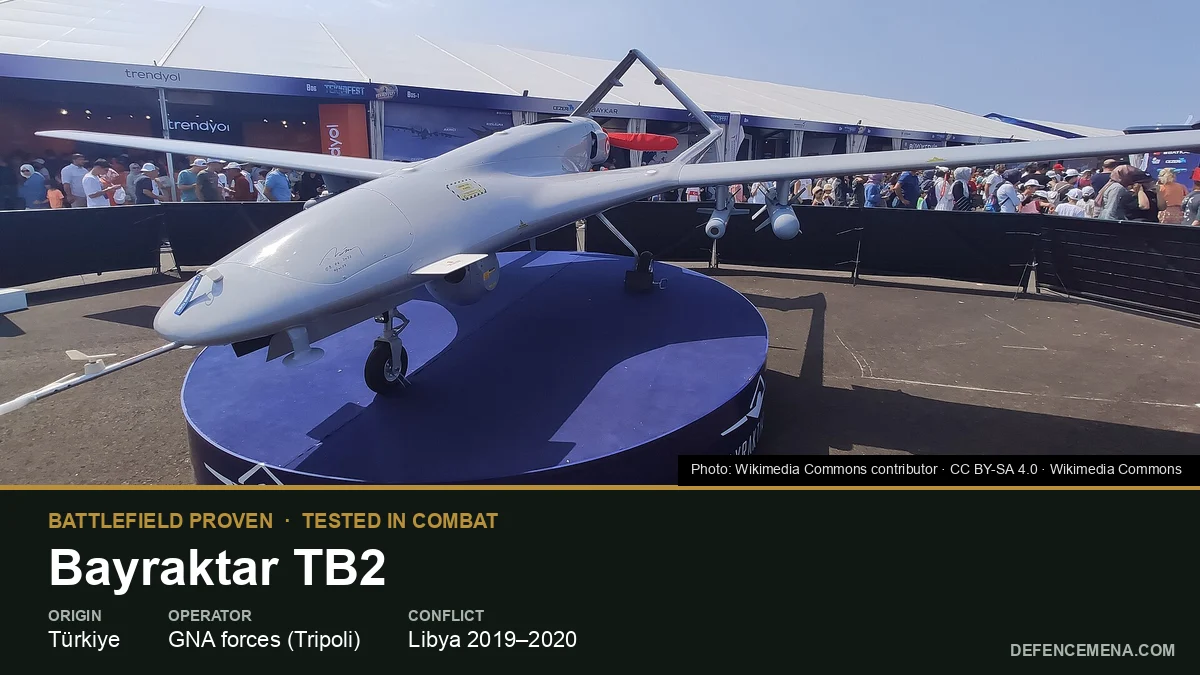
The Bayraktar TB2 Libya record, from 2019 to 2020, is the case African air forces cite most often when they talk about armed drones, and it is also one of the most misread. UN investigators judged Turkish drones, electronic warfare and air defence together to be a decisive element in the defeat of Khalifa Haftar’s forces around Tripoli in 2020. They were just as clear that the drone could not have done it alone.
Photo: A Bayraktar TB2 on display at TEKNOFEST 2022. Credit: 𐰇𐱅𐰚𐰤, CC BY-SA 4.0, via Wikimedia Commons. Credit: 𐰇𐱅𐰚𐰤 (Wikimedia Commons user), CC BY-SA 4.0, via Wikimedia Commons.
Direct answer
In Libya, the Bayraktar TB2 worked best as one part of a Turkish package that also included electronic warfare, layered air defence, military advisers and precision artillery. The UN Panel of Experts on Libya judged that package a decisive element in the defeat of Haftar’s Libyan National Army (LNA) in western Libya during 2020. On its own, in 2019, the TB2 was outmatched in reach and payload by the UAE-supplied Wing Loong II fleet on the other side. Sortie numbers, total deliveries and exact loss figures have never been published.
| System | Bayraktar TB2 medium-altitude armed drone (UCAV) |
| Manufacturer | Baykar |
| Origin | Türkiye |
| Operator(s) in this conflict | Government of National Accord Affiliated Forces (GNA-AF), Tripoli, with Turkish support; the exact Libyan/Turkish division of operating roles is not publicly disclosed |
| Period | First identified in Libya in June 2019; heaviest use March–June 2020; nationwide ceasefire signed 23 October 2020 |
| Opposing drone fleet | Wing Loong II (Chinese-built), transferred to the LNA side by the United Arab Emirates, according to the UN Panel |
| Evidence level summary | Transfers and overall impact: confirmed by UN Panel reports. Individual strikes: mostly visually documented or officially claimed. Sortie and loss totals: no reliable public figure |
Where was it used?
The TB2 flew in the war that began when the LNA launched its offensive on Tripoli in April 2019. According to the UN Panel’s December 2019 report (S/2019/914), confidential sources told investigators that drones were being assembled at Misrata on 4 June 2019, and the type was identified as the Bayraktar TB2 five days later. Social media then showed the aircraft operating regularly from Mitiga airport in Tripoli and from Misrata.
At first the drones were limited to the front lines around Tripoli. The Panel reported that ground relay stations deployed in late 2019 extended their reach to roughly 150 km beyond GNA-held territory, bringing the LNA’s Jufra air base into range. In 2020 the TB2 supported the push west to the Tunisian border, the fall of al-Watiya air base on 18 May, the capture of Tarhuna on 5 June and the advance towards Sirte. That advance stopped at the Sirte–Jufra line after Egypt’s President Abdel Fattah al-Sisi called the two locations a “red line” on 20 June 2020, as The Defense Post reported.
Reporting on the conflict has often called Libya Africa’s first major drone war, fought between two rival foreign-supplied fleets. The other side flew Wing Loong II drones from al-Khadim air base in the east. DefenceMENA’s Wing Loong operator page tracks that type across Africa.
What was the mission?
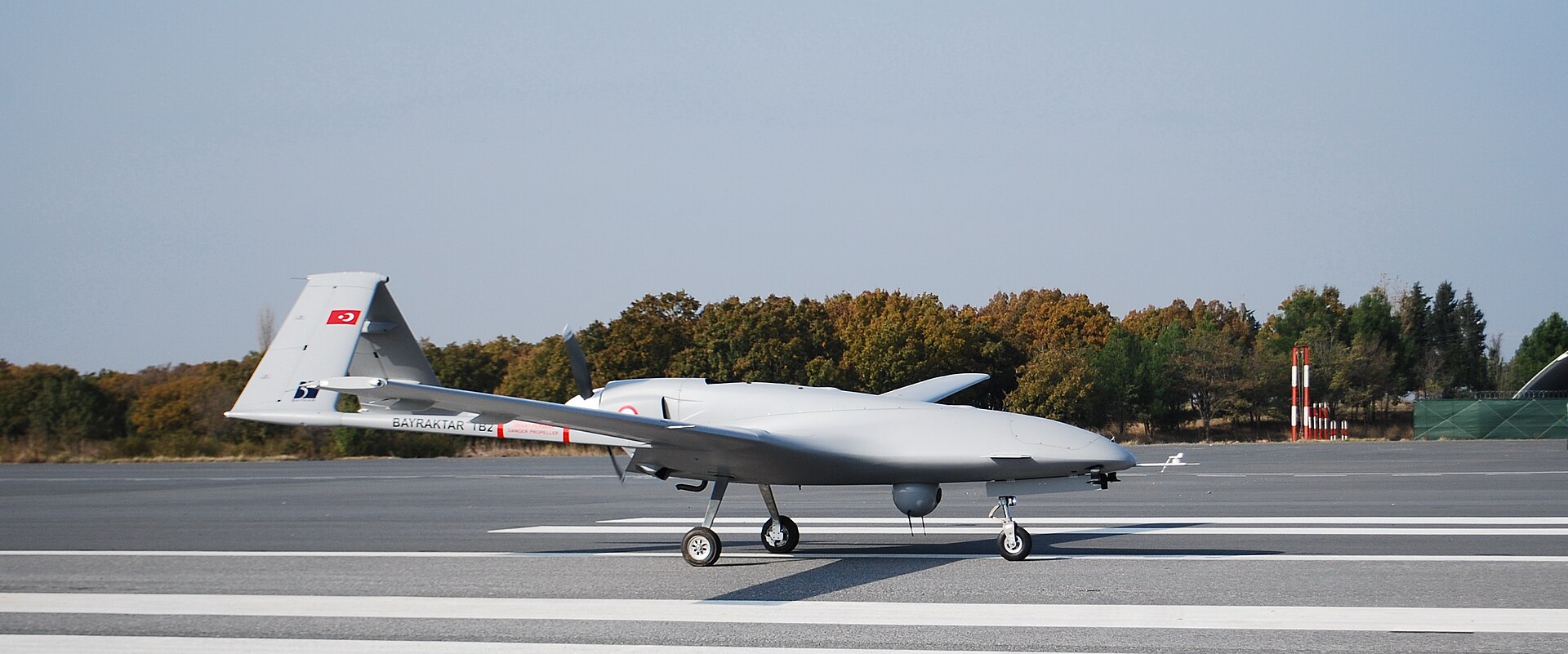
In 2019 the mission was defensive: strike LNA units, artillery and supply lines close to Tripoli and watch the approaches to the capital. The Panel found that the drone war had escalated from May 2019, and that for both sides armed drones had become the main way to deliver precision munitions.
From early 2020 the mission changed. After the security and military cooperation agreement between the GNA and Turkey was signed on 27 November 2019, Turkey deployed air defence and, according to the Panel, electronic warfare. On 27 March 2020 the GNA announced Operation Peace Storm. The Panel describes the TB2, and probably the larger TAI Anka-S, providing intelligence, surveillance and reconnaissance (ISR) alongside Turkish-operated signals intelligence. It describes the aim as a war of attrition to wear down the LNA’s ground units, with loitering munitions and precision artillery firing on targets the drones helped to find.
For a side-by-side look at the aircraft, see DefenceMENA’s TB2 vs Wing Loong II vs CH-4 comparison.
What does the public evidence show?
The strongest evidence on the TB2 in Libya comes from two UN Panel of Experts reports: S/2019/914 (December 2019) and S/2021/229 (March 2021). Both treat the drone transfers as violations of the UN arms embargo. The Panel also found Turkey, the UAE and other states in breach over other transfers. Open-source analysts such as Oryx add imagery of specific events. The table below separates what is confirmed from what is only claimed.
| Claim / event | Date | Evidence level | Source |
|---|---|---|---|
| TB2s transferred from Turkey to GNA-AF; several batches, first reported as four aircraft, second as probably eight | May–Aug 2019 | Confirmed (UN finding); batch sizes partly from open sources | UN Panel, S/2019/914 |
| UAE post-delivery transfer of Wing Loong II and Blue Arrow 7 missiles to the LNA side | 2019 | Confirmed (UN finding) | UN Panel, S/2019/914 |
| Wing Loong II judged to carry over eight times the TB2’s ordnance and to cover all of Libya via satellite link | 2019 | Official assessment (UN) | UN Panel, S/2019/914 |
| ASELSAN KORAL electronic warfare system transferred by Turkey | Identified 23 Oct 2019 | Officially reported by the Panel; based on confidential sources | UN Panel, S/2021/229 |
| Six MIM-23 HAWK and 12 Korkut air defence systems transferred by Turkey | Jan 2020 | Confirmed (UN finding, satellite imagery, ship tracking) | UN Panel, S/2021/229 |
| At least nine Wing Loong II moved from al-Khadim to an air base in Egypt | Feb 2020 | Confirmed (UN finding) | UN Panel, S/2021/229 |
| One LNA Pantsir-S1 destroyed and one captured at al-Watiya after drone strikes | 16–18 May 2020 | Visually documented; capture confirmed by UN | Oryx imagery analysis; UN Panel, S/2021/229 |
| Drones plus loitering munitions judged very effective against UAE-delivered Pantsir-S1 systems | 2020 | Official assessment (UN) | UN Panel, S/2021/229 |
| Drone strikes in support of the GNA killed 17 civilians at Qasr bin Ghashir | 3 Jun 2020 | Officially reported (UN); drone type not specified | UNSMIL civilian casualties report |
| Two TB2s seen at al-Khadim in eastern Libya; supplier unknown | Imagery 2025 | Independently reported (commercial imagery) | Reuters, via Al Jazeera |
The al-Watiya case is the clearest single example. The Panel records that a relatively intact Pantsir-S1 was captured when the LNA withdrew on 18 May 2020. It was later placed under Turkish protection at Mitiga and then removed from Libya under a US foreign military exploitation programme, which the Panel also counted as an embargo violation. Oryx’s imagery-based account attributes the destruction of a second Pantsir at the base to TB2 strikes. That account is visual documentation, not an official finding.
What worked?
Persistent ISR tied to firepower. The Panel’s central finding is that the combination of drones, fused intelligence and precision fire changed the course of what had been a low-intensity, low-technology war. It judged that LNA units were neither trained nor motivated to cope with this and usually retreated. Once in retreat they were continually harassed from the air.
Working inside an air defence and EW umbrella. The Panel describes Gabya-class frigates offshore, HAWK batteries around Tripoli and Misrata airports, and Korkut guns moving with ground units. Together they removed the LNA’s local air superiority early in 2020. According to the same report, the KORAL electronic warfare system jammed LNA drones and small ISR drones. DefenceMENA explains the system in its KORAL explainer, and the Korkut family in its ASELSAN air defence overview.
Staff work and adaptation. The Panel credits Turkish military advisers with making GNA-AF operational planning more professional, with phased objectives and faster decisions than an LNA command where every decision went to the top. The Panel also noted that the GNA side dispersed drone operations away from fixed air bases in 2019.
Low-cost reach on a limited budget. The TB2 gave a government with almost no working combat aircraft a strike and surveillance capability. The Panel’s 2019 comparison shows how modest that capability was on paper: range under 200 km on line of sight and a payload of about 55 kg of small precision munitions.
What problems appeared?
It was outclassed in 2019. Until Turkish air defence and electronic warfare arrived, the Panel judged the LNA to have a significant tactical advantage, because its Wing Loong II fleet carried much heavier weapons and flew under satellite control across the whole country.
Dependence on a foreign partner. The Panel stated that operating and maintaining such drones needed months of technical and simulator training, beyond the known capability of Libyan units on either side in 2019. Drone Wars UK described the TB2s as operated by Turkey on behalf of the GNA. For any buyer, Libya shows how far results depended on outside people, spares and support, not only the airframe.
Ground infrastructure was a target. LNA air strikes repeatedly hit the hangars and support facilities built for the drones at Misrata air academy in 2019, according to the Panel.
Civilian harm and legal exposure. UNSMIL recorded the 3 June 2020 strikes at Qasr bin Ghashir, which killed 17 civilians, as reported drone strikes in support of the GNA; it did not name the drone type. New America’s strike database separately lists joint GNA–Turkey strikes with civilian deaths. The opposing side was also accused: Human Rights Watch attributed a November 2019 strike on a factory near Tripoli, which killed eight civilians, to a UAE drone, Al Jazeera reported. Every transfer on both sides was also an embargo violation in the Panel’s view, which is a reputational cost that suppliers and buyers inherit.
Confirmed losses and limitations
Libya is one of the few conflicts where TB2 losses were examined by UN investigators, but even here no complete or official total exists. Neither Turkey nor the Libyan authorities have published fleet size, sortie numbers or attrition figures. The figures below are the most reliable public ones, grouped by source.
| Period | What is reported | Evidence level | Source |
|---|---|---|---|
| 6–7 Jun 2019 | Two TB2s destroyed on the ground in LNA air strikes on Misrata air academy | Confirmed (UN) | UN Panel, S/2019/914 |
| 30 Jun 2019 | One TB2 shot down by the LNA; the Panel added that reported combat losses were much higher | Confirmed (UN) for one; rest reported | UN Panel, S/2019/914 |
| Late 2019 | LNA-claimed TB2 losses (15) exceeded the 12 reported as delivered | Disputed; the Panel cited it as evidence of propaganda | UN Panel, S/2019/914, annex 48 |
| Nov 2019 – Mar 2020 | LNA claimed its UAE-supplied Pantsir-S1s destroyed 16 Turkish aircraft | Unverified claim | defenceWeb |
| Jan – Jun 2020 | 16 TB2 and 8 Wing Loong losses counted where photos, video or reliable sources existed; some wreckage looked intact, suggesting crashes as well as shoot-downs | Independently reported / visually documented | Drone Wars UK |
| 2019 – early 2020 | TB2s judged vulnerable at their bases and to Pantsir-S1 in the air, before Turkish air defence and EW arrived | Official assessment (UN) | UN Panel, S/2021/229 |
Context. The losses were significant in proportion to the known deliveries, and both UN reports say so. They also show how the operator responded. Further batches were sent, in part to replace combat losses, according to the Panel. Launch sites were dispersed, and from January 2020 the drones worked under a Turkish air defence and electronic warfare umbrella. The Panel’s March 2021 report records the balance shifting after that, with the LNA’s Pantsir-S1 systems suffering heavy losses in turn. The Wing Loong II fleet also had documented losses and was largely moved out of Libya to Egypt in February 2020. None of this gives a loss rate per sortie, because the sortie count is not public.
What is still disputed?
- Loss tallies on both sides. Claims from both camps routinely ran ahead of the evidence, as the losses section above shows. The UN Panel itself described a propaganda battle around the drone war.
- Who flew the aircraft. Independent reporting describes Turkish operation. Neither government has published the arrangement, and the balance between Turkish and Libyan crews over time is unknown.
- The autonomy debate. The March 2021 report described STM Kargu-2 loitering munitions “programmed to attack targets without requiring data connectivity”. The passage drew worldwide attention, but the report does not describe a specific autonomous engagement, and the question remains contested. The Kargu-2 is not the TB2, but the two are often wrongly merged in coverage.
- The July 2020 al-Watiya strike. Unidentified jets hit the base after Turkish forces moved in. Middle East Eye, citing Reuters and AFP, reported that attribution was contested. Oryx suggests Egyptian or Emirati aircraft, but no official finding has been published.
- Eastern Libya’s new drones. Reuters, reviewing commercial imagery with analysts from Janes, the IISS and PAX, reported two TB2s at al-Khadim in 2025. It could not establish who supplied them or who operates them, Al Jazeera reported.
Did the manufacturer or operator change anything?
The clearest changes in Libya were operational, not technical. The UN documents extra relay stations to extend range, dispersed launch sites, replacement batches, and above all the decision to put the drones inside a layered air defence and electronic warfare system. The Panel also records the arrival of the larger TAI Anka-S and of loitering munitions alongside the TB2. No public source reviewed documents a Libya-specific hardware change to the TB2 itself. Baykar has not published lessons learned from Libya. Claims that particular upgrades came from the Libyan experience could not be verified and are left out here.
Politically, the 23 October 2020 ceasefire called for foreign forces and mercenaries to leave within 90 days. The Panel noted in March 2021 that commitment to implementing it remained questionable.
Did other countries buy it afterwards?
Yes, and quickly. In October 2021 Reuters linked Turkey’s new drone deals with Morocco and Ethiopia to the drones’ use in Syria, Libya and Nagorno-Karabakh (via defenceWeb). In the African orders that followed, marketing, price, training packages and political access all played a part. Combat reputation was one factor among several.
| Country | Year | What is reported | Source |
|---|---|---|---|
| Morocco | 2021 | 13 TB2s ordered in April 2021, reported at MAD 626m (about US$70m) | The Defense Post |
| Ethiopia | 2021 | Purchase reported by sources; no official delivery statement found | defenceWeb (Reuters) |
| Niger | 2022 | Six TB2s delivered | The Defense Post |
| Burkina Faso | 2022 | Reportedly delivered 2022; officially presented March 2023 | defenceWeb |
| Togo | 2022 | TB2s delivered | Military Africa |
| Mali | 2022–2023 | First TB2s in December 2022, more in March 2023 | Military Africa |
| Kenya | 2024 | Six TB2s received | Military Africa |
| Nigeria | 2022–2024 | 43 TB2s announced; delivered number not publicly disclosed | Defense Mirror |
DefenceMENA’s TB2 operator list separates ordered, delivered and operational status country by country, including Djibouti, Tunisia and Somalia. Several of the same air forces later moved up to the heavier Akinci, tracked on the Akinci operator page.
What does this mean for African procurement?
Buy the system, not the aircraft. In Libya, the results the UN described came from a package: ISR fusion, electronic warfare, short-range air defence, artillery, advisers and a replacement pipeline. An African air force buying six TB2s without the ground stations, spares, trained crews and intelligence cell to use them should not expect Libyan-style outcomes.
The threat environment decides survivability. Libya shows the same drone looking vulnerable in 2019 and dominant in 2020 as the air defence and EW picture changed. Most African TB2 users fly against insurgents with little or no air defence. That is a different risk from facing an army with modern short-range air defence. Libya’s results should not be applied to the Sahel, or the other way round.
Protect the base. Hangars, ground control stations and runways were targets from the first weeks. Budgets need to cover base protection and counter-drone systems, because rival states and armed groups are acquiring drones too. Eastern Libya’s reported new fleet shows how quickly that can happen.
Training and sustainment are the real lead time. The Panel’s point that operating these systems takes months of technical and simulator training applies to every buyer. Contracts should fix training numbers, simulator access, spares and munition supply in writing.
Accountability affects reputation. Civilian casualties attributed by the UN to drone strikes in Libya became part of the system’s record on both sides. Rules of engagement, target verification and investigation capacity are procurement issues, not afterthoughts. For the wider regional picture, see DefenceMENA’s survey of military drones operated across Africa and the military equipment database.
Battlefield file: 7 cards
A medium-altitude armed drone carrying small precision munitions; the UN put its 2019 payload at about 55 kg.
First identified at Misrata in June 2019; used by GNA-aligned forces until the October 2020 ceasefire.
ISR and precision strikes against LNA units, supply lines and air defence during Operation Peace Storm in 2020.
The UN Panel credits drones, KORAL EW, Turkish air defence and advisers together with the LNA’s defeat in western Libya.
UN-confirmed losses in 2019 and independent counts for 2020; sortie and fleet figures remain undisclosed.
The operator’s response was operational: replacement batches, layered air defence and jamming, plus larger drones.
Morocco, Niger, Burkina Faso, Togo, Mali, Kenya and others followed; results depend on support, training and threat level.
FAQ
Did Turkey use Bayraktar TB2 drones in Libya?
Yes. The UN Panel of Experts confirmed that Turkey transferred TB2s to the Tripoli-based GNA forces from mid-2019, in violation of the arms embargo. Independent reporting describes the aircraft as operated by Turkey on behalf of the GNA. Neither government has published the exact arrangement.
What drones were used in Libya’s civil war?
The GNA side used Turkish Bayraktar TB2s and, according to the UN, probably TAI Anka-S drones and Kargu-2 loitering munitions. The LNA side used Chinese-built Wing Loong II drones transferred by the UAE, which the Panel says were largely moved to Egypt in February 2020.
How did Turkish drones change the war in Libya?
Working with KORAL electronic warfare, HAWK and Korkut air defence and Turkish advisers, the drones helped the GNA end the LNA’s local air superiority. They supported the capture of al-Watiya and Tarhuna in May–June 2020. The UN Panel called this technology a decisive element in the LNA’s defeat in western Libya.
Does Libya still have Bayraktar TB2 drones?
The Tripoli-based authorities remain a TB2 user, but current numbers are not public. Reuters reported two TB2s at al-Khadim in eastern Libya in 2025 imagery, and it could not establish the supplier or the operator.
Which African countries bought the TB2 after Libya?
Deliveries have been reported to Morocco, Niger, Burkina Faso, Togo, Mali and Kenya, among others. Ethiopia’s purchase was reported by sources. Nigeria’s army has announced 43 aircraft without a public delivery count.
Sources
- UN Panel of Experts on Libya, final report S/2021/229 (8 March 2021)
- UN Panel of Experts on Libya, final report S/2019/914 (9 December 2019)
- Security Council Report: S/2021/229 document record
- UNSMIL: Civilian casualties report, 1 April – 30 June 2020
- Oryx: Al-Watiya, from Libyan super base to Turkish air base
- Oryx: Disaster at Tarhuna
- Drone Wars UK: Libyan war sees record number of drones brought down (July 2020)
- defenceWeb: LNA claims on Pantsir-S1 in Libya (April 2020)
- New America: Strikes by Libyan belligerents, the GNA and the LNA
- Al Jazeera: HRW says UAE drone strike on factory near Tripoli killed 8 civilians
- The Defense Post: Egypt says assault on Sirte is a red line (June 2020)
- Middle East Eye: Jets hit al-Watiya air base (July 2020)
- Al Jazeera: What does Libya’s ceasefire deal contain? (October 2020)
- Al Jazeera / Reuters: Libyan military leader may have combat drones despite UN embargo (April 2026)
- defenceWeb / Reuters: Turkey expands armed drone sales to Ethiopia and Morocco
- The Defense Post: Morocco to receive 13 Bayraktar TB2 drones
- The Defense Post: Turkey delivers six Bayraktar drones to Niger
- defenceWeb: Burkina Faso commissions Bayraktar TB2 UAVs
- Military Africa: Kenya receives Bayraktar TB2 drones
- Envanter Media: Why Turkish armed drones sell worldwide (background on the export model)
Evidence note: most individual strike and loss claims from Libya come from the warring parties or social media and cannot be independently verified. This article relies on UN Panel findings where they exist and labels everything else by evidence level. Sortie numbers, the total number of TB2s delivered to Libya and a complete loss count are not publicly available. This article will be updated at the same URL if significant new evidence appears.