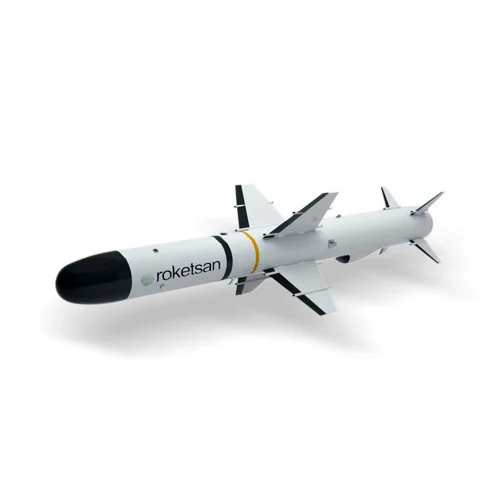
ATMACA is ROKETSAN’s long-range, precision anti-ship and surface-to-surface cruise missile, built under a Turkish Presidency of Defence Industries (SSB) programme and in service with the Turkish Navy since 2021. It carries a 220 kg penetrating warhead out to a publicly disclosed range of 250 km, using inertial and satellite mid-course guidance and an active radio-frequency terminal seeker. Turkey has fitted or is fitting it to eleven naval platforms, and in April 2026 Malaysia became ATMACA’s first confirmed export customer, ordering 24 missiles for its new Littoral Mission Ships. In September 2026 Azerbaijan became ATMACA’s second confirmed export customer, contracting the missile as part of ROKETSAN’s new BARBAROS mobile coastal defence system.
Photo: ATMACA anti-ship missile. Credit: ROKETSAN official product media.
| Manufacturer | ROKETSAN, under a Turkish Presidency of Defence Industries (SSB) programme |
| Type | All-weather, long-range, precision anti-ship / surface-to-surface cruise missile |
| Range | 250 km (ROKETSAN official specification, 2024 export catalogue) |
| Warhead | High-explosive fragmentation, penetrating, 220 kg |
| Guidance | INS + GPS + barometric altimeter + radar altimeter (mid-course); active RF seeker (terminal) |
| Launch platforms | Assault boats, corvettes, frigates; submarine-launched (tested); coastal/land variant in parallel development |
| Status | Operational (Turkish Navy, since 2021); exported (Malaysia, contracted 2026; Azerbaijan, contracted 2026, via BARBAROS) |
| Confirmed operators | Türkiye, Malaysia, Azerbaijan |
What is the ATMACA missile?
ATMACA (Turkish for “hawk”) is a Turkish-designed, all-weather anti-ship and surface-to-surface cruise missile. ROKETSAN’s own product description states it is intended for integration on assault boats, frigates and corvettes, giving surface combatants a long-range, precision strike capability against land and surface targets from both surface and underwater platforms (ROKETSAN, official product page, accessed 30 September 2026). It was developed to gradually replace the Turkish Navy’s legacy Harpoon inventory with a domestically produced missile.
Who manufactures ATMACA — ROKETSAN’s role versus SSB and shipyards
ROKETSAN is the prime developer and manufacturer of the ATMACA missile itself, under a serial-production contract signed with the Presidency of Defence Industries (SSB) — then the Undersecretariat for Defence Industries — on 29 October 2018 (Naval News). ROKETSAN does not build the ships or submarines that carry ATMACA: platform integration is carried out by the relevant shipyard. For the Turkish Navy that means the naval yards building and refitting Ada-class corvettes, Istanbul-class and G-class frigates and Hisar-class offshore patrol vessels; for Malaysia’s Littoral Mission Ship Batch 2, integration is being handled by STM, the Turkish state-owned defence technology company managing that programme (Naval News, 22 April 2026).
Development and testing timeline
| Date | Milestone |
|---|---|
| 2009 | Development of the missile begins under a Turkish indigenous anti-ship missile programme |
| March 2017 | First land-based firing test |
| 29 October 2018 | SSB–ROKETSAN serial production contract signed |
| 3 November 2019 | First ship-launched firing, from the Ada-class corvette TCG Kınalıada in the Black Sea |
| 1 July 2020 | Test hit on a target at a reported range beyond 200 km |
| 3 February 2021 | Live-warhead firing from TCG Kınalıada off Sinop |
| June 2021 | Certification test hit on the target ship ex-TCG Işın; start of serial production |
| 10 March 2024 | Test hit using Türkiye’s first domestically produced turbojet engine, the Kale KTJ-3200 |
| 12 March 2025 | First submarine-launched firing, from the submarine TCG Preveze off Mersin, using a torpedo-tube-compatible capsule |
Sources: Naval News; The Defense Post, 17 March 2025; Janes, 26 January 2024.
What is ATMACA’s current status?
ATMACA is operational with the Turkish Navy. Türkiye has stated it plans to fit the missile to eleven naval platforms, with integration work reported by STM as targeted for completion around April 2027. Deployed and planned platforms include Ada-class corvettes, Istanbul-class and G-class frigates, Hisar-class offshore patrol vessels, and the future TF-2000-class air-defence destroyers. A submarine-launched variant has completed its first live test (March 2025) but has not been reported as operationally fielded. ROKETSAN’s catalogue also lists a related but distinct coastal/land-based derivative, KARA ATMACA, which is a separate product line and is not covered on this page.
Range, guidance and warhead — what ROKETSAN discloses publicly
ROKETSAN’s official specification sheet (2024 export catalogue) lists a range of 250 km, a length of 4.3–5.2 m depending on configuration, an all-up weight below 750 kg, and a 220 kg high-explosive fragmentation warhead with penetration capability. Mid-course guidance combines inertial navigation, GPS, a barometric altimeter and a radar altimeter for sea-skimming flight; terminal guidance uses an active radio-frequency seeker. ROKETSAN states the missile supports data-link updates in flight, enabling target update, re-attack and mission-abort options, plus simultaneous time-on-target and ripple-fire engagement modes. ROKETSAN’s public materials do not disclose a precise flight speed figure, and this article does not estimate one.
Launch platforms and variants
ATMACA is cleared for surface launch from assault boats, corvettes and frigates, and — following the March 2025 test — for submerged launch from a submarine torpedo tube using a dedicated watertight capsule. ROKETSAN and Turkish defence media also refer to a coastal/land-based derivative under the name KARA ATMACA, first reported in development around 2021; that variant uses a truck-mounted launcher rather than a naval platform and is treated by ROKETSAN as a separate product.
Who operates the ATMACA missile?
| Country | Status | Platform | Quantity | Contract value | Year | Source |
|---|---|---|---|---|---|---|
| Türkiye | OPERATIONAL | Ada-class corvettes, Istanbul-class & G-class frigates, Hisar-class OPVs; TF-2000 planned | Not publicly disclosed | Not publicly disclosed | Serial production from 2021 | Naval News; Janes |
| Malaysia | CONTRACTED | Littoral Mission Ship Batch 2 (built by STM) | 24 missiles | EUR 79.5 million (package; full scope not detailed in public reporting) | 2026 (signed 22 April, DSA exhibition, Kuala Lumpur) | Naval News, 22 April 2026; BERNAMA |
| Azerbaijan | CONTRACTED | BARBAROS mobile coastal defence battery (Azerbaijani Navy), alongside CAKIR | Not disclosed | Not disclosed (part of a wider ADEX 2026 Türkiye-Azerbaijan defence package) | 2026 (signed 30 September, ADEX Baku) | Janes, 1 October 2026; Anadolu Agency/Teknoblog, 30 Sept-3 Oct 2026 |
No other country has publicly confirmed operator or contract status for ATMACA as of this writing. Azerbaijan’s order covers the missile as part of the BARBAROS coastal battery rather than a standalone shipborne ATMACA sale; for the full BARBAROS package, including its CAKIR component, see CAKIR Cruise Missile Explained and Which Countries Use ROKETSAN Systems?. Reports that a country’s navy or air force operates other Turkish equipment — including Bayraktar TB2 or Turkish-built ships — are not evidence of an ATMACA acquisition; this page lists only product-level, sourced ATMACA status.
Are there confirmed African or Middle Eastern ATMACA users?
Azerbaijan, in the South Caucasus, is outside DefenceMENA’s Africa and Middle East regional scope; as of 30 September 2026, no African or Middle Eastern country has a publicly confirmed ATMACA order, contract or delivery. General reporting on Turkish naval cooperation with African or Gulf states does not, on its own, establish ATMACA as the missile involved; DefenceMENA will only add a country to the operator table above once product-level evidence — an official statement, contract, delivery report or equivalent — is public. This page will be updated, and cross-linked from DefenceMENA’s ROKETSAN Africa and Middle East pages, if and when that evidence appears.
What has ATMACA cost, and what do contracts include?
Public reporting on the April 2026 Malaysia order cites a package value of EUR 79.5 million for 24 missiles, but does not break out how much of that figure covers the missiles themselves versus launchers, integration, training or support — DefenceMENA has not found a source dividing the total to produce a unit missile price, and does not estimate one. No public unit price is available for ATMACA in Turkish Navy service; Turkish procurement contract values for domestic programmes are routinely not disclosed in full.
How does ATMACA compare with other anti-ship missiles?
The three missiles below sit in the same general class: subsonic, sea-skimming, ship-launched anti-ship cruise missiles with ranges in the 100–250 km class. Figures are each manufacturer’s or reported public maximum range and reflect different disclosure practices, so they should be read as each producer’s own stated figures rather than independently tested like-for-like results.
| Missile | Origin / maker | Public range | Guidance | Status |
|---|---|---|---|---|
| ATMACA | Türkiye / ROKETSAN | 250 km (official) | INS+GPS mid-course, active RF terminal seeker | Operational (Türkiye); exported (Malaysia, 2026) |
| Harpoon (RGM/UGM-84) | United States / Boeing | ~130 km, most common ship-launched variant | INS mid-course, active radar terminal seeker | Operational; in service with over 30 navies |
| Exocet MM40 Block 3 | France / MBDA | >180 km (turbojet-powered) | INS/GPS mid-course, active radar terminal seeker | Operational; widely exported |
On officially stated maximum range, ATMACA’s 250 km figure exceeds the publicly cited figures for both the most common Harpoon variant and the Exocet MM40 Block 3. A full side-by-side comparison — including cost, combat history, integration record and export terms — is planned as a separate DefenceMENA article; this page covers ATMACA specifically. For background on Harpoon pricing in recent export cases, see Envanter Media’s analysis of Harpoon missile costs (Turkish-language technical coverage).
Frequently asked questions
What is the range of the ATMACA missile?
ROKETSAN’s official specification sheet states a range of 250 km. This is the manufacturer’s own published figure; DefenceMENA has not seen an independent test confirming or disputing it.
How fast is the ATMACA missile?
ROKETSAN has not publicly disclosed a precise speed figure for ATMACA. DefenceMENA does not estimate performance data that the manufacturer has not released.
Is ATMACA better than the Harpoon missile?
On officially stated maximum range, ATMACA (250 km) exceeds the most common ship-launched Harpoon variant (around 130 km). Range is only one factor in overall capability; DefenceMENA has not found public data comparing the two missiles’ combat record, seeker performance or cost on a like-for-like basis.
Which countries operate the ATMACA missile?
Türkiye operates ATMACA operationally, fitting it to Ada-class corvettes, Istanbul-class and G-class frigates and Hisar-class patrol vessels. Malaysia contracted 24 ATMACA missiles in April 2026 for its Littoral Mission Ship Batch 2. Azerbaijan contracted ATMACA in September 2026 as part of the BARBAROS coastal defence battery. No other country has a publicly confirmed order as of this writing.
What does the ATMACA missile cost?
Malaysia’s April 2026 order for 24 missiles was reported at EUR 79.5 million, but public sources do not specify what the package includes beyond the missiles, so no reliable unit price can be derived. Turkish Navy procurement values have not been publicly disclosed.
Can ATMACA be launched from a submarine?
Yes. The Turkish Navy first test-fired ATMACA from the submarine TCG Preveze on 12 March 2025, using a torpedo-tube-launched capsule. The submarine-launched variant has completed testing but has not been reported as operationally fielded.
Related ROKETSAN systems
ATMACA covers ROKETSAN’s dedicated, vertically-launched naval anti-ship role; for the company’s lighter, multi-domain cruise missile launched from air, land and sea platforms, including Qatar’s new fast attack craft, see CAKIR Cruise Missile Explained. For the company’s lightweight, drone-launched precision munitions, see MAM-L, MAM-C and MAM-T Explained, for the company’s man-portable anti-tank missile — also a confirmed Malaysia export — see KARAOK Anti-Tank Missile Explained, for ROKETSAN’s 70mm laser-guided rocket and its UAE export history see CIRIT Laser-Guided Missile Explained, for the company’s 230mm and 300mm guided artillery rockets and their confirmed Bangladesh, Azerbaijan and Ukraine users see TRG-230, TRLG-230 and TRG-300 Explained, for the company’s full product range see the ROKETSAN company hub, for a global tally of every confirmed ROKETSAN export customer see Which Countries Use ROKETSAN Systems?, and for how to apply for an engineering job or internship at the company see How to Get a Job or Internship at ROKETSAN, and for ROKETSAN’s submarine-launched heavyweight torpedo — a separate underwater weapon fired from torpedo tubes rather than missile launchers — see AKYA Torpedo Explained.
Sources
- ROKETSAN: ATMACA Anti-Ship Missile, official product page (accessed 30 September 2026)
- Naval News: “Malaysia taps Roketsan for Atmaca anti-ship missiles” (22 April 2026)
- Baird Maritime: “Malaysian defence ministry orders anti-ship missiles for future surface combatants” (April 2026)
- Janes: “ADEX 2026: Roketsan coastal defence contract announced” (1 October 2026)
- Teknoblog/Anadolu Agency: BARBAROS-Azerbaijan coverage (30 September-3 October 2026)
- The Defense Post: “Turkey Fires Atmaca Anti-Ship Missile From Submarine” (17 March 2025)
- Janes: “Turkey starts mass production of new naval torpedo, missile systems” (26 January 2024)
- Naval News: “Roketsan test-fires new coastal variant of Atmaca missile” (July 2022)
- ROKETSAN: official website (accessed 30 September 2026)