TRG-230, TRLG-230 and TRG-300: ROKETSAN’s Guided Rocket Artillery Explained



TRG-230, TRLG-230 and TRG-300 are ROKETSAN’s family of guided artillery rockets, built to put precision fire onto high-value targets at ranges of 20 to 120 km from truck-mounted multi-barrel launchers. TRG-230 uses GPS/GLONASS-aided inertial guidance alone; TRLG-230 adds a laser seeker for pinpoint accuracy against moving targets; TRG-300, often called “KAPLAN” (Turkish for Tiger) in Turkish and export contexts, is the largest 300 mm member of the family, reaching up to 120 km. All three are in Turkish Land Forces service, and Bangladesh, Azerbaijan and Ukraine are the only publicly confirmed export or combat users.
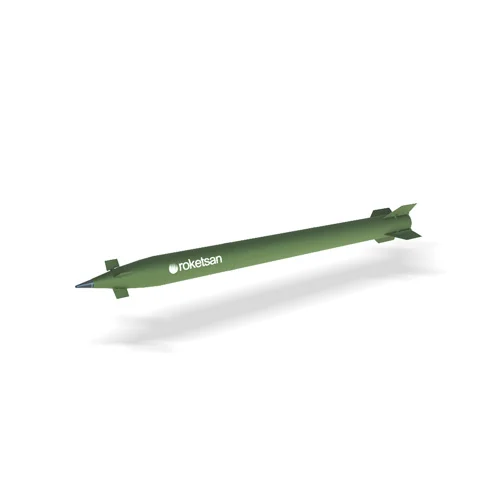
Photo: ROKETSAN TRG-300 guided missile, official product image. Credit: ROKETSAN.
| Manufacturer | ROKETSAN |
| TRG-230 diameter / weight / range | 230 mm / 215 kg / 20-70 km (ROKETSAN official specification) |
| TRG-230 guidance / accuracy | GPS+GLONASS-aided INS; CEP ≤10 m |
| TRLG-230 diameter / weight / range | 230 mm / 210 kg / 20-70 km (ROKETSAN official specification) |
| TRLG-230 guidance / accuracy | GPS+GLONASS-aided INS plus a STANAG 3733-compatible laser seeker; CEP ≤2 m |
| TRG-300 diameter / weight / range | 300 mm; Block-II 660 kg / 20-90 km, Block-III 585 kg / 30-120 km (ROKETSAN official specification) |
| TRG-300 guidance / accuracy | GPS+GLONASS-aided INS with anti-jam features; CEP ≤10 m |
| Warheads | High-explosive with steel-ball fragmentation; 42 kg (TRG-230/TRLG-230), 180 kg Block-II / 105 kg Block-III (TRG-300) |
| Launch platforms | ROKETSAN’s Multi-Barrel Rocket Launcher (MBRL) and MCL multi-caliber launcher, plus other platforms with compatible interfaces |
| Status | ROKETSAN lists all three as “Combat Proven”; in Turkish Land Forces service |
| Confirmed non-Turkish users | Bangladesh (TRG-230, TRG-300), Azerbaijan (TRLG-230), Ukraine (TRLG-230) |
What are TRG-230, TRLG-230 and TRG-300?
TRG-230, TRLG-230 and TRG-300 are guided artillery rockets in ROKETSAN’s surface-to-surface rocket family, designed to extend the reach and accuracy of Turkish rocket artillery beyond unguided systems such as the 122 mm T-107/122 rocket. ROKETSAN’s own product pages describe all three as providing “accurate and effective fire power on high priority targets,” with potential targets including enemy artillery and air-defence systems, radar sites, troop assembly areas, logistics facilities and command-and-control (C3) facilities (ROKETSAN, official product pages, accessed 14 October 2026). All three share a common design logic: a solid composite propellant, aerodynamic control via electromechanical actuators, and a high-explosive steel-ball warhead with point-detonating and (on most variants) proximity fuzing.
The family sits above ROKETSAN’s lighter 122 mm TRG-122 and TRLG-122 guided rockets (covered on the ROKETSAN company hub) and below ROKETSAN’s longer-range ballistic systems such as BORA and TAYFUN, which this routine covers separately at the public-disclosure level only.
What is the difference between TRG-230 and TRLG-230?
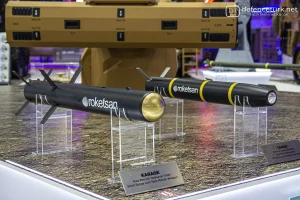
TRG-230 and TRLG-230 share the same 230 mm diameter, the same 20-70 km official range band and nearly the same weight (215 kg versus 210 kg), but they differ in terminal guidance and resulting accuracy. TRG-230 relies solely on GPS/GLONASS-aided inertial navigation, giving a stated circular error probable (CEP) of 10 m or less. TRLG-230 adds a laser seeker compatible with NATO’s STANAG 3733 standard, which a forward observer or UAV can use to designate a moving or newly identified target in the missile’s final seconds of flight; ROKETSAN states this cuts the CEP to 2 m or less (ROKETSAN, official TRG-230 and TRLG-230 product pages). In practice this makes TRLG-230 the preferred variant against moving vehicles or time-sensitive targets, while TRG-230 is better suited to fixed, pre-surveyed coordinates where laser designation is unnecessary or unavailable. TRG-230 is listed as fired from ROKETSAN’s MBRL system, while TRLG-230 is listed against ROKETSAN’s MCL multi-caliber launcher, though both are described as compatible with “other platforms with compatible interfaces.”
ROKETSAN began flight-testing a laser-seeker version of the 230 mm rocket in 2020, releasing footage of a test launch on 30 August 2020, under the TRLG-230 designation (Defence24, reporting on Roketsan’s 2020 test announcement). A further air-launched derivative, referred to in some reporting as TRG-230-IHA, was test-fired from a Bayraktar Akinci UCAV in December 2022 and reported to have struck a target beyond 100 km — a range figure that comes from Turkish and open-source defence reporting rather than ROKETSAN’s current official product page, which lists only the ground-launched 20-70 km figure (Militarnyi, December 2022 test report). This routine treats the air-launched extended-range figure as reported, not official, pending an updated ROKETSAN specification sheet.
Is TRG-300 the same system as “KAPLAN”?
Largely yes, with a naming inconsistency worth flagging. ROKETSAN’s current official English-language product page lists this 300 mm rocket simply as “TRG-300 Guided Missile,” with no reference to “KAPLAN” (ROKETSAN, official TRG-300 product page, accessed 14 October 2026). However, Turkish military and industry sources, the Bangladesh Chief of General Staff’s own public statements, and most English-language defence press consistently refer to the fielded 300 mm system as “TRG-300 KAPLAN” (Turkish for “Tiger”; rendered as “TRG-300 Tiger” in some English coverage) when describing the truck-mounted launcher vehicle exported to Bangladesh (Army Recognition, 3 June 2021; GlobalDefenseCorp, 6 June 2021). This page treats “TRG-300” (ROKETSAN’s current product name) and “TRG-300 KAPLAN” (the name used for the fielded launcher system, especially in export contexts) as referring to the same missile family, and notes the discrepancy rather than resolving it as a ROKETSAN naming change.
ROKETSAN’s official specification lists two publicly disclosed TRG-300 variants: Block-II, at 660 kg with a 180 kg warhead reaching 20-90 km, and the newer Block-III, at a lighter 585 kg with a smaller 105 kg warhead reaching further, 30-120 km. Both use GPS/GLONASS-aided inertial guidance with anti-jam features and share the same 10 m-or-better CEP (ROKETSAN, official TRG-300 product page).
Development and public timeline
| 2010s | TRG-230 and TRG-300 (Block-II) enter ROKETSAN’s product catalogue and Turkish Land Forces service; exact in-service date not officially disclosed (ROKETSAN official product pages; GlobalSecurity.org country-system profile) |
| March 2021 | Bangladesh Chief of General Staff Gen. Aziz Ahmed states TRG-300 KAPLAN systems will be delivered to the Bangladesh Army in June 2021 (Army Recognition, 3 June 2021) |
| June 2021 | Bangladesh Army takes delivery of its first TRG-300 (KAPLAN/Tiger) launcher systems, reported as 18-20 units mounted on Kamaz 65224 6×6 chassis (Army Recognition, 3 June 2021; GlobalDefenseCorp, 6 June 2021) |
| 30 August 2020 | ROKETSAN releases first test-launch footage of the laser-seeker 230 mm rocket under the TRLG-230 designation (Defence24) |
| 2020 (Nagorno-Karabakh war) | Azerbaijani forces are reported, via footage released by Azerbaijan’s own Ministry of Defence, to have used TRLG-230 rockets against Armenian positions (Yeniakit, citing Azerbaijani MoD footage; Middle East Eye) |
| 2022 | ROKETSAN exports TRG-230 systems to Bangladesh, according to Army Recognition’s 2022 land-defence coverage; a Turkish press report (Turkgun) describes a phased, four-convoy delivery programme covering both TRG-300 and TRG-230 |
| Spring/summer 2022 | Open-source group Oryx reports, citing two sources inside Ukraine’s Ministry of Defence, that Turkiye has supplied a batch of TRLG-230 rockets and MCL launchers to Ukraine; neither government confirms this officially at the time (Overt Defense, 28 November 2022; The War Zone) |
| 26 April 2023 | Ukraine’s own 49th Artillery Brigade publishes a photograph of its TRLG-230 launcher and reloader vehicle, providing the first direct visual confirmation of the system in Ukrainian service (Militarnyi, 26 April 2023; Overt Defense) |
| January 2025 | Further TRG-230/TRG-300 deliveries reported to Bangladesh, taking its combined inventory of the two systems past 18 units (Sozcu, reporting on a Bangladesh National Day display) |
| July 2025 | Bangladesh Army reportedly conducts live-fire test shots confirming the operational capability of its TRG-230/TRG-300 systems (Army Recognition, “Bangladesh Army Receives TRG-230/300 Rocket Systems From Tuerkiye,” 2025 archive) |
Independent reports disagree on exact unit counts across these batches — Wikipedia-sourced Bangladeshi government figures cite 18 or 20 TRG-300 units delivered in 2021 and a further regiment of TRG-230 in 2022, while Army Recognition’s 2025 report describes a combined TRG-230/TRG-300 inventory of “more than 18” units without separating the two systems or confirming whether this is cumulative or a new batch. This page does not attempt to reconcile the figures and presents each report’s own count with its source.
Which countries use ROKETSAN’s TRG-230, TRLG-230 and TRG-300?
| Country | System | Status | Year | Source |
|---|---|---|---|---|
| Turkiye | TRG-230, TRLG-230, TRG-300 | OPERATIONAL (home market) | Not officially dated; ROKETSAN lists all three as “Combat Proven” | ROKETSAN official product pages |
| Bangladesh | TRG-300 | DELIVERED | 2021 (18-20 units reported) | Army Recognition (3 Jun 2021); GlobalDefenseCorp (6 Jun 2021) |
| Bangladesh | TRG-230 | DELIVERED | 2022, with further batches reported Jan 2025 | Army Recognition (2022 archive; 2025 archive); Sozcu |
| Azerbaijan | TRLG-230 | OPERATIONAL | 2020 (Second Nagorno-Karabakh War) | Yeniakit, citing Azerbaijan MoD footage; Middle East Eye |
| Ukraine | TRLG-230 | DELIVERED / OPERATIONAL | Reported from 2022; visually confirmed April 2023 | Militarnyi (26 Apr 2023); Overt Defense; Oryx-sourced reporting |
No African or Middle Eastern operator of TRG-230, TRLG-230 or TRG-300 is currently supported by public evidence. A dedicated WebSearch of ROKETSAN, Turkish and regional defence press for African, Gulf and wider MENA buyers of this specific rocket family returned nothing beyond exhibition-level mentions; this is distinct from ROKETSAN’s confirmed African customers for other systems (chiefly MAM-family drone munitions) and ROKETSAN’s confirmed Middle East customers (UAE, Saudi Arabia and Qatar, for different product lines). Should a product-level contract emerge for this family in Africa or the Middle East, it will be added here and cross-posted to those regional hubs.
Turkey’s own supply of TRLG-230 rockets to Ukraine, and the earlier Azerbaijani use in 2020, remain publicly unconfirmed at the government-to-government level by either Ankara or the recipient states; this page relies instead on the receiving militaries’ own released imagery and on Oryx’s sourcing from within Ukraine’s Ministry of Defence, each corroborated by multiple independent outlets, consistent with the evidence standard used throughout this ROKETSAN cluster.
How do TRG-230/TRLG-230/TRG-300 compare to Western and Chinese guided rocket artillery?
The comparison below uses the same criteria for each system: mission class, caliber, range, guidance, confirmed export record and public contract pricing. It covers only rockets in the same mission class — truck/launcher-fired guided artillery rockets in the roughly 70-150 km bracket — not longer-range ballistic missiles.
| System | Country | Caliber | Range | Guidance | Confirmed export record | Public unit/contract price |
|---|---|---|---|---|---|---|
| TRG-230 / TRLG-230 | Turkiye (ROKETSAN) | 230 mm | 20-70 km | GPS/GLONASS-aided INS; TRLG-230 adds laser seeker | Bangladesh, Azerbaijan, Ukraine (TRLG-230) | Not publicly disclosed |
| TRG-300 | Turkiye (ROKETSAN) | 300 mm | 20-120 km (Block-III) | GPS/GLONASS-aided INS with anti-jam | Bangladesh | Not publicly disclosed |
| M30/M31 GMLRS | United States (Lockheed Martin) | 227 mm | ~70-150 km (official figures vary by variant and export restriction) | GPS-aided INS; M30A2/M31A2 add a unitary warhead | Fielded by NATO members and partners including Ukraine, Poland, Saudi Arabia, UAE | Not publicly disclosed per round; FMS case values published, not per-unit |
| AR-1 / AR-3 / A200 | China (NORINCO/CASIC family) | 300-370 mm depending on variant | Reported up to 130-290 km depending on variant (manufacturer marketing material, not independently verified to the same standard as ROKETSAN/Lockheed figures) | GPS/INS-aided | Reported exports to several Asian and African armed forces per open-source compilations; not independently verified by this routine’s sourcing standard | Not publicly disclosed |
On confirmed, product-level export record, ROKETSAN’s 230 mm family has a narrower but independently verifiable customer base (Bangladesh, Azerbaijan, Ukraine) than the US GMLRS, which is fielded far more widely through NATO and FMS channels, but a more independently verifiable one than the Chinese AR-1/AR-3/A200 family, whose export claims in open-source compilations are not held to the same two-source standard applied elsewhere on this page. No system is presented as superior here; each serves the same guided-rocket-artillery mission with different reach, guidance options and export channels.
What does TRG-230, TRLG-230 or TRG-300 cost?
No per-unit missile price has been publicly disclosed by ROKETSAN, the Turkish government, or any confirmed customer. Bangladesh’s 2021 and 2022 delivery reports describe quantities of launcher systems and rockets but do not disclose a package or unit value. Ukraine’s and Azerbaijan’s TRLG-230 use is documented through imagery and open-source reporting rather than published contracts, so no price figure exists for either case. Where a contract covers launchers, rockets, support and training together, this routine does not divide a package value by round count to estimate a unit price, consistent with the evidence rules applied across this ROKETSAN cluster.
Frequently asked questions
What is the range of ROKETSAN’s TRG-230, TRLG-230 and TRG-300?
TRG-230 and TRLG-230 both have an official range of 20 to 70 km. TRG-300 reaches 20-90 km in its Block-II version and 30-120 km in the newer, lighter Block-III version, per ROKETSAN’s official specifications.
What is the difference between TRG-230 and TRLG-230?
TRG-230 uses GPS/GLONASS-aided inertial guidance only, with a stated accuracy of 10 m or less. TRLG-230 adds a STANAG 3733-compatible laser seeker for terminal guidance, improving stated accuracy to 2 m or less, making it better suited to moving or time-sensitive targets.
Is TRG-300 the same as “TRG-300 KAPLAN”?
They refer to the same 300 mm missile family. ROKETSAN’s current official product page lists it simply as “TRG-300 Guided Missile,” while Turkish military statements, Bangladesh’s own officials and most English-language defence press call the fielded launcher system “TRG-300 KAPLAN” (Tiger).
Which countries use these ROKETSAN rockets?
Turkiye is the home-market user of all three systems. Bangladesh has confirmed deliveries of both TRG-300 (from 2021) and TRG-230 (from 2022). Azerbaijan used TRLG-230 in the 2020 Nagorno-Karabakh war, and Ukraine’s own 49th Artillery Brigade confirmed TRLG-230 in its service via a published photograph in April 2023.
Has ROKETSAN sold this rocket family to any African or Middle Eastern country?
No public evidence currently supports an African or Middle Eastern customer for TRG-230, TRLG-230 or TRG-300 specifically. ROKETSAN’s confirmed Africa and Middle East customers for other product lines are covered on this site’s dedicated ROKETSAN in Africa and ROKETSAN in the Middle East hubs.
What platform fires TRG-230, TRLG-230 and TRG-300?
ROKETSAN lists its own Multi-Barrel Rocket Launcher (MBRL) and MCL multi-caliber launcher as the primary platforms, with compatibility for other launcher vehicles that meet ROKETSAN’s interface requirements. In Bangladeshi service, the systems are mounted on a Kamaz 65224 6×6 truck chassis.
Sources
- ROKETSAN: TRG-230 Guided Missile (official product page, accessed 14 October 2026)
- ROKETSAN: TRLG-230 Laser Guided Missile (official product page, accessed 14 October 2026)
- ROKETSAN: TRG-300 Guided Missile (official product page, accessed 14 October 2026)
- Army Recognition: “Bangladesh Takes Delivery of Turkish-Made Roketsan TRG-300 MLRS Rocket Launchers” (3 June 2021)
- GlobalDefenseCorp: “Roketsan Delivers TRG-300 Kaplan MLRS to Bangladesh” (6 June 2021)
- Army Recognition: “Roketsan From Turkey Has Exported TRG-230 Surface-to-Surface Missile to Bangladesh” (2022 archive)
- Army Recognition: “Bangladesh Army Receives TRG-230/300 Rocket Systems From Tuerkiye” (2025 archive)
- Sozcu: Bangladesh National Day display of Turkish-supplied systems (Turkish-language)
- Yeniakit: Azerbaijan’s TRLG-230 use against Armenian targets, citing Azerbaijani MoD footage (Turkish-language)
- Militarnyi: “Ukrainian Military Receives Turkish TRLG-230 Precision-Guided Missiles – Oryx”
- Overt Defense: “Ukraine Officially Confirms That It Has Turkish Laser-Guided TRLG-230 Missiles” (26 April 2023)
- The War Zone: “Turkish Laser-Guided Artillery Rockets Could Be Giving Ukraine New Capability”
- Militarnyi: Bayraktar Akinci UCAV test of the air-launched 230 mm rocket (December 2022)
- Envanter Medya: “TRG-300 KAPLAN Fuzesi: Menzili, Block Surumleri ve Kullanicilari” (Turkish-language technical background)