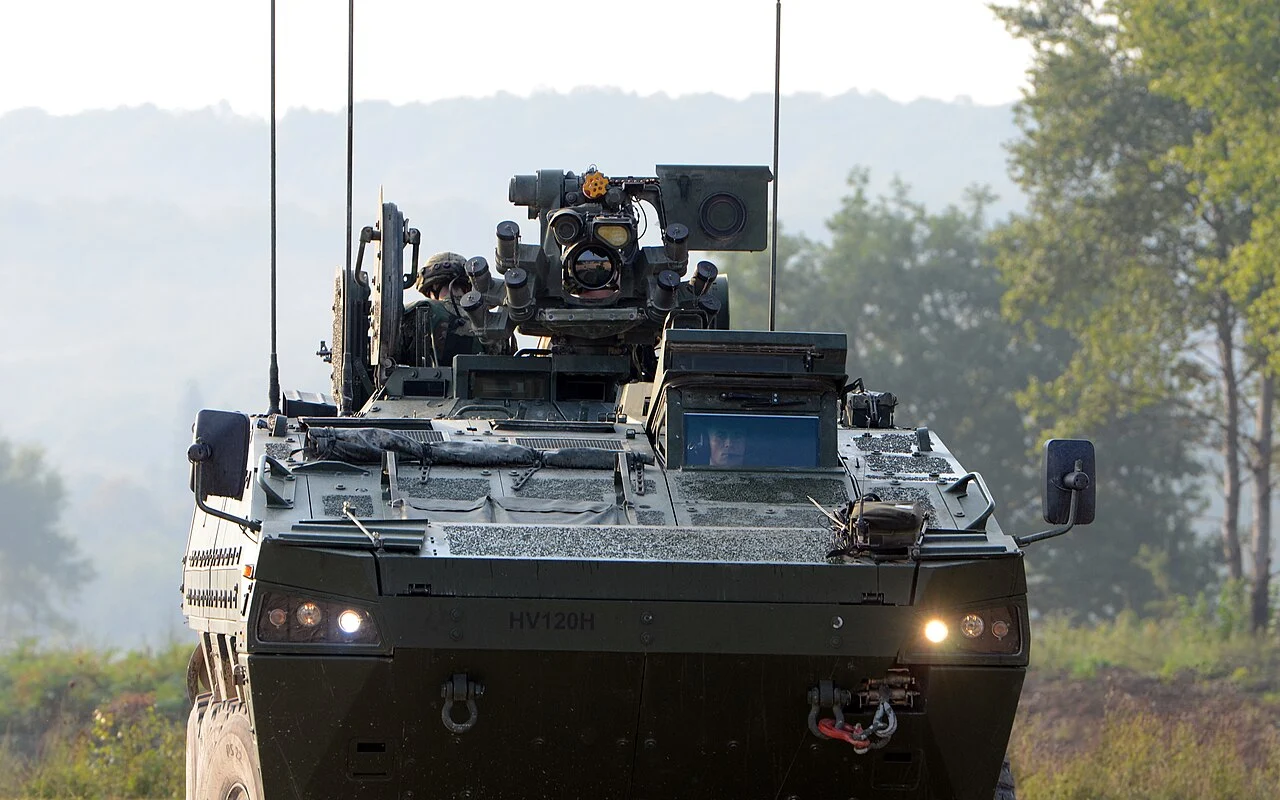
Project Hoefyster, South Africa’s programme to replace the Ratel wheeled infantry fighting vehicle with the Denel-built Badger, has run for more than eighteen years without delivering a single production vehicle to the South African Army. This tracker follows the programme’s contract history, delivery status, industrial participation model and the alternatives now under review, drawing on Armscor, Denel and Parliament’s own public accounts of the programme through late 2025.
DEFENCE AFRICA | Programme tracker | Data as of September 2026
Photo: A Croatian Army Patria AMV 8×8, the Finnish-designed base vehicle licensed for South Africa’s Badger. Credit: Pfc. Javon Spence, U.S. Army, public domain, via Wikimedia Commons
Project Hoefyster is the South African National Defence Force’s programme to replace its Ratel 90 and Ratel 60 wheeled infantry fighting vehicles, in service since the 1970s, with a new 8×8 platform designated the Badger. The winning design, submitted in a February 2005 tender by a consortium of Patria of Finland, EADS, Denel, OMC and Land Mobility Technologies (LMT), paired Patria’s Armoured Modular Vehicle (AMV) hull with a South African-designed turret built by Denel Land Systems (defenceWeb, 2011).
Development began under a roughly R1 billion contract signed in June 2007, with a production order for 264 vehicles following in 2013 at a contracted value that later rose to R8.3 billion (defenceWeb, October 2023). Neither phase has closed on schedule. As of the most recent parliamentary briefing, in November 2025, Denel had spent R7.7 billion and told MPs the “current acquisition plan is not executable” against the roughly R1.9 billion available in the Department of Defence’s system (defenceWeb, 8 December 2025).
The Badger’s status is acquisition-contracted, not operational: the production contract remains in force, four pre-production hulls have been built for testing, and the South African Army Chief announced in November 2024 that the programme had been “paused” pending a way forward (Badger IFV, Wikipedia, summarising Denel and Armscor statements). This tracker sets out how the programme reached that point.
Key facts
- R7.7 billion spent by Denel on Project Hoefyster as of November 2025, against an original 2007 development contract of roughly R1 billion (source: defenceWeb, December 2025).
- Zero production Badger vehicles delivered to the South African Army as of the November 2025 parliamentary briefing (source: defenceWeb, December 2025).
- Funded requirement stands at 244 vehicles across nine variants; the near-term acquisition plan was cut to a single battalion set of 88 vehicles in a 2024 revision (sources: defenceWeb, December 2025 and February 2024 — published figures vary between the two briefings).
- An additional R6.6 billion in funding is required to complete production, against roughly R1.9 billion currently available (source: defenceWeb, December 2025).
- Programme status: contracted, paused since November 2024, under review following a Denel request for information (RFI) issued to 8×8 vehicle manufacturers on 19 November 2025 (source: defenceWeb, December 2025).
Programme timeline
| Date | Event | Status | Source |
|---|---|---|---|
| Feb 2005 | Patria/EADS/Denel/OMC/LMT consortium submits the sole bid against RfP MFT/2003/564: Patria AMV hull, Denel turret | selected | defenceWeb, 2011 |
| Jun 2007 | Phase 1 development contract signed, ~R1bn, for 264 vehicles across five variants | contracted | defenceWeb, Oct 2023 |
| May 2012 | Original Phase 1 completion deadline passes, missed | delayed | defenceWeb, Dec 2025 |
| Mar 2011 | BAE Systems SA (OMC) pitches its RG41 as a cheaper alternative; contract not reopened | alternative rejected | defenceWeb, 2011 |
| 2013 | Phase 2 production contract signed for 244 vehicles; value later rises to R8.3bn | contracted | defenceWeb, Dec 2025 |
| 2013–2015 | Gupta-linked VR Laser Services delivers only 14 of 217 contracted hull shells before collapsing | subcontract failed | defenceWeb, Dec 2025 |
| Mar 2020 | Section-variant pre-production vehicles complete testing at De Brug, Bloemfontein | in development | defenceWeb, Mar 2020 |
| Nov 2023 | Revised Phase 2 completion deadline passes, missed | delayed | defenceWeb, Dec 2025 |
| Feb–Apr 2024 | Near-term plan cut from three battalions to one (88 vehicles); Phase 2 re-costing begins | revised | defenceWeb, Feb 2024 |
| Nov 2024 | SA Army Chief announces Project Hoefyster has been “paused” | paused | Badger IFV, Wikipedia |
| Jul 2025 | Armaments Acquisition Council reaffirms the requirement; Section-variant product baseline completed | reaffirmed | defenceWeb, Dec 2025 |
| 19 Nov 2025 | Denel issues an RFI to 8×8 OEMs for partnership options, prioritising local industry participation | reportedly under negotiation | defenceWeb, Dec 2025 |
| 26 Nov 2025 | Denel briefs Parliament’s PCDMV; calls the current acquisition plan “not executable” | under review | defenceWeb, Dec 2025 |
| Targeted 2026–27 | Remaining variant baselines scheduled Apr 2026–Nov 2027; overall Phase 1 targeted for end 2027, then a production decision | reportedly under negotiation | defenceWeb, Dec 2025 |
No independently confirmed update on whether the April and June 2026 product-baseline targets were met had been published in the sources reviewed for this tracker as of September 2026; DefenceMENA will update this article when Denel or Armscor next reports to Parliament.
What has been delivered — and what hasn’t
Eighteen years after the original development contract, the South African Army has received no series-production Badger vehicles. Denel has built four pre-production hulls for engineering and mine-protection testing, and the Section variant — the base infantry carrier — reached “product baseline,” the milestone confirming a design is ready for industrialisation, in July 2025 (defenceWeb, December 2025). Even that is conditional: Denel has told Parliament that obsolescence checks, stock usability, landmine testing and software work still need to be resolved before the Section variant can enter industrialisation, targeted for completion by July 2026.
Published figures on the eventual order size vary. Armscor’s 2024 re-costing cut the near-term plan to a single battalion of 88 vehicles, down from an original three-battalion requirement of 264 (defenceWeb, February 2024). By November 2025, Denel described a funded requirement of 244 vehicles across nine variants — 97 Section, 52 Command, 14 Fire Support, 14 Missile, 29 Mortar, 8 Ambulance, 13 Signal, 12 Basic Observation Artillery and 5 Tactical Command Post — while acknowledging that plan is not executable within available funding (defenceWeb, December 2025). Both figures come from official briefings at different points in the programme’s repeated re-scoping; DefenceMENA presents them both rather than choosing one, since neither has been superseded by a confirmed final order.
The Ratel: what Badger is meant to replace
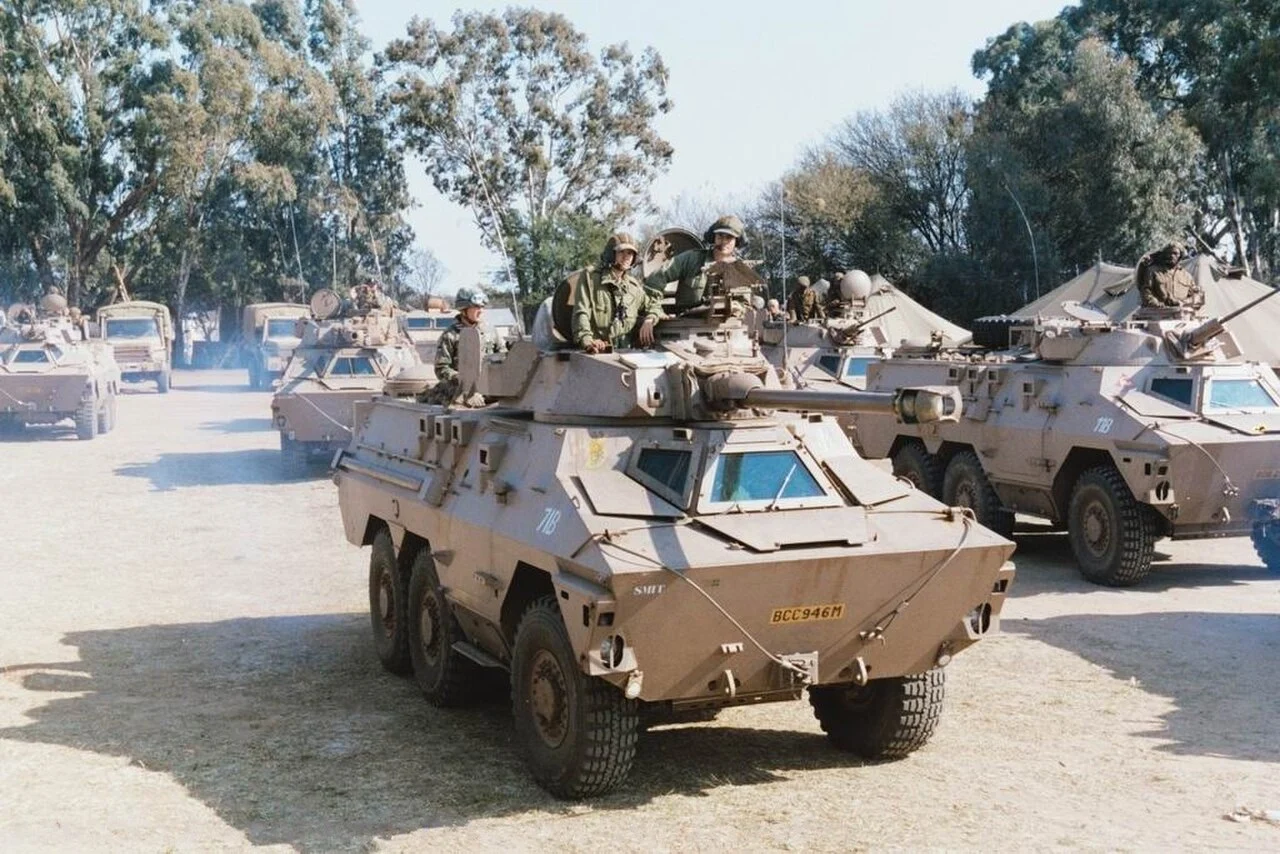
The Ratel entered South African Army service in the 1970s as a locally designed 6×6 infantry fighting vehicle and remains, in upgraded form, the backbone of the Army’s mechanised infantry battalions, operational well beyond its planned service life. The Badger is meant to bring a larger 8×8 platform, improved mine and ballistic protection, and a modernised turret and sensor suite to the same role. With Badger deliveries not yet under way, the Ratel remains the SANDF’s only fielded wheeled infantry fighting vehicle, and its continued service life is a direct consequence of the delays covered here.
Industrial participation and offsets
Hoefyster splits the vehicle between an imported base and local integration. The hull design originates with Patria’s AMV, redesigned for South African conditions by Land Mobility Technologies; hull structures were contracted to OMC (later part of BAE Systems Land Systems SA), while Denel Land Systems designs and integrates the turret, the 30mm EMAK cannon and the vehicle’s other South African-built systems (defenceWeb, 2011).
That local-content model suffered a serious setback in 2013–2015, when hull-shell manufacturing was subcontracted to VR Laser Services, a company later named in South Africa’s state capture inquiries for its links to the Gupta family. VR Laser was contracted for 217 hull shells worth hundreds of millions of rand but delivered only 14 before its operations collapsed, forcing Denel to re-source hull manufacturing and adding directly to the programme’s cost and schedule overruns (defenceWeb, 2025).
The November 2025 RFI to international 8×8 manufacturers marks a shift away from that model. Rather than continuing as sole prime, Denel is now seeking partnerships with other OEMs, “with a prioritisation of local industry participation,” to move the programme past its funding and capacity constraints (defenceWeb, December 2025). No partner has been selected; any arrangement is reportedly under negotiation.
Alternatives considered
Hoefyster’s 2005 tender drew a single bid — the Patria-led consortium — leaving the Badger without a head-to-head competitor at selection (defenceWeb, 2011). In March 2011, after the production contract had already been signed, BAE Systems Land Systems SA (OMC) publicly pitched its own RG41 8×8, a mine-protected design it said was 10–20% cheaper and over 70% locally sourced, as a replacement path for the stalled programme; the pitch did not reopen the Denel-Patria contract (defenceWeb, 2011).
More recently, Armscor has run a parallel study into a life-extension programme for the existing Ratel fleet as a hedge against further delays, rather than a replacement decision (defenceWeb). The November 2025 RFI to 8×8 OEMs is a different alternative again: not a competing vehicle, but a search for partners to help Denel complete the Badger it has already contracted to build.
Why it matters for Africa
Project Hoefyster is a case study in the sustainment cost of a delayed local-industrial procurement model, on a continent where few armed forces can absorb an eighteen-year gap between contract and capability. South Africa paired an imported hull with locally designed turrets and weapons, seeking technology transfer and jobs rather than an off-the-shelf import; the state capture-era collapse of its hull subcontractor shows how exposed that model was to a single failed supplier. For African militaries weighing local-assembly programmes against direct imports, Hoefyster shows both the industrial upside — Denel Land Systems retains integration know-how few African firms possess — and the cost of prioritising local content over a fielded capability, with the SANDF’s mechanised infantry still reliant on a decades-old Ratel fleet as a result. The shift toward external partnership in late 2025 shows that even an established state-owned prime can be forced to look outward when a fully indigenous production model runs out of funding.
Sources
- defenceWeb: “Project Hoefyster still has many years to go” (8 December 2025)
- defenceWeb: “R7.7 billion and 18 years later: Badger project has delivered zero vehicles” (2025)
- defenceWeb: “Denel concluding Hoefyster development but fewer vehicles to be manufactured” (February 2024)
- defenceWeb: “New timelines for Project Hoefyster” (October 2023)
- defenceWeb: “Progress, but no delivery date for Badger yet”
- defenceWeb: “BAE Systems punts for Hoefyster” (4 March 2011)
- Army Technology: “Badger Infantry Combat Vehicle”
- “Badger IFV,” Wikipedia (summarising Denel and Armscor statements)
Related on DefenceMENA: Armscor Explores AK-203 Rifles to Replace SANDF’s R4/R5 | Hensoldt South Africa Secures 200-Unit KENIS Sensor Order at AAD 2026 | AAD 2026: Who Is Selling Defence Gear Into Africa | More on South Africa