Milkor Group and Safran Electronics & Defense signed a Memorandum of Understanding at AAD 2026 in Pretoria to explore integrating Safran optronics and navigation systems onto the Milkor 380 and the larger Milkor 780 unmanned aircraft. The tie-up would give South Africa’s flagship MALE drone programme a French sensor and PNT pedigree as it competes for export orders against Turkish and Chinese rivals.
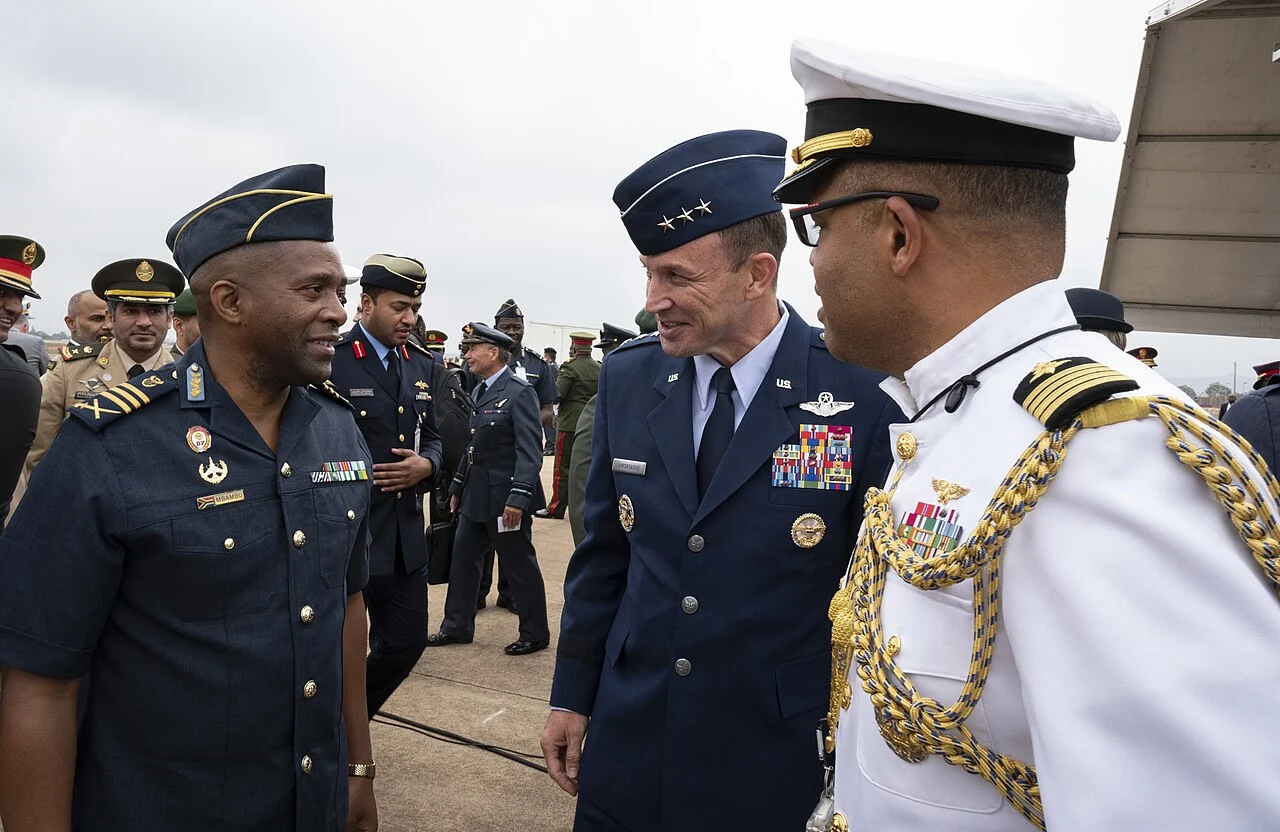
Photo: South African Air Force Chief Lt Gen W.S. Mbambo at the Africa Aerospace and Defence exhibition in Centurion, South Africa. Credit: Master Sgt. Michael Battles/U.S. Air Force, Public domain, via Wikimedia Commons
Milkor Group and Safran Electronics & Defense signed the MoU during the Africa Aerospace and Defence (AAD) 2026 exhibition in Pretoria, with Safran defence division director Alexandre Ziegler and Milkor chief executive Julian Coetzee putting their names to the agreement. DefenceWeb reported the two companies will study integrating Safran’s airborne optronics and position-navigation-timing (PNT) technology — including inertial navigation, GNSS and guided-weapon-related systems — onto Milkor’s medium-altitude long-endurance (MALE) drones, and will pursue joint marketing and trade-show appearances together.
What is on the table
The MoU covers two aircraft: the Milkor 380, already in production, and the Milkor 780, still under development. Ziegler described the goal as putting “optronic and navigation systems integrated into drones exported by Milkor worldwide,” language that signals Safran’s interest in the deal reaching beyond South Africa to every market Milkor sells into. Coetzee was not quoted directly in the coverage, but the company’s messaging around the MoU frames it as a way to widen the 380 and 780’s sensor and navigation options beyond what Milkor and its existing partners currently offer.
It is a study agreement, not a signed production contract — workshare, pricing and integration timelines are still to be defined, and any actual hardware fit still needs both companies’ governments to clear the underlying technology-transfer approvals.
The Milkor 380 and 780
The Milkor 380 is Africa’s largest indigenously developed MALE UAV, with an 18.6-metre wingspan, 30-35 hours of endurance and a range beyond 4,000 km on a roughly 220 kg payload. It already flies with a synthetic-aperture radar pod and a Hensoldt Argos 15 electro-optical gimbal, and has been fitted with two Denel Dynamics Sean/ANL lightweight anti-ship missiles for a maritime-strike role. The larger Milkor 780, still in development, is designed around a 24-metre wingspan, 30-40 hours of endurance, a claimed maximum range of 9,300 km and a 2,700 kg payload spread across nine hardpoints — figures that would put it in the same performance class as larger Western and Chinese MALE platforms rather than the smaller tactical drones African militaries have historically bought.
Why Safran, and why now
Milkor has built the 380 largely on South African and allied-sourced sensors and navigation kit to date. Bringing in Safran — one of Europe’s established suppliers of airborne optronics (the Euroflir family) and inertial/GNSS navigation systems used across French and NATO military aircraft — would let Milkor offer customers a Western-certified sensor and navigation option alongside its existing fit, a credential that matters for governments wary of being locked into a single supplier or a non-NATO-standard avionics stack. For Safran, the MoU is a route into a fast-growing African and Middle Eastern MALE drone market currently being carved up largely by Bayraktar TB2/Akinci-class Turkish systems and Chinese Wing Loong and CH-series platforms, both of which have found steady buyers among African air forces over the past five years.
Why it matters for Africa
Milkor is one of the very few African companies building and exporting an indigenous MALE-class UAV rather than assembling or operating imported ones, and a credible Western sensor partnership strengthens its pitch to governments that want capability without depending entirely on Ankara or Beijing for their surveillance and strike drones. A Safran-equipped Milkor 380 or 780 would give African air forces — and export customers beyond the continent — a third serious option in a market segment where choice has so far been narrow. It also keeps a larger share of the drone’s value chain, and the diplomatic leverage that comes with owning the platform, inside South Africa rather than a foreign design house. DefenceMENA covered the wider field of AAD 2026 suppliers in its show wrap-up; for more on South Africa’s defence-industrial base, visit the South Africa desk.
Sources
- DefenceWeb: “Milkor and Safran sign MoU on optronics and navigation integration for UAVs”
- Global Defense Insight: “Milkor, Safran Sign MoU to Integrate Optronics and Navigation Systems on UAVs”
- Army Recognition: Milkor 380 specifications