Saab Grintek Defence, the South African subsidiary of Saab, says its sales have grown fivefold over the past five years and that its order book points to continued growth, as the electronic-warfare specialist leans further into exports built on 85 percent local content.
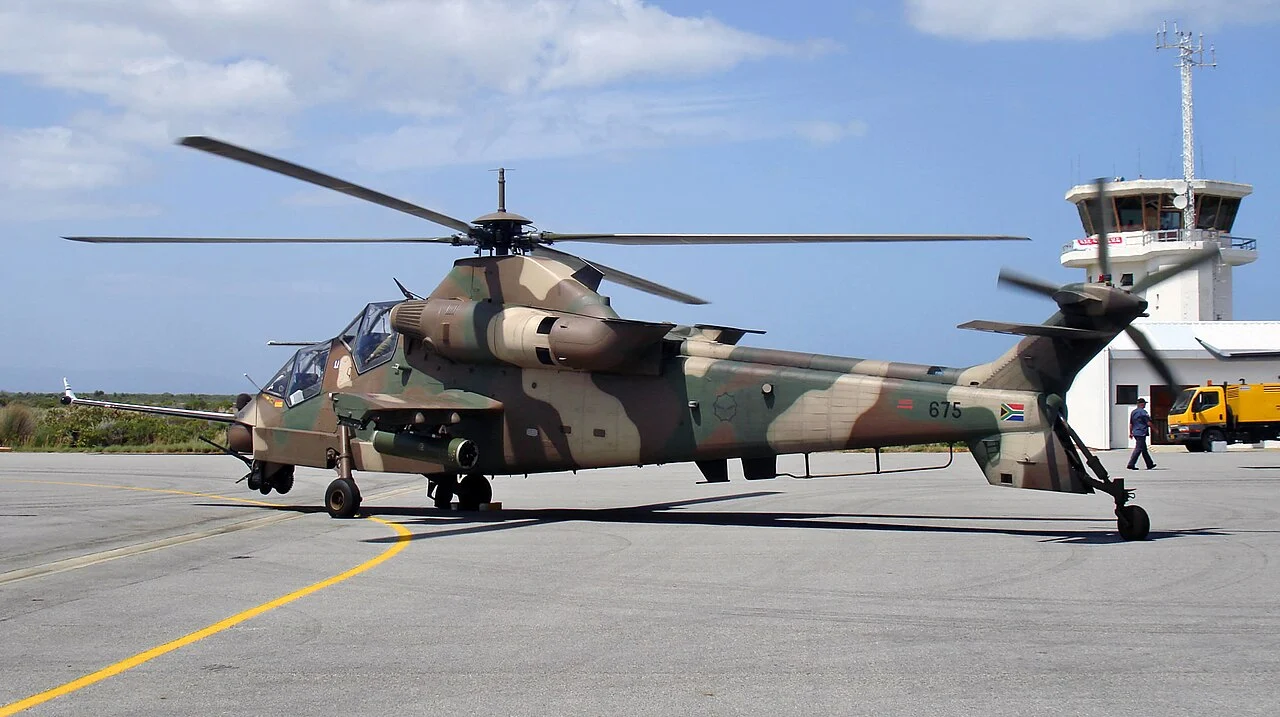
Photo: A South African Air Force Denel AH-2 Rooivalk attack helicopter, one of the platforms fitted with Saab Grintek Defence’s Integrated Defensive Aids Suite (IDAS). Credit: Warren Rohner, CC BY-SA 2.0, via Wikimedia Commons
Speaking at the Africa Aerospace and Defence (AAD) 2026 exhibition, newly appointed Saab Grintek Defence (SGD) president and managing director Sara Radu said the Centurion-based company expects “strong growth in all areas of our business,” according to defenceWeb. The company’s workforce has grown 40 percent to around 500 people over the same five-year period, and more than 99 percent of its revenue now comes from exports to roughly 25 countries.
A South African base for a Swedish group’s electronic warfare business
SGD builds electronic-warfare systems, principally self-protection suites for military aircraft, land vehicles and ships, alongside avionics work. Its flagship product is the Integrated Defensive Aids Suite (IDAS), a self-protection system used on South African Air Force platforms including the Denel Rooivalk attack helicopter and the Oryx transport helicopter, and exported to military operators abroad; India is SGD’s largest single customer base for the system, built on a technology-transfer and local-maintenance relationship with Hindustan Aeronautics Limited dating back almost a decade. The Rooivalk fleet that carries IDAS is itself the subject of a modernisation push, covered in DefenceMena’s report on Denel Aeronautics’ Rooivalk Mk1.1 upgrade, while the full South African Air Force fleet is catalogued in DefenceMena’s South African Air Force aircraft inventory.
Dr Nivan Moodley, SGD’s vice-president and head of strategy, pointed to the company’s radio-frequency and microwave component design as a particular strength, the kind of specialised electronics work that has let a relatively small South African operation compete for self-protection contracts against larger Western and Israeli electronic-warfare houses. Radu said SGD is also pushing to deepen its local supply chain beyond the current 85 percent domestic sourcing figure, a point of emphasis for a company whose growth has been almost entirely export-led rather than dependent on South African defence budgets.
Why it matters for Africa
South Africa’s electronic-warfare and avionics sector is one of the more mature parts of the country’s defence-industrial base, built originally around state-owned Denel and now sustained in large part by foreign-owned subsidiaries such as SGD that combine South African engineering talent with a multinational parent’s sales reach. A fivefold sales increase and a 40 percent larger workforce, if sustained, would make SGD one of the more concrete growth stories in an industry that has otherwise struggled with Denel’s long-running financial troubles and the consolidation of several local primes. For the wider African market, SGD’s position also matters because IDAS and similar South African-designed self-protection systems are among the few electronic-warfare products built and supported on the continent, rather than sourced from Europe, Israel, Türkiye or China, giving African air forces an alternative supplier with established in-country production.
The figures Radu and Moodley gave at AAD 2026 are company statements rather than independently audited results, and SGD has not disclosed absolute revenue or order-book values alongside the growth percentages. SGD’s export performance echoes a broader trend tracked in DefenceMena’s report on South Africa’s arms exports tripling to R10bn, and more of the country’s defence-industry coverage is gathered on DefenceMena’s South Africa desk.