Radar cross section (RCS) is a measure of how strongly an object reflects radar energy back toward a radar. Stealth, or low observability, is the design goal of making that return—and other signatures—harder to detect. In Africa, no air force publishes official RCS figures for its aircraft. What is documented is radar hardware on modern fighters (for example Egypt’s Rafale RBE2 AESA) and a thin trail of stealth-fighter claims and talks—Algeria and the Su-57E, Egypt and Chinese fifth-generation types—that must be kept separate from confirmed inventory.
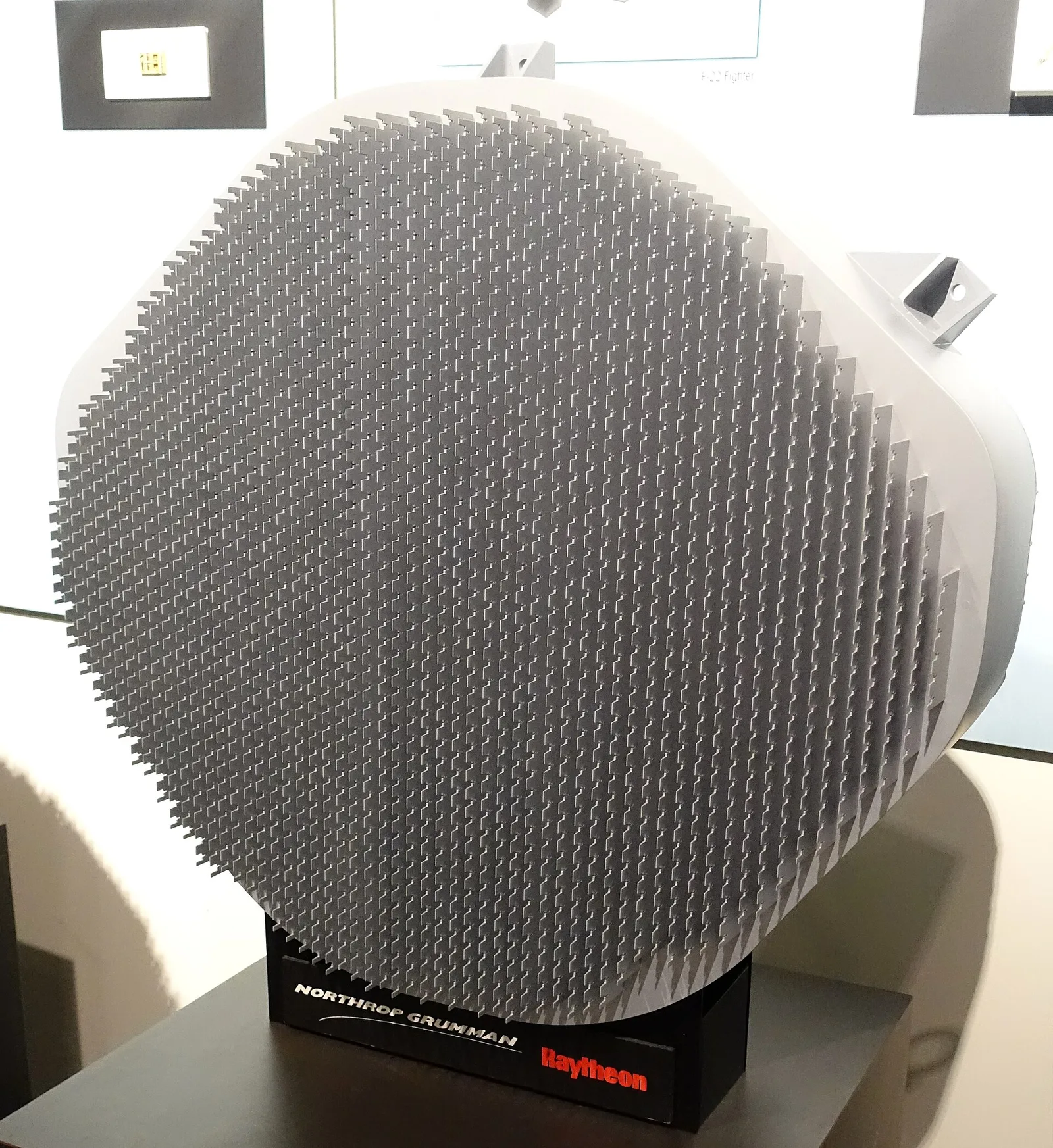
Image: Northrop Grumman AN/APG-77 AESA fire-control radar (F-22), National Electronics Museum. Credit: Daderot, CC0, via Wikimedia Commons.
The terms
The Turkish defence industry glossary (SSB) groups these related terms: Radar, Radar İzi, Radar Kesit Alanı, Radar Kilitlenmesi, Radar Soğurucu Malzeme, İz Düşürücü Malzeme, Radom, Anten, Anten Birimi, Anten Kazancı, Anten Mekaniği, Döner Eklem, Osilatör, RF Anahtar, RF Güç Yükselteci, Transistör and Göndermeç/Almaç İzolasyon Birimi. Plain-English equivalents:
- Radar: a sensor that transmits radio-frequency (RF) energy and listens for echoes to find range, direction and, with Doppler processing, relative speed of objects.
- Radar signature / radar cross section (RCS): how large a target appears to a radar. RCS is an effective area (usually in square metres). It depends on shape, size, materials, frequency, aspect angle and polarisation—not simply on physical size (NASA far-field definition).
- Radar lock-on: a tracking mode in which the radar (or a missile seeker) continuously tracks a selected target, often with a tighter beam or dedicated track channel. Lock-on is a tracking state, not a guarantee that a weapon will hit.
- Radar-absorbent material (RAM) and signature-reduction materials: coatings and structural materials designed to absorb or redirect radar energy so less of it returns to the illuminating radar. They complement shaping; they do not make a platform invisible.
- Radome: a weather and aerodynamic cover over an antenna that is designed to pass RF with minimal distortion. Nose cones on fighters are typically radomes.
- Antenna, antenna unit and antenna gain: the antenna radiates and receives RF. Gain describes how strongly it concentrates energy in a preferred direction. An antenna unit is the packaged assembly (array, feed, structure).
- Antenna mechanics and rotary joint: mechanical scan radars point the dish with motors and gimbals. A rotary joint (döner eklem) passes RF and often power across a rotating interface. AESA radars steer the beam electronically, so they need less mechanical scan hardware.
- Oscillator, RF switch, RF power amplifier and transistor: the oscillator generates the RF carrier; switches route transmit and receive paths; power amplifiers raise transmit power. In AESA arrays, many solid-state transistors (often GaAs or GaN) form the transmit/receive modules behind each radiating element.
- Transmitter/receiver isolation unit: hardware that keeps the high-power transmit pulse from overwhelming the sensitive receiver on a shared antenna (circulators, duplexers and related isolation).
Quick answer, verified 6 November 2026
- RCS is an effective reflecting area, not a public African inventory statistic—no African MoD publishes aircraft RCS values.
- Documented AESA on African fighters: Egypt’s Rafale with Thales RBE2 AESA (Thales/Dassault).
- Stealth-fighter claims: Algeria–Su-57E and Egypt–Chinese fifth-generation talks remain claims/orders/talks—not audited fleets with published RCS.
- Orders are not inventory. AESA and low-observable marketing claims are not the same as measured in-service RCS.
How RCS, lock-on and absorbers fit together
A radar illuminates a target; some energy scatters back. RCS summarises that backscatter in the far field. Lower RCS shortens the range at which a given radar can detect or track the target, all else equal. Stealth design combines shaping (angles that deflect energy away from the threat radar), materials (RAM and edge treatments) and emission control (limiting the aircraft’s own radar and radio emissions). US and NASA technical literature treat RCS as one signature among several; infrared, visual and acoustic signatures are separate.
Lock-on sits later in the kill chain: after search and detection, the radar or seeker transitions to continuous track. A low-RCS target may delay detection and make lock-on harder, but electronic warfare, terrain, clutter and operator tactics also matter. Reducing RCS does not replace electronic protection or tactics.
Radomes and antennas are RCS-critical hardware. A fighter nose radome must pass the fire-control radar’s band while the airframe behind it is shaped and treated to cut returns. Mechanically scanned radars add rotary joints and antenna mechanics; AESA arrays replace much of that motion with transistor-based transmit/receive modules, which also changes how the radar contributes to the aircraft’s forward-aspect signature and reliability.
Africa-relevant radar and low-observable facts (sourced)
| Country | Platform or topic | Radar / RCS-relevant fact | Status | Confidence |
|---|---|---|---|---|
| Egypt | Dassault Rafale | Thales equips Egypt’s Rafales with the RBE2 AESA fire-control radar (Thales statement on the 2015 Egypt Rafale selection). AESA improves detection and tracking; it is not a published RCS figure for the airframe. | In service (first batch from 2015; further aircraft on contract) | High (Thales, Dassault) |
| Morocco | F-16C/D Block 72 (25 aircraft) | Block 70/72 configuration centres on an AESA fire-control radar (industry-standard AN/APG-83 SABR for that block). Listed here as an order feature, not an RCS value. | On order / delivery not treated as complete inventory here | High for the order type; delivery count not asserted |
| Algeria | Su-57E (reported) | The Su-57 family is marketed as a reduced-signature / fifth-generation fighter. Algeria is widely reported as the first export customer, with delivery claims in late 2025. Neither Algiers nor Moscow has published a confirmed fleet size or any RCS number. | Claim / unconfirmed official inventory | Low–medium (leaks, video, unnamed-customer statements) |
| Egypt | Chinese J-20 / J-35 talks | Media reports of Egyptian interest in Chinese stealth fighters while US F-35 hopes remain unmet. No contract confirmed by Cairo or Beijing. | Talks / reports only | Claims only |
| South Africa | Saab Gripen C/D (SAAF) | Operates a conventional (non-stealth) fighter with a mechanically scanned PS-05/A radar lineage. Useful contrast: modern fighters can have capable radars without low-observable airframes. | In service | High for type; no RCS claimed |
| Türkiye (industry, Africa-relevant) | ASELSAN MURAD AESA | GaN AESA nose radar family flown on Turkish platforms; no African export customer announced by ASELSAN as of this update. | Product / no African operator confirmed | High for the product; users not claimed |
Orders and talks are not inventory. No RCS numbers for African aircraft are asserted here because none are published by the relevant ministries or OEMs for those fleets.
Africa angle: what matters and what does not
For African air forces the practical radar story today is mostly which fighters carry modern fire-control radars (especially AESA) and how those sensors support beyond-visual-range missiles and multi-role missions—not published square-metre RCS tables. Egypt’s Rafale with RBE2 AESA is the clearest OEM-documented example. Morocco’s F-16 Block 72 order points the same way once delivered. See also fighter aircraft of African air forces and MURAD AESA radar explained.
Low-observable fighters are a separate, thinner file. DefenceMENA’s own reporting on Algeria’s Su-57 fleet and Egypt’s Chinese stealth-fighter talks stresses that filmed aircraft, leaks and unnamed-customer statements are not the same as an official MoD inventory with measured RCS. Until Algiers, Cairo or the manufacturers publish confirmed numbers, those stories stay in the claims column.
Radar and electronic warfare also interact: jamming and decoys can complicate tracking even when RCS is not low. See ASELSAN KORAL and counter-drone systems in African armies. A dedicated Africa EW inventory piece is scheduled separately (electronic warfare in Africa explained, coming soon). For the aircraft side, see our round-up of African fighter jets with AESA radar.
Frequently asked questions
What is radar cross section in simple terms?
It is how big a target looks to a radar, measured as an effective area. A smaller RCS means a weaker echo for the same radar, frequency and aspect.
Is stealth the same as having an AESA radar?
No. AESA is a radar antenna technology. Stealth is about reducing signatures (including RCS). A fighter can have AESA without being low-observable, and a stealth design still needs its own sensors.
Do any African countries publish RCS figures for their aircraft?
No public ministry of defence source checked for this article publishes numerical RCS values for African combat aircraft. Claims about stealth exports should be read as claims until confirmed.
What is radar lock-on?
It is the continuous-tracking state after a radar or missile seeker has selected a target. It is one step in engagement, not proof of a hit.
What does a radome do?
It protects the antenna from weather and airflow while letting radar waves pass. On fighters it is usually the nose cone in front of the fire-control radar.
Related reading
- MURAD AESA radar explained
- Algeria’s Su-57 fleet: what is confirmed
- Egypt and Chinese stealth-fighter talks
- Fighter aircraft of African air forces
- Egypt’s Rafale fleet
- Morocco’s F-16 fleet
- How many Gripens does South Africa have?
- ASELSAN KORAL electronic warfare system
- Counter-drone systems in African armies
Sources
- NASA NTRS – Stadmore, Radar cross section fundamentals for the aircraft designer (AIAA, 1979)
- NASA Science – Introduction to the Electromagnetic Spectrum
- Thales – RBE2 AESA
- Thales – Shares in Rafale, FREMM contracts with Egypt (17 February 2015)
- Dassault Aviation – Rafale detect and pursue (RBE2 AESA)
- Dassault Aviation – Rafale contract for Egypt comes into force (15 November 2021)
- US Congressional Record – Morocco F-16C/D Block 72 notification (26 March 2019)
- DefenceMENA – Algeria’s Su-57 fleet explained (sourced claims vs confirmation)
- DefenceMENA – Egypt Chinese stealth-fighter talks
- DefenceMENA – MURAD AESA radar explained (ASELSAN catalogue; no African export announced)
Method: RCS is defined from public technical sources only. African holdings are limited to OEM/official radar facts or explicitly flagged claims. No invented RCS numbers. Orders and talks are kept out of confirmed inventory.
Last updated: 6 November 2026