Nigeria’s Navy Commissions First of Ten SEEPCO-Funded Security Vessels



Nigeria’s Navy has commissioned the first of ten privately built patrol vessels funded by an oil company, a public-private model officials want other operators in the Niger Delta to copy.
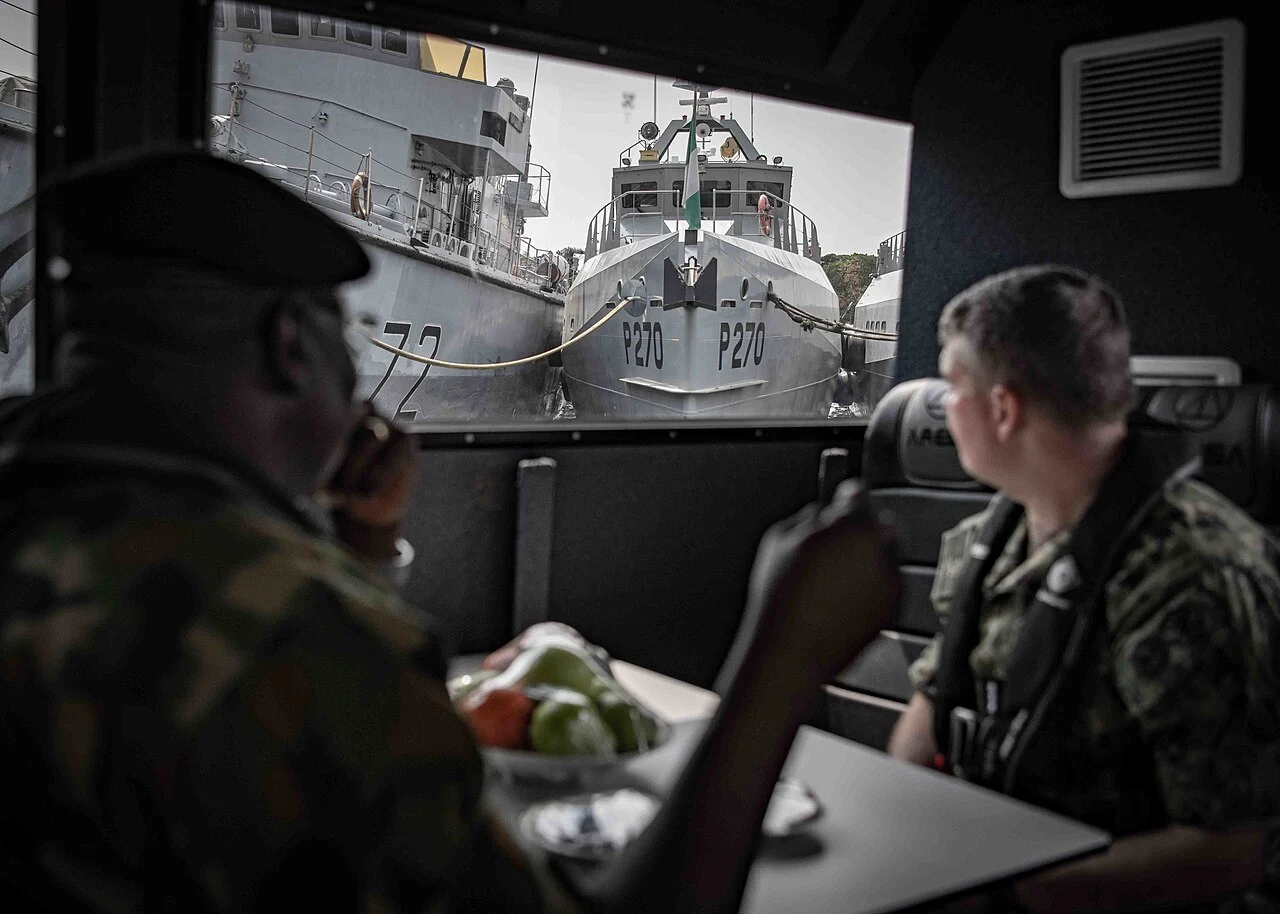
Photo: Nigerian Navy Rear Admiral Yakubu Wambai and US Sixth Fleet commander Vice Admiral Thomas Ishee inspect the Nigerian Navy patrol vessel NNS Kano in Lagos, January 2023 (illustrative). Credit: Petty Officer 2nd Class Cameron Edy, Public domain, via Wikimedia Commons
The 40-metre Security Support Vessel SSV Kali-3 was inducted into the Nigerian Navy at Asemoku Jetty in Delta State on 18 August 2026, under a memorandum of agreement between the Navy and Sterling Oil Exploration and Energy Production Company (SEEPCO). The Voice of Nigeria reported that Chief of the Naval Staff Vice Admiral Idi Abbas presided over the ceremony, and Military Africa’s coverage, published this week, adds detail on the programme’s technical specifications and its place in the Navy’s wider anti-piracy effort.
What was commissioned
Kali-3 is the first of ten Security Support Vessels SEEPCO is providing under the agreement. It was built at the Okpai HM Shipyard in Delta State to Bureau Veritas classification standards, and the Navy describes it as equipped for coastal and offshore surveillance, boarding and interdiction, anti-piracy patrols, maritime law enforcement and escort duty for tankers, LNG carriers and offshore supply vessels moving through the Niger Delta’s creeks and approaches.
The vessel is fitted with two rigid-hull inflatable boats for boarding operations, draws only 2.5 metres so it can operate in the shallow creeks that crisscross the delta, and carries ten to twelve days of endurance at sea. The Navy supplies and trains the crew; SEEPCO funds construction and maintenance. A second hull, Kali-4, is reported to be close to completion and ready for launch.
Vice Admiral Abbas called the induction “a consequential moment” and urged other operators in the Niger Delta to pursue similar partnerships. SEEPCO framed the programme as “strengthening the operational capacity of the Nigerian Navy,” and Delta State’s deputy governor, Monday Onyeme, who represented Governor Sheriff Oborevwori at the ceremony, said the state “remains open for business.”
Part of a wider private-sector push against oil theft
The SEEPCO vessels join a growing list of privately funded maritime security assets in the Niger Delta, and sit alongside a broader fleet of offshore patrol vessels already in service across African navies. Tantita Security Services Nigeria Limited handed over 15 semi-ballistic gunboats to security operations on 14 May 2026, and the oil major Aiteo donated 50 patrol boats to the Navy in 2021. Collectively, these programmes supplement a naval order of battle that the Navy itself has acknowledged is stretched thin across a coastline and inland waterway network much larger than its hull count can cover.
The ten-vessel SEEPCO programme is explicitly tied to Operation Delta Sentinel, a Navy-led effort launched in January 2026 to counter crude oil theft in the Niger Delta, long one of the costliest forms of resource leakage facing Nigeria’s economy. Pipeline vandalism and illegal bunkering have at various points cost the country hundreds of thousands of barrels of production per day, and the Navy has increasingly leaned on industry-funded hulls, rather than new budget allocations, to put more patrol assets on the water.
That model marks a shift from one-off donations toward a standing construction programme: SEEPCO is not simply handing over existing boats but building a dedicated ten-vessel class at a domestic shipyard, with the Navy supplying crews and operational control. If the remaining eight hulls follow Kali-3 and Kali-4 on a similar schedule, the Navy’s Western Naval Command would gain a meaningful increment of shallow-draft patrol capacity purpose-built for creek and inshore operations, rather than general-purpose offshore patrol vessels better suited to deeper water.
Why it matters for Africa
The Gulf of Guinea remains one of the world’s most persistent maritime-crime hotspots, with the Nigerian Navy serving as the region’s primary counter-piracy and anti-bunkering force under frameworks such as the Yaoundé Code of Conduct. See DefenceMENA’s profile of Nigeria’s armed forces for the wider force structure the Navy’s patrol fleet sits within. Budget constraints have long limited how many hulls West African navies can put to sea, and Nigeria’s experiment with industry-funded, purpose-built patrol boats offers a template other coastal states and extractive industries across the continent — from Ghana’s offshore gas fields to Mozambique’s Cabo Delgado LNG terminals — may look to as a way of expanding maritime domain awareness without waiting on treasury allocations. It also signals that Nigerian oil majors increasingly see direct investment in naval capacity as cheaper than continued losses to theft and sabotage.
Sources
- Voice of Nigeria: “Nigerian Navy Inducts KALI-3 Vessel To Boost Security”
- Military Africa: “Nigerian Navy receives first of ten privately funded security vessels”
- The Maritime Executive: “Oil Company Donates 50 Security Boats to the Nigerian Navy”