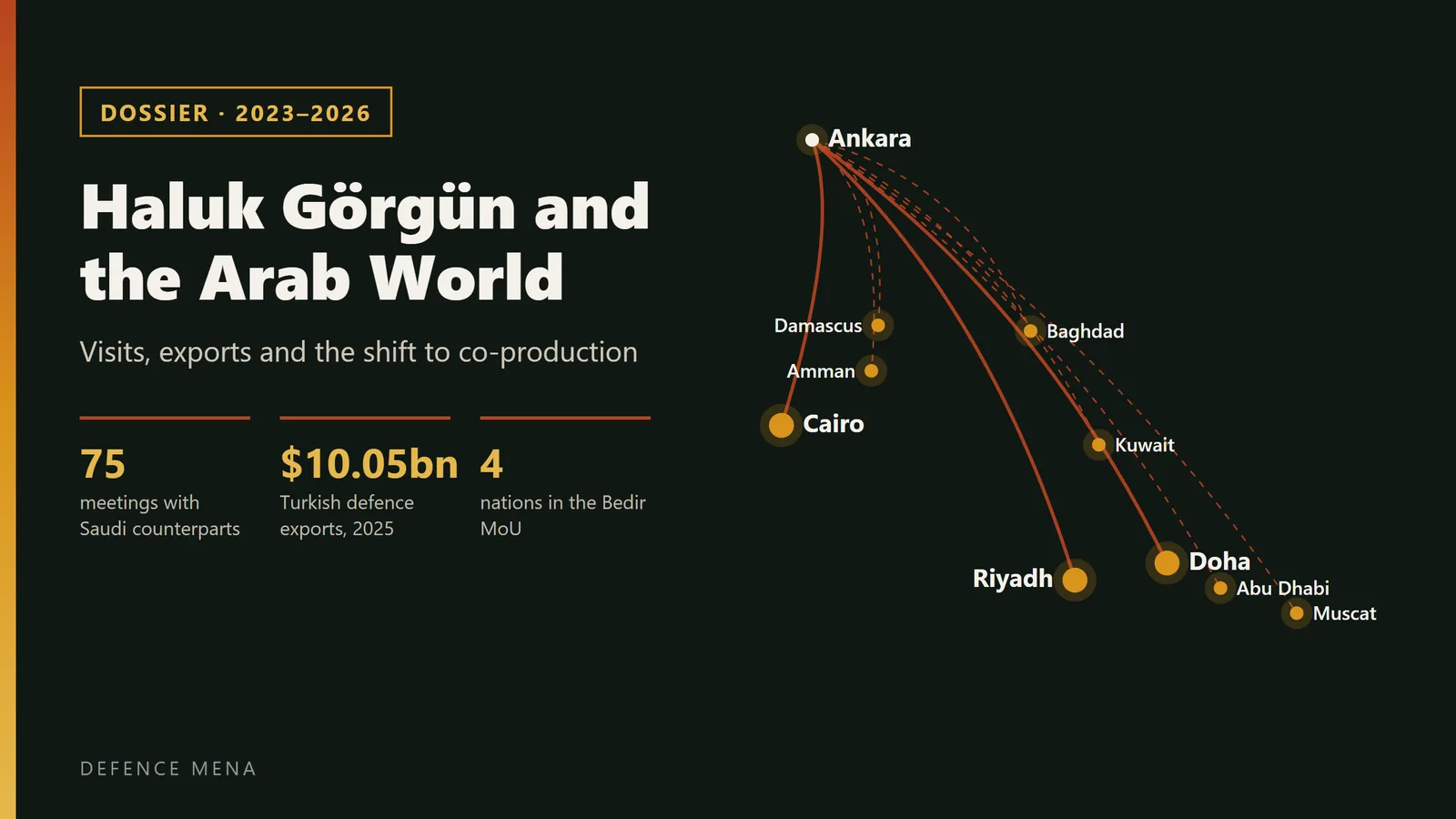
When Haluk Görgün took over Türkiye’s Presidency of Defence Industries (SSB) in June 2023, Turkish defence sales to the Arab world still looked like a catalogue business: a platform was offered, a contract was signed, the hardware shipped. Three and a half years later, the vocabulary in Riyadh, Doha and Cairo has changed. The talks are now about local assembly lines, joint ventures, technology transfer and shared R&D.
This dossier pulls together the visits Görgün made to Arab capitals, the delegations he received in Ankara and Istanbul, and the contracts and memoranda that came out of that traffic between June 2023 and November 2026. It relies on SSB statements, official Arab news agencies and specialist defence media, and it flags the items that remain unconfirmed.
Cover graphic: Defence Mena. Map is schematic.
The dossier in figures
- 75 meetings held with Saudi counterparts at SSB level in three and a half years, according to Görgün (12 November 2026).
- $10.05 billion in Turkish defence and aerospace exports in 2025, up 48% on 2024; $1.6 billion of that went to the Middle East.
- $2.2 billion of the new export contracts signed in 2025 came from the Middle East, out of a total of $17.9 billion.
- 5 agreements signed between Qatar’s Barzan Holdings and MKE, ASELSAN, STM, ASFAT and TAIS at DIMDEX 2026.
- 4 countries in the Bedir defence-industry MoU signed in Doha on 21 October 2026: Türkiye, Qatar, Pakistan and Indonesia.
Saudi Arabia: the core of the relationship
The Saudi file opened weeks into Görgün’s tenure. On 18 July 2023, during President Erdoğan’s Gulf tour, Baykar signed the Akıncı UCAV export deal with Saudi Arabia, described in Türkiye as the largest single defence export in the country’s history. Neither side published the value or the number of aircraft. What followed matters more for the long term: on 6 August 2023 Saudi Arabian Military Industries (SAMI) signed a technology localisation agreement with Baykar, and SAMI said that up to 70% of the Akıncıs built for the Saudi air force and navy would be produced locally. ASELSAN and ROKETSAN were to localise sensors and munitions with Saudi partners.
Training followed. Around 300 Saudi personnel worked with Baykar in Türkiye, and a group of 15 Royal Saudi Navy pilots and 15 technicians completed their course at Çorlu in October 2025. The first batch of aircraft was delivered at the end of 2025.
Görgün’s own calendar with Riyadh is dense. He attended World Defense Show 2024, where Türkiye fielded 63 companies. In December 2024 he hosted Deputy Defence Minister Dr Khaled Al-Biyari and Air Force commander Turki bin Bandar in Istanbul for three days of industry talks, then flew to Riyadh to meet GAMI Governor Ahmed Al-Ohali. He was back with Al-Ohali in Riyadh on 10 July 2025 to discuss technology transfer and co-production models, and received him again at IDEF 2025 in Istanbul, where SAMI signed land-systems teaming agreements with Nurol Makina, FNSS and ASELSAN. In February 2026 he was part of the presidential delegation that met Crown Prince Mohammed bin Salman.
The results kept arriving through 2026. At WDS 2026 in Riyadh, where SSB coordinated 130 Turkish firms across 4,400 square metres, TUSAŞ signed with the Saudi Ministry of Investment and GAMI for final assembly of the T625 Gökbey helicopter in the Kingdom, ROKETSAN signed with MISA and GAMI, and ULAQ Global agreed a strategic partnership with SAMI Autonomous.
The latest marker came on 11–12 November 2026 at the Türkiye–Saudi Arabia Defence Industry Days in Istanbul, organised by DEİK, SAHA Istanbul and SAMI, with 102 companies taking part. Görgün tied Turkish industry directly to Vision 2030’s goal of producing at least half of Saudi defence spending at home. “Over the last three and a half years, the number of meetings we have organised, many of which I attended myself, is 75,” he said. Saudi Minister of State and acting GAMI chairman Bandar Al-Khorayef put the Saudi interest plainly: Riyadh wants to draw on Türkiye’s experience. Defence Turkey describes the trajectory as a move from arms procurement to industrial partnership.
Qatar: from Barzan to Bedir
Qatar is where the relationship became most institutional. After IDEX 2025, Görgün flew to Doha on 20 February 2025 and met Deputy Prime Minister and Minister of State for Defence Affairs Sheikh Saoud bin Abdulrahman Al Thani, the commanders of the Qatari air, land and naval forces, and the management of Barzan Holdings, the state’s defence investment arm.
Eleven months later, at DIMDEX 2026 (19–22 January), Türkiye was the country with the most exhibitors, 47 firms under SSB coordination. Barzan signed five agreements with Turkish companies. The ASELSAN–Barzan joint venture BARQ was expanded for local production and technology transfer, STM agreed to produce tactical UAVs in Qatar, and TAIS signed a frigate agreement worth about $1 billion that, according to Naval News, covers two ships for Indonesia with Barzan providing the financing. Defense News reported the package as a broad deepening of Turkish–Qatari ties. Görgün’s own summary in Doha was short: when strategic cooperation comes up, defence cooperation comes first.
The arrangement turned multilateral on 21 October 2026, when Türkiye, Qatar, Pakistan and Indonesia signed the Bedir (Badr) defence-industry MoU in Doha, with Defence Minister Yaşar Güler and Görgün signing for Türkiye. It covers co-production, technology sharing, R&D and technical training, and carries no mutual-defence obligation. Sheikh Saoud then came to Ankara, where Görgün hosted him at SSB to start turning the framework into joint projects. For background on how the wider partnership works, see our earlier analysis of Türkiye’s military partnership with Qatar.
UAE and Oman: industry at head-of-state level
At IDEX 2025 in Abu Dhabi, UAE President Sheikh Mohamed bin Zayed Al Nahyan visited the ROKETSAN stand with Görgün at his side; joint projects and technology transfer were on the agenda. Görgün also met Minister of State for Defence Affairs Mohammed Al Mazrouei, with whom he had earlier witnessed an ASELSAN signing at SAHA EXPO in Istanbul, and attended three MoUs between Turkish firms Barko Elektronik, MZD and T-Kalıp and the Emirati companies KRMC and Al Esnad.
In Muscat on 4–5 February 2025, Görgün met Defence Ministry Secretary-General Mohammed bin Nasser Al Zaabi and Oman Investment Authority chief Abdulsalam Al-Murshidi. ASELSAN opened its Oman office during the visit, and both ASELSAN and HAVELSAN signed sales contracts. In October 2026 Ankara received Oman’s Director-General of Research and Military Industrialisation, Said Al-Shabibi, for a follow-up round.
Egypt: a page turned in 2026
The Egyptian channel moved fastest. HAVELSAN and the Arab Organization for Industrialization (AOI) agreed in August 2025 to co-produce a vertical take-off UAV in Egypt. At EDEX 2025 in December, around 80 Turkish companies exhibited, President Sisi toured the Turkish stands, ASELSAN opened ASELSAN Egypt, and the co-produced HAMZA-1 UAV was shown for the first time.
On 13 July 2026 Görgün received Egypt’s Minister of Defence and Military Production, Lt Gen Ashraf Salem Zaher, at SSB, the first visit by an Egyptian defence minister to Ankara in 13 years. A letter of intent was signed to set the framework for defence-industry cooperation. “I believe the cooperation to be developed between Türkiye and Egypt in the defence industry will contribute to regional security and to the capacity of both sides,” Görgün said. Al-Ahram covered the visit from the Egyptian side. In September 2026, at the El Alamein air show, HAVELSAN and AOI signed a sales agreement that opened HAMZA-1 to export, a co-produced Turkish–Egyptian product now on the market. A separate meeting timeline for Egypt’s Military Production Ministry and Türkiye follows on Defence Mena.
Kuwait, Iraq, Syria and beyond
Görgün visited Kuwait on 11 November 2024 at the invitation of then First Deputy Prime Minister and Defence Minister Sheikh Fahad Yousuf Saud Al Sabah. No contract was signed, and in December the Kuwaiti deputy chief of staff visited Türkiye. At DIMDEX 2026 he met Iraqi Defence Minister Thabet Al-Abbasi, and later in 2026 received the director of the Iraqi Commander-in-Chief’s office, Gen Abdulamir Al-Shammari, at SSB.
The Syrian file is the newest. On 11 October 2025 Görgün made a one-day working visit to Damascus and met Defence Minister Maj Gen Murhaf Abu Qasra. The Syrian state agency SANA announced the meeting, and TRT World reported both sides’ commitment to defence collaboration as Syria rebuilds its defence infrastructure. It was one of the highest-level Ankara–Damascus contacts of the post-2024 period.
The map also includes Libya, whose Chief of General Staff Gen Mohammed Al-Haddad came to SSB in 2024; Jordan, whose JODDB chief met Görgün at ADEX 2024 in Baku; and Somalia, whose Defence Minister Ahmed Moallim Fiqi met him at DIMDEX 2026.
Timeline
| Date | Country | Counterpart | Direction | Outcome |
|---|---|---|---|---|
| 18 Jul 2023 | Saudi Arabia | Saudi government / Baykar | n/a | Akıncı export deal |
| 6 Aug 2023 | Saudi Arabia | SAMI | n/a | Akıncı localisation, up to 70% |
| Feb 2024 | Saudi Arabia | WDS 2024 | Outbound | 63 Turkish firms |
| 11 Nov 2024 | Kuwait | Sheikh Fahad Al Sabah | Outbound | Talks |
| 24 Dec 2024 | Saudi Arabia | Al-Biyari, Turki bin Bandar | Inbound | Three days of industry talks |
| 4–5 Feb 2025 | Oman | Al Zaabi, Al-Murshidi | Outbound | ASELSAN office; ASELSAN and HAVELSAN contracts |
| 17–21 Feb 2025 | UAE | Sheikh Mohamed bin Zayed; Al Mazrouei | Outbound | ROKETSAN stand visit; 3 MoUs |
| 20 Feb 2025 | Qatar | Sheikh Saoud Al Thani; service chiefs; Barzan | Outbound | Co-production agenda |
| 10 Jul 2025 | Saudi Arabia | GAMI Governor Al-Ohali | Outbound | Technology transfer, co-production |
| 11 Oct 2025 | Syria | Maj Gen Murhaf Abu Qasra | Outbound | First senior SSB contact |
| 19–22 Jan 2026 | Qatar, Iraq, Somalia | Sheikh Saoud; Al-Abbasi; Fiqi | Outbound | 5 Barzan deals; BARQ; frigate deal |
| 8–12 Feb 2026 | Saudi Arabia | WDS 2026 | n/a | Gökbey, ROKETSAN, ULAQ agreements |
| 13 Jul 2026 | Egypt | Lt Gen Ashraf Salem Zaher | Inbound | Letter of intent |
| Sep 2026 | Egypt | AOI–HAVELSAN | n/a | HAMZA-1 sales agreement |
| 21 Oct 2026 | Qatar | Sheikh Saoud Al Thani | Outbound | Bedir MoU |
| 11–12 Nov 2026 | Saudi Arabia | Al-Khorayef; SAMI CEO AlMuhid | Inbound | Defence Industry Days; 102 firms |
What the pattern shows
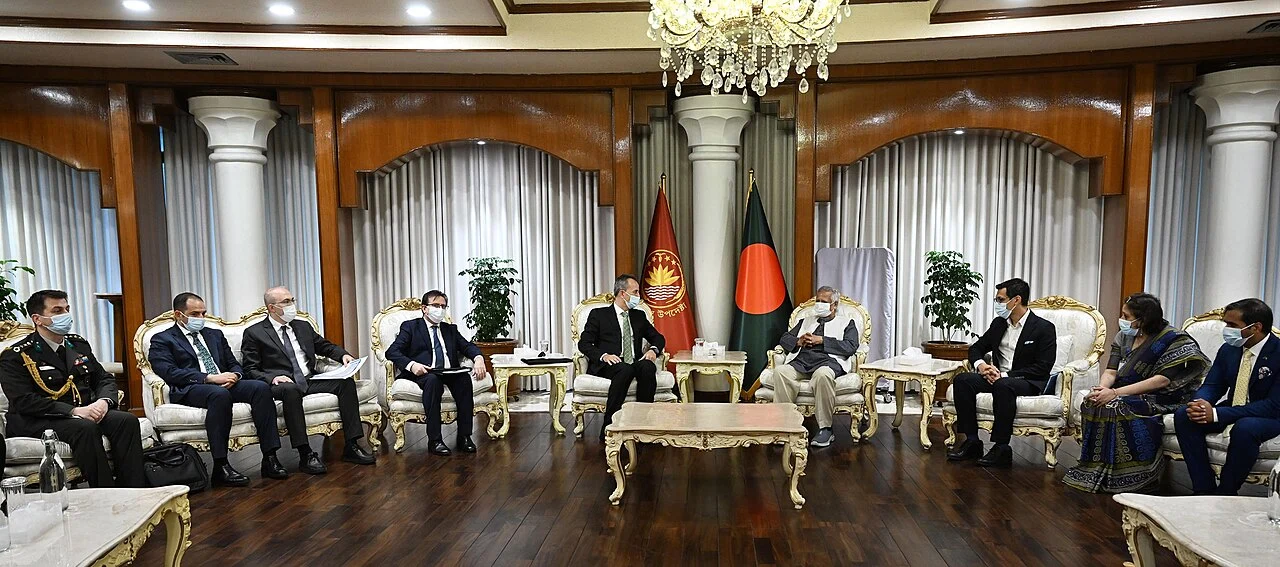
Three things stand out. First, the traffic runs both ways. Görgün went to Riyadh, Abu Dhabi, Doha, Kuwait, Muscat and Damascus; Egypt’s defence minister, Qatar’s defence minister, Saudi deputy ministers and Iraqi and Omani military delegations came to SSB. That is what a partnership looks like, as opposed to a sales tour.
Second, almost every deal now carries a local-industry clause: 70% Akıncı localisation with SAMI, Gökbey final assembly in the Kingdom, the BARQ joint venture and STM drone production in Qatar, HAMZA-1 co-production with AOI. Turkish industry has accepted the Gulf’s offset and localisation demands rather than resisting them, which is one reason Arab buyers keep returning.
Third, the money follows. Turkish defence exports rose from $5.5 billion in 2023 to $10.05 billion in 2025, and January–October 2026 exports reached $8.05 billion, up 20.2% year on year. The Middle East accounted for $1.6 billion of 2025 exports but $2.2 billion of contracts signed that year, which points to a growing order book in the region. Görgün has spoken of an SSB portfolio of more than 1,400 projects worth “about $100 billion”.
Confirmed and not confirmed
- Not officially disclosed: the value and quantity of the Saudi Akıncı order; any Saudi or Egyptian participation in the KAAN fighter programme; reported Kuwaiti TB2 purchases.
- Company-level: agreements at WDS 2026 and EDEX 2025 were signed by companies; Görgün’s personal attendance at those two shows is not confirmed.
- End user: Barzan’s own statement points to the Indonesian Armed Forces as the end user of the TAIS frigates.
Sources
- Presidency of Defence Industries (SSB) statements and Haluk Görgün’s official X account, 2023–2026
- Janes: Local production agreements signed for Saudi Bayraktar Akıncı UAVs
- Defence Turkey: The strategic rise of Türkiye–Saudi Arabia defence cooperation
- Naval News: TAIS signs $1 billion frigate agreement with Barzan Holdings
- Defense News: Turkey, Qatar deepen defense ties at DIMDEX
- Euronews: Bedir defence-industry MoU
- Hürriyet Daily News: Türkiye, Egypt sign letter of intent and Al-Ahram
- TRT World: Turkish, Syrian officials meet in Damascus; SANA
- Ekonomi Gazetesi: Gökbey co-production agreement with Saudi Arabia
- Turkish Exporters Assembly (TİM) and SSB export data, 2023–2026