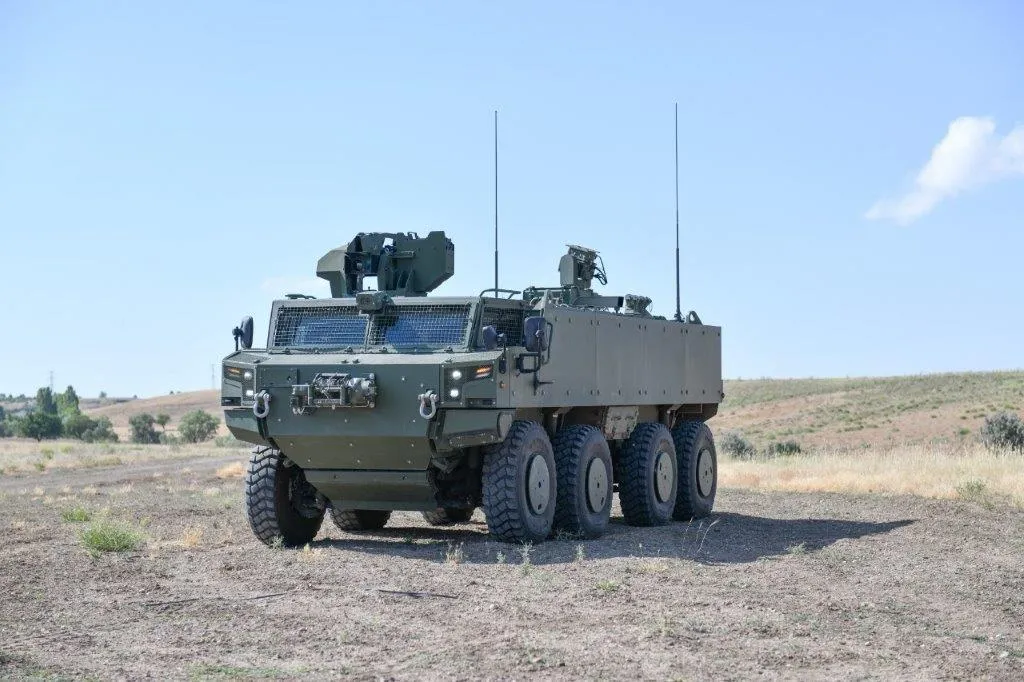
Türkiye’s ÖMTTZA programme gives the Turkish Land Forces a family of special-purpose wheeled armoured vehicles built by FNSS for the jobs that sit behind the front line of any modern battle: command, sensor reconnaissance, ground surveillance radar and CBRN reconnaissance. With 100 vehicles delivered and a contract amendment for 337 more signed on 18 August 2026, it is one of the larger wheeled armour efforts managed by Türkiye’s Presidency of Defence Industries (SSB), and a ready-made template for African armies that want to see further and survive contaminated ground.
Photo: Presidency of Defence Industries (SSB), Türkiye.
What is ÖMTTZA?
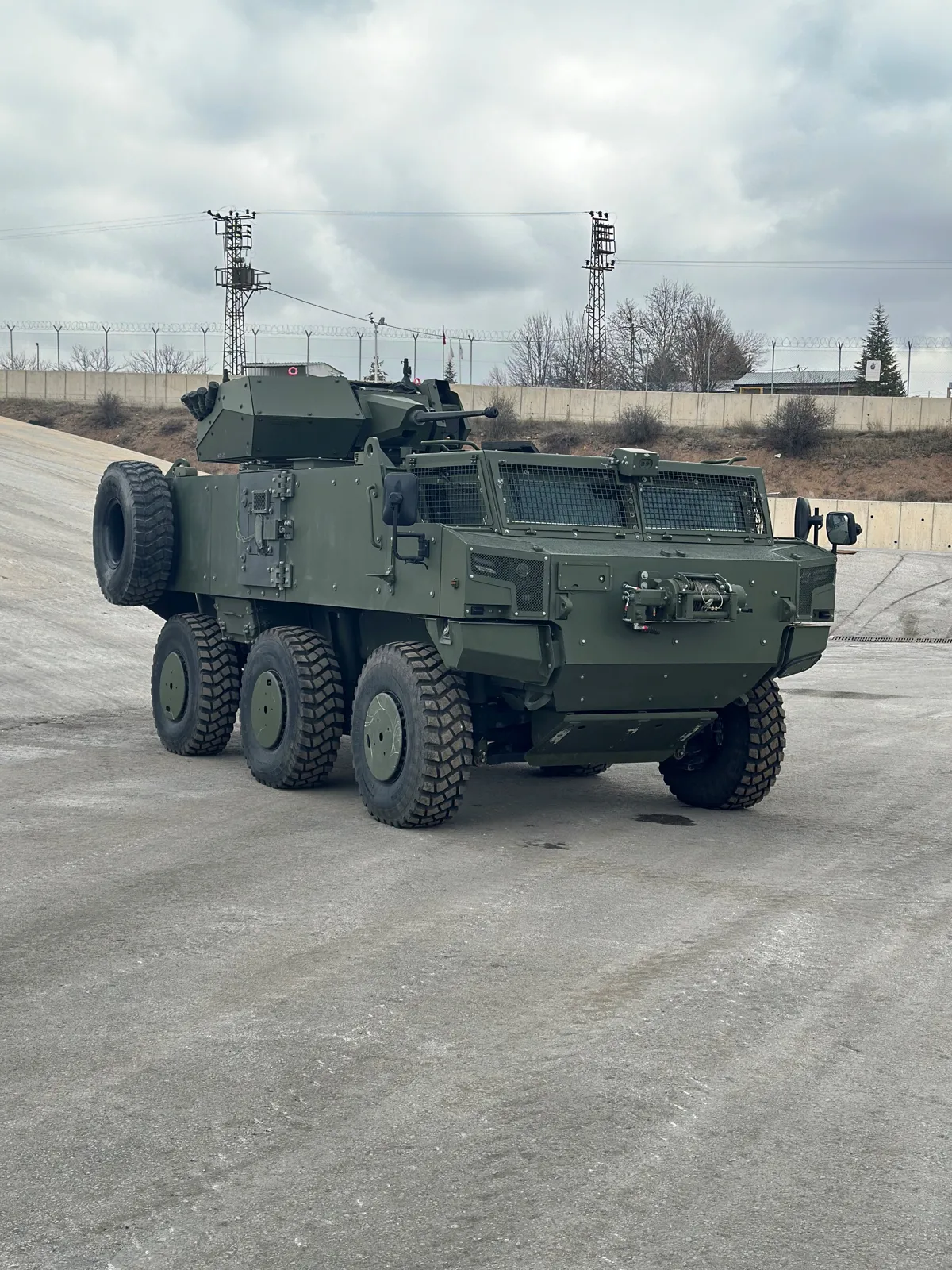
ÖMTTZA is the Turkish abbreviation for Özel Maksatlı Taktik Tekerlekli Zırhlı Araçlar, which translates as special-purpose tactical wheeled armoured vehicles. It is not a single vehicle but a programme: FNSS supplies protected wheeled platforms from its PARS family, and each one is fitted with a specific mission kit. Trade-press reporting on the programme describes the production vehicles as PARS Scout models in 6×6 and 8×8 configurations, with the 6×6 used for command and radar roles and the 8×8 for sensor reconnaissance, CBRN reconnaissance and armed combat versions. The vehicles in SSB’s official photographs match that picture: a three-axle command vehicle and a four-axle sensor carrier with a mast-mounted electro-optical head.
SSB defines the requirement in practical terms. The Land Forces Command needed wheeled vehicles with armour and mine protection suited to operational demands, onto which mission systems could be mounted, to carry out command, sensor and reconnaissance, radar and CBRN reconnaissance tasks. In other words, the programme is about protecting the people and electronics that give a brigade its eyes, ears and decision-making, which in most armies still ride in soft-skinned trucks or converted personnel carriers.
Key specifications
| Manufacturer | FNSS Savunma Sistemleri (Ankara, Türkiye) |
| Platform | PARS family wheeled armoured vehicles (PARS Scout 6×6 and 8×8, as reported) |
| Turkish users | Turkish Land Forces Command; Turkish General Staff |
| Procurement authority | Presidency of Defence Industries (SSB) |
| Mission roles | Command, sensor/reconnaissance, radar, CBRN reconnaissance |
| Gradient / side slope | 60% / 30% (SSB data) |
| Maximum speed | 100 km/h (SSB data) |
| Operating temperature | -32°C to +55°C (SSB data) |
| Critical subsystems | Electro-optical sensor system; CBRN standoff detector; 25 mm NEFER turret; CBRN sampling systems; ACAR ground surveillance radar; laser target designator |
| Highlighted features | Image transfer; detection and identification of biological and chemical warfare agents |
| Status (Sept 2026) | 100 vehicles delivered; amendment for 337 more signed 18 August 2026 |
The operating temperature range is worth a second look from an African perspective. A vehicle certified to work from -32°C to +55°C has been designed for eastern Anatolian winters and for desert summers alike, and the upper figure covers the hottest conditions most Sahelian and Horn of Africa armies will face. A 100 km/h top speed lets the reconnaissance and command vehicles keep up with fast wheeled formations, and the 60% gradient and 30% side-slope figures reflect a vehicle designed to reach observation points on high ground rather than stay on the road below.
The mission systems
The value of the ÖMTTZA fleet lies in what it carries. SSB lists six critical subsystems. The electro-optical sensor system and the laser target designator give the sensor reconnaissance vehicle the ability to find, identify and mark targets at long range, while the ACAR ground surveillance radar, a Turkish-developed system, lets the radar variant watch a wide sector day and night and in poor weather. The 25 mm NEFER turret gives the armed version enough firepower to defend itself and to fight for information when a screen is contested.
The CBRN reconnaissance version carries a standoff detector, able to identify a chemical cloud before the crew drives into it, and sampling systems that collect evidence for laboratory confirmation. SSB highlights the vehicle’s ability to detect and identify biological and chemical warfare agents, and the ability to transmit imagery. That last point ties the whole family together: what the sensor or radar vehicle sees can be passed back to the command vehicle in near real time, so the commander works from a live picture rather than radio reports.
The SSB programme and Turkish service
The ÖMTTZA contract was signed at the IDEF exhibition in 2019, and it was widely reported at the time as the Turkish Land Forces’ first order for FNSS wheeled armoured fighting vehicles, an important step for a company that had until then been best known in Türkiye for tracked vehicles. The first production stage covered 100 vehicles across five versions.
SSB’s September 2026 status confirms that all 100 vehicles of that stage have been delivered. On 18 August 2026 SSB signed a contract amendment for 337 additional vehicles, which will more than quadruple the fleet. That scale-up says a lot about how the Land Forces rate the vehicles after several years of use, and it reflects SSB’s approach of buying in phases: field the first batch, gather user feedback, then commit to volume. The listed users are the Land Forces Command and the General Staff.
The programme also illustrates SSB’s push for local content. The platforms come from FNSS, while the radar, the turret and much of the sensor and CBRN equipment are drawn from Türkiye’s own defence electronics base. The result is a reconnaissance and command fleet whose key components can be supported, upgraded and, where needed, exported from a single country.
Who operates it?
The ÖMTTZA mission fleet itself is in Turkish service only; no export customer for these specific special-purpose configurations has been announced. The PARS family on which it is based, however, has an established export record. Malaysia ordered 257 vehicles of the 8×8 AV8 Gempita, developed from the PARS and built with local partner DefTech, in what was at the time described as Türkiye’s largest single-contract defence export. Oman took 172 PARS III vehicles, 145 in 8×8 and 27 in 6×6 configuration, across 13 variants; the first was handed over in July 2017 and deliveries were completed in 2020. FNSS and DefTech also teamed up in 2022 to offer the PARS 4×4 and 6×6 to the Malaysian Army.
For a prospective buyer, those programmes show that FNSS can deliver PARS vehicles in many variants, set up local production and support fleets far from Ankara.
Can ÖMTTZA-type vehicles go to Africa?
African armies rarely lack infantry or light vehicles. What they often lack is protected reconnaissance and command capability, the ability to see an ambush before it happens and to keep the headquarters moving under fire. The insurgencies in the Sahel, the Lake Chad basin, Somalia and northern Mozambique are all fights in which the side that sees first usually wins, and in which roadside bombs make soft-skinned command vehicles a liability. An armoured, mine-protected sensor vehicle with a mast-mounted EO head and a radar partner is a direct answer to that problem.
The CBRN reconnaissance variant addresses a less discussed but real requirement. Several North African states maintain CBRN defence units, and industrial accidents, chemical stockpiles and the risk of chemical attacks in conflict zones make detection and sampling capability more relevant than budgets usually admit. A vehicle that can confirm a release, mark the area and collect samples without exposing the crew fills a gap many armies cover only with handheld detectors.
Likely candidates include armies that already operate mixed Western and Turkish fleets and want to add an ISR layer: Egypt, Algeria and Morocco, which run large mechanised forces and value modern sensors; Nigeria and Kenya, which have heavy commitments to counter-insurgency and border surveillance; and Sahel partners such as Niger, Mali and Burkina Faso, which have turned to Turkish suppliers for drones and armoured vehicles in recent years. Türkiye’s footprint on the continent, from Bayraktar TB2 operators to fleets of Turkish MRAPs, means many of these armies already have the training links and logistics channels to absorb a PARS-based fleet.
The model also scales down well. An African army does not need 437 vehicles; a battalion-sized package of a few command, sensor and radar vehicles, tied into existing drones, can change how a brigade sees its area of operations. Because the mission kits are modular, a buyer can start with a small number of sensor vehicles and add CBRN or armed versions later.
FAQ
What does ÖMTTZA stand for?
ÖMTTZA stands for Özel Maksatlı Taktik Tekerlekli Zırhlı Araçlar, meaning special-purpose tactical wheeled armoured vehicles. It is a Turkish Land Forces programme managed by SSB with FNSS as prime contractor.
How many ÖMTTZA vehicles has Türkiye ordered?
According to SSB, 100 vehicles have been delivered and a contract amendment for 337 more was signed on 18 August 2026, bringing the total to 437.
What roles do the vehicles perform?
The fleet covers command, sensor and reconnaissance, ground surveillance radar and CBRN reconnaissance roles, with systems including an electro-optical sensor suite, the ACAR radar, a 25 mm NEFER turret, a laser target designator and CBRN detection and sampling equipment.
Which vehicle is ÖMTTZA based on?
The programme uses FNSS’s PARS family of wheeled armoured vehicles; trade reporting identifies the production vehicles as PARS Scout 6×6 and 8×8 models.
Has the PARS family been exported?
Yes. Malaysia operates the PARS-derived AV8 Gempita (257 ordered) and Oman received 172 PARS III vehicles. The special-purpose ÖMTTZA configurations themselves are currently in Turkish service only.
Related: FNSS company profile · ASELSAN company profile · Turkish systems in African service