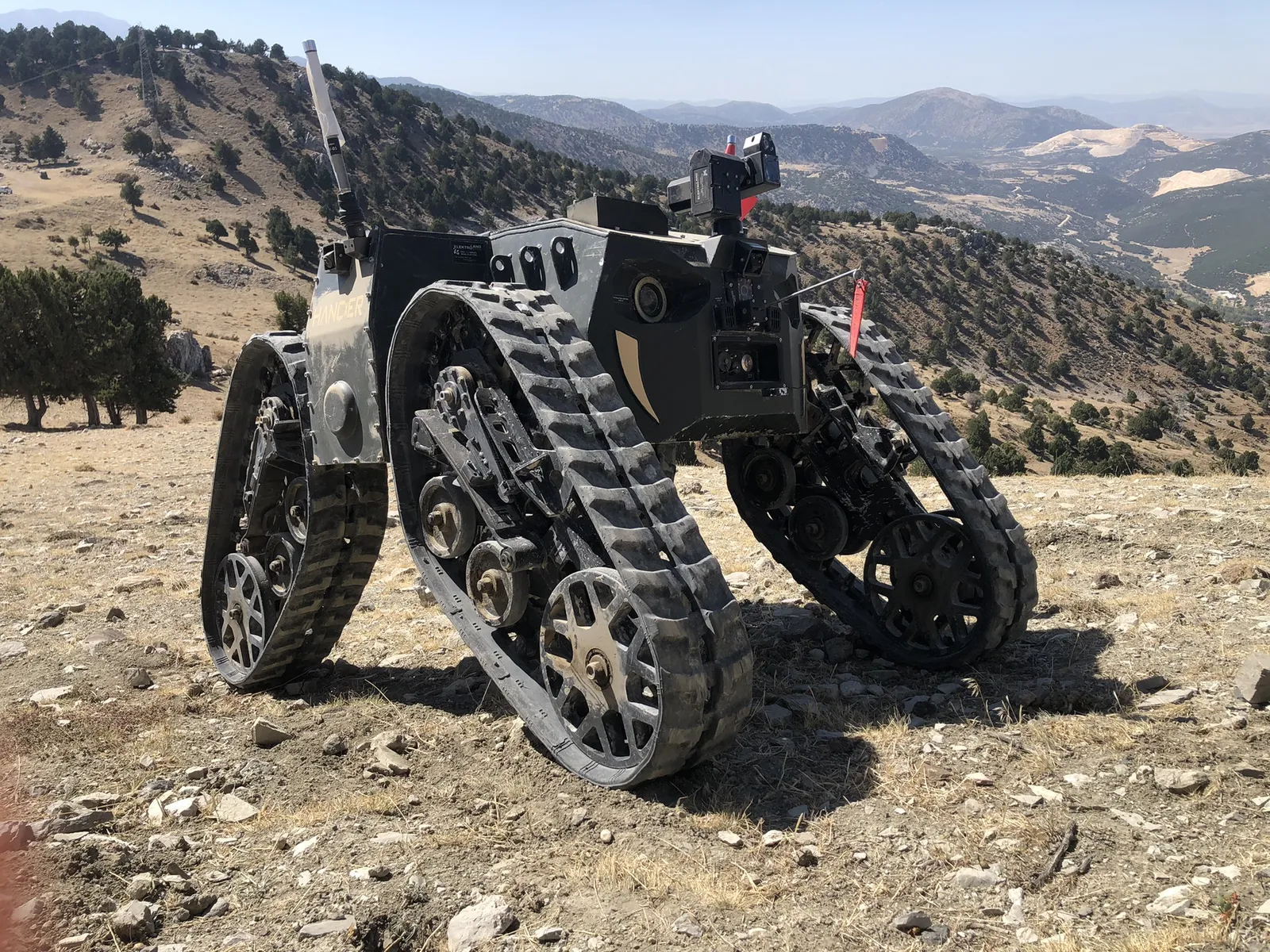
HANÇER is the Turkish army’s agile, mid-weight ground robot: an 804 kg unmanned vehicle that walks over obstacles on four articulated track units and can raise or lower itself on command. Built by Elektroland Defence under a serial-production programme of Türkiye’s Presidency of Defence Industries (SSB), it has completed qualification of its first five vehicles, with five more on contract. Reported export success in Canada and Elektroland’s long record of supplying bomb-disposal robots abroad give it a solid base for African markets.
Photo: Presidency of Defence Industries (SSB), Türkiye.
What is HANÇER?
HANÇER, Turkish for “dagger”, is a medium-class, Level-1 unmanned ground vehicle (UGV) built by Ankara-based Elektroland Defence. SSB procures it for the Turkish Land Forces Command (KKK) under the HANÇER Medium Class Level-1 UGV Serial Production Project, abbreviated H-OİKA1. The programme’s stated purpose is to reduce the exposure of personnel to dangerous situations by handing reconnaissance, surveillance and load-carrying tasks to an unmanned land system.
Elektroland is one of Türkiye’s most experienced ground-robot makers. The company says it has delivered more than 1,000 systems, including hundreds of explosive ordnance disposal robots in service in more than 15 countries, and it is a registered supplier to the United Nations and NATO. HANÇER draws on that experience, with the first prototype appearing in 2019 and several vehicles delivered to the Turkish Land Forces since, according to a SAHA Expo 2024 show report.
Key specifications
| Manufacturer | Elektroland Defence (Türkiye) |
| Procurement authority | Presidency of Defence Industries (SSB) |
| Turkish user | Turkish Land Forces Command |
| Class and weight | Medium class, Level 1; 804 kg |
| Mobility | Four articulated track units (flippers); height adjustable from the remote control unit |
| Communications | Wired and wireless; RF and LTE modules |
| Equipment (SSB) | Cargo basket, perimeter monitoring mast system |
| Manufacturer-quoted data | Up to 4 hours continuous operation; about 16 km/h; ASELSAN remote weapon station option; follow-the-soldier mode on latest version |
| Status (SSB, Sept 2026) | Qualification of first 5 vehicles completed; serial acceptance planned; contract amendment for 5 more signed |
| Export operators | Canada (reported, SAHA Expo 2024); others unnamed |
SSB lists HANÇER at 804 kg in the Medium Class-1 category, with both wired and wireless communications through RF and LTE modules. The wired option matters in tunnels, buildings and areas where radio is jammed or blocked, while LTE allows the robot to be managed from a command post well beyond direct radio range. For its main jobs it carries a cargo basket and a mast-mounted perimeter monitoring system that lifts its cameras to see over walls and vegetation.
The feature SSB singles out is the running gear. Instead of two continuous tracks, HANÇER rides on four independently articulated track units, often called flippers, and its ride height can be adjusted from the remote control unit. In practice that means the robot can lift its body to clear rocks or step up kerbs and stairs, lower itself to present a smaller target, and angle its tracks to keep traction on slopes or in mud. Trade press reporting adds manufacturer figures of up to four hours of continuous operation, a top speed of about 16 km/h, the option of an ASELSAN remote weapon station and, on the latest version, a guide-tracking mode that lets the robot follow a dismounted soldier without a control panel.
The SSB programme and Turkish service
HANÇER shows SSB’s preference for qualifying a robot thoroughly before scaling up. According to SSB’s September 2026 status, qualification activities for the first five vehicles have been completed, acceptance of serial-production vehicles is planned to follow, and a contract amendment has been signed for five additional vehicles. Elektroland said the amendment was signed with SSB at SAHA Expo 2026 in Istanbul, the same show where it unveiled a new 6×6 robot.
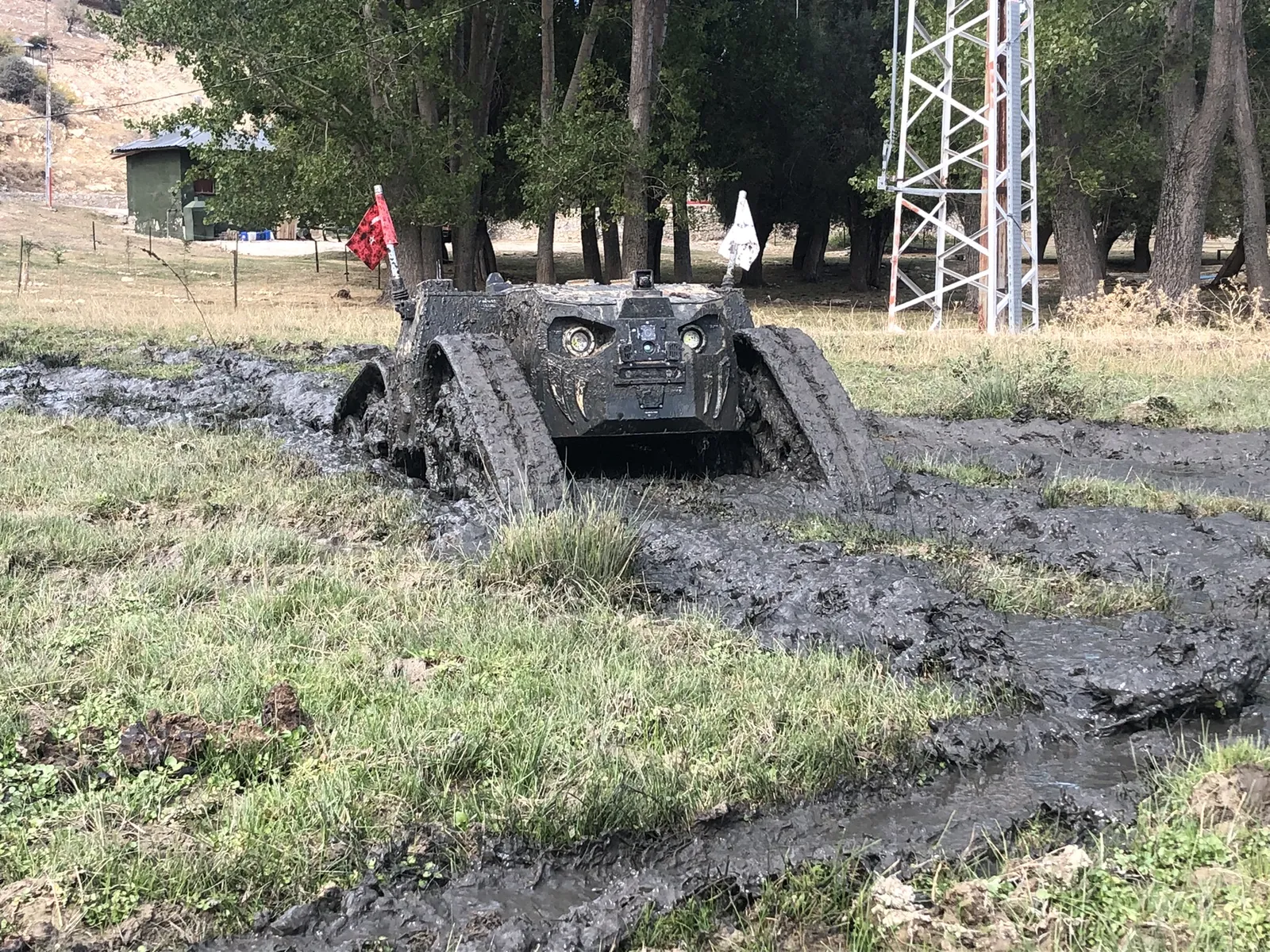
The procurement fits into a broader SSB effort to field different UGV classes side by side: one-tonne armed robots such as HAVELSAN’s BARKAN, the heavier tracked PALEM and wheeled 6×6 vehicles such as Elektroland’s own BOZKURT. HANÇER covers the agile end of that range, where a robot needs to move with dismounted infantry over broken ground rather than along roads, and where its lighter weight makes it easier to transport and recover.
Who operates HANÇER?
The Turkish Land Forces Command is the main user. On exports, the SAHA Expo 2024 show daily published by Global Business Press reported that HANÇER had been exported to Canada and that Canada was its only export customer at that point. DefenceMENA has not found a Canadian government announcement to confirm the order, so it is best treated as reported rather than officially confirmed. Elektroland itself states that HANÇER is in service with the Turkish Armed Forces and in serial production for other customers, and the company has established subsidiaries in the United Arab Emirates, Canada and Oman to support its export business.
Can HANÇER go to Africa?
For African armies and police forces, the strongest argument for HANÇER is the threat it was built to reduce. Improvised explosive devices on tracks and in villages, booby-trapped buildings and ambushes on foot patrols are daily risks in the Sahel, the Lake Chad Basin, Somalia and northern Mozambique. A robot that goes first into a compound, scouts a culvert with its mast camera or carries the patrol’s ammunition and water over rough ground keeps soldiers back from the point of greatest danger. DefenceMENA’s survey of unmanned ground vehicles in African armies found that EOD robots are the most mature robotic capability on the continent, which is exactly the market where Elektroland already has a long export record.
The design suits African terrain. Articulated tracks and adjustable height help on rocky hills, in laterite mud during the rainy season and over the walls and ditches of villages, and an 804 kg robot can be moved on a pickup or light truck rather than needing a dedicated transporter. Wired control is useful where insurgents use radio jammers or where operations move into caves and buildings. For border units, the perimeter mast turns the vehicle into a mobile observation post that can be pushed forward at night without exposing a sentry.
Natural candidates include the many African security forces that already use Turkish equipment and those whose EOD teams operate imported bomb-disposal robots. Nigeria, Kenya, Somalia and Ethiopia, all fighting insurgencies with heavy IED use, and North African states with long desert borders such as Egypt, Libya and Morocco, are logical first markets. Turkish platforms are already familiar across these forces, as DefenceMENA has shown in its overview of Turkish systems in African service, and the operator training that Elektroland provides with its EOD robots offers a ready path to introduce a reconnaissance and logistics UGV.
How it compares
HANÇER sits above small throwable or EOD robots and below one-tonne-plus armed UGVs such as BARKAN or Estonia’s THeMIS. Its distinctive selling point is mobility: four articulated track units and adjustable height are rare in this weight class and give it an advantage in broken terrain, stairs and mud. Combined with wired and wireless control, an optional ASELSAN weapon station and a manufacturer with an established export and training record, it is a practical first UGV for an army that wants to start with reconnaissance and logistics.
Frequently asked questions
What is HANÇER?
HANÇER is a medium-class, Level-1 unmanned ground vehicle built by Elektroland Defence and procured by Türkiye’s Presidency of Defence Industries (SSB) for the Turkish Land Forces Command. It weighs 804 kg, runs on four articulated track units and is used for reconnaissance, surveillance and load carrying so that soldiers are kept out of dangerous situations.
What makes HANÇER different from other UGVs?
SSB highlights its articulated track units, or flippers, as the vehicle’s distinguishing feature, and notes that its height can be adjusted from the remote control unit. This lets the robot raise itself over obstacles, lower its profile, and keep moving over rocks, mud and steps.
What is the status of the SSB programme?
According to SSB in September 2026, qualification of the first five vehicles has been completed, acceptance of serial-production vehicles is planned next, and a contract amendment has been signed for five additional vehicles.
Has HANÇER been exported?
A SAHA Expo 2024 show daily reported that HANÇER had been exported to Canada, its only export customer at the time; Elektroland states that the vehicle is in serial production for other customers as well. No African operator has been announced.
Related: Unmanned ground vehicles in African armies · Turkish systems in African service