Eight African air forces still list MiG-21-family fighters, according to FlightGlobal’s 2025 World Air Forces directory. Nigeria (11), Tanzania (11 plus 2 trainers), Zimbabwe (10 plus 2 trainers) and Sudan (12) operate the Chinese-built Chengdu F-7; Angola (23), Libya (12), Mali (9) and Mozambique (8) still list Soviet-built MiG-21s, with Sudan also listing 4. Listed is not the same as flying: Nigeria’s F-7s are the best-documented active fleet, while most remaining MiG-21s are rarely seen airborne. Egypt, Algeria, Ethiopia and Uganda have retired the type.
Quick answer
Chengdu F-7 (listed 2025): Sudan 12, Nigeria 11, Tanzania 11 (+2 FT-7), Zimbabwe 10 (+2 FT-7). MiG-21 (listed 2025): Angola 23, Libya 12, Mali 9, Mozambique 8, Sudan 4. Recently retired: Uganda (5 MiG-21s, removed in 2024 directory year). Former operators: Egypt, Algeria, Ethiopia, Somalia, Zambia and others.
Last updated: 8 November 2026. Fleet figures are FlightGlobal/Cirium directory listings (published November 2024), which count aircraft held in inventory, not aircraft confirmed airworthy. Historical deliveries are from SIPRI and include estimates.
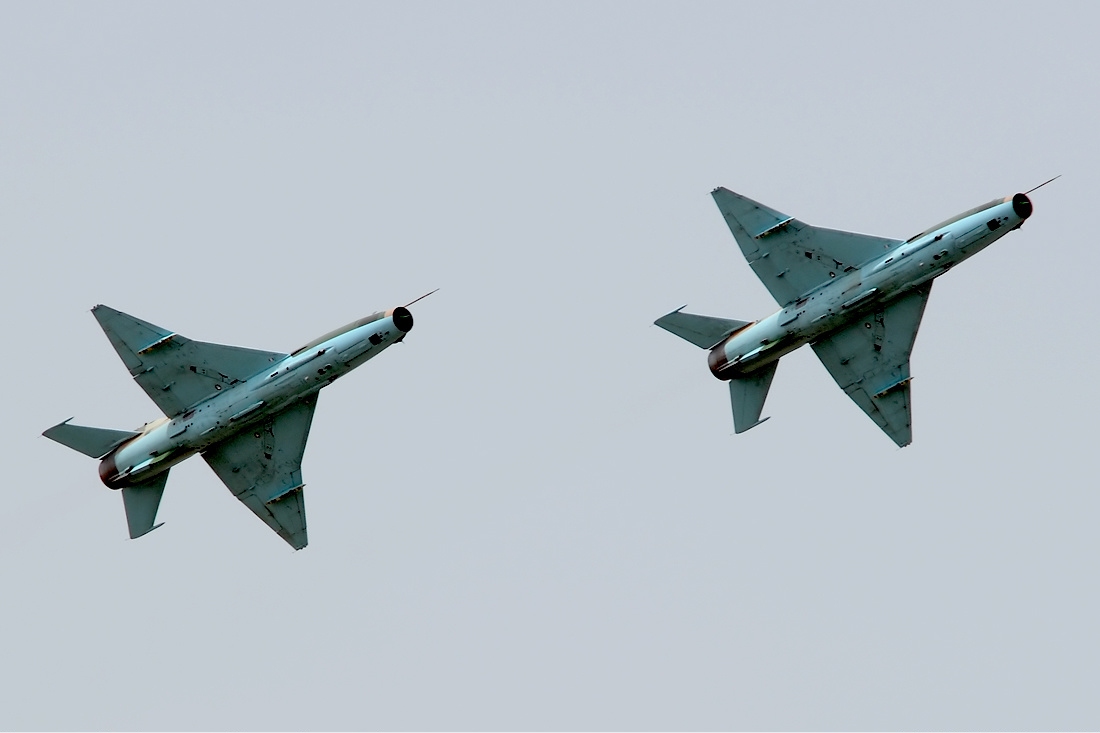
MiG-21 and F-7: one family, two production lines
The Mikoyan-Gurevich MiG-21 is a light, single-engine supersonic fighter that entered Soviet service around 1959 and was built in greater numbers than any other supersonic jet. China reverse-engineered and licence-developed it as the Chengdu J-7, exported as the F-7. Later export models such as the F-7MG added a double-delta wing and Western avionics. Africa’s newest MiG-21-family jets are all F-7MG derivatives: Nigeria’s F-7NI, Tanzania’s F-7TN and Namibia’s F-7NM.
The aircraft’s appeal was simple: it was cheap, fast and often supplied as aid. Its weakness today is equally simple. It has short range, a small radar and limited payload, and spare parts for Soviet-built airframes are scarce. That explains why most African air forces that still list it are either replacing it or keeping only a handful flying.
Who still lists MiG-21s and F-7s
| Country | Type listed | Listed (2025 directory) | Historical deliveries (SIPRI) | Status note |
|---|---|---|---|---|
| Nigeria | F-7NI / FT-7NI | 11 | 15 F-7NI/FT-7NI (2010) + 1 FT-7NI (2023) | Active; deep maintenance in China 2020–2022 |
| Tanzania | F-7TN / FT-7 | 11 + 2 | ~14 F-7TN (2009–2012); 12 F-7A (1981) | Listed; low reported activity |
| Zimbabwe | F-7 / FT-7 | 10 + 2 | ~12 F-7BS (1986), 2 FT-7BZ (1991) | Listed; age limits availability |
| Sudan | F-7 and MiG-21 | 12 F-7, 4 MiG-21 | ~18 F-7B (1987, 1997); ~22 MiG-21PFM (1970) | Status uncertain since the 2023 war |
| Angola | MiG-21 | 23 | ~99 MiG-21MF/bis (1975–1986) | Listed; serviceability unconfirmed |
| Libya | MiG-21 | 12 | ~90 MiG-21PF/bis (1975–1979) | Split between rival authorities |
| Mali | MiG-21 | 9 | ~16 MiG-21bis (1976), 3 MiG-21MF (2005) | Listed; not seen in recent operations |
| Mozambique | MiG-21 | 8 | ~43 MiG-21bis (1977–1978) | Listed; serviceability unconfirmed |
Sources: FlightGlobal 2025 World Air Forces directory; SIPRI Arms Transfers Database (data to 2025). Listed is not the same as flying: none of these air forces publishes readiness figures.
Nigeria: the best-documented active F-7 fleet
Nigeria bought 12 F-7NI fighters and 3 FT-7NI two-seaters in a deal SIPRI values at $251 million, delivered in 2010, and added one more FT-7NI in 2023. In November 2020 Military Africa reported that most of the frontline F-7 fleet had been sent to China for deep maintenance. The Nigerian Air Force later published an account of the Chief of the Air Staff inspecting reactivation work on F-7NIs at Makurdi, and in October 2022 the jets were reported back in Nigeria after overhaul. They serve alongside Pakistani JF-17s, Brazilian-designed A-29 Super Tucanos and Italian M-346FAs. See our Nigerian Air Force aircraft guide.
Tanzania, Zimbabwe and Namibia: China’s F-7 customers
Tanzania took about 14 F-7TNs between 2009 and 2012, replacing earlier F-7As and MiG-21s; its fleet is profiled in our Tanzania Air Force aircraft guide. Zimbabwe’s F-7s date from 1986 and are among the oldest still listed anywhere, flying alongside Chinese K-8 jet trainers. Namibia also bought F-7NM fighters, delivered in 2006–2008 according to SIPRI. Public counts of the Namibian fleet conflict, so we do not give a figure here. For the trainers that accompany these fighters, see our guide to K-8 operators in Africa.
The Soviet-built MiG-21 holdouts
Angola once received about a hundred MiG-21s, many flown by Cuban pilots during the civil war; it now relies primarily on Su-30K and other Russian types, covered in our Angolan Air Force guide. Libya’s MiG-21s saw use by eastern forces after 2014, but its air arms are divided and records are poor. Mali’s and Mozambique’s small fleets are carried in the directory but have not been documented in recent operations. Sudan lists both F-7s and a few MiG-21s; the condition of its air force since the war with the Rapid Support Forces began in April 2023 is unclear. Our Sudan Air Force aircraft guide sets out what is known.
Who has retired the MiG-21
Egypt was Africa’s largest MiG-21 user, receiving more than 400 from the Soviet Union and Czechoslovakia in 1961–1973, then about 110 Chinese F-7Bs in 1980–1986, many assembled locally. None appear in FlightGlobal’s 2025 Egyptian listing, which is now dominated by F-16s, Rafales and MiG-29s; see Egypt’s fighter fleet. FlightGlobal recorded Uganda removing its last five MiG-21s from use, leaving Su-30MK2s as its fighters. Algeria, Ethiopia, Somalia, Zambia, Guinea, Guinea-Bissau, Madagascar, Congo-Brazzaville and DR Congo also received MiG-21s in the past and no longer list them.
Replacements vary. Wealthier air forces moved to Su-30s or F-16s (see Su-30 operators in Africa); others chose light attack aircraft and armed jet trainers, which are cheaper to run and better suited to counter-insurgency.
Frequently asked questions
Which African countries still fly the MiG-21?
FlightGlobal’s 2025 directory lists Soviet-built MiG-21s in Angola (23), Libya (12), Mali (9), Mozambique (8) and Sudan (4). How many are airworthy is not publicly confirmed.
What is the difference between the MiG-21 and the F-7?
The F-7 is the export version of China’s Chengdu J-7, developed from the MiG-21. Later F-7MG variants used in Nigeria, Tanzania and Namibia have a double-delta wing and Western-supplied avionics.
Does Nigeria still operate the F-7?
Yes. FlightGlobal lists 11 F-7NIs. The fleet returned from deep maintenance in China in 2022 after reactivation work, and Nigeria received an additional FT-7NI trainer in 2023 according to SIPRI.
Did Egypt retire its MiG-21s?
Egypt does not appear with MiG-21s or F-7s in FlightGlobal’s 2025 listing. It once operated more than 500 MiG-21-family aircraft.
Did Uganda retire the MiG-21?
Yes. FlightGlobal’s 2025 analysis recorded Uganda ending its use of five MiG-21s.
Sources
- FlightGlobal, “2025 World Air Forces directory”, November 2024. https://www.flightglobal.com/defence/2024/11/2025-world-air-forces-directory/ (accessed 8 November 2026).
- Stockholm International Peace Research Institute (SIPRI), “SIPRI Arms Transfers Database, trade registers for African recipients (data to 2025)”, March 2026 release. https://armstransfers.sipri.org/ (accessed 6 November 2026 (local extract re-checked 8 November 2026)).
- Nigerian Air Force, “Operational effectiveness receives boost as CAS inspects ongoing reactivation work on F-7NI aircraft, commissions infrastructural projects in Makurdi”, undated news release (2022). https://airforce.mil.ng/news/operational-effectiveness-receives-boost-as-cas-inspects-ongoing-reactivation-work-on-f-7ni-aircraft,-commissions-infrastructural-projects-in-makurdi882635573 (accessed 8 November 2026).
- Military Africa, “Nigeria: 78% of frontline F-7 aircraft fleet in China for maintenance”, November 2020. https://www.military.africa/2020/11/nigeria-78-of-frontline-f-7-aircraft-fleet-in-china-for-maintenance/ (accessed 8 November 2026).
- Military Africa, “Nigeria’s F-7Ni Airguards returns from maintenance in China”, October 2022. https://www.military.africa/2022/10/nigerias-f-7ni-airguards-returns-from-maintenance-in-china/ (accessed 8 November 2026).
Method: counts from SIPRI are deliveries recorded by SIPRI, not current inventories. Status labels distinguish delivered, reported in service, ordered and retired; where open sources disagree, the range is shown rather than a single figure.