Eight African countries have taken delivery of the Hongdu K-8 Karakorum jet trainer and light-attack aircraft, according to SIPRI: Egypt, Zambia, Zimbabwe, Sudan, Angola, Tanzania, Namibia and Ghana. Egypt is by far the largest operator, with about 120 licence-assembled K-8Es recorded, while Angola’s 12 K-8Ws, delivered in 2019–2020, are the newest African fleet. Africa has been the type’s main export market outside Asia, but no African air force publishes a current K-8 serviceability figure.
Quick answer
Delivered (SIPRI): Egypt ~120 K-8E; Sudan ~23 K-8S plus 1 second-hand; Zambia 16; Zimbabwe 12; Angola 12 K-8W; Tanzania ~6; Namibia 4 (possibly up to 12); Ghana 4. Role: intermediate/advanced jet training, with light ground attack in several fleets. Newest African customer: Angola (order 2018, deliveries 2019–2020). Current totals: not officially published; treat tracker figures as estimates.
Last updated: 8 November 2026. Delivery figures come from SIPRI’s trade registers (data to 2025); “?” values in SIPRI are flagged as uncertain. Current in-service figures are not published by African governments.
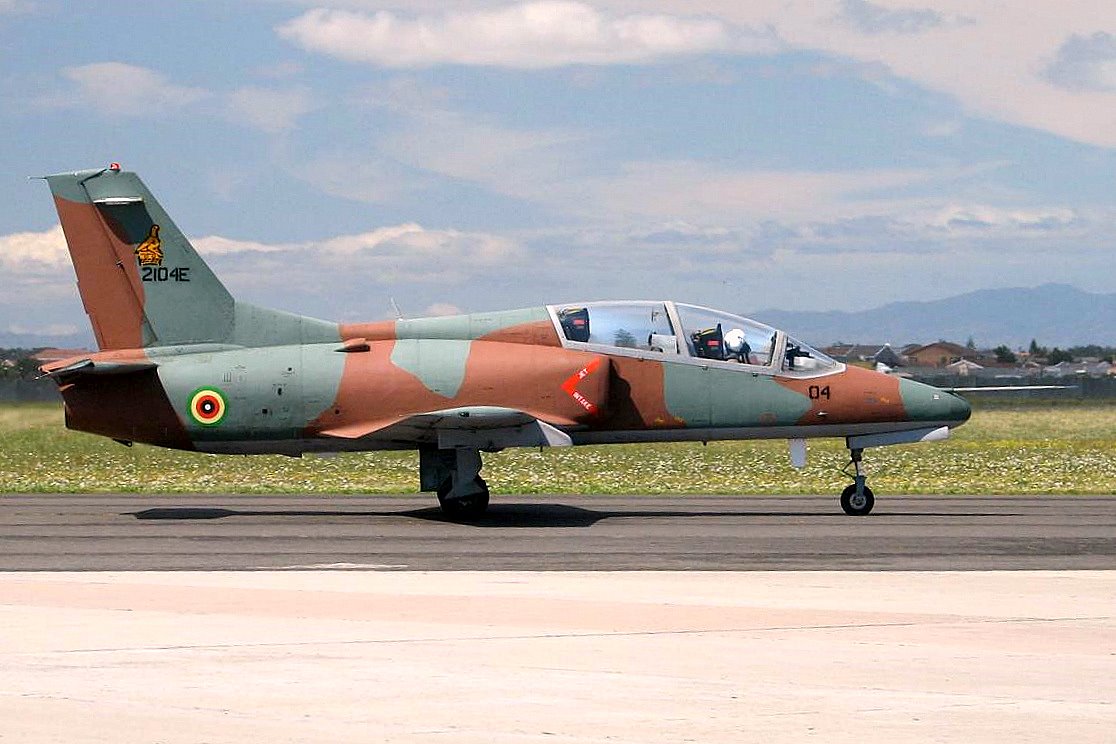
What is the K-8 Karakorum?
The K-8 is a single-engine, two-seat jet trainer developed by China’s Hongdu Aviation Industry Corporation with Pakistan Aeronautical Complex in the 1990s. It sits between basic turboprop trainers and fast jets: pilots learn jet handling, formation flying and weapons employment before moving to frontline fighters. Export aircraft carry an underfuselage gun pod and underwing stores, which is why SIPRI classifies the type as a “trainer/combat aircraft”. defenceWeb’s 2020 description of the export standard lists a top speed of about 800 km/h, a maximum take-off weight of 4,470 kg and options for a Western-style glass cockpit and head-up display.
For many African air forces, the K-8’s appeal has been cost and availability rather than performance. It filled a gap left by retiring British, Czech and Italian trainers and arrived without the political conditions attached to some Western sales. The clearest example is Zimbabwe: SIPRI notes that Harare bought K-8s after the United Kingdom refused to supply spare parts for its BAE Hawk fleet.
African K-8 operators at a glance
| Country | Version | Delivered (SIPRI) | Delivery years | Status, November 2026 |
|---|---|---|---|---|
| Egypt | K-8E | 80 + 40 = ~120 | 2001–2005; 2007–2010 | Reported in service; most assembled in Egypt |
| Sudan | K-8S | ~13 + ~10, plus 1 second-hand | 2006–2007; 2012–2013; 2024 | Reported; wartime status unclear |
| Zambia | K-8 | 8 + 8 = 16 | 2000; 2012 | Reported in service |
| Zimbabwe | K-8 | 6 + 6 = 12 | 2005; 2006 | Reported in service |
| Angola | K-8W | 12 | 2019–2020 | Delivered; newest African fleet |
| Tanzania | K-8 | ~6 | 2011–2012 | Reported in service |
| Namibia | K-8 | 4 (SIPRI notes could be up to 12) | 2001 | Status unconfirmed |
| Ghana | K-8 | 4 | 2007 | Status unconfirmed |
Source: SIPRI Arms Transfers Database (data to 2025). Delivered numbers are cumulative transfers, not present inventories; losses and retirements are not subtracted.
Egypt: the licence-assembly model
Egypt is the outlier. SIPRI records an order for 80 K-8Es in 1999, worth $345 million, with 70 assembled from kits in Egypt, followed by a second order for 40 in 2004, also kit-assembled. That makes Egypt the only African K-8 operator with a local production role, and it explains why the K-8E is described as a distinct variant with modified airframe and avionics. Our guide to trainer aircraft in African air forces covers how the K-8E fits alongside Egypt’s ageing Alpha Jets.
Southern and East Africa: Zambia, Zimbabwe, Tanzania, Namibia and Angola
Southern Africa accounts for most African K-8 customers. Zambia took two batches of eight, in 2000 and 2012. Zimbabwe received six in each of 2005 and 2006. Tanzania’s six arrived in 2011–2012, alongside Chinese F-7 fighters. Namibia’s 2001 delivery is the least certain entry in the register: SIPRI lists four but notes the number could be as high as 12, so it should not be quoted as a firm total.
Angola is the most recent customer. defenceWeb reported in May 2020 that six K-8Ws had been delivered and a further six were due that year; SIPRI records 12 K-8Ws ordered in 2018. The K-8W is an improved export standard with an upgraded cockpit. Angola’s choice is notable because the Angolan air force had historically relied on Soviet and Russian aircraft.
Sudan and Ghana
Sudan bought K-8S jets in two batches (2006–2007 and 2012–2013), and SIPRI says the order explicitly included a combat role. It also records a single second-hand K-8 delivered in 2024 from an unknown supplier, possibly Egypt. Since April 2023, Sudan’s war has made independent verification of any aircraft type’s status difficult; see our Sudan air force aircraft profile for wider context. Ghana’s four K-8s, delivered in 2007, were partly paid for with a second-hand Gulfstream III, according to SIPRI. Their current status is not confirmed in the sources reviewed here.
K-8 compared with Africa’s other jet trainers
| Type | Origin | Main African users | Position in the training pipeline |
|---|---|---|---|
| K-8 Karakorum | China/Pakistan | Egypt, Zambia, Zimbabwe, Sudan, Angola | Intermediate/advanced jet trainer with light attack |
| L-39 Albatros / L-39NG | Czech Republic | Algeria, Ethiopia, Mali, Angola (L-39NG order) | Intermediate jet trainer; widely armed |
| Alpha Jet | France/Germany | Egypt, Morocco, Nigeria, Cameroon | Advanced trainer and light attack |
| Hongdu L-15 | China | Zambia | Supersonic lead-in fighter trainer |
The K-8 is subsonic and relatively simple. Air forces that want a lead-in trainer for fourth-generation fighters, such as Zambia with its L-15s, use it as a step below a faster aircraft rather than as the last stage before frontline jets. For a broader comparison of armed trainers used in counter-insurgency, see our analysis of light attack aircraft and armed trainers in Africa.
What the numbers do not show
A delivery total is not an operational fleet. K-8s have been lost in accidents, some airframes are used for spares and others may be stored. Public tracker counts often differ from SIPRI totals for this reason. Where a figure cannot be traced to a dated, identifiable source, DefenceMENA treats it as an estimate.
Frequently asked questions
Which African country has the most K-8 jets?
Egypt. SIPRI records about 120 K-8Es delivered between 2001 and 2010, most of them assembled in Egypt from kits.
Is the K-8 a fighter jet?
No. It is a jet trainer that can carry light weapons. SIPRI classifies it as a trainer/combat aircraft, and several African air forces use it for light ground attack, but it is not an air-superiority fighter.
Did Angola buy the K-8?
Yes. SIPRI records 12 K-8Ws ordered in 2018, and defenceWeb reported in May 2020 that the first six had been delivered with six more due that year.
Why did Zimbabwe buy the K-8?
SIPRI notes that Zimbabwe ordered K-8s in 2005 after the United Kingdom refused to supply spare parts for its Hawk trainer/combat aircraft.
How many K-8s does Namibia have?
SIPRI records four delivered in 2001 but notes the total could be up to 12. No current official figure is published.
Sources
- Stockholm International Peace Research Institute (SIPRI), “SIPRI Arms Transfers Database, trade registers for African recipients (data to 2025)”, March 2026 release. https://armstransfers.sipri.org/ (accessed 6 November 2026 (local extract re-checked 8 November 2026)).
- defenceWeb, “Angolan K-8 deliveries underway”, 25 May 2020. https://defenceweb.co.za/aerospace/aerospace-aerospace/angolan-k-8-deliveries-underway/ (accessed 8 November 2026).
- Airforce Technology, “K-8 Karakorum Light Attack and Jet Trainer Aircraft”, undated project profile. https://www.airforce-technology.com/projects/hongdu-k8/ (accessed 8 November 2026).
- defenceWeb, “L-39 Skyfox set for African debut as Angola places first order”, June 2026. https://defenceweb.co.za/aerospace/aerospace-aerospace/l-39-skyfox-set-for-african-debut-as-angola-places-first-order/ (accessed 7 November 2026 (DefenceMENA L-39 ledger)).
- defenceWeb, “China makes big inroads into African defence market”, undated industry analysis. https://defenceweb.co.za/industry/industry-industry/china-makes-big-inroads-into-african-defence-market/ (accessed 8 November 2026).
Method: counts from SIPRI are deliveries recorded by SIPRI, not current inventories. Status labels distinguish delivered, reported in service, ordered and retired; where open sources disagree, the range is shown rather than a single figure.