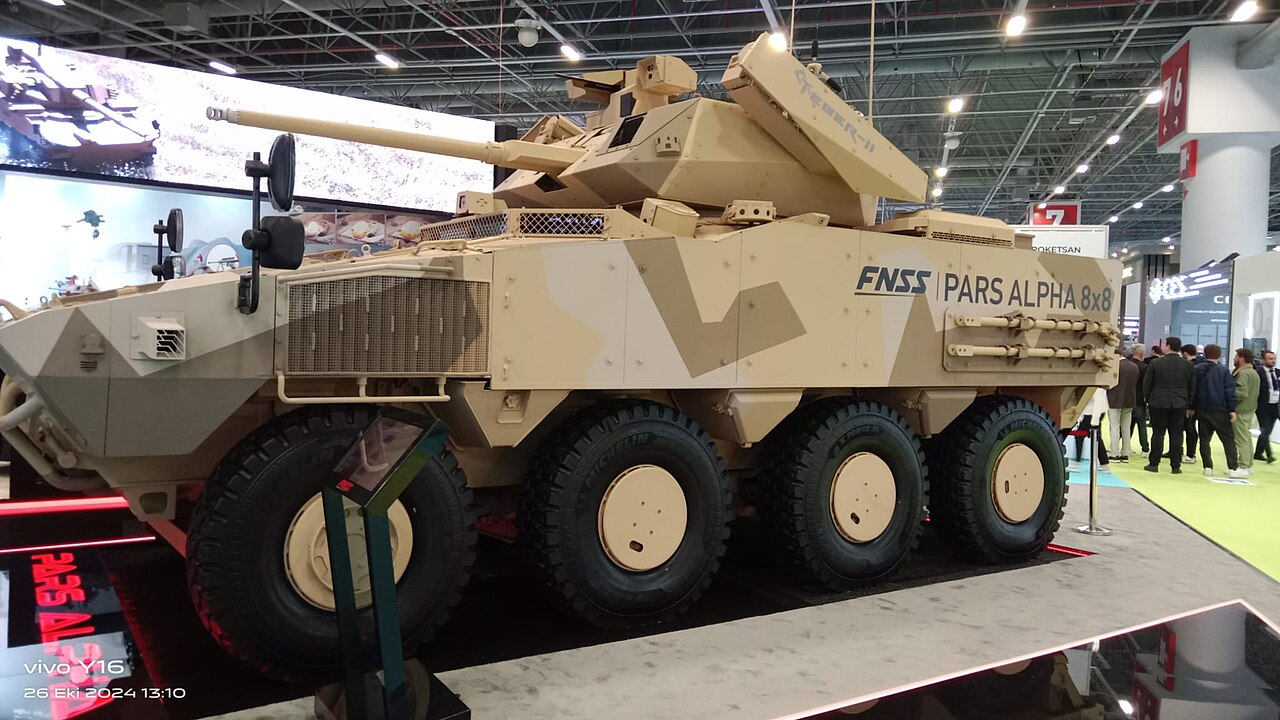
The FNSS company profile starts in Ankara, where Türkiye’s main maker of tracked and wheeled armoured vehicles has operated since 1988. FNSS Savunma Sistemleri designs the ACV-15 family, the Pars 4×4, 6×6 and 8×8 range and the Kaplan medium tank platform, and it serves the Turkish Armed Forces first and export buyers second. Its confirmed customers sit mainly in Southeast Asia and the Gulf. In Africa, no government contract has been publicly documented. This profile separates what is confirmed from what is only reported.
FNSS Company Profile: Origins and Ownership
FNSS was founded in 1988 as FMC Nurol Savunma Sanayii, a joint venture between the US group FMC Corporation and Nurol Holding of Türkiye. The company is headquartered in Gölbaşı, on the outskirts of Ankara. Its first product line grew from the American armoured infantry fighting vehicle family, itself a development of the M113 carrier, adapted to a Turkish Land Forces requirement.
The resulting ACV-15 reached the Turkish Army in the early 1990s and became the base for most of the company’s tracked designs. It was also exported in modified form, and the ACV family has seen service in Somalia, Bosnia and Kosovo.
Ownership has changed since then. Older trade profiles describe FNSS as jointly held by Nurol and a US defence group, the successor to the original FMC stake. Current reference listings describe the company as fully owned by Nurol Holding since January 2025. The company’s own corporate profile page does not state the shareholding, so the point should be treated as reported rather than company-confirmed.
The same page says FNSS has supplied more than 4,000 armoured combat vehicles to users in several countries. The company does not break that total down by customer or by year.
Key Products: ACV-15, Pars and Kaplan
The tracked ACV-15 is an amphibious vehicle armed in its basic form with a 25 mm cannon and a coaxial 7.62 mm machine gun. The stretched ACV-S adds a roadwheel, extra armour and a 350 or 400 hp powerpack, and weighs about 18 tonnes. Role variants include mortar carriers, anti-tank vehicles, command posts and recovery vehicles. A version with a BMP-3 turret and 100 mm gun was also developed.
The wheeled Pars family comes in 4×4, 6×6 and 8×8 layouts. Published figures put combat weight between roughly 16 and 24.5 tonnes depending on configuration, with protection up to STANAG 4569 Level 4 and a 25 mm turret option. The newer Pars Alpha 8×8 was displayed at the SAHA Expo in Istanbul in 2024.
In April 2019 FNSS announced that the first stage of the Pars-based SPTWAV programme covered five configurations and 100 vehicles for the Turkish Land Forces and the Gendarmerie, including command, radar, sensor and CBRN reconnaissance versions. Details are in the company’s Pars Scout announcement.
The Kaplan MT, developed with Indonesia’s PT Pindad, is a medium tracked vehicle with a CMI Cockerill 3105 turret carrying a 105 mm gun and autoloader. FNSS quotes a power-to-weight ratio of 20 hp per tonne and a minimum range of 450 km on its Kaplan MT page. A hybrid-drive option, the Kaplan Hybrid, is offered for vehicles up to 20 tonnes, with a 40-tonne version still in development.
| Family | Type | Notable configuration | Known users |
|---|---|---|---|
| ACV-15 / ACV-S / ACV-300 | Tracked amphibious IFV and APC | 25 mm cannon; mortar, anti-tank and recovery variants | Türkiye, Malaysia, UAE, Jordan (ACV-S), Philippines |
| Pars 4×4, 6×6, 8×8 | Wheeled armoured vehicle | 25 mm turret option; Scout and Alpha variants | Türkiye, Oman; Malaysian AV8 Gempita is a derivative |
| Kaplan MT | Medium tracked vehicle | 105 mm gun with autoloader | Indonesia |
| Kaplan Hybrid | Hybrid powertrain offer | Serial hybrid, up to 20 tonnes | No customer identified |
Confirmed Customers and Export Markets
The Turkish Armed Forces are by far the largest user. Reference listings credit the army with 2,249 ACV-15 vehicles. The Amphibious Marine Brigade also operates the ZAHA marine assault vehicle.
Malaysia is the largest export market. It ordered 211 ACV-300 Adnan vehicles in 2000 and 56 more in 2008, and a separate deal with DefTech for 257 wheeled vehicles was reported in March 2011. The Malaysian AV8 Gempita is based on the Pars design.
In the Gulf, the United Arab Emirates fields the ACV-15, and Jordan ordered the ACV-S, according to the Army Technology project file. Oman is the Pars export customer in the region. FNSS dates Pars exports to Malaysia in 2010 and Oman in 2015, and reference listings put the Omani total at 172 vehicles, delivered between July 2017 and August 2020.
Indonesia operates the Kaplan MT, as confirmed in the trade coverage of the CSG agreement. The Philippines holds a small batch of six ACV-300 vehicles.
FNSS in Africa: What Is and Is Not Documented
No African government contract with FNSS has been announced by the company or confirmed by an African ministry in the sources checked for this profile. FNSS’s corporate and product pages name no African customer. A 2015 defenceWeb survey of the African armoured vehicle market does not mention FNSS or any other Turkish tracked or wheeled vehicle.
The one African entry in open-source reference lists is Libya. Those lists record at least 50 ACV-15 vehicles used by forces aligned with the Tripoli government in the 2019 and 2020 fighting. The basis is press reporting and not a published contract or export licence, so the count is unconfirmed.
The gap matters for anyone searching for Turkish armour in Africa. Turkish exports to the continent have so far been led by drones, patrol vehicles and naval ships, a pattern covered in the site’s review of arms suppliers to Africa. FNSS appears to be a Gulf and Asian exporter that has not yet crossed into sub-Saharan markets.
Partnerships and Local Production
The most recent partnership is with Czechoslovak Group. On 12 May 2026, at the IDEB exhibition in Bratislava, CSG Defence and FNSS announced cooperation to develop, produce and sell armoured platforms for European and other markets. The first product is the CFL-120 Karpat, built on the Kaplan MT chassis with Leonardo’s HITFACT Mk II turret and a 120 mm gun.
Published figures for the Karpat give a combat weight of up to 34 tonnes, a top speed of 70 km/h and a range of about 450 km. Production would use CSG capacity in Slovakia, with technology transfer introduced gradually and local suppliers involved.
Elsewhere, local assembly has been part of the export model for years. Malaysian Adnan vehicles were partly assembled from kits at Pekan, and the Kaplan MT line in Indonesia is a joint effort with PT Pindad. FNSS also advertises localisation packages that cover local hiring, domestic supply chains, in-country training and technology transfer. For a possible African buyer, that offer is the relevant point, since several African states require local content. Related Turkish prime contractors are profiled in the ASELSAN company profile, the Roketsan company profile and the Baykar company profile.
Financial Snapshot and Workforce
FNSS does not publish a full annual report on its website. Reference listings give revenue of about US$374.6 million for 2018 and US$515.0 million for 2019, and a workforce of 782 employees without a stated year. No later audited figures were found for this profile.
In any FNSS company profile, that limits claims about growth. The 2019 figure is the last revenue number available, and the company’s order book since then, including Pars Scout and any hybrid or Karpat work, has not been quantified in public sources.
Strengths, Limits and Outlook
The main strength in the FNSS company profile is a complete in-house line of tracked and wheeled vehicles, backed by a domestic customer that has bought in large numbers. It has delivered to demanding Gulf and Asian buyers, and it holds a hybrid drive concept that few competitors offer.
The limits are visible in the data. The export base is narrow, ownership and finances are thinly disclosed, and Africa remains unproven. The CSG partnership shows FNSS is willing to share production abroad, which is the model most African buyers would ask for.
Whether that translates into African orders depends on funding and on competition from other Turkish and international suppliers. At the time of writing, no such contract is public.
Frequently Asked Questions
Who owns FNSS?
FNSS was founded in 1988 as a joint venture between FMC Corporation and Nurol Holding. Current reference listings describe it as fully owned by Nurol Holding since January 2025. The company’s own profile page does not state the shareholding, so the point is reported rather than company-confirmed.
What does FNSS make?
FNSS makes tracked and wheeled armoured vehicles and turrets. The main families are the tracked ACV-15 and ACV-S, the wheeled Pars 4×4, 6×6 and 8×8, and the Kaplan MT medium tracked vehicle. It also offers upgrade and modernisation work for existing vehicles.
Does FNSS sell to African countries?
No African government contract has been publicly documented. Open-source lists record ACV-15 vehicles in Libya, at least 50 by one count, but that rests on press reporting and not on a published contract. Confirmed export customers are in Southeast Asia, the Gulf and Indonesia.
What is the CFL-120 Karpat?
The CFL-120 Karpat is a medium tracked combat vehicle unveiled by CSG and FNSS in Bratislava on 12 May 2026. It uses the Kaplan MT chassis with a Leonardo HITFACT Mk II turret and 120 mm gun, and its stated combat weight is up to 34 tonnes.
Sources
- FNSS: corporate profile
- FNSS: Kaplan MT product page
- FNSS: Kaplan Hybrid product page
- FNSS: Pars Scout 8×8 and 6×6 announcement
- European Defence Review: CSG and FNSS cooperation and CFL-120 Karpat
- Janes: CSG and FNSS unveil the CFL-120 Karpat
- Army Technology: ACV-S tracked armoured combat vehicle
- defenceWeb: FNSS and DefTech deal for 257 vehicles
- defenceWeb: Security challenges driving modest African armoured vehicles market