Bayraktar Akinci Africa: Operators, Orders and Combat Record

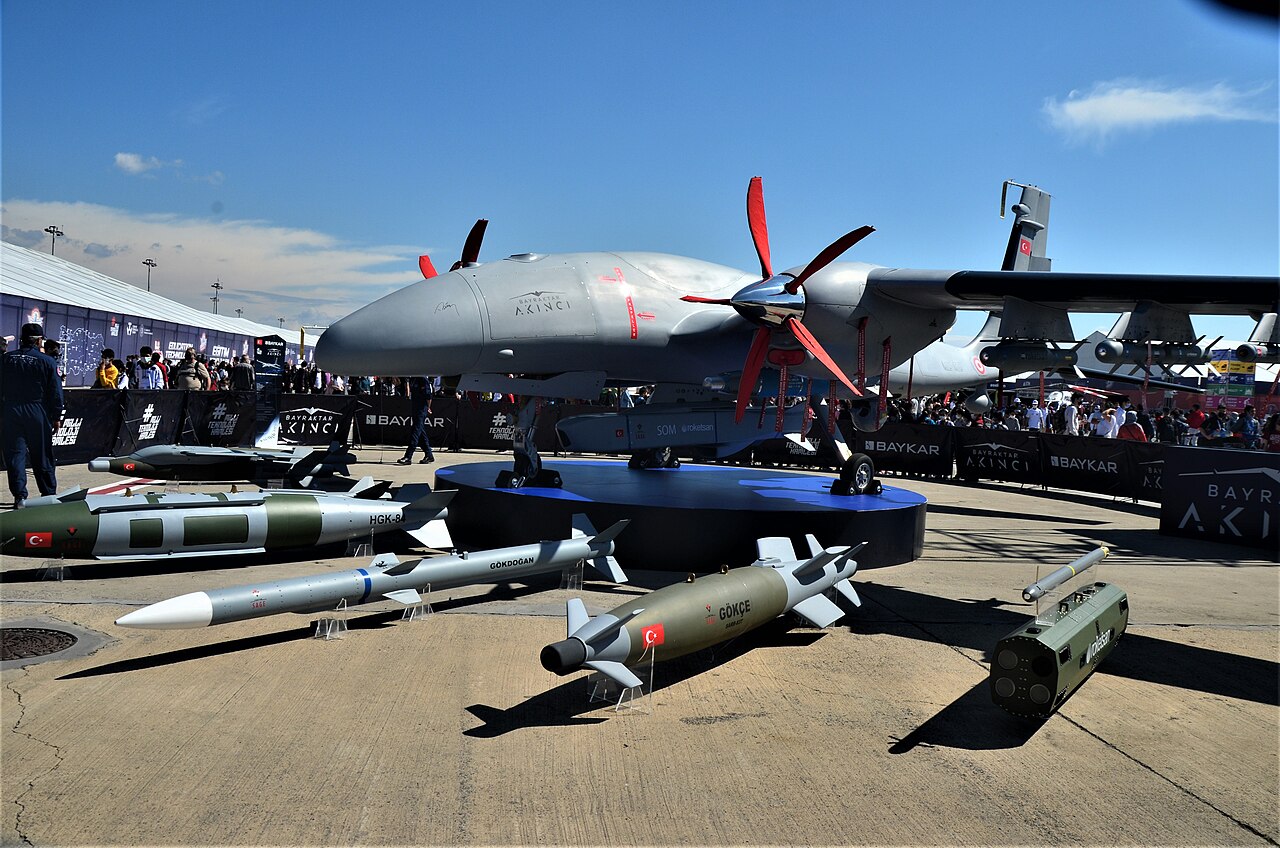


The Bayraktar Akinci Africa story is smaller than the drone’s reputation suggests: a handful of governments have been seen with it, and almost none has published numbers. Baykar’s twin-engine Akinci is a heavy armed drone built by Turkey’s Baykar, and visual or official evidence places it in service in Ethiopia, Burkina Faso and Mali. Somalia, Libya, Sudan and Morocco are reported users with weaker documentation, and Nigeria has no confirmed order. This Bayraktar Akinci Africa guide sorts operators by the strength of the evidence, sets out the specifications and reviews what is known of its combat record on the continent.
Bayraktar Akinci Africa: Overview and Development History
The Akinci is a high-altitude, long-endurance armed drone developed by Baykar. It first flew in December 2019 and entered Turkish Armed Forces service in 2021, according to Militarnyi. A first batch reached the Turkish Army in August 2021, Atalayar reports.
It is a step up from the smaller Bayraktar TB2 that made Baykar’s name in Africa, which our guide to the Bayraktar TB2 in Africa covers. The Akinci carries a heavier load, flies higher and uses a national active electronically scanned array radar, as Baykar’s own data sheet lists. The company’s wider product range is profiled in our Baykar company profile.
Outside Africa, Military Africa names Azerbaijan, Pakistan, Indonesia, Kyrgyzstan and Saudi Arabia as export customers. Forbes reports that the Saudi contract was described by Baykar as Turkey’s biggest defence and aviation export deal.
Specifications and Performance
Baykar’s published data gives the figures below. Three engine options are offered: 2 x 450 hp, 2 x 750 hp or 2 x 850 hp. Early African examples appear to be the A model with the smaller engines, which is what defenceWeb concluded for Ethiopia and Military Africa for Mali.
| Parameter | Baykar figure |
|---|---|
| Maximum take-off weight | 6,000 kg |
| Payload capacity | 1,500 kg |
| Endurance | 20+ hours |
| Service ceiling | 40,000 ft |
| Operational altitude | 30,000 ft |
| Wingspan / length | 20 m / 12.2 m |
| Operational range | 6,000 km |
| Radar | National multi-mode AESA radar |
Third-party articles quote different endurance and ceiling values, from 24 hours to 25 hours and from about 11,000 to 12,200 m. The Baykar table is the safer reference. Range and altitude figures are manufacturer claims and are not independently verified in African service.
Armament and Capabilities
Photographs from African users show Roketsan munitions. The Malian aircraft shown in Bamako carried MAM-T smart munitions and TEBER-81 and TEBER-82 guidance kits, according to Military Africa. Burkina Faso’s aircraft were seen with MAM-L and MAM-T munitions plus TEBER and HGK guided-bomb kits, and Ethiopian aircraft with underwing MAM-L missiles.
These weapons are precision-guided munitions for strikes against vehicles, camps and fixed positions. They suit counter-insurgency tasks. They are not designed to defeat modern air defences, a limit that matters in the combat record below.
Bayraktar Akinci Africa Operators and Numbers in Service
The table separates evidence levels. “Seen” means photographs or video of the aircraft with national markings. “Reported” means a single press or forum claim without official confirmation.
| Country | Status | Number | Evidence |
|---|---|---|---|
| Ethiopia | In service (seen) | Not disclosed | Tail S40 in Ethiopian markings; MAM-L missiles; defenceWeb, January 2024 |
| Burkina Faso | In service (seen) | Two seen | First public sighting reported April 2024 |
| Mali | In service (official presentation) | At least two in 2024; further batch reported July 2026, size not stated | State television, ceremony in Bamako; minister said purchased from the national budget |
| Somalia | Reported delivered | Two | Social media post by a Somali minister, March 2025; no official statement found |
| Libya, Tripoli government | Reported | At least one | Photograph with Libyan flag, July 2024; operator unconfirmed |
| Libya, eastern forces | Reported | At least two | Satellite imagery of Al-Khadim airbase, August, per Janes |
| Sudan | Reported in use | Not disclosed | Rapid Support Forces claim of a shootdown, July 2025; no official procurement record |
| Morocco | Reported first batch | Not disclosed | Unofficial FAR Maroc forum, via Atalayar and Yabiladi, February 2025 |
| Egypt | Reported | Not disclosed | Forbes, citing satellite imagery; no official confirmation found |
| Nigeria | No Akinci order found | None | Military Africa reported a TB2 order, not an Akinci |
| Algeria | Not an operator | None | Operates other Turkish types; see the Anka and Aksungur guide |
Mali is the clearest case. Reports say a first pair arrived in late 2024, at least two airframes were transferred in January, and a new batch was received at Sévaré air base on 30 July, with a Turkish A400M flight logged the day before. The size of that batch has not been published.
The Libyan entries are the most layered. Janes describes at least two Akinci parked at Al-Khadim airbase in eastern Libya, a base controlled by Khalifa Haftar’s forces, while the same report notes that the Tripoli side also operates Turkish drones. Forbes says Turkey deployed the eastern aircraft. Who holds title to them is not established in the sources reviewed.
Operational Record and Combat Use
Publicly verifiable combat reporting on the Bayraktar Akinci Africa fleet is thin and mostly comes from the parties themselves. The most documented incident involves Mali and Algeria. Algeria’s defence ministry said its air defences downed a Malian Akinci that entered about 2 km into Algerian airspace near Tin Zaouatine on 31 March or 1 April 2025. Mali said the aircraft suffered a technical failure inside its own territory. Mali recalled its ambassador and filed a complaint, which Algeria rejected.
In Sudan, the Rapid Support Forces announced on 10 July 2025 that they had shot down a Sudanese Armed Forces Akinci over El Fasher. The claim rests on an RSF statement, with no independent wreckage or footage in the report. Turkish instructors were reportedly training Sudanese crews on the type by early May 2025.
One defence-industry article lists further Akinci losses in Libya and Sudan, but names no sources, so those counts should be treated as unverified. The fuller picture of drone use on the continent is in our overview of military drones in Africa.
How the Akinci Compares With Rival Systems
The Bayraktar Akinci Africa offer competes for the same buyers as Turkish Aerospace’s Aksungur and Chinese Wing Loong types. Figures below come from the manufacturers or from trade press at first flight, and are not like-for-like test results.
| System | Max take-off weight | Payload | Endurance | Wingspan |
|---|---|---|---|---|
| Baykar Akinci | 6,000 kg | 1,500 kg | 20+ hours | 20 m |
| Turkish Aerospace Aksungur | 3,300 kg | 750+ kg | Up to 50 hours | 24 m |
| AVIC Wing Loong II | 4,200 kg | 480 kg external | 20 hours | 20.5 m |
The Akinci offers the heaviest payload of the three. The Aksungur trades payload for far longer endurance, and its African customers are covered in our guide to African Anka and Aksungur operators. Chinese systems have a separate record, assessed in the report on Chinese drones in Nigeria.
Price and availability also shape choices. Turkish drones come with training and often with local production offers: Atalayar reports that the Moroccan arrangement includes local assembly lines, though that is not officially confirmed.
Frequently Asked Questions
Which African countries operate the Bayraktar Akinci?
Ethiopia, Burkina Faso and Mali have the strongest evidence, with aircraft photographed in national markings or presented officially. Somalia, Libya, Sudan, Morocco and Egypt are reported users but lack official confirmation in the sources reviewed. Numbers are rarely published, so fleet sizes are unknown for most operators.
Does Nigeria operate the Bayraktar Akinci?
No Akinci order for Nigeria has been found. Military Africa reported in 2022 that Nigeria was acquiring the Bayraktar TB2 rather than the Akinci, citing images shared by Baykar. The Nigerian Air Force has since been linked to other drone types, so any Akinci purchase would need official confirmation before it can be reported as fact.
Has an Akinci been shot down in Africa?
Two incidents are documented by named parties. Algeria said it downed a Malian Akinci near Tin Zaouatine on 31 March or 1 April 2025, which Mali disputes, and the Rapid Support Forces claimed a Sudanese Akinci over El Fasher on 10 July 2025. Neither claim has been independently verified in the sources reviewed.
How much weight can the Akinci carry?
Baykar lists a payload capacity of 1,500 kg and a maximum take-off weight of 6,000 kg. African photographs show smaller Roketsan weapons such as MAM-T and MAM-L munitions and TEBER guidance kits rather than the full load. Actual loadouts in service have not been published.
Sources
- Baykar: Bayraktar Akinci technical specifications
- Military Africa: Mali acquired Akinci drone, after Bayraktar TB2
- Military Africa: Mali acquires additional Akinci drones from Turkey
- Military Africa: Burkina Faso’s Akinci drone breaks cover
- Military Africa: Somalia acquires Akinci drone from Turkey
- defenceWeb: Ethiopia acquires Akinci UAVs, Su-30 fighters
- Military Africa: Akinci drone downed in Sudan
- Janes: Akinci UAVs deployed to eastern Libya
- Atalayar: Morocco receives first batch of Turkish Bayraktar Akinci drones
- Forbes: Turkey’s homegrown armed drones are now ubiquitous in the Arab world
- Turkish Aerospace: Aksungur