Which African Countries Have Ballistic Missiles?



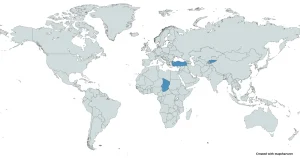
Only two African states have a ballistic missile capability that is both documented by independent sources and believed to be in service today: Algeria, which operates the Russian 9K720 Iskander-E short-range system, and Egypt, which has fielded Soviet-designed Scud-B missiles since the 1970s and is reported to hold locally developed Scud derivatives. Ethiopia acquired Chinese M20 short-range ballistic missiles before 2020, but much of that force was seized by Tigrayan forces at the start of the Tigray war and its current status is unclear. Libya’s Gaddafi-era Scud force and South Africa’s RSA programme are historical. Morocco has ordered US ATACMS missiles, which are not yet delivered. No other African country has a publicly verified ballistic missile arsenal, and no African country has nuclear-armed missiles.
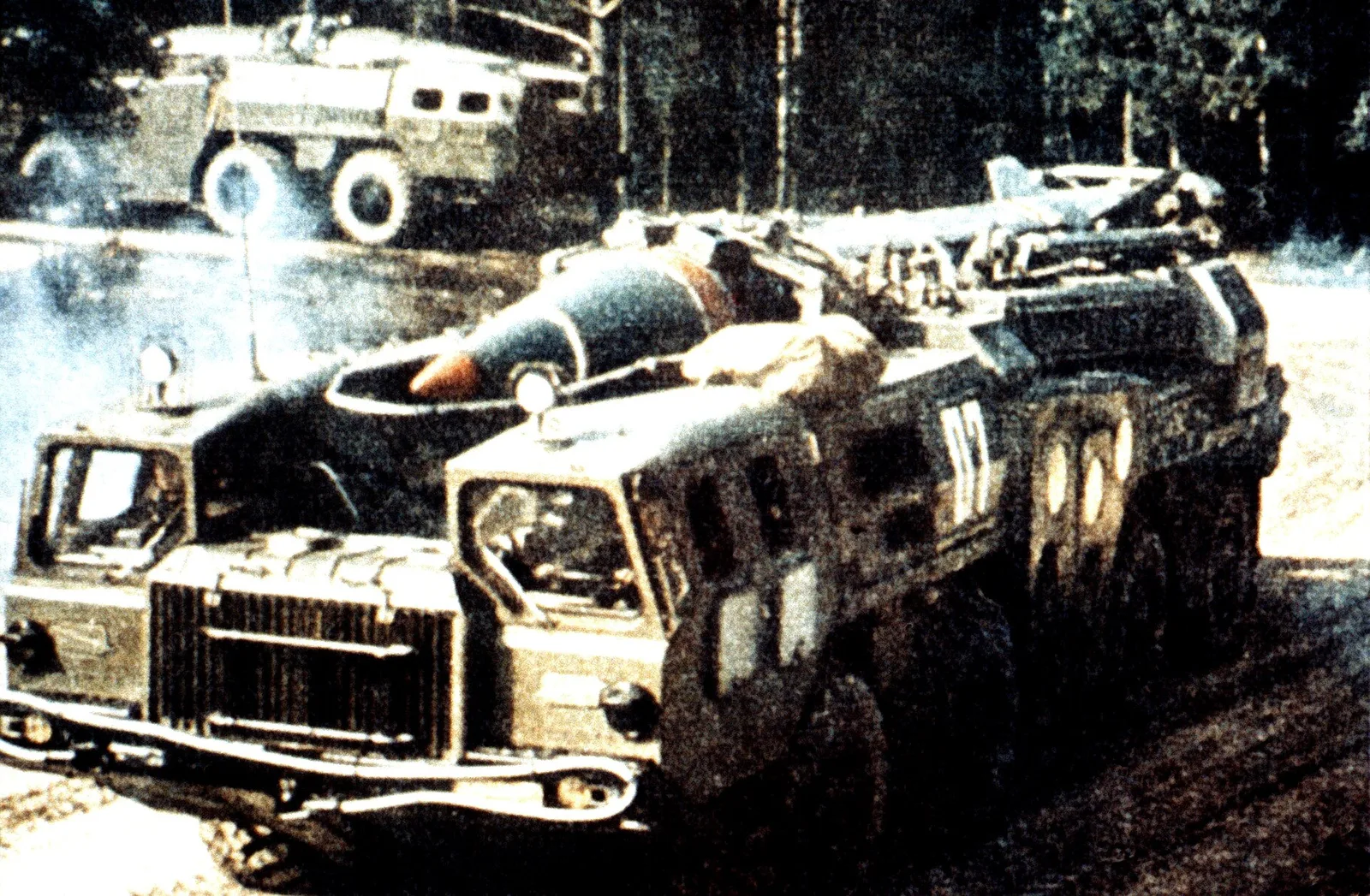
Photo: Soviet-designed SS-1C Scud-B missiles on their transporter-erector-launchers, the missile family that formed the backbone of North African ballistic missile forces from the 1970s. Credit: U.S. Department of Defense, public domain, via Wikimedia Commons.
What counts as a ballistic missile here?
A ballistic missile is rocket-powered only in the first phase of flight and then follows a mostly unpowered, gravity-shaped trajectory to its target. That separates it from a cruise missile, which flies under engine power for most of its route, and from unguided artillery rockets. The line is blurred by modern long-range guided rockets such as Israel’s Predator Hawk or the US GMLRS, which fly short quasi-ballistic arcs from multiple-launch rocket systems. This article counts dedicated short-range ballistic missiles (SRBMs, up to roughly 1,000 km) and lists guided rockets separately so the two are not confused.
Status labels used below: In service (documented delivery and no evidence of withdrawal), Ordered (approved or contracted, not delivered), Uncertain (delivered but current holdings unknown), Historical (programme ended or stocks eliminated).
Quick answer, verified 3 November 2026
- In service: Algeria (Iskander-E), Egypt (Scud-B; Scud-C/Project T reported)
- Uncertain: Ethiopia (Chinese M20 SRBM, partly captured in 2020)
- Ordered, not delivered: Morocco (40 M57 ATACMS approved in 2023)
- Historical: Libya (Scud-B, Scud-C), South Africa (RSA-series), Egypt’s Badr-2000/Condor II project
- No verified capability: the other African states, including Nigeria, Kenya and South Africa today
Operator table
| Country | System | Origin | Range (public figure) | Status | Confidence |
|---|---|---|---|---|---|
| Algeria | 9K720 Iskander-E | Russia | about 280 km (export version) | In service; delivered 2017 per SIPRI, first paraded November 2024 | High |
| Egypt | R-17 (Scud-B) | Soviet Union | about 300 km | In service (ageing) | High for delivery, medium for current readiness |
| Egypt | Project T / Scud-C type | Local with foreign help | about 450 km reported | Reported | Medium-low |
| Ethiopia | M20 (export DF-12 family) | China | about 280 km | Uncertain after 2020 losses | Medium |
| Morocco | M57 ATACMS | United States | up to about 300 km | Ordered (40 approved April 2023) | High for approval |
| Libya | Scud-B, Scud-C | Soviet Union / North Korea | 300 km / about 800 km | Historical; Scud-C removed 2004 | High |
| South Africa | RSA-series | Local (Israeli-linked) | n/a | Historical; ended 1993 | High |
Algeria: Iskander-E
Algeria is the clearest current case. The SIPRI Arms Transfers Database records 12 Iskander launchers and about 75 missiles ordered from Russia in 2013 and delivered in 2017; SIPRI notes the missile entry was originally reported only as going to “a state in the Middle East or North Africa”. Algeria kept the system out of public view until the 1 November 2024 parade for the 70th anniversary of its revolution. The export Iskander-E is limited to around 280 km. DefenceMENA covers the wider arsenal, including Algeria’s submarine-launched Klub-S and Chinese CM-302 anti-ship missiles, in Algeria’s Missile Forces Explained.
Egypt: Scud-B and local derivatives
Egypt received Soviet Scud-B (R-17E) missiles in the early 1970s, and a small number were fired during the October 1973 war. Open-source inventories, including the Arms Control Association’s worldwide ballistic missile table and the NTI country profile, still list Egypt as a Scud-B operator. NTI and the Federation of American Scientists also describe a locally improved Scud-C type known as Project T, with a reported range of about 450 km, developed with foreign, reportedly North Korean, assistance. The two-stage Badr-2000 (Condor II) project with Argentina and Iraq was abandoned in 1989 and never produced. Egypt’s current readiness is not publicly documented.
Ethiopia: Chinese M20
Ethiopia bought Chinese 300 mm A200 guided-rocket launchers and the M20, an export version of China’s DF-12 SRBM family. The purchase was not public until the Tigray war. In November 2020, Tigrayan forces seized launchers from the Ethiopian army’s Northern Command and fired missiles at Gondar and Bahir Dar airports in Ethiopia and at Asmara in Eritrea. Open-source analysts at Oryx and The National Interest documented the strikes, and Russian expert Yuri Lyamin was quoted by Rossiyskaya Gazeta on the federal army’s later recapture of systems. Ethiopia’s surviving holdings are not publicly known, so DefenceMENA lists Ethiopia as uncertain. See Ethiopia army weapons for the wider inventory.
Morocco: ATACMS on order, guided rockets in service
On 11 April 2023 the US Defense Security Cooperation Agency notified Congress of a possible sale to Morocco of 18 M142 HIMARS launchers and 40 M57 ATACMS missiles, worth an estimated $524.2 million. The notification was later published in the Federal Register as transmittal 21-27. ATACMS is a short-range ballistic missile fired from HIMARS. As of September 2026, Moroccan and US reporting described 10 HIMARS entering the US Army’s fiscal 2027 logistics plan, and no delivery of launchers or missiles had been confirmed. Separately, Morocco fields Israel’s Elbit PULS rocket system. Army Recognition reported Royal Moroccan Army footage in 2023 showing PULS with Predator Hawk rockets, which are quoted at about 300 km. These are guided rockets rather than SRBMs. Background: HIMARS M142 explained.
Libya: a Scud force that outlived its elimination deal
Libya bought hundreds of Scud-B missiles from the Soviet Union. In its December 2003 decision to give up weapons of mass destruction, Tripoli agreed to keep only missiles inside Missile Technology Control Regime limits (300 km, 500 kg). The US State Department confirmed that all Scud-C elements were removed by 2004. Libya later agreed to eliminate its Scud-B force, but that had not been completed when the Gaddafi government fell in 2011, according to a study published in International Affairs. No functioning national Scud force has been documented since, and DefenceMENA classes Libya as historical.
South Africa: a programme dismantled
South Africa tested RSA-series rockets from the Overberg Test Range in 1989 and 1990. On 30 June 1993, under US pressure, it agreed to stop making long-range missiles and to dismantle the production capacity, according to NTI’s South Africa missile chronology. It joined the Missile Technology Control Regime in 1995. South Africa today has no ballistic missiles.
Regional comparison
Africa’s ballistic missile picture is small compared with the Middle East, where Iran, Saudi Arabia and Israel field much larger and longer-range forces. In Africa, Algeria holds the most modern confirmed system. Egypt holds the oldest still-listed force. Morocco is buying US long-range precision fires and Israeli guided rockets rather than a dedicated SRBM. For the defensive side, see Which African Countries Operate Advanced Air Defence Systems and the Egypt vs Algeria military comparison.
Frequently asked questions
Which African country has the most advanced ballistic missiles?
Algeria. Its Iskander-E is the most modern ballistic missile confirmed in an African national inventory and in service.
Does Nigeria have ballistic missiles?
No. There is no official statement, SIPRI record or credible open-source report of Nigeria acquiring a ballistic missile.
Does South Africa have ballistic missiles?
No. South Africa ended its RSA missile and space-launch work in 1993, dismantled the facilities and joined the MTCR in 1995.
Does Morocco have ballistic missiles?
Not yet confirmed. Morocco has US approval for 40 ATACMS missiles, but delivery had not been confirmed by November 2026. Its PULS Predator Hawk rockets are guided rockets.
Does any African country have nuclear missiles?
No. No African state possesses nuclear weapons. South Africa dismantled its small arsenal in the early 1990s, and the continent is covered by the Pelindaba Treaty, which establishes an African nuclear-weapon-free zone.
Sources
- SIPRI Arms Transfers Database – trade registers for Algeria, Egypt, Ethiopia, Libya and Morocco (accessed 3 November 2026)
- Arms Control Association – Worldwide Ballistic Missile Inventories
- Nuclear Threat Initiative – Egypt country profile
- Federation of American Scientists – Egypt missile programs
- US Federal Register, 17 September 2024 – DSCA transmittal 21-27 (Morocco HIMARS and ATACMS)
- Morocco World News, September 2026 – Morocco’s 10 HIMARS enter US Army’s fiscal 2027 logistics plan
- Army Recognition, 2023 – Morocco equipped with Israeli PULS
- Oryx, September 2021 – Tigray’s forgotten missile war
- The National Interest – Chinese ballistic missiles in Ethiopia’s Tigray war
- US State Department – Verification of Libya’s decision to eliminate WMD and MTCR-class missiles
- International Affairs – Disarming Libya: a reassessment after the Arab Spring
- NTI – South Africa missile chronology
Method: holdings were checked against SIPRI transfer records, US government notifications and arms-control research bodies (ACA, NTI, FAS), with defence-press and open-source analysis used for status. Orders are not counted as inventory. No African government publishes its missile holdings, so readiness figures are deliberately not given.
Last verified: 3 November 2026