South African Startup Avior Labs Unveils Long-Endurance Callisto VTOL Drone



South African startup Avior Labs has unveiled Callisto, a long-endurance VTOL drone with an onboard AI mission computer designed for border security, maritime patrol and search and rescue. The prototype has no announced customer yet, but it signals a widening field of homegrown African UAV developers moving beyond small tactical drones.
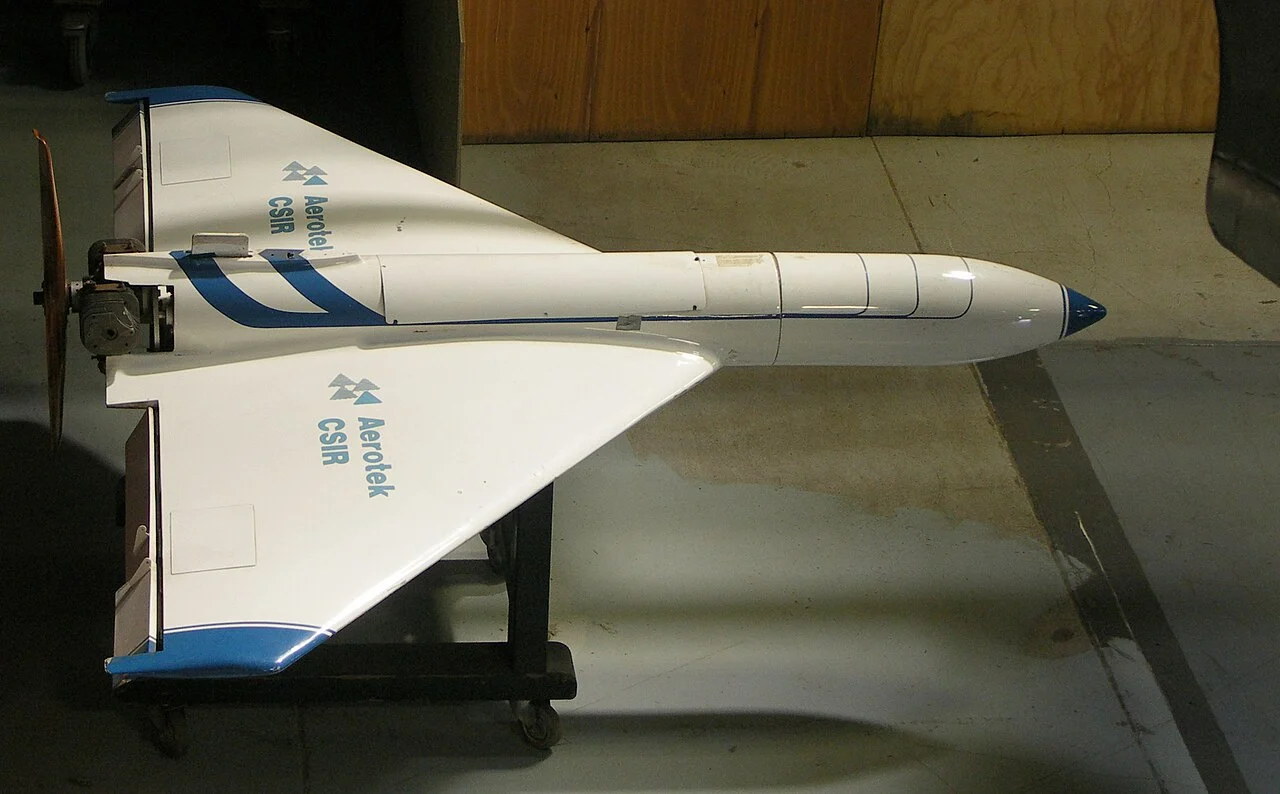
Photo: a CSIR Aerotek SkyFly target drone prototype, an earlier South African-designed UAV, on display at the South African Air Force Museum, Swartkop. Credit: NJR ZA, CC BY-SA 3.0, via Wikimedia Commons
Avior Labs, a UAV developer based in Irene, Gauteng, showcased Callisto at the Africa Aerospace and Defence (AAD) exhibition near Pretoria in September, and the design was detailed in a report by defenceWeb on 26 October. The company, founded in 2019 and led by managing director Dr Bennie Broughton, has previously built the smaller Elevation platform and is now scaling up its vertical take-off and landing (VTOL) design for longer-range missions.
What Callisto is built to do
Callisto is an all-electric, fixed-wing VTOL aircraft with a 3.6-metre wingspan and a maximum take-off weight of 15 kg, considerably larger than the 2.5-metre, 4.5 kg Elevation. It uses a three-lift-rotor, over-actuated configuration for vertical take-off and landing, then transitions to forward flight. Depending on battery configuration, Avior says Callisto can stay airborne for four to eight hours and cover up to 580 km, carrying a 2 kg modular payload bay that can be reconfigured if the optional battery extender is removed. The airframe is rated IP55 for dust and water resistance and is designed to operate in winds of 12-14 m/s at ground level, according to the company.
The more significant claim is onboard autonomy. Avior says Callisto runs a proprietary software stack on a dedicated FPGA-based mission computer that processes sensor data and detects objects in real time, rather than streaming raw video back to an operator over a high-bandwidth link — a constraint that has limited drone operations in much of rural Africa. The system also monitors its own health, including vibration signatures that can indicate a developing motor or propeller fault, and can reallocate control functions if part of the flight-control system fails. Operators are intended to define an area of interest and a task, Avior says, rather than programming individual waypoints, and an encrypted mesh datalink allows multiple aircraft to share data and split tasks — one drone tracking a detected target while another continues covering an assigned area.
“We don’t fly anything without simulating it first,” Broughton told defenceWeb, describing a simulation-led development process intended to validate performance before committing to hardware builds.
Civilian and military variants
Avior is positioning Callisto for border security, coastal and maritime patrol, search and rescue, and infrastructure protection along pipelines, power lines and rail corridors, as well as large-area survey work such as wildlife counts and vegetation monitoring over missions that can exceed 2,000 hectares. The company says it will offer two configurations on the same airframe: a civilian and commercial version, and a second variant with additional systems and hardened software for military use. No operator, military or civilian, has been named, and the aircraft remains a prototype; Avior says it will draw on manufacturing experience from the smaller, already-fielded Elevation once Callisto completes development and validation.
A crowded field of South African UAV builders
Callisto’s unveiling adds to a growing list of South African companies developing surveillance and strike drones largely outside the state-owned Denel group, whose own UAV programmes have been hampered for years by funding shortages. Incomar used the same AAD 2026 show to display target drones, loitering munitions and a counter-drone interceptor, while Milkor — maker of the combat-tested Milkor 380 — has been expanding internationally and signed an optronics and navigation integration agreement with France’s Safran this year. Avior’s bet is that onboard autonomy and long endurance, rather than payload or speed, will differentiate Callisto in a market where operators often have limited bandwidth and ground infrastructure.
Why it matters for Africa
Long-endurance patrol drones address a problem specific to much of the continent: vast borders, coastlines and pipeline networks that are expensive to cover with crewed aircraft or ground patrols. South Africa’s own defence force has faced years of budget pressure that have grounded portions of its air and naval assets, pushing border and maritime surveillance work toward lower-cost unmanned platforms, whether built locally or imported. A credible, locally built long-range VTOL drone would reduce reliance on imported systems from Turkey, Israel and China that currently dominate African UAV fleets, and could find buyers among neighbouring states managing similar maritime and border-security burdens, from Mozambique’s Cabo Delgado coastline to the Sahel’s land borders. Whether Callisto reaches that market will depend on Avior completing certification and finding a first customer — the step at which many African UAV prototypes have historically stalled.
Sources