Otokar Cobra II vs Arquus Bastion vs NORINCO VN4: How Three Light Armoured 4x4s Compare for African Forces



The Otokar Cobra II, the Arquus Bastion and the NORINCO VN4 are all wheeled 4×4 armoured personnel carriers that African armies and police forces use for patrols, troop transport and peacekeeping, but they are not equals. On the makers’ own figures the Turkish Cobra II is the heaviest and most powerful of the three, at up to 14.5 tonnes and 360 hp. The French Bastion is a 12–12.5-tonne vehicle with a V-shaped hull, and it has the widest documented African customer base, much of it paid for by US and EU security assistance. The Chinese VN4 is a 9-tonne vehicle whose only documented African operator, Kenya’s police, has said it protects against small-arms fire but is not mine-resistant. There is no overall winner: the right choice depends on the threat, the budget and who is paying.
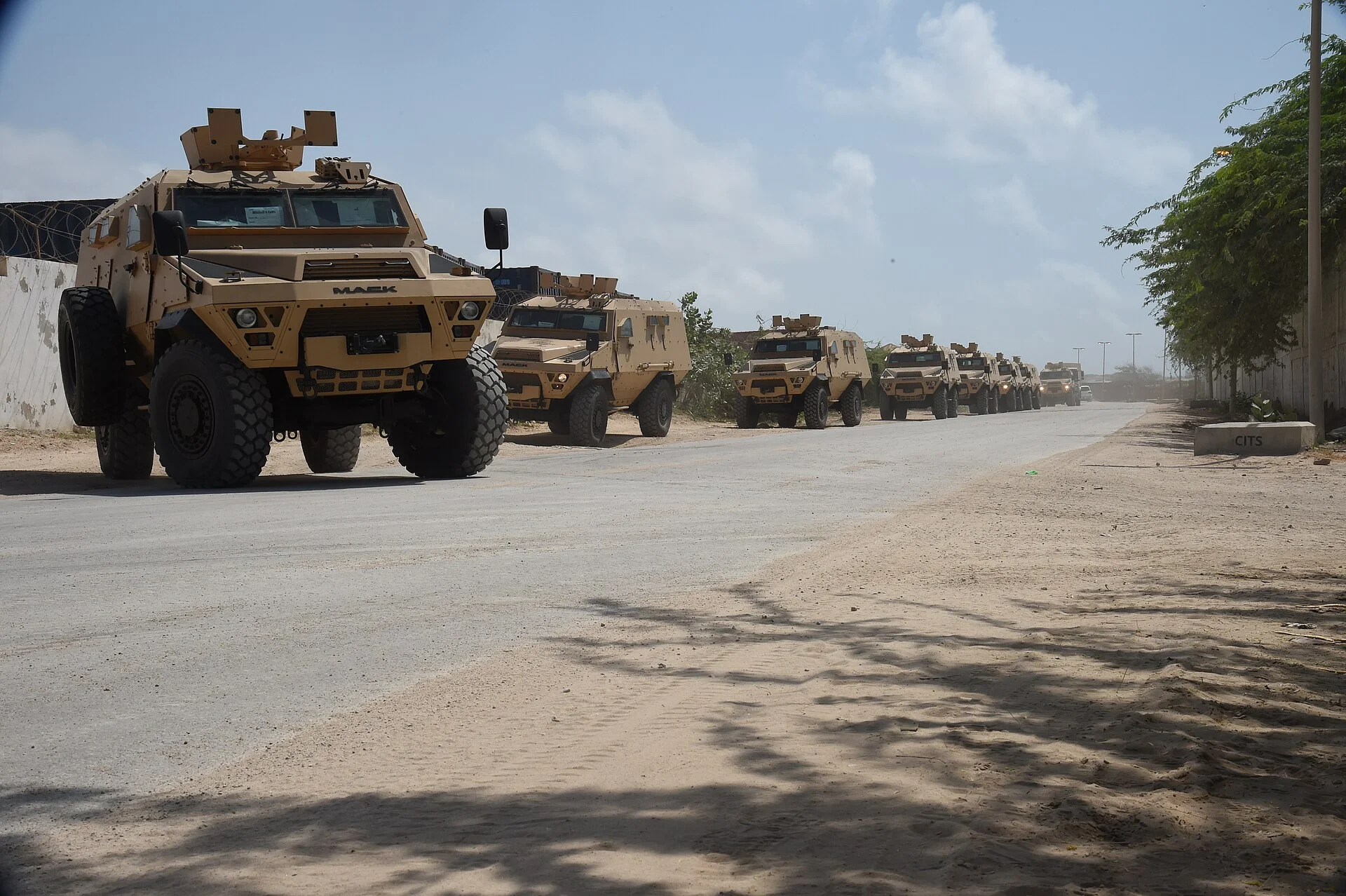
Photo: a Bastion armoured personnel carrier among vehicles US forces delivered to the Uganda People’s Defence Force at Mogadishu International Airport, Somalia, on 25 September 2017. Credit: U.S. Air Force / Tech. Sgt. Andria Allmond, via Wikimedia Commons, public domain (US government work).
This comparison is part of DefenceMENA’s Global Defence Industry series. Our earlier article Ejder Yalçın vs Kirpi vs Cobra II compares Türkiye’s three protected 4x4s with each other. This one sets the Cobra II against its main French and Chinese rivals in the same light-armour segment. It does not repeat the Turkish-only comparison, and country-by-country Cobra detail stays on our Otokar Cobra operator tracker.
Quick comparison (as of 24 October 2026)
- Heaviest and most powerful (maker’s figures): Cobra II, up to 14,500 kg gross and 360 hp (Otokar brochure). A separate Cobra II MRAP version reaches 19,000 kg.
- Longest stated range: Bastion, 1,000 km in a 2019 data sheet from Arquus’s US partner AM General and 1,400 km in other published figures. The Cobra II and VN4 are both quoted at 700 km.
- Widest African customer base: Bastion. Arquus said 500 were in service worldwide in March 2020 and called it “the armored vehicle of choice for the African theaters” (Arquus).
- Largest single African order found: Cobra II. Otokar announced a US$136 million order for 4×4 armoured vehicles from an unnamed foreign customer in December 2023. Media identified the customer as Morocco and put the number at 200 vehicles.
- Thinnest African record: VN4. Kenya’s police received 30 in 2016. Sudan is reported as an operator by open-source analysts, but not officially.
- Unit prices: none published for any of the three. The package values below cannot be divided into a per-vehicle price.
Why compare these three?
All three fill the same slot. Each is a wheeled 4×4 that carries a section of eight or more people under armour, takes a machine gun or light turret on the roof, and is sold to armies, gendarmeries and police forces for internal security, border patrol and UN missions. They also meet in the same markets: West Africa and the Sahel, East Africa and the Horn.
The class differences are real, though. The VN4 is lighter than the other two and, in Kenyan police service, was never meant to resist mines. The Cobra II has grown heavier since its 2013 launch. The Bastion sits between them on weight and was designed on an existing truck chassis. These differences are set out below rather than hidden behind a single score.
Who makes them
- Otokar (Türkiye): a Koç Group company. It says more than 33,000 of its military vehicles serve in over 40 countries, and that the Cobra II, launched in 2013, is used by more than 20 users in 13 countries (Otokar). Otokar is not in the SIPRI Top 100 for 2024.
- Arquus (France): formerly Renault Trucks Defense, which includes the ACMAT and Panhard brands and builds the Bastion at Saint-Nazaire. Volvo Group sold Arquus to John Cockerill Defense on 2 July 2024 (Volvo Group). Arquus developed the Bastion in 2012 on its VLRA truck chassis.
- NORINCO (China): China North Industries Group, ranked 11th in the SIPRI Top 100 for 2024, with arms revenue of US$13.97 billion, down 31% on 2023 (SIPRI). The VN4 is built by Chongqing Tiema Industries, a NORINCO company, and was unveiled in 2009 (Daily Nation; defenceWeb).
Published specifications
Otokar and Arquus publish data sheets. NORINCO does not appear to publish a current VN4 sheet online, so its column relies on the defence press. Weights are the least reliable figures: makers quote gross, combat or kerb weight, and all three vehicles exist in several versions.
| Parameter | Otokar Cobra II | Arquus Bastion (APC) | NORINCO VN4 |
|---|---|---|---|
| Introduced | 2013 (Otokar) | 2012 (Arquus) | 2009 (defenceWeb) |
| Weight | Up to 14,500 kg gross; MRAP version up to 19,000 kg (Otokar) | 12.5 t gross; 12 t for the APC version (Arquus) | 9,000 kg combat (defenceWeb; Army Technology archive) |
| Occupants | Up to 11 including driver and commander (Otokar) | 2 + 8 (Arquus) | 2 + 8 (Army Technology archive) |
| Engine | Turbocharged diesel, 360 hp (Otokar) | 180 hp or 270 hp (Arquus, 2020); 215 hp option (AM General) | Cummins diesel, 235 hp (Army Technology archive) |
| Transmission | Automatic | 6-speed manual (AM General) | Not published by the maker |
| Dimensions (L × W × H) | 6.4 × 2.5 × 2.3 m over hull | 6.0 × 2.2 × 2.4 m (AM General) | 5.4 × 2.4 × 2.05 m |
| Top speed | 110 km/h | 110 km/h | 115 km/h |
| Range | 700 km | 1,000 km (AM General); 1,400 km (other published figures) | 700 km |
| Air transport | Not stated in the brochure reviewed | C-130, A400M | Not published |
| Typical armament | Open cupola or remote weapon station (Otokar variants) | 7.62 mm or 12.7 mm, ring mount or remote station | Light turret with 7.62 mm or 12.7 mm machine gun |
Sources: Otokar Cobra II brochure and Cobra II MRAP brochure; Arquus Bastion page and AM General Bastion data sheet; Army Technology / Homeland Security Technology (archived) and defenceWeb for the VN4.
Protection: what each maker claims
- Cobra II: Otokar says the vehicle protects against ballistic, mine and IED threats, and lists a floating floor and run-flat tyres as standard. The brochures reviewed give no STANAG 4569 level for the base vehicle. For the MRAP version, the brochure lists a mine kit and an RPG protection kit as options.
- Bastion: Arquus cites STANAG 4569 protection. Published figures range from Level 1 to Level 3 depending on configuration (The Defense Post), and the hull is described as V-shaped.
- VN4: an all-welded steel hull against small-arms fire and shell splinters (defenceWeb). In June 2017 the spokesman of Kenya’s National Police Service said the force’s armoured personnel carriers were “not mine resistant” and that it had bought separate MRAPs for terror-prone areas (Daily Nation).
None of the three makers has published independent test results. Every protection figure above is a manufacturer or trade-press statement.
African operators and status
The table separates contracted, delivered and operational vehicles. Quantities come from the named source and are not DefenceMENA estimates.
| Country | Vehicle | Status | Detail and source |
|---|---|---|---|
| Morocco | Cobra II | CONTRACTED; delivery completion not officially confirmed | US$136m package including spares, maintenance equipment and training, with deliveries planned to start at the end of 2023 and run for one year (Otokar, 14 Dec 2023). Otokar did not name the buyer; media identified Morocco and 200 vehicles (The Defense Post). |
| Senegal, Rwanda, Ghana, Côte d’Ivoire | Cobra II | OPERATIONAL | Gendarmerie (Senegal), UN and Mozambique deployments (Rwanda), mixed Cobra/Cobra II fleet (Ghana), about 20 (Côte d’Ivoire). Detail and sources on our Cobra operator tracker. |
| Tunisia | Cobra II; Bastion | DELIVERED | Cobra II photographed in 2016 (DefenceMENA tracker). Four Bastions under a US-funded order, according to an industry source quoted by Janes in 2018 (Janes). |
| Cameroon | Bastion | OPERATIONAL (as of 2018) | 15 Bastions reached the Rapid Intervention Battalion (BIR) in late 2017 and were deployed against Boko Haram, Janes reported after a visit. Shephard later counted 23 (Janes; CAMTO, citing Shephard). |
| Uganda | Bastion | DELIVERED (UPDF contingent in AMISOM, 2017) | Delivered by US forces at Mogadishu in September 2017 (photo above). An industry source told Janes 31 had gone to Uganda under a 2015 US Department of Defense order for 62 vehicles. |
| Kenya | Bastion; VN4 | DELIVERED (Bastion); OPERATIONAL as of 2017 (VN4, police) | 12 Bastions (Janes industry source; Shephard). 30 VN4s commissioned for the police General Service Unit by President Uhuru Kenyatta on 1 February 2016 (defenceWeb; Daily Nation). |
| Mali, Niger, Mauritania, Chad, Burkina Faso | Bastion | DELIVERED | EU-funded programme of 46 vehicles for the G5 Sahel Joint Force: 13 handed to Mali on 17 January 2020, 13 to Niger, 7 to Mauritania, 4 to Chad and 4 to Burkina Faso, with 3 more for Chad and 2 for Burkina Faso announced (The Defense Post / AFP). Burkina Faso also had ten earlier Bastions (see why Burkina Faso bought Chinese armoured vehicles). |
| Senegal, Ethiopia, Somalia | Bastion | REPORTED | Shephard counts: Senegal 43, Ethiopia 12, Somalia 13 (CAMTO, citing Shephard). Janes’s 2018 industry source said none had gone to Ethiopian or Somali forces, so these two remain unconfirmed. |
| Sudan | VN4 | REPORTED (unconfirmed) | Listed in the Oryx open-source catalogue of Sudanese armed forces vehicles in April 2023 (Oryx). No official Sudanese or NORINCO confirmation was found. |
Army Recognition’s August 2025 survey adds Togo (30), Gabon (5), Côte d’Ivoire (at least 9) and Congo-Brazzaville (2) as Bastion users, but gives no primary source for these, so DefenceMENA treats them as unconfirmed (Army Recognition).
Documented operational use
- Bastion: the best-documented African combat use of the three. Cameroonian BIR officers told Janes in 2018 that the vehicle had good mobility compared with heavier US-donated vehicles. Arquus said it delivered 50 Bastions to Africa and the G5 Sahel in 2020 (Army Recognition, citing Arquus).
- Cobra II: Rwandan Cobra IIs have served on UN and Mozambique deployments (DefenceMENA tracker). Otokar describes the vehicle as “combat proven” but does not say where, so the claim cannot be checked.
- VN4: used by Kenya’s police since 2016. Outside Africa, Janes reported in 2014 that Venezuela’s National Guard, which bought 141 in 2012, used VN4s against protesters (Janes, archived).
An isolated loss or a protest deployment is not a reliability test for any of the three. No independent field-performance data is public.
Beyond Africa: what the wider customer base shows
- Cobra II in Romania: the largest documented Cobra II programme. Romania signed for 1,059 vehicles in nine configurations on 27 November 2024, worth about 4.26 billion lei excluding VAT (Otokar). The defence ministry said 276 had been received by 14 May 2026, and the first 12 built entirely in Romania, at Mediaș, were delivered in July 2026 (Romanian Ministry of National Defence via Agerpres). It is the only documented local-production deal for any of the three vehicles. Otokar also announced a further US$83.6 million Cobra II export order in 2025 without naming the customer (Otokar).
- Bastion in Ukraine and elsewhere: according to Army Recognition, John Cockerill’s 2024 activity report recorded a contract for 61 Bastions for Ukraine, 11 of them already delivered. The same survey lists Armenia, Chile and Saudi Arabia (PATSAS version) among other users.
- VN4 in Nepal: Nepal’s army bought 63 Chinese APCs, identified as VN4s, for UN peacekeeping. In 2019 army sources quoted by Khabarhub complained that the vehicles lacked RPG protection and a V-shaped underside, and said they were in storage (Khabarhub). This has not been officially confirmed.
International alternatives
Buyers looking at this class usually also see:
- Türkiye: the heavier Nurol Ejder Yalçın and BMC Kirpi, compared in our Turkish 4×4 comparison, and Katmerciler’s Hızır.
- China: NORINCO’s own mine-protected CS/VP14 and VP11, which Mali and Burkina Faso have ordered or received in large numbers since 2024.
- South Africa: Paramount’s Marauder and Mbombe 4, and the Casspir.
- United Arab Emirates: the Streit Typhoon.
Our guide to MRAPs used in the Sahel sets out the heavier mine-protected options, and our ranking of Africa’s most widely exported armoured vehicles puts these families in context.
Procurement and industrial considerations
- Who pays shapes the fleet. Many African Bastions arrived through US Department of Defense contracts or the EU’s African Peace Facility, not national tenders. Recipients gain vehicles without spending their own budgets, but they do not choose the supplier.
- Package values are not unit prices. Morocco’s US$136 million covers vehicles, spares, maintenance equipment and training. Romania’s €857 million includes logistics support and local production. Neither can be turned into a per-vehicle price, and no VN4 contract value has been published.
- Local production. Romania is the only documented case, through a joint venture at Mediaș. DefenceMENA found no assembly, licensed production or technology transfer for any of the three vehicles in an African country.
- Training and sustainment. Otokar’s Moroccan package explicitly includes training and maintenance equipment. Arquus says the Bastion offers wide commonality with existing VLRA truck fleets. No sustainment terms are public for the Kenyan VN4s.
- Sanctions exposure. In 2023 the Kathmandu Post reported that a Nepal Army plan to buy 26 more NORINCO APCs stalled after the bank handling the letter of credit found the company on a US Treasury sanctions list (Kathmandu Post). Buyers that depend on Western finance or UN reimbursement should check this before signing.
- Match the vehicle to the threat. Where buried IEDs are the main danger, the Kenyan police’s own distinction between APCs and MRAPs applies to the whole class.
For how Türkiye’s wider defence trade with Morocco has developed, see what Morocco buys from Türkiye. For other Turkish platforms in African service, see Turkish systems in African armed forces. For Kenya’s wider vehicle fleet, see Kenya Army weapons.
Side-by-side summary
| Criterion | Cobra II | Bastion | VN4 |
|---|---|---|---|
| Origin / maker | Türkiye / Otokar (Koç Group) | France / Arquus (John Cockerill Defense since 2024) | China / NORINCO (Chongqing Tiema) |
| Production status | In production in Türkiye and Romania | In production; 500 in service by March 2020 (Arquus) | No current production data published |
| Weight class (maker or press) | Up to 14.5 t (MRAP version 19 t) | 12–12.5 t | 9 t |
| Mine protection | Claimed; level not published | Claimed, STANAG 4569 Level 1–3 depending on version | Not mine-resistant (Kenyan police statement) |
| Documented African users (delivered or operational) | Senegal, Rwanda, Ghana, Côte d’Ivoire, Tunisia; Morocco under contract | Cameroon, Uganda, Kenya, Tunisia, Mali, Niger, Mauritania, Chad, Burkina Faso; others reported | Kenya (police); Sudan reported |
| Main funding route in Africa | National purchases | Largely US and EU security assistance | National purchase (Kenya) |
| Local production | Romania (none in Africa) | None documented in Africa | None documented |
| Published unit price | None | None | None |
FAQ
Which is better, the Cobra II, the Bastion or the VN4?
None is better across the board. The Cobra II is the heaviest and most powerful on its maker’s figures, the Bastion has the widest documented African use, and the VN4 is the lightest, with a police and internal-security record. The right choice depends on the threat, especially mines, and on budget and support.
Which African countries use the Bastion?
Documented users include Cameroon, Uganda, Kenya, Tunisia, Mali, Niger, Mauritania, Chad and Burkina Faso. Senegal, Ethiopia and Somalia appear in Shephard counts; delivery to Ethiopia and Somalia is disputed.
Is the NORINCO VN4 mine-resistant?
Kenya’s National Police Service said in 2017 that its armoured personnel carriers were not mine-resistant and protect against small-arms fire, and that it bought separate MRAPs for that threat.
Did Morocco buy the Cobra II?
Otokar announced a US$136 million order from an unnamed foreign customer in December 2023. Media identified Morocco and 200 vehicles. Neither Otokar nor Rabat has officially named the buyer, and completion of deliveries has not been officially confirmed.
How much does each vehicle cost?
No unit price has been published for any of them. Contract values include spares, training and support, so they cannot be divided by the number of vehicles.
Sources
- Otokar: Cobra II brochure; Cobra II MRAP brochure; US$136m export order (14 December 2023); Romania contract (27 November 2024); US$83.6m Cobra II order (2025)
- Romanian Ministry of National Defence, press release via Agerpres (30 July 2026)
- Arquus: Bastion product page; 500th Bastion and new engine (23 March 2020); AM General, Bastion data sheet (2019)
- Volvo Group, divestment of Arquus (July 2024)
- SIPRI, Top 100 arms-producing companies, 2024 (December 2025)
- Janes, “Cameroon’s Bastion APCs now in action” (6 June 2018), reproduced by Mack Defense; Janes, Venezuela VN-4 report (2014, archived)
- The Defense Post / AFP, EU Bastions for the G5 Sahel (21 January 2020); Morocco Cobra II (19 January 2024)
- defenceWeb, Kenya’s police receive VN4s (2016); Daily Nation, police statement on APCs and MRAPs (June 2017)
- Army Recognition, Arquus 2020 deliveries (2021) and Bastion operators and Ukraine (August 2025); CAMTO, Shephard country counts (2020)
- Oryx, Sudan’s fighting vehicles (April 2023); Khabarhub, Nepal Army VN4s (2019); Kathmandu Post, Nepal NORINCO APC plan (May 2023); Army Technology VN4 profile (archived)
Last reviewed 24 October 2026. Specifications are manufacturer or trade-press figures; DefenceMENA has not tested any of the vehicles. Statuses follow DefenceMENA’s classes: contracted, delivered, operational, reported. This page will be updated when a new African contract or delivery is documented.