Mozambique’s Army Is Losing Ground in Cabo Delgado as Foreign Partners Multiply



Mozambique’s armed forces are losing ground against the insurgency in Cabo Delgado, according to an analysis by the Institute for Security Studies republished by defenceWeb. Since the regional SADC mission withdrew in mid-2024, militants have regained the initiative on key roads, while a growing list of foreign training partners — Rwanda, the EU, the US, India, Turkey and Algeria — has yet to translate into results on the ground.
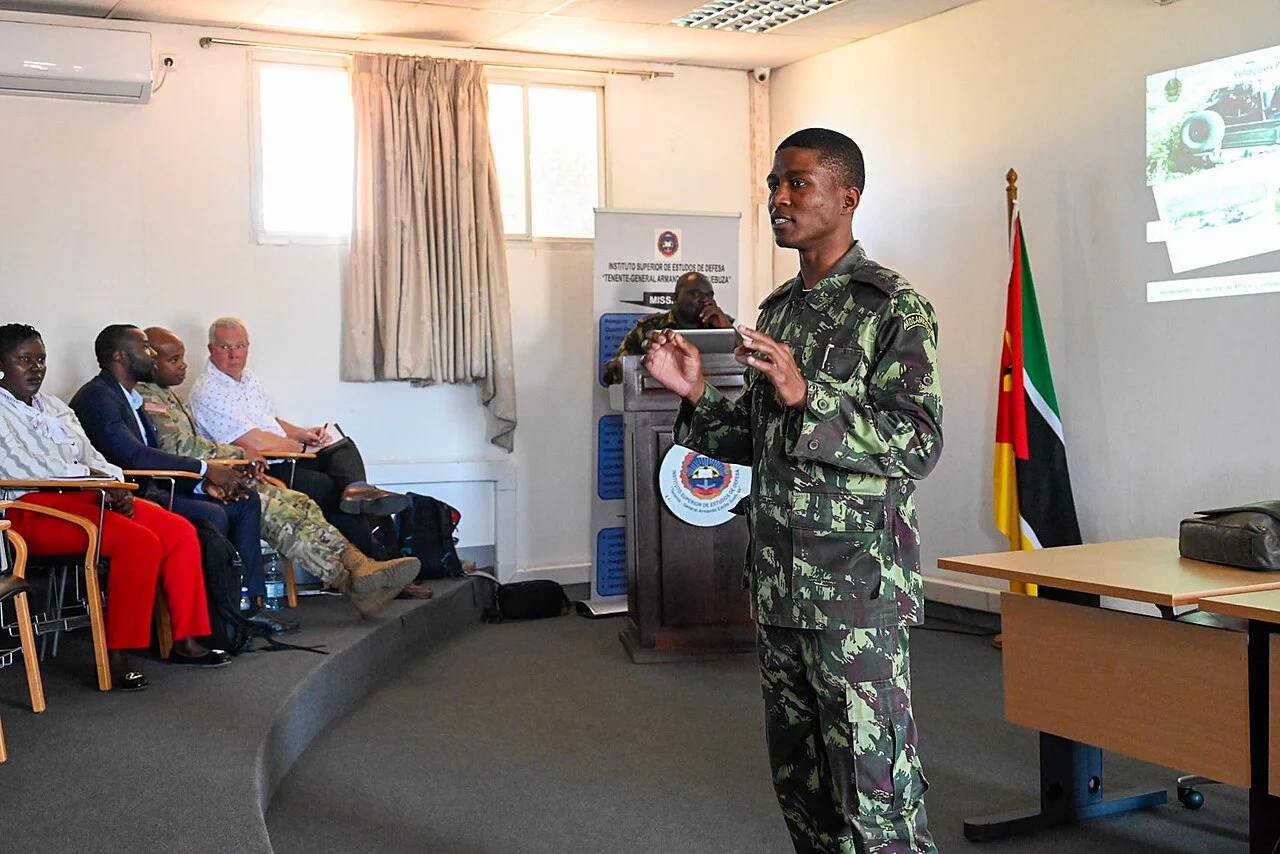
Photo: An officer of the Mozambican Armed Forces (FADM) briefs US Army personnel at the Instituto Superior de Estudos de Defesa in Maputo, September 2024. Credit: Capt. Billy Lacroix, U.S. Army SETAF-AF, Public domain, via Wikimedia Commons
According to an analysis published by defenceWeb and written by Borges Nhamirre, a researcher at the Institute for Security Studies (ISS), the Forças Armadas de Defesa de Moçambique (FADM) is struggling to hold the gains made against the Islamic State-linked insurgency in the northern province of Cabo Delgado. Insurgents who had been pushed back by a multinational intervention are attacking major roads again, ambushing convoys, abducting drivers and passengers for ransom and stealing food supplies, in a pattern Nhamirre says is costing the government control it had only recently recovered.
How Mozambique got here
The insurgency, waged by a group known locally as al-Shabaab (unaffiliated with the Somali group of the same name) and aligned with Islamic State Mozambique, first struck Cabo Delgado on 5 October 2017. Despite roughly three decades of experience managing internal armed conflict, the FADM was caught off guard. By 2021, insurgents had seized district capitals and forced TotalEnergies to suspend its US$20 billion liquefied natural gas project at Afungi, a blow that pushed Maputo to formally request outside military help.
The Southern African Development Community’s intervention mission, SAMIM, together with troops from Rwanda, helped dismantle insurgent bases, neutralise several of the group’s leaders, restore government administration in lost districts and reopen key access routes. SAMIM withdrew in mid-2024 once its mandate ended. Rwanda’s contingent, which has operated separately from SAMIM and focused on territory critical to the gas industry’s logistics, has stayed on — but not without friction. In March 2026, Rwandan Foreign Minister Olivier Nduhungirehe signalled Kigali was prepared to pull its troops out if the European Union, whose funding underwrites much of the deployment, did not renew support. Rwanda reversed course in May, announcing it would remain in Cabo Delgado after what it described as reluctant EU engagement on two funding requests, with Mozambique left to absorb the gap. Maputo has said the arrangement buys time to train and equip its own forces, though it has not disclosed the costs involved.
A crowded field of partners, with little coordination to show for it
Nhamirre’s analysis lists a growing roster of foreign assistance that has not yet reversed the insurgents’ momentum. The EU has had the largest footprint, channelling roughly €89 million into training and non-lethal equipment; its training mission has put more than 1,600 personnel through 11 FADM Quick Reaction Force companies. The United States runs a Joint Combined Exchange Training programme covering small-unit tactics, planning and combat medical care, and has separately committed US$1.5 million to improve Mozambique’s management and security of weapons and ammunition stocks. India signed an agreement in March 2026 covering defence equipment and technology transfer for aircraft, vehicles and patrol vessels. Turkey’s defence cooperation agreement, ratified in 2024, spans aviation, weapons, combat vehicles and naval manufacturing — part of the same pattern of Turkish defence-industrial outreach into African militaries that DefenceMENA has tracked across the continent. Algeria has reactivated an older cooperation agreement and is currently training a specialised FADM battalion.
Much of the FADM’s existing equipment, by contrast, is older Russian- and Chinese-origin material. Nhamirre’s reporting cites accounts from personnel of obsolete and non-functional weapons that have contributed to battlefield deaths, along with insufficient transport for troops and for evacuating casualties — an equipment gap that stands in sharp contrast to the volume of training programmes now running in parallel. The result, as Nhamirre puts it, is that “the impact of these partnerships has yet to be felt on the ground”: Mozambique has accumulated foreign trainers and modest equipment pledges from at least six separate countries without a unifying strategy, while its forces in the field still fight with Cold War-era inventory.
The analysis also raises human-rights concerns that complicate the partnerships further: FADM troops have been accused of sexually exploiting displaced women, killing civilians suspected of collaborating with insurgents, and committing abuses against captured suspects. At the FADM’s 62nd anniversary commemoration in September, President Daniel Chapo’s speech did not address human rights in counter-terrorism operations, a silence Nhamirre treats as a missed opportunity to signal reform to partners and civilians alike. One structural bright spot he notes is a newly created counter-terrorism centre intended to improve interagency coordination, though it is too new to have demonstrated results.
Why it matters for Africa
Cabo Delgado is a test case for a pattern repeating elsewhere on the continent: a government facing an entrenched insurgency turns to a patchwork of bilateral partners — some offering training, others hardware, others funding — rather than a single, resourced strategy, and the seams between those efforts become exploitable gaps. The parallel with the Sahel, where Mali, Niger and Burkina Faso have cycled through French, UN, Russian and now homegrown regional-force arrangements with similarly mixed results, is direct. For Mozambique specifically, the stakes extend beyond counter-insurgency: TotalEnergies’ suspended Afungi LNG project, one of the largest single investments in Mozambique’s history, remains hostage to a security guarantee the FADM has not yet been able to provide on its own, which is precisely why Rwanda’s continued presence — however contested its funding — remains the variable foreign partners and the Mozambican government are each watching most closely.
Sources
- defenceWeb / ISS Africa — “Mozambique’s army is losing a crucial counter-insurgency battle” (Borges Nhamirre)
- Stratfor — on Rwanda’s March 2026 withdrawal threat
- ACLED — Mozambique Conflict Monitor Update, 25 March 2026