CIRIT Laser-Guided Missile Explained: ROKETSAN’s 70mm Precision Rocket

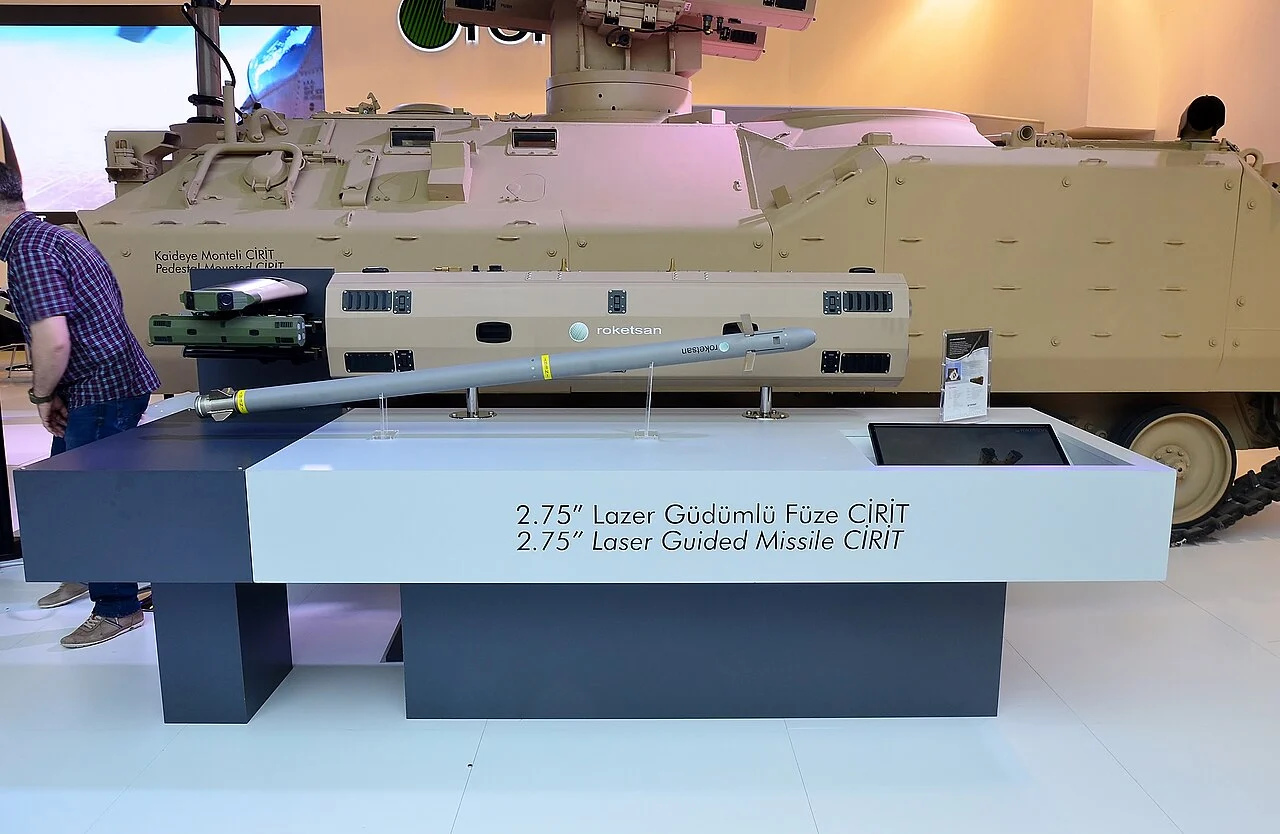


CIRIT is ROKETSAN’s 70 mm (2.75-inch) laser-guided missile, built from scratch as a complete guided round rather than a guidance kit fitted to an existing unguided rocket. It fills the gap between unguided aerial rockets and heavier anti-tank guided missiles, giving helicopters, light aircraft, drones, armoured vehicles and patrol boats a low-cost precision weapon against lightly armoured vehicles and infantry. CIRIT entered Turkish Armed Forces service in 2012 and is the primary rocket armament of the T129 ATAK attack helicopter. The United Arab Emirates became ROKETSAN’s first international CIRIT customer in a February 2013 agreement with Tawazun Holding, and deliveries to both Türkiye and the UAE had passed 1,000 missiles by June 2014. In 2026 ROKETSAN unveiled a dedicated CIRIT Anti-UAV (C-UAS) variant against low-flying drones.
Photo: ROKETSAN CIRIT 2.75-inch laser-guided missile on display at IDEF 2015, Istanbul. Credit: CeeGee, via Wikimedia Commons (CC BY-SA 4.0).
| Manufacturer | ROKETSAN (sole developer and prime; built as an all-up round, not a guidance-kit retrofit) |
| Type | 70 mm (2.75-inch) laser-guided missile for air-to-surface and surface-to-surface use |
| Range | Up to 8 km (ROKETSAN official specification); CIRIT Anti-UAV variant, 5 km |
| Guidance | Semi-active laser seeker with MEMS/IMU; compatible with STANAG 3733 laser designators |
| Warhead | Multi-Purpose (anti-armour/anti-personnel/incendiary), High-Explosive (anti-personnel), Thermobaric (added 2019); CIRIT Anti-UAV carries an air-target warhead |
| Weight / dimensions | 15 kg without canister; 1.9 m length; 70 mm diameter |
| Status | Operational (Türkiye, since 2012); delivered and operational (UAE, since 2013-14); CIRIT Anti-UAV unveiled 2026, not yet in service |
| Confirmed operators | Türkiye, United Arab Emirates |
What is the CIRIT missile?
CIRIT is ROKETSAN’s 2.75-inch (70 mm) laser-guided missile, developed entirely in-house rather than as a guidance add-on for an existing unguided rocket (ROKETSAN, official product page, accessed 10 October 2026; GlobalMilitary.net profile). ROKETSAN describes its mission as engaging static or moving, lightly armoured or unarmoured targets with high precision at a cost well below that of a full anti-tank guided missile. This design choice sets CIRIT apart from the closest Western equivalent, the US Advanced Precision Kill Weapon System (APKWS), which is a laser-guidance kit added to existing Hydra-70 rocket motors and warheads rather than a purpose-built round (Air & Space Forces Magazine; GlobalSecurity.org).
Development and public timeline
| 2004 | Development begins under a Turkish government programme (Wikipedia/GlobalMilitary summary of public reporting, used for discovery only; corroborated by Airforce Technology and Military Periscope profiles) |
| 2006-2007 | First test firings and public unveiling (sources differ on the exact year: Airforce Technology cites 2006, GlobalMilitary cites first public display in 2007) |
| 2010-2011 | Serial production begins (GlobalMilitary: 2010; Airforce Technology: 2011) |
| May 2012 | First missiles delivered to the Turkish Armed Forces under a Turkish Ministry of National Defence contract; ROKETSAN’s own release calls CIRIT the first 2.75-inch guided missile in serial production |
| 25 February 2013 | ROKETSAN and UAE’s Tawazun Holding sign CIRIT’s first export and joint-production agreement (ROKETSAN official press release) |
| By June 2014 | More than 1,000 CIRIT missiles delivered to Türkiye and the UAE combined (ROKETSAN official figures, cited by Anadolu Agency) |
| 2019 | Thermobaric warhead added, bringing the total to three warhead options (Air Recognition; Monch.com) |
| May 2026 | CIRIT Anti-UAV (C-UAS) variant unveiled at SAHA Expo 2026, Istanbul, alongside Nester, Cida and a mini cruise missile (Türkiye Today; EDR Magazine) |
| June 2026 | Memorandum of understanding signed with Spain’s EM&E Group at Eurosatory to explore integrating CIRIT into EM&E’s remote weapon stations (RaillyNews; single-source report, not yet a sale) |
Who manufactures CIRIT — ROKETSAN’s role
Unlike several other ROKETSAN munitions that combine subsystems from several Turkish companies — for example KARAOK, which uses an ASELSAN-developed imaging-infrared seeker — CIRIT was developed and is manufactured by ROKETSAN as a complete, self-contained round, from airframe and solid-propellant motor to seeker, warhead and fuze (ROKETSAN official product page). It was procured under a Turkish government requirement process (predecessor of today’s Presidency of Defence Industries, SSB) but ROKETSAN was the sole prime contractor for the missile itself.
Range, guidance and warhead options
ROKETSAN’s official specification gives CIRIT a maximum range of 8 km, guided by a semi-active laser seeker aided by MEMS sensors and an inertial measurement unit, and compatible with STANAG 3733 laser target designators (ROKETSAN official product page; ROKETSAN 2013 press release). Some secondary compilations list a shorter effective or “guaranteed launch” range band closer to 1.5-6 km depending on launch geometry and target reflectivity; this article uses ROKETSAN’s own published 8 km figure as the primary reference and flags the secondary-source variation rather than treating either as precise under all conditions.
CIRIT has carried three publicly disclosed warhead types since 2019: a Multi-Purpose Warhead effective against light armour, personnel and incendiary targets; a High-Explosive Warhead for anti-personnel use; and a Thermobaric Warhead added in 2019 for use against targets in enclosed spaces (Air Recognition, March 2019; Monch.com). The 2026 CIRIT Anti-UAV variant instead carries a dedicated air-target warhead described by ROKETSAN as effective against Group 2-class drones at low altitude, with a reduced 5 km range (EDR Magazine, SAHA Expo 2026 coverage; Türkiye Today).
Launch and compatible platforms
CIRIT’s primary platform is the Turkish Aerospace T129 ATAK attack helicopter, which can carry up to four CIRIT launch pods, each holding four missiles (ROKETSAN; Defence Turkey). ROKETSAN’s own materials and defence-press reporting describe wider integration work covering armed unmanned aerial vehicles, wheeled and tracked armoured vehicles, towed and fixed ground-based launchers, light attack and border-patrol aircraft, armed utility helicopters, and naval platforms including corvettes and coastguard/fast patrol boats (ROKETSAN official product page; Airforce-technology.com). Not every platform ROKETSAN lists as compatible has a confirmed, publicly documented operational fielding — the T129 ATAK (Türkiye) and UAE-integrated platforms under the Tawazun agreement are the only launch platforms with confirmed in-service CIRIT use.
Which countries operate CIRIT?
| Country | Status | Year | Platform | Source |
|---|---|---|---|---|
| Türkiye | OPERATIONAL | Since May 2012 | T129 ATAK attack helicopter (primary); ground and naval platforms | ROKETSAN official press release; Defence Turkey |
| United Arab Emirates | DELIVERED / OPERATIONAL | Agreement Feb 2013; deliveries from 2014 | Helicopter and other UAE-integrated platforms under the Tawazun agreement | ROKETSAN official press release (25 Feb 2013); Defence Turkey; Anadolu Agency |
The UAE’s CIRIT agreement was signed with Tawazun Holding in February 2013 and is reported at approximately US$196 million, covering missile supply and platform integration — making the UAE ROKETSAN’s first international CIRIT customer (Defence Turkey; ROKETSAN official release, which does not itself disclose the contract value). A separate ROKETSAN agreement with Burkan Munitions Systems, a UAE-based manufacturer, covers local co-production of artillery rockets with technology transfer; public reporting does not confirm whether that specific agreement extends to CIRIT production (Defence Turkey).
Reported but not independently confirmed customers
Open-source defence media have named additional CIRIT customers, but DefenceMENA’s evidence standard requires either an official statement or at least two independent sources before listing a country as a confirmed operator. None of the following currently clears that bar:
- Bangladesh — EVALUATED, evidence conflicting. A single outlet, Overt Defense, reported in October 2023 that footage from a Bangladesh Air Force Day event showing a Falco drone fitted with what it identified as a CIRIT missile made a Bangladeshi export “official.” However, a later report (News Arena, citing anonymous defence-ministry sources, December 2025) describes Bangladesh as still running an open international tender for the Cirit system at that date — which is inconsistent with a completed 2023 export. Given the single-source 2023 claim and the later report describing an unresolved tender, this article lists Bangladesh as EVALUATED, not confirmed.
- Philippines, Bahrain and Chad — not independently verified. One open-source compilation (Overt Defense, October 2023) names these three countries as CIRIT recipients “according to open-source data,” without citing primary documentation. No corroborating official statement, contract record or second independent outlet was found for any of the three during this research. The Philippines’ confirmed 2021 purchase of six T129B ATAK helicopters from Turkish Aerospace is sometimes cited as circumstantial support, but a platform purchase does not by itself confirm a CIRIT munitions order (Defence Blog, “Philippines confirms buying six T129 attack helicopters”, May 2021; see Sources note on access) — the same evidence standard DefenceMENA applies when distinguishing Bayraktar TB2 ownership from confirmed MAM-series munitions use in Africa.
Contract value and pricing
No unit price for CIRIT has been publicly disclosed by ROKETSAN, the Turkish government, or the UAE. The 2013 UAE agreement is reported at approximately US$196 million, but that figure covers an unspecified missile quantity plus platform-integration work, not missiles alone, so no per-missile price can be derived from it (Defence Turkey). Turkish Armed Forces procurement values for CIRIT have not been publicly disclosed. Where a package value is public but its scope is not itemised, this article states the package value and flags that scope rather than dividing it into a unit cost.
Competing systems
CIRIT belongs to the global class of laser-guided 70 mm/2.75-inch rockets built to bridge unguided rockets and full anti-tank missiles. The comparison below uses the same criteria for each system — mission class, guidance approach, range, warhead options, and export record — based only on public figures from each manufacturer or government.
| System | Origin | Design approach | Range | Guidance | Status / export record |
|---|---|---|---|---|---|
| CIRIT | Türkiye (ROKETSAN) | Purpose-built all-up round | Up to 8 km (official) | Semi-active laser + MEMS/IMU | Operational Türkiye since 2012; exported to UAE since 2013-14 |
| APKWS (Advanced Precision Kill Weapon System) | United States (BAE Systems) | Laser-guidance kit retrofitted to existing Hydra-70 rocket motors/warheads | Publicly described as several km; exact figure not disclosed by manufacturer | Semi-active laser | Fully qualified, in full-rate US DoD production; exported to multiple allied air forces |
| Fire Snake 70A / GR-5 | China (Norinco-linked) | Purpose-built guided rocket | ~6 km (reported) | Inertial navigation (no laser seeker on the 70 mm variant) | Reported in Chinese and export catalogues; independent operator confirmation limited |
| Fire Snake 90A / BRM-1 | China | Purpose-built guided rocket, larger 90 mm calibre | ~8 km (reported) | Semi-active laser | Reported export catalogue system; independent operator confirmation limited |
On the public figures available, CIRIT and the Chinese 90 mm Fire Snake/BRM-1 are the only two systems in this group combining a laser seeker with a purpose-built (not retrofitted) round, while APKWS has the advantage of reusing the US military’s existing Hydra-70 rocket stockpile and infrastructure. A full side-by-side including unit cost, combat record and integration support is limited by the fact that none of the four governments involved has published a unit price.
Related ROKETSAN systems
CIRIT is ROKETSAN’s lightweight, helicopter-primary guided rocket, sitting alongside the company’s other precision-guided systems. For ROKETSAN’s drone-launched precision munitions, see MAM-L, MAM-C and MAM-T Explained. For its man-portable and vehicle anti-tank missiles, see KARAOK Anti-Tank Missile Explained and Turkish Anti-Tank Missiles Explained (OMTAS and UMTAS/L-UMTAS). For its naval anti-ship missile, see ATMACA Anti-Ship Missile Explained. For the UAE’s and Saudi Arabia’s wider ROKETSAN relationships, see ROKETSAN in the Middle East, and for Africa-specific findings see ROKETSAN in Africa. For a global summary of confirmed operators across all ROKETSAN systems, see Which Countries Use ROKETSAN Missiles and Munitions?. For ROKETSAN’s full product range and corporate background, see the ROKETSAN company hub. For Turkish-language technical background, see Envanter Medya’s profile of the CIRIT laser-guided missile.
Frequently asked questions
What is the range of the CIRIT missile?
ROKETSAN’s official specification states a maximum range of up to 8 km. The 2026 CIRIT Anti-UAV variant has a shorter, officially stated range of 5 km.
Which countries use the CIRIT missile?
Türkiye has operated CIRIT since 2012, when it entered service with the Turkish Armed Forces. The United Arab Emirates is the only confirmed foreign operator, under a February 2013 agreement with Tawazun Holding and deliveries from 2013-14.
Has Bangladesh bought the CIRIT missile?
Not confirmed. A single 2023 report said footage of a Bangladesh Air Force Falco drone showed a CIRIT missile, but a later December 2025 report described Bangladesh as still running an open tender for the system at that date. DefenceMENA lists Bangladesh as EVALUATED rather than a confirmed operator until the conflict between these reports is resolved by an official source.
How is CIRIT different from the US APKWS?
CIRIT was built from the ground up as a complete guided round. APKWS is a laser-guidance kit added to the existing Hydra-70 rocket motor and warhead. Both use a semi-active laser seeker and are broadly comparable in mission, but they differ in design philosophy and in their logistics base.
What does CIRIT cost?
No unit price has been publicly disclosed. The UAE’s 2013 agreement is reported at roughly US$196 million, but that figure covers an unspecified missile quantity plus platform integration, not missiles alone, so a reliable unit price cannot be derived from it.
What is the CIRIT Anti-UAV variant?
ROKETSAN unveiled a dedicated counter-drone version of CIRIT, called CIRIT Anti-UAV (C-UAS), at SAHA Expo 2026 in Istanbul. It keeps CIRIT’s 70 mm diameter and semi-active laser seeker but carries a different warhead optimised against Group 2-class drones at low altitude, with a 5 km range. As of this article’s publication it has been unveiled but is not yet confirmed in operational service with any air force.
Sources
- ROKETSAN: CIRIT Laser-Guided Missile, official product page (accessed 10 October 2026)
- ROKETSAN: official press release, “ROKETSAN Awarded to Supply CIRIT to the UAE” (25 February 2013)
- Defence Turkey: “Cirit 2.75” Laser Guided Missiles’ First International Sale to UAE by Roketsan”
- Anadolu Agency: “Turkey to export missiles to UAE”
- Airforce Technology: “Cirit Laser Guided Missile” project profile
- Air Recognition: “Thermobaric Warhead for Cirit 2.75in Laser Guided Rocket by Roketsan” (March 2019)
- Türkiye Today: “Roketsan debuts Nester, Cida, mini cruise missile and anti-UAV Cirit at SAHA 2026”
- EDR Magazine: SAHA Expo 2026 coverage, Roketsan CIRIT Anti-UAV (C-UAS)
- RaillyNews: “CIRIT Anti-Aircraft Missiles Ready for Europe” (Eurosatory 2026, EM&E Group MoU)
- Overt Defense: “Bangladesh Procures CIRIT Laser Guided Missiles From Roketsan For Its Falco Unmanned Aerial Vehicles” (17 October 2023)
- News Arena: report on Bangladesh Air Force CIRIT tender (December 2025)
- Defence Blog: “Philippines confirms buying six T129 attack helicopters” (May 2021) — cited for the Philippines T129 purchase; the outlet currently blocks automated access, so no live link is given here
- Air & Space Forces Magazine: APKWS profile (comparison reference)
- Envanter Medya: “CIRIT Nedir? Helikopterden Atilan Lazer Gudumlu Roket” (Turkish-language technical background)