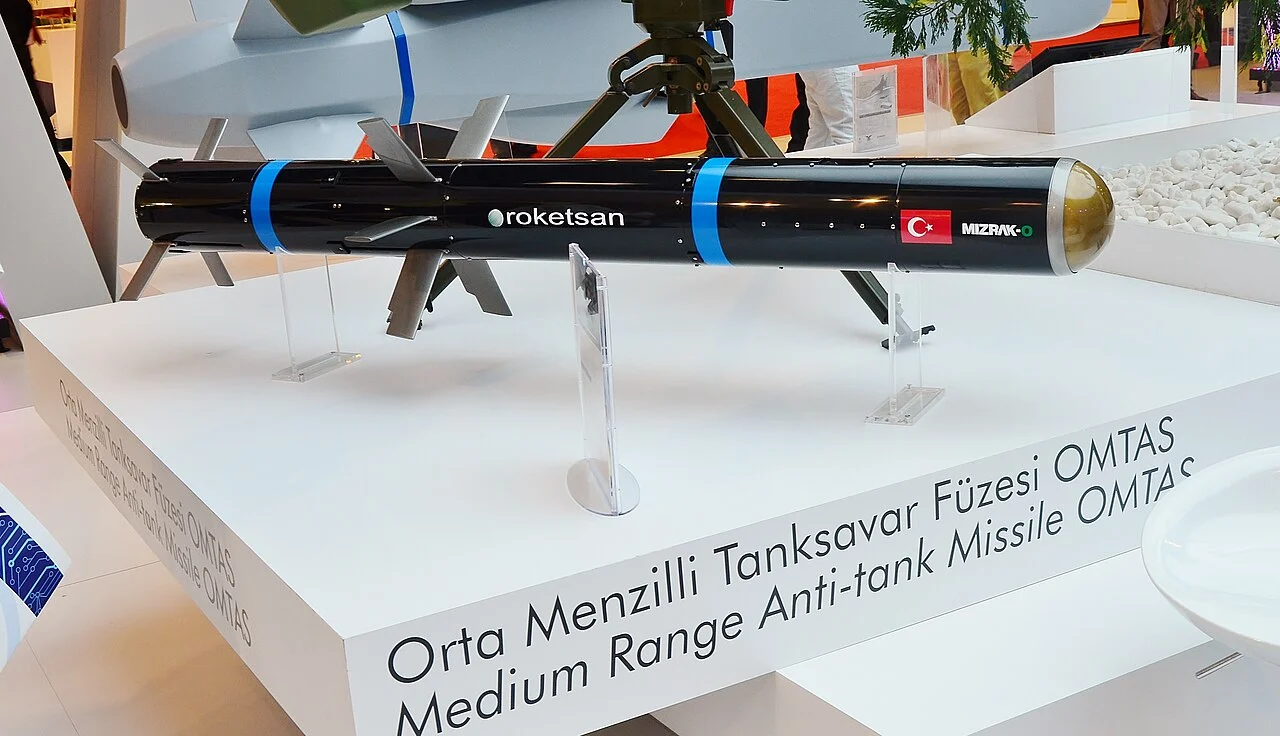
Turkey’s anti-tank guided missiles (ATGMs) are built almost entirely by ROKETSAN, which fields three families covering different ranges and launch platforms: KARAOK, a man-portable, fire-and-forget missile with a range beyond 2.5 km; OMTAS, a medium-range (0.2-4 km) tripod- or vehicle-mounted system; and UMTAS/L-UMTAS, a long-range (0.5-8 km) missile designed primarily for the T129 ATAK attack helicopter but also usable from vehicles, light attack aircraft and naval platforms. All three use imaging-infrared seekers and tandem-charge warheads built to defeat explosive reactive armour. Turkey operates all three; confirmed export customers include Malaysia (KARAOK), Kosovo (OMTAS) and Nigeria, whose T129 ATAK helicopters were delivered with 30 L-UMTAS missiles in 2023-2024 — the first confirmed African use of a ROKETSAN anti-tank missile.
Photo: ROKETSAN OMTAS medium-range anti-tank missile on its tripod launcher, on display at IDEF 2015. Credit: CeeGee, via Wikimedia Commons (CC BY-SA 4.0).
| Missile | Role | Range | Launch platform | Guidance | Confirmed operators |
|---|---|---|---|---|---|
| KARAOK | Man-portable, short-range | >2.5 km (official) | Shoulder- or tripod-fired, infantry | Imaging infrared, fire-and-forget | Türkiye, Malaysia |
| OMTAS | Medium-range | 0.2-4 km (official) | Tripod or land vehicle | Imaging infrared (fire-and-forget) or RF data link (fire-and-update) | Türkiye, Kosovo |
| UMTAS / L-UMTAS | Long-range | 0.5-8 km (official) | T129 ATAK helicopter; also land vehicles, light attack aircraft, naval platforms | UMTAS: imaging infrared + RF data link. L-UMTAS: semi-active laser | Türkiye, Nigeria |
What anti-tank missiles does Turkey make?
Turkey’s anti-tank missile capability is built almost entirely by ROKETSAN, the state-linked missile manufacturer majority-owned by the Turkish Armed Forces Foundation (TSKGV). ROKETSAN’s official product catalogue lists three guided anti-tank systems, each sized for a different tactical role: KARAOK for a single infantry soldier, OMTAS for a tripod or light-vehicle crew, and UMTAS/L-UMTAS for attack helicopters and heavier vehicle or aircraft mounts. This article covers ROKETSAN’s full in-service family; DefenceMENA has already published a dedicated product master page for KARAOK with its complete development history, pricing detail and a same-class comparison against the Javelin, AT-1K Raybolt and HJ-12. OMTAS and UMTAS/L-UMTAS do not yet have separate DefenceMENA master pages and are covered here at full depth; dedicated pages for each are planned for this cluster.
OMTAS: ROKETSAN’s medium-range anti-tank missile
OMTAS (Orta Menzilli Tanksavar Sistemi, “Medium-Range Anti-Tank System”) is ROKETSAN’s crew-served anti-tank missile, fired from a tripod or integrated into open- or closed-turret land vehicles. ROKETSAN’s official specification gives a 160 mm diameter, 1.8 m length, a combined missile-and-launch-tube weight of 35 kg, and an effective firing range of 0.2-4 km. The missile carries a tandem-charge warhead combining high-explosive anti-tank (HEAT), blast-fragmentation and thermobaric effects, and ROKETSAN states it is built with insensitive-munition characteristics against fuel fire and bullet impact. Guidance uses an imaging infrared (IIR) seeker for fire-and-forget engagements, or an RF data link for a fire-and-update mode that lets the operator adjust the strike point, switch targets mid-flight, or fire from a covered position (ROKETSAN official product page, accessed 5 October 2026). OMTAS was inducted into Turkish Army service in the mid-2010s, replacing older wire-guided anti-tank missiles, and has since become a standard medium-range anti-tank weapon across Turkish land forces.
UMTAS and L-UMTAS: ROKETSAN’s long-range anti-tank missiles
UMTAS (Uzun Menzilli Tanksavar Sistemi, “Long-Range Anti-Tank System”) and its laser-guided variant L-UMTAS are ROKETSAN’s heaviest anti-tank missiles, developed primarily as the main air-to-surface anti-armour weapon for the Turkish Aerospace T129 ATAK attack helicopter. Both variants share the same airframe: 160 mm diameter, 1.8 m length and approximately 37.5 kg missile weight, with an official range band of 0.5-8 km. UMTAS uses an imaging infrared seeker combined with an RF data link, giving lock-on-before-launch or lock-on-after-launch flight modes; L-UMTAS instead uses a semi-active laser seeker, letting the missile be guided onto a target designated by the helicopter, another aircraft, or a ground observer. Both carry a tandem anti-tank warhead with high-explosive blast-fragmentation and thermobaric options, and ROKETSAN states the family can operate day or night. Beyond the T129, ROKETSAN lists attack helicopters generally, light attack aircraft, land vehicles and naval platforms as approved launch platforms, using a quadruple or double launcher with a MIL-STD-1760 interface (ROKETSAN official product pages, accessed 5 October 2026). In May 2023 ROKETSAN announced it had begun production of UMTAS-GM, a further-developed guided variant intended as the primary anti-tank weapon for the future ATAK-2 (T929) helicopter as well as ground-based anti-tank units, with first-batch production targeted for completion by the end of 2023 (defence-industry.eu, 8 May 2023).
Development and export timeline
| Date | Milestone |
|---|---|
| Mid-2010s | OMTAS inducted into Turkish Army service, replacing older wire-guided systems |
| Early 2010s onward | UMTAS/L-UMTAS enters Turkish Army and Turkish Aerospace T129 ATAK service as the helicopter’s primary anti-tank weapon |
| 2020 | KARAOK reaches Initial Operational Capability with the Turkish Army |
| 2022 | KARAOK formally inducted into Turkish Army service |
| 24 May 2023 | Kosovo’s Ministry of Defence confirms a procurement of OMTAS anti-tank missiles and PMT-76/57A machine guns from Turkey (contract reported as signed December 2023) |
| 8 May 2023 | ROKETSAN announces start of production of UMTAS-GM for the future ATAK-2 (T929) and ground anti-tank units |
| 11 September 2023 | ROKETSAN wins its first KARAOK export order, from Malaysia |
| 2023-2024 | Nigeria receives four T129 ATAK helicopters in two batches (November 2023, September 2024), delivered with 30 L-UMTAS missiles, 50 CIRIT laser-guided rockets and 1,456 unguided 2.75-inch rockets |
| 20 April 2026 | First batch of 18 KARAOK systems delivered to the Malaysian Armed Forces |
| 9 January 2026 | Kosovo receives a further shipment of OMTAS anti-tank missiles under the December 2023 contract |
Sources: Overt Defense, 24 May 2023; defence-industry.eu, 8 May 2023; Defense News, 14 September 2023; Janes, 26 October 2023; Türkiye Today, 22 November 2024; Janes, 7 February 2024; defenceturk.net, 20 April 2026; The Defense Post, 9 January 2026.
Who operates ROKETSAN’s anti-tank missiles?
| Country | Missile | Status | Quantity | Platform | Source |
|---|---|---|---|---|---|
| Türkiye | KARAOK, OMTAS, UMTAS/L-UMTAS | OPERATIONAL | Not publicly disclosed | Infantry (KARAOK); tripod/vehicle (OMTAS); T129 ATAK helicopter and vehicles (UMTAS/L-UMTAS) | ROKETSAN; Turkish defence press |
| Malaysia | KARAOK | DELIVERED (first batch) | 18 launchers delivered, April 2026 | Man-portable | Defense News, 14 Sep 2023; Janes, 26 Oct 2023; defenceturk.net, 20 Apr 2026 |
| Kosovo | OMTAS | DELIVERED | Not publicly disclosed | Tripod/vehicle | Overt Defense, 24 May 2023; The Defense Post, 9 Jan 2026; Defence Security Asia, 2026 |
| Nigeria | L-UMTAS | DELIVERED | 30 missiles, delivered with 4 T129 ATAK helicopters (2023-2024) | T129 ATAK helicopter | Türkiye Today, 22 Nov 2024; Military Africa, 2024 (two independent reports citing matching figures) |
Two further situations are platform-level, not confirmed missile-level, evidence and are therefore not listed in the table above. Pakistan signed a 2018 contract for 30 T129 ATAK helicopters that would be armed with UMTAS/L-UMTAS, but delivery has not proceeded as of this writing because of a long-running U.S. export-licence dispute over the helicopter’s LHTEC CTS800 engine; DefenceMENA has found no public evidence that Pakistan has received the missile itself. The Philippines has operated six T129 ATAK helicopters since 2021, which are capable of carrying L-UMTAS/UMTAS, but DefenceMENA has not found public reporting confirming a missile-specific delivery, so the Philippines is not listed as a confirmed operator. Separately, ROKETSAN has signed cooperation agreements with Poland’s WZL-1 and Mesko covering potential co-production of CIRIT and UMTAS for Polish helicopters (defence24.pl); this remains a proposed industrial-cooperation agreement, not a confirmed order, and is not listed as an operator entry.
Are there confirmed African or Middle Eastern users?
Yes, for UMTAS/L-UMTAS: Nigeria is the first confirmed African operator of a ROKETSAN anti-tank missile. Nigeria’s Air Force took delivery of four T129 ATAK attack helicopters in two batches (two in November 2023, two more on 3 September 2024), and independent reporting states that 30 L-UMTAS laser-guided anti-tank missiles were delivered alongside the helicopters, together with 50 CIRIT laser-guided rockets and 1,456 unguided 2.75-inch rockets (Türkiye Today, 22 November 2024; Military Africa, 2024). This is treated as DELIVERED-status, munition-specific evidence rather than inferred from platform ownership alone, consistent with DefenceMENA’s editorial standard that T129 or TB2 ownership alone does not prove possession of a specific ROKETSAN munition. No other African country and no Middle Eastern country has a publicly confirmed KARAOK, OMTAS or UMTAS/L-UMTAS order, contract or delivery as of 5 October 2026. In September 2026 ROKETSAN signed a sales and joint-production agreement with Saudi Arabia’s SAMI Land Systems covering an unnamed “anti-tank guided missile weapon system”; public reporting has not specified whether this covers KARAOK, OMTAS, UMTAS/L-UMTAS or a new system, so it is not attributed to any one missile here. DefenceMENA will update this section, and cross-link it from the planned ROKETSAN Africa and Middle East hubs, as soon as product-level evidence is public.
How do ROKETSAN’s anti-tank missiles compare by range and role?
The three systems are deliberately sized for different roles rather than competing with each other, so the comparison below is organised by class rather than head-to-head. For a full same-class comparison of KARAOK against Western and Asian man-portable missiles (Javelin, AT-1K Raybolt, HJ-12), see the dedicated KARAOK product page. OMTAS’s closest same-class Western counterpart by range and crew-served role is the European MILAN ER (up to around 3 km, publicly reported) and the US-Israeli Spike-MR/LR family (up to around 4-5.5 km depending on variant, publicly reported); UMTAS/L-UMTAS’s closest same-class counterpart as a helicopter-launched long-range ATGM is the US AGM-114 Hellfire family (up to around 8 km, publicly reported) and the European Spike-NLOS/longer-range Spike variants. DefenceMENA has not found a single public dataset that directly compares unit cost, combat record or integration support across all of these systems on the same terms, so no ranking is made here; dedicated same-class comparison articles for OMTAS and UMTAS/L-UMTAS are queued separately in this cluster’s publication plan.
Related ROKETSAN systems
For ROKETSAN’s full product range, see the ROKETSAN company hub. For the man-portable short-range missile covered in depth, see KARAOK Anti-Tank Missile Explained. ROKETSAN’s man-portable short-range air defence missile, built on a similar fire-and-forget philosophy, is covered in SUNGUR: ROKETSAN’s Short-Range Air Defence Missile Explained. For the company’s drone-launched precision munitions, see MAM-L, MAM-C and MAM-T Explained. For further Turkish-language technical background on the L-UMTAS GM variant’s test programme, see Envanter Media’s report on L-UMTAS GM and TEMREN missile air-drop testing at Beşadalar.
Frequently asked questions
What anti-tank missiles does ROKETSAN make?
ROKETSAN makes three guided anti-tank missile families: KARAOK (man-portable, short-range), OMTAS (medium-range, tripod/vehicle) and UMTAS/L-UMTAS (long-range, primarily helicopter-launched).
What is the difference between KARAOK, OMTAS and UMTAS?
They are sized for different roles rather than being alternatives to each other. KARAOK is fired by a single infantry soldier at ranges beyond 2.5 km. OMTAS is crew-served from a tripod or vehicle at 0.2-4 km. UMTAS and its laser-guided variant L-UMTAS are ROKETSAN’s longest-range system at 0.5-8 km, built mainly for the T129 ATAK attack helicopter.
Which countries use ROKETSAN’s anti-tank missiles?
Türkiye operates all three families. Malaysia is a confirmed KARAOK operator, Kosovo a confirmed OMTAS operator, and Nigeria a confirmed UMTAS/L-UMTAS operator, having received 30 L-UMTAS missiles with its T129 ATAK helicopters in 2023-2024.
Is UMTAS the same missile as L-UMTAS?
They share the same airframe, weight and warhead, but use different guidance: UMTAS uses an imaging infrared seeker with an RF data link, while L-UMTAS uses a semi-active laser seeker guided onto a target designated by the helicopter or another observer.
Has an African country ordered a ROKETSAN anti-tank missile?
Yes. Nigeria received 30 L-UMTAS laser-guided anti-tank missiles in 2023-2024, delivered together with four Turkish Aerospace T129 ATAK attack helicopters, making it the first confirmed African operator of a ROKETSAN anti-tank missile.
Has Pakistan received UMTAS or L-UMTAS missiles?
Not confirmed. Pakistan contracted for 30 T129 ATAK helicopters in 2018 that would be armed with UMTAS/L-UMTAS, but delivery has been held up by a U.S. licensing dispute over the helicopter’s engine, and DefenceMENA has found no public evidence the missile itself has been delivered.
Sources
- ROKETSAN: L-UMTAS Laser Guided Long Range Anti-Tank Missile System, official product page (accessed 5 October 2026)
- ROKETSAN: UMTAS Long Range Anti-Tank Missile System, official product page (accessed 5 October 2026)
- ROKETSAN: OMTAS Medium-Range Anti-Tank Weapon System, official product page (accessed 5 October 2026)
- Overt Defense: “Kosovo Procures OMTAS Anti-Tank Missiles And PMT-76-57A Machine Guns From Turkey” (24 May 2023)
- The Defense Post: “Kosovo Expands Anti-Tank Arsenal With New Turkish OMTAS Missiles” (9 January 2026)
- Türkiye Today: “Nigeria strengthens defense with T-129 Atak helicopters from Türkiye” (22 November 2024)
- Janes: “Nigerian Air Force inducts T129 attack helicopters” (7 February 2024)
- Defense News: “Turkey’s Roketsan wins Malaysian deal for Karaok anti-tank missiles” (14 September 2023)
- defence-industry.eu: “Roketsan launches production of the UMTAS-GM anti-tank missile” (8 May 2023)
- Defence24.pl: Turkish missiles for Polish helicopters — ROKETSAN cooperation with WZL-1 and Mesko
- Envanter Medya: “ROKETSAN’ın L-UMTAS GM ve TEMREN Füzeleri Beşadalar’da Havadan Atışla Test Edildi” (Turkish-language technical background)
- ROKETSAN: official website (accessed 5 October 2026)