A year after a colonel’s coup toppled Madagascar’s elected government, Russian military intelligence officers, Africa Corps personnel and weapons shipments have become a fixture in Antananarivo. The buildup is now colliding with France’s own push to keep a foothold in its former colony’s armed forces.
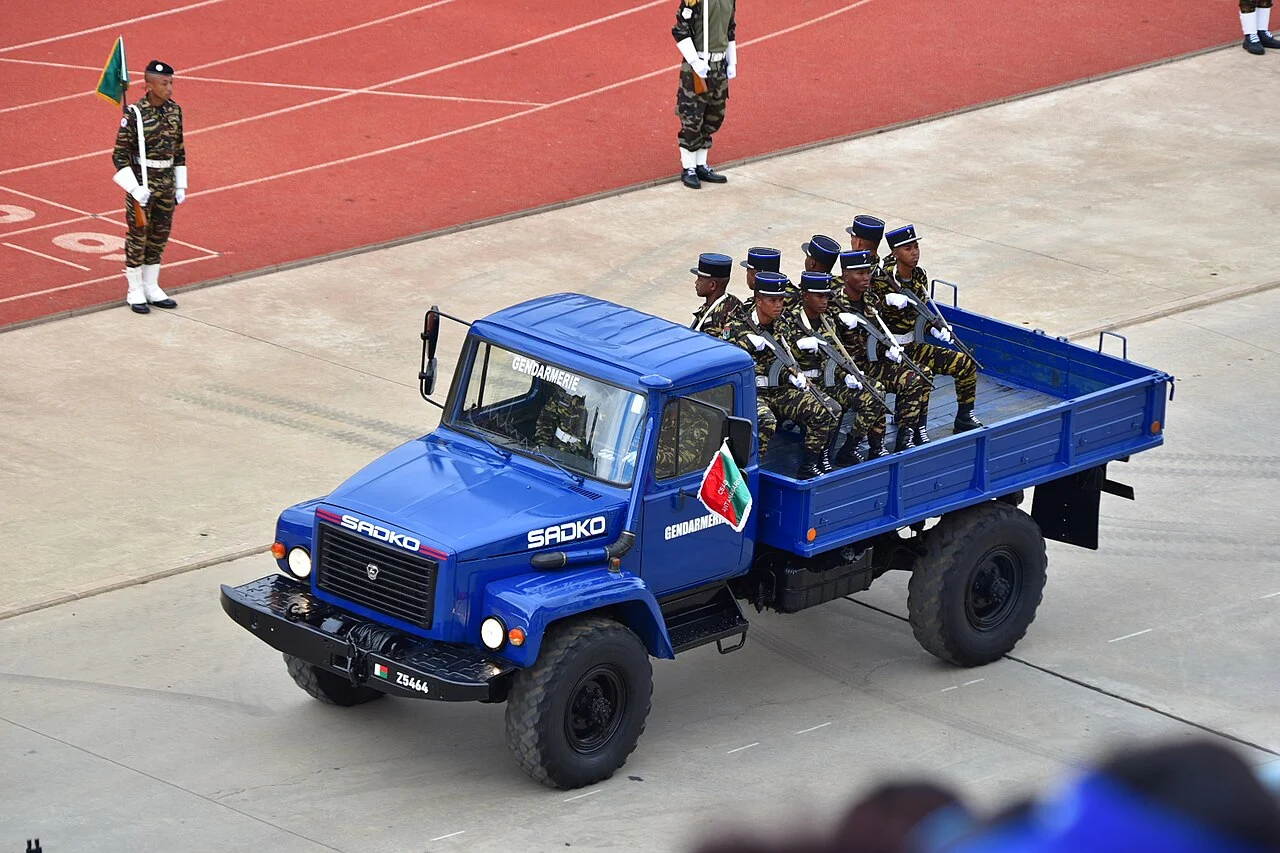
Photo: Malagasy forces on parade at Barea Stadium, Antananarivo, during Madagascar’s independence day celebrations, June 2026. Credit: Anai171, CC BY-SA 4.0, via Wikimedia Commons
An investigation published by RFE/RL journalists Mark Krutov and Sergei Dobrynin has traced how Russia’s military intelligence agency, the GRU, and the Kremlin-controlled Africa Corps have built a working relationship with the military-led government that took power in Madagascar after President Andry Rajoelina fled the country in October 2025. The reporting, based on flight records and documents, places senior Russian officers inside the island nation repeatedly over the past year and describes arms transfers that have drawn new attention to an Indian Ocean partner Paris has long treated as its own backyard.
From coup to Moscow visit
Colonel Michael Randrianirina, who led the Army Corps of Personnel and Administrative and Technical Services (CAPSAT) unit that withdrew its backing from Rajoelina during a youth-led uprising, took power as interim president after the then-president fled and was later impeached by parliament. Within months, according to the RFE/RL investigation, Russia had moved to establish ties with the new authorities in Madagascar.
A Russian military aircraft landed at Ivato International Airport near Antananarivo in December 2025, according to reporting from The Moscow Times and Militarnyi, unloading 43 crates of weapons, including assault rifles, sniper rifles and anti-tank missile systems, along with roughly 40 personnel identified as members of the Africa Corps. The equipment was handed to Madagascar’s Presidential Guard under what Malagasy officials described as a “legitimate cooperation agreement.”
Major General Andrei Averyanov, the GRU officer who previously ran Wagner-linked operations across Africa before heading the newer Africa Corps structure, met Randrianirina at Antananarivo’s airport and later hosted him in Moscow. Randrianirina travelled to Russia in February 2026 for talks with President Vladimir Putin, where he said he was open to cooperation with Moscow “across several sectors, including defence,” according to the RFE/RL account. The following month, Russian instructors began training Madagascar’s 1st Airborne Battalion at Ivato, a ceremony attended by GRU officer Anton Papshev. In May, Prime Minister Mamitianna Rajaonarison met Russian Security Council secretary Sergei Shoigu in Moscow to discuss further military and economic cooperation.
The RFE/RL report also identifies National Assembly speaker Siteny Randrianasoloniaiko as an early public booster of the relationship, and ties Belarusian businessman Alyaksandr Zingman — a figure previously linked to sanctioned networks moving Russian commodities — to a since-cancelled agricultural contract signed in August 2025 and partly financed by Moscow.
A navy with little to defend its coastline
Madagascar’s armed forces have historically been small and poorly equipped relative to the country’s size: a roughly 13,500-strong force built around light infantry, a handful of ageing patrol boats and a fleet of Soviet-era MiG-21s long since retired to static display, as documented in Wikimedia Commons imagery of derelict airframes. That leaves the government reliant on outside partners for everything from sealift to intelligence, airlift and training — the same gap Operation Cutlass Express exercises with the U.S. Navy and periodic joint training with French forces based in Réunion have tried to fill for over a decade.
It is that dependency Russia appears to be targeting. Beyond the Ivato training and arms transfer, the RFE/RL investigation reports that a Russian delegation inspected a disused naval facility on Madagascar’s coast, one which Antananarivo had separately agreed with France, two months earlier, to restore and modernise. No financing or construction timeline for that facility has been made public by either Paris or Antananarivo.
France pushes back with its own offer
The Russian overtures have landed just as France works to keep its own defence relationship with Madagascar intact. Malagasy and French officials signed two agreements in June 2026, including a letter of intent to build a reconnaissance-drone capability for Madagascar’s armed forces aimed at creating a dedicated intelligence-drone unit to support operations against rural banditry (dahalo raids), according to Madagascar’s L’Express de Madagascar. France’s defence ministry has also confirmed continuing training exchanges between its 5th Overseas Regiment, based on Réunion, and Malagasy army units.
French officials have told local media they are concerned Moscow could ultimately install a more permanent military presence in the southern Indian Ocean that would compete directly with France’s own forces based on Réunion and Mayotte — a worry reportedly raised during the Papangue 2026 exercise Madagascar co-hosted with France, according to Madagascar’s Financial Afrik. Neither Madagascar’s transitional government nor the Kremlin has issued a public response to the RFE/RL findings.
Why it matters for Africa
Madagascar joins a growing list of African states — Mali, Burkina Faso, Niger, the Central African Republic and, more recently, several West African juntas — where a change of government by force has been followed within months by Russian military personnel, instructors or hardware, usually delivered through the Africa Corps structure the Kremlin built to formalise what Wagner Group once ran informally in places such as Mali, where Amnesty International has documented civilian killings by Malian forces operating alongside Russian personnel. For the Southern African Development Community (SADC), of which Madagascar is a member, the pattern raises the same questions already debated over the Sahel: whether a government that owes its security to Moscow still answers to regional bodies, and whether the arrangement outlasts the officer currently in charge. Russia has steadily grown into one of the continent’s largest arms suppliers over the past decade, a trend tracked in detail in DefenceMENA’s analysis of who supplies Africa’s weapons.
The Indian Ocean dimension adds a layer rarely present in the Sahel cases. Madagascar sits astride shipping lanes serving the Mozambique Channel and the wider route around southern Africa that global trade has leaned on more heavily since Red Sea shipping risk rose. A Russian-linked naval facility there, even a modest one, would be the first of its kind on Africa’s eastern seaboard and would sit close to French forces on Réunion and Mayotte, as well as to the U.S. and other partners’ periodic deployments under exercises such as Cutlass Express. The pattern echoes what satellite imagery has already shown of China’s own signals-intelligence expansion at its Djibouti base on Africa’s other coast. For now the Madagascar facility remains an inspected ruin rather than an operational base, but the competition over who modernises it — Paris or Moscow — will be a test case for how much leverage outside militaries now hold over African governments that come to power through unconstitutional means.
Update, 7 October 2026: France has since formalised a drone donation to Madagascar’s armed forces during a visit by Armed Forces Minister Catherine Vautrin. See France Gives Madagascar a Long-Range Drone and Promises About 100 More.
Sources
- RFE/RL: “Russia’s GRU, Africa Corps Deepen Ties With Madagascar’s Junta”
- The Defense Post: “Russian Military Intelligence Expands in Madagascar: Report”
- The Moscow Times: “Russia Sends Weapons to Madagascar Following Military Coup”
- Militarnyi: “Russians Send Weapons and Soldiers to Madagascar to Help Military Junta”
- L’Express de Madagascar: “Madagascar et la France resserrent les rangs”
- Financial Afrik: “Comment la Russie exploite la transition militaire malgache pour s’implanter dans l’océan Indien”