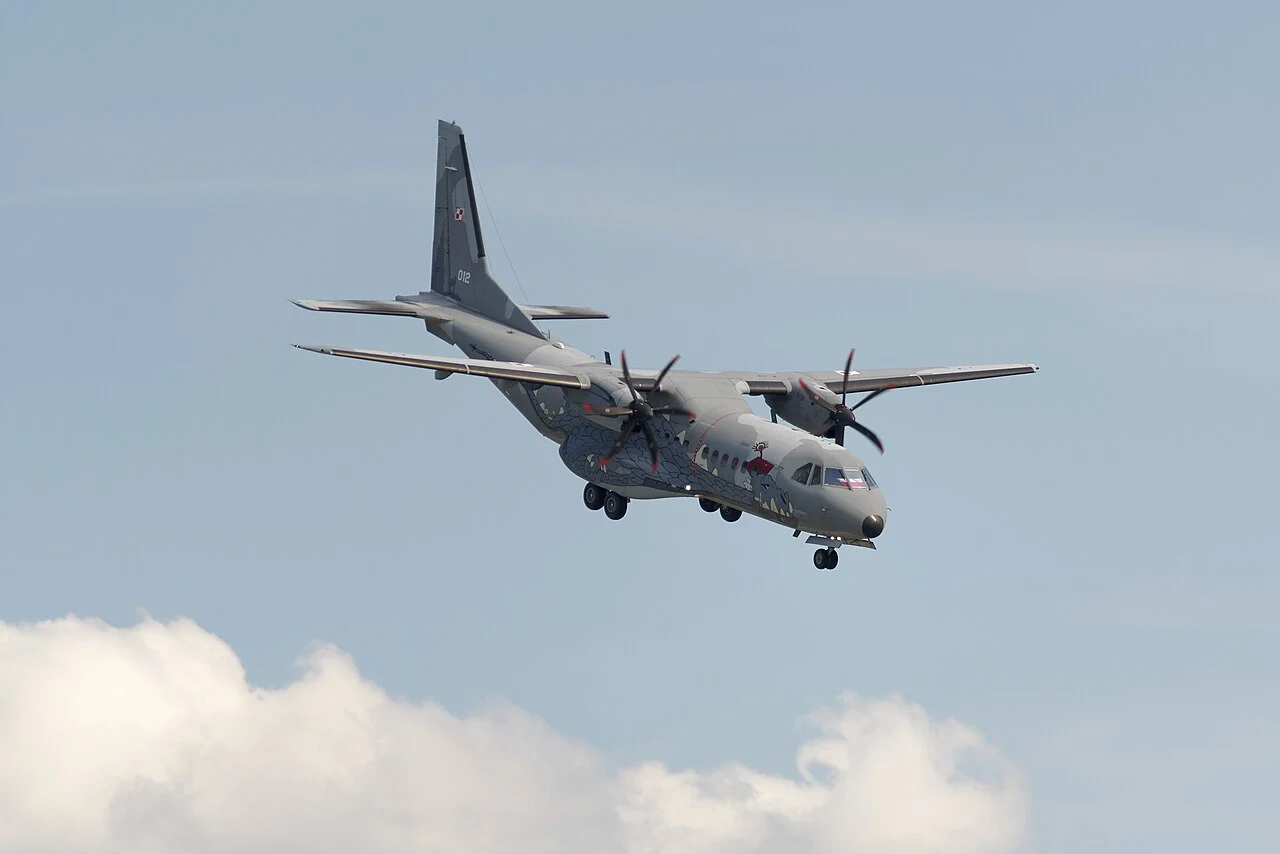
Morocco’s Royal Air Force has quietly taken delivery of its first Airbus C-295W tactical transport aircraft, with the airframe tracked landing at Kénitra airbase near Rabat on 29 September. No Moroccan or Spanish authority has confirmed the delivery publicly.
Photo: An Airbus C-295 tactical transport aircraft (Polish Air Force example shown). Credit: Jakub Hałun, CC BY-SA 4.0, via Wikimedia Commons
According to Infodefensa, the aircraft, registration CN-AMT and manufacturer’s serial number 253, flew from the Airbus Defence and Space plant at Seville-San Pablo to Kénitra, home to a large share of the Royal Air Force’s transport squadrons. The Spanish outlet pieced the movement together from ADS-B Exchange flight-tracking data, the specialist X account @komarmies, which follows Moroccan armed-forces procurement, and the Moroccan tech portal Silicon Valley Maroc. Rabat has a long-standing practice of not announcing military aircraft deliveries, leaving open-source tracking as the primary way such arrivals become public.
A First Sighting in May, a Quiet Arrival in September
CN-AMT was first photographed on the Seville production line in mid-May 2026, when it was spotted by aviation enthusiasts on the Forum Far-Maroc community and reported by Morocco World News. Four and a half months separated that sighting from the aircraft’s actual handover and ferry flight to Morocco, a gap consistent with final acceptance testing, crew conversion and paperwork that typically follows a C-295 rollout before an operator takes formal custody.
Morocco has ordered a minimum of two C-295W aircraft, according to Spanish defence-industry reporting; some accounts put the eventual total as high as four, though neither Rabat nor Airbus has disclosed contract value or the full order size. The “W” designation refers to winglets fitted to later-production C-295 airframes, which improve fuel efficiency on longer transport legs.
Filling a Gap Below the C-130
The Royal Air Force’s existing tactical-airlift fleet is built around roughly 14 Lockheed Martin C-130 Hercules, one of which is configured for signals-intelligence collection and two of which serve as aerial tankers, plus around six older CASA CN-235s. L3Harris Technologies began a multi-year overhaul of Morocco’s C-130 fleet in 2025, a contract expected to run through 2029.
The C-295W does not replace the C-130; it is a smaller, twin-turboprop aircraft that can lift up to nine tonnes of cargo or around 70 troops and operate from short, unprepared airstrips, making it better suited to routine logistics, troop rotation and domestic missions than the Hercules fleet’s longer-range and heavier-lift role. It effectively takes over the niche the ageing CN-235s have filled for two decades, while adding capacity the Royal Air Force did not previously have spare C-130 airframes to cover.
A Deepening Industrial Relationship With Spain
The delivery lands alongside a broader rapprochement between Rabat and Madrid since 2022, when Spain shifted its position on Western Sahara, and a growing Airbus industrial footprint inside Morocco itself. Airbus subsidiary Stelia Aerospace and Airbus Atlantic Morocco Composites already manufacture aerostructures, composite parts and wiring for the A320 civil airliner family at plants in Morocco, and Moroccan officials have set out an ambition to build a fully “Made in Morocco” aircraft by 2030. The C-295W handed over this week is, however, a standard Seville-built airframe with no Moroccan-manufactured content of its own — a distinction Moroccan aerospace officials will need to close if that longer-term ambition is to move from industrial-park marketing to an actual assembly line.
Why It Matters for Africa
The C-295 is already the tactical transport of choice for several African air forces, including Ghana, Senegal and Egypt, making Morocco’s order less a novelty than a continuation of a continent-wide shift away from Soviet-era An-12s and towards Western turboprop airlifters that are cheaper to maintain and easier to source spares for. For North Africa specifically, the aircraft gives the Royal Air Force more flexibility to support National Gendarmerie and civil-protection missions — disaster response, border patrol over the Sahara, and troop rotation to forward bases — without tying up scarce C-130 airframes that are themselves now mid-overhaul. The unannounced nature of the delivery also fits a pattern: Morocco has increasingly let open-source and flight-tracking communities do the work of confirming its military modernisation, a contrast with the more formal procurement disclosures typical of Gulf and European buyers of the same aircraft.
Sources
- Infodefensa: “El primer C-295 ensamblado en Sevilla para Marruecos llega al país norteafricano”
- Morocco World News: “Morocco Set to Receive First Airbus C295W Military Transport Aircraft”
- Bladi.net: “L’armée marocaine accueille un nouvel avion stratégique”