South African start-up Dinkwanyana Aerospace unveiled its UVH-170 vertical take-off and landing drone at the Africa Aerospace and Defence exhibition, pitching a 350km-range platform built for the continent’s heat and humidity. The company says a related system is already flying operational missions in Eastern Europe.
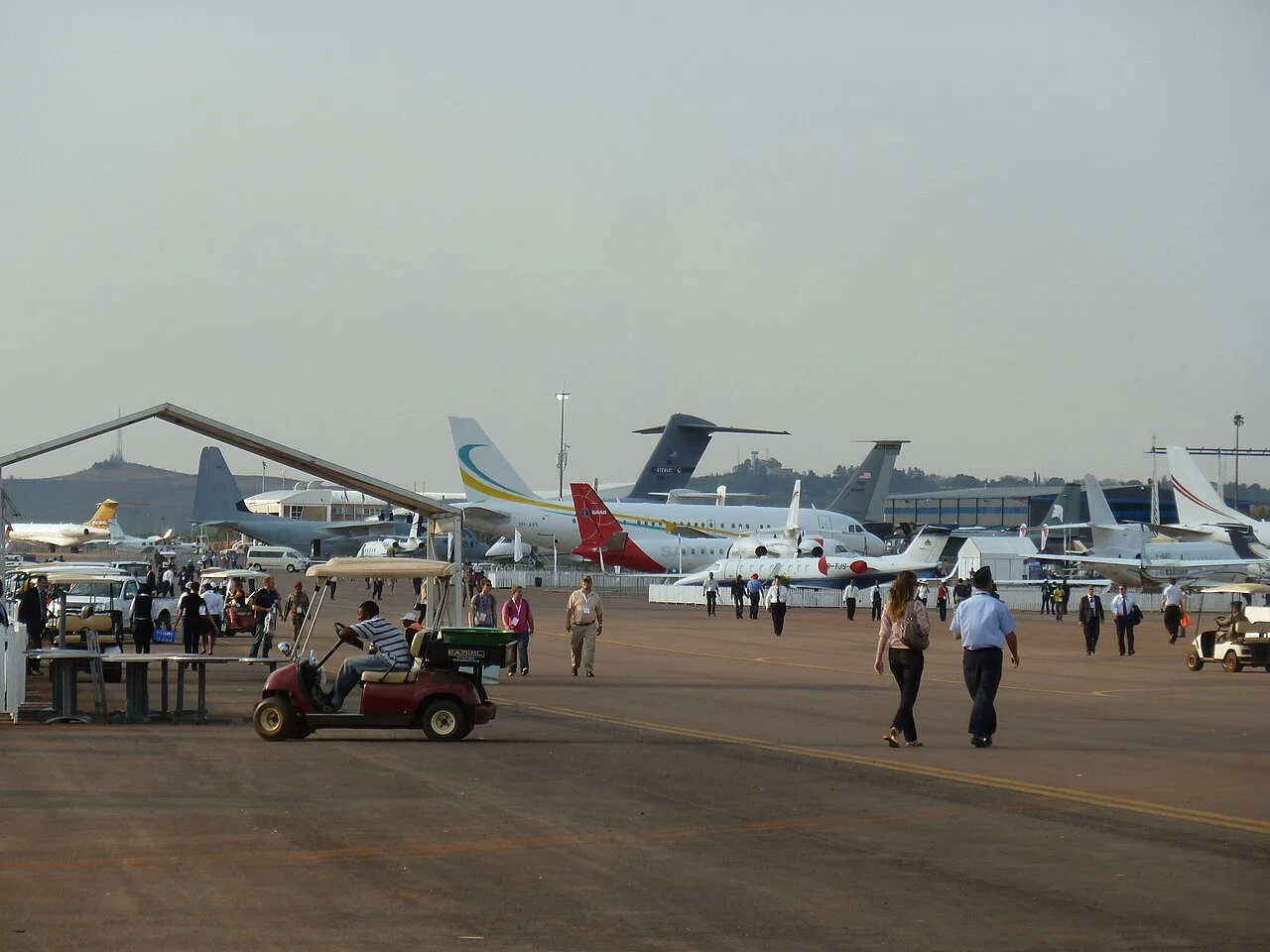
Photo: Visitors and aircraft at the Africa Aerospace and Defence (AAD) exhibition, Waterkloof Air Force Base, Pretoria. Credit: JMK, CC BY-SA 3.0, via Wikimedia Commons
Dinkwanyana Aerospace showed its new UVH-170 vertical take-off and landing (VTOL) unmanned aerial vehicle for the first time at AAD 2026, the biennial airshow held at Waterkloof Air Force Base outside Pretoria, defenceWeb reported. The drone is aimed at surveillance, reconnaissance and, in armed configurations, light strike roles for African militaries and security forces operating in hot, humid terrain.
What the UVH-170 offers
The UVH-170 has a maximum take-off weight of 45kg and carries up to 15kg of surveillance or reconnaissance payload, or a 4kg payload in its heavier-lift configuration. It cruises at 60km/h, with a top speed of 120km/h, an endurance of five hours and a range of 350km, according to figures Dinkwanyana gave defenceWeb. The aircraft is powered by a four-stroke petrol engine with strengthened cooling that the company says was specifically engineered for tropical and humid climates — a recurring design problem for UAVs deployed in Central and West Africa, where standard cooling systems can struggle in sustained heat.
Flight control runs on a proprietary autopilot with automatic take-off and landing, automatic mission flight, and a semi-automatic override option. Mission planning and diagnostics are handled over a wireless data link. Dinkwanyana says the airframe can be configured for straightforward surveillance work or fitted with rocket pods, grenade or bomb dispensers, and other weaponised payloads, positioning the UVH-170 as a multi-role platform rather than a pure intelligence, surveillance and reconnaissance (ISR) tool.
Msawakhe Dlamini, Dinkwanyana’s Head of Landward Defence, told defenceWeb that a system from the same family “is operational in Eastern Europe” — the company’s first public claim of an overseas combat deployment, though it did not name the customer or specify which variant is in service there.
Part of a wider product line
The UVH-170 sits alongside two other Dinkwanyana platforms: the UVH-500, built for night operations and adverse weather, and the UVH-25EL, a smaller commercial variant used for LiDAR data collection. The line reflects a broader pattern among newer South African UAV manufacturers of building one common autopilot and airframe architecture, then adapting payload and role across military and commercial customers to spread development cost.
Dinkwanyana entered AAD 2026 as a new exhibitor, and the UVH-170 reveal came in the same week as South Africa’s broader AAD showcase of aerospace hardware, which included Paramount’s V-Raven reusable VTOL drone and Denel Dynamics’ Seeker 400 tactical UAV. South Africa’s drone sector has grown crowded quickly: Denel, Paramount, Milkor and now Dinkwanyana are all marketing VTOL or fixed-wing unmanned platforms out of the same domestic industrial base, competing for both SANDF interest and export orders elsewhere on the continent.
Alternatives on the African market
The UVH-170’s closest domestic competitors are Paramount’s V-Raven, also unveiled at AAD 2026, and Denel Dynamics’ Seeker 400, a larger, combat-proven tactical UAV already integrated with the Impi precision-guided munition. Beyond South Africa, African militaries buying comparable medium-endurance ISR drones have largely turned to Turkish systems such as the Bayraktar TB2, or to Chinese platforms including CASC’s CH-series and Wing Loong variants. Dinkwanyana’s pitch is price and climate-specific engineering rather than raw endurance or payload, positioning the UVH-170 below the TB2’s weight class and closer to tactical, unit-level reconnaissance drones.
Why it matters for Africa
A domestically engineered VTOL drone rated for tropical operating conditions addresses a specific gap: many imported UAV designs, optimised for temperate or desert climates, have had reliability problems in the humid heat of the Sahel, the Gulf of Guinea coast and Central Africa. If Dinkwanyana’s cooling claims hold up under real deployment, the UVH-170 could offer African buyers — particularly smaller air forces and paramilitary units without the budget for TB2-class systems — a lower-cost, regionally supported alternative that doesn’t require reliance on Turkish, Chinese or Israeli export approval processes. It also adds to South Africa’s push, visible across AAD 2026, to rebuild a domestic unmanned-systems export base after years in which Denel’s own drone programmes were constrained by state funding problems.