Uganda’s top general has set 1 August 2027 as the date for a full withdrawal of Ugandan forces from Somalia, the most concrete timeline yet in a withdrawal debate that has dragged on for years. The announcement lands just as the African Union’s Somalia mission faces a UN funding cliff, raising the prospect of a security vacuum before any replacement force is in place.
Update, 2 November 2026: Uganda has begun the withdrawal. The UPDF said the first cohort of troops is back in Uganda, that the bilateral force will leave within days, and that all forces, including the AUSSOM contingent, will exit “by the close of 2027”, later than the 1 August 2027 date given in August. Full details here.
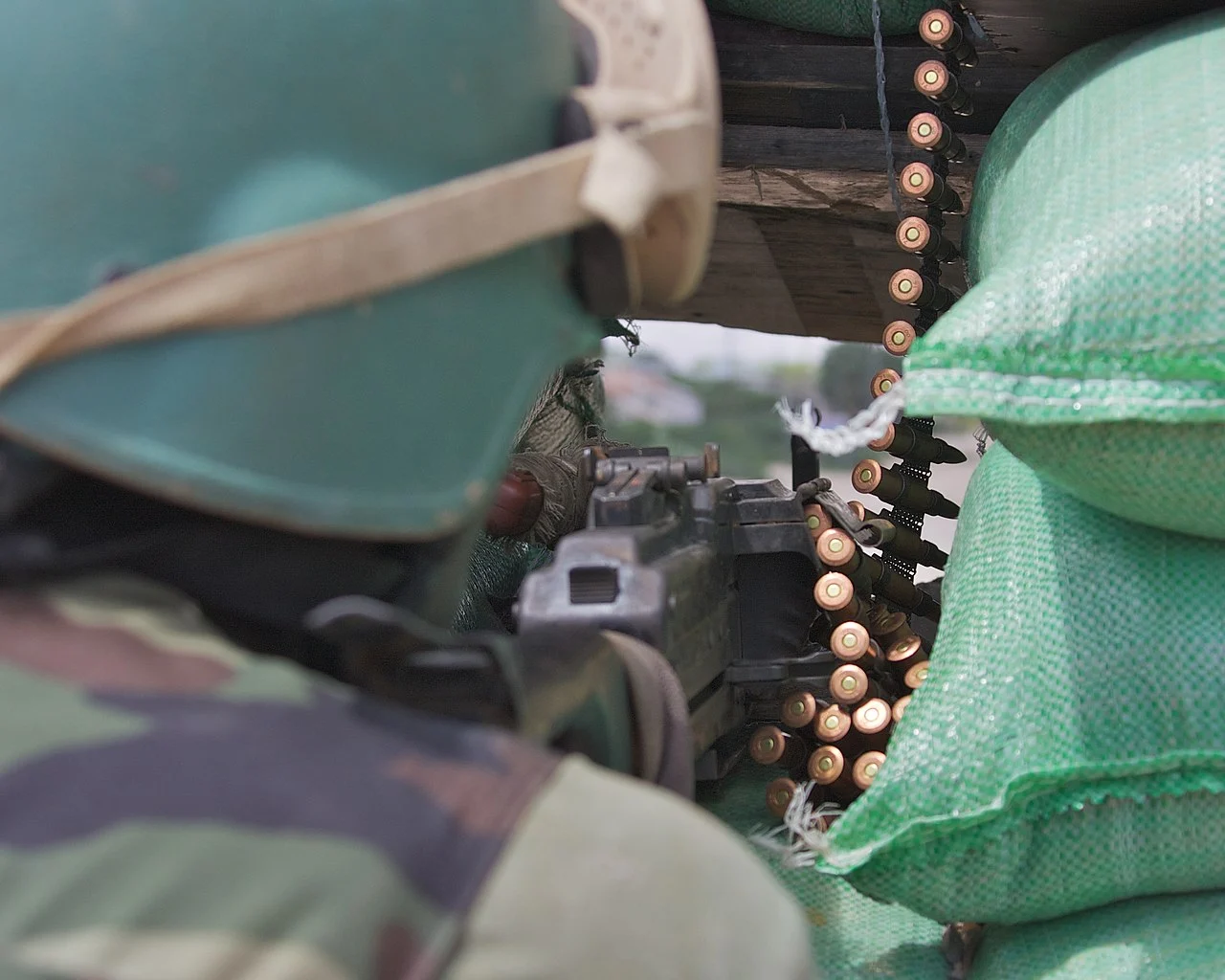
Photo: Ugandan troops establishing forward positions while serving with the African Union mission in Somalia. Credit: AMISOM Public Information, CC0, via Wikimedia Commons
General Muhoozi Kainerugaba, Chief of the Uganda People’s Defence Forces (UPDF), said on 28 August 2026 that “we are withdrawing completely from Somalia by the 1st of August 2027,” according to Military Africa. It is the clearest deadline any troop-contributing country has put on the table since discussions about winding down the African Union mission in Somalia began.
A deployment stretching back to 2007
Uganda has kept forces in Somalia continuously since March 2007, when it became the first contributor to what was then the African Union Mission in Somalia (AMISOM), now reconstituted as the African Union Support and Stabilization Mission in Somalia (AUSSOM). At its peak the UPDF contingent numbered around 6,000 troops; a 2,000-strong reduction in 2023 and further drawdowns have brought the AUSSOM-badged contingent to roughly 4,500 soldiers today, alongside a separate bilateral security force of between 2,000 and 6,000 troops (reporting varies) deployed since 2025 outside the AU mission structure.
That bilateral arrangement is where the confusion starts. In mid-August, Uganda’s Defence Minister Kiryowa Kiwanuka suggested Kampala might keep troops in Somalia under the bilateral agreement even after the multilateral AU mission winds down — directly at odds with Kainerugaba’s “completely” language two weeks later. Neither position has been formally reconciled, leaving open exactly what a “complete” Ugandan withdrawal would actually mean in practice.
Why the timing matters
The announcement comes against a hard deadline elsewhere: the UN Security Council’s current authorisation for AUSSOM, including roughly $500 million a year in UN-funded logistics support, expires on 31 December 2026. The United States has told the African Union it will not back a further extension of that funding arrangement, which would leave a five-month gap between the funding cliff and Uganda’s stated exit date — a gap during which Somalia’s federal government would need to either secure alternative funding, accelerate the handover of security responsibility to its own forces, or persuade troop contributors to stay on without the UN funding mechanism that has underwritten the mission for years.
Uganda’s contingent has historically anchored operations in and around Mogadishu and central Somalia against al-Shabaab, the al-Qaeda-linked insurgency that remains the mission’s principal target. A Ugandan drawdown on this scale, layered onto the funding uncertainty, would force a rapid reassessment of troop density in some of the areas where the insurgency is most active, and comes even as neighbouring Kenya has been deepening its own counter-terrorism cooperation with Western partners, including a new trilateral counter-terrorism hotline with the US and UK.
Why it matters for Africa
AUSSOM’s funding and troop-contribution troubles are a live test of whether African-led peace-support operations can survive the retrenchment of Western funding that has already reshaped missions in the Sahel and DRC. Uganda has been the single most consistent troop contributor to the Somalia mission for nearly two decades; a firm, dated exit — even one still tangled in contradictory statements about bilateral forces — signals to Addis Ababa, Nairobi and Washington that the burden-sharing model underpinning AUSSOM cannot be taken for granted much longer. For Somalia’s Federal Government, the practical question is now less about diplomacy and more about arithmetic: replacing thousands of experienced Ugandan troops, and the funding that supports them, in well under a year, at the same time as East African states are separately trying to stand up a combined anti-piracy task force to cover the maritime side of the region’s security gap.