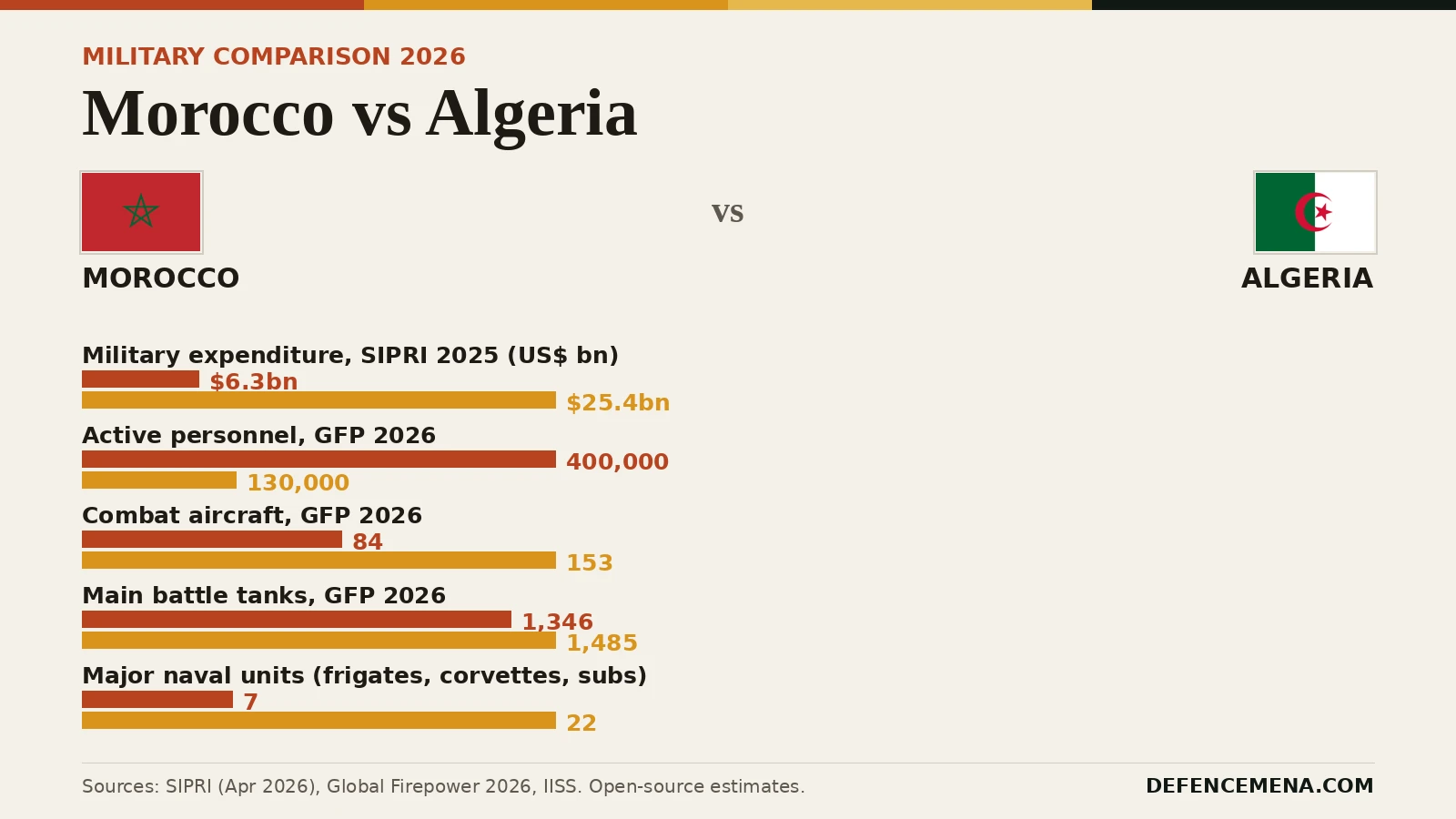
Morocco and Algeria have spent the past three years on parallel rearmament drives, but from very different starting points: Algeria still outspends its neighbour roughly four to one, while Morocco has quietly become Africa’s largest arms importer. This comparison sets out what each country actually operates in the air, on land, at sea and in air defence, using SIPRI, Global Firepower, FlightGlobal’s World Air Forces directory and open-source defence reporting, rather than headline “who is stronger” claims.
Both countries have dedicated Morocco and Algeria desks on DefenceMENA, filed under Analysis & Geopolitics and North Africa. Standalone country-strength profiles for both are in production separately and will be linked here once published.
| Metric | Morocco | Algeria | Source / year |
|---|---|---|---|
| Military expenditure | $6.3bn (+6.6% real, 2025) | $25.4bn (+11% real, 2025) | SIPRI, Apr 2026 |
| Official defence budget, 2026 | MAD 157.2bn (~$15.7bn appropriation; ~$5.6bn payment credits) | DZD 3,208bn (~$25bn) | 2026 finance laws |
| Active personnel | ~200,000 estimated (GFP 2026: 400,000) | 130,000 | GFP 2026 / IISS-based estimate |
| Reserve / paramilitary | 250,000 reserve; ~50,000 Gendarmerie Royale & Auxiliary Forces | 150,000 reserve; 150,000 paramilitary | GFP 2026, estimated |
| Main battle tanks | 1,346 (Abrams, T-72B, legacy M60) | 1,485 (T-90SA, T-72M1, T-62, T-55AMV) | GFP 2026 / IISS, estimated |
| Combat aircraft | 84 fighters (F-16, Mirage F1, F-5) | ~153 (Su-30MKA, Su-35, Su-57E, Su-34ME, MiG-29, Su-24) | World Air Forces 2026 / GFP |
| Attack helicopters | 12 AH-64E Apache (by Apr 2026) | 74 (Mi-28NE, Mi-24 Super Hind) | World Air Forces 2026 |
| UAV / UCAV capability | Bayraktar TB2 & Akinci, Wing Loong II, Heron/Harfang, Harop loitering munitions | Wing Loong II, CH-3/CH-4, WJ-700, El Djazair 54 (domestic) | Open-source, various dates |
| Major naval vessels | 1 FREMM frigate, 3 Sigma-class corvettes/frigates, 2 Floréal-class frigates | 8 frigates, 8 corvettes | GFP 2026, open-source estimates differ |
| Submarines | 0 (exploring options) | 6 (2 Kilo 877EKM, 4 Kilo 636) | Open-source, 2026 |
| Air defence | Barak MX (new), legacy I-HAWK; Patriot under evaluation | S-400, S-300PMU-2, Buk-M2E, Tor-M2E, Pantsir-S1/SM | Open-source, 2025-26 |
| Defence industry | Foreign-JV based: MRO, drone and optronics plants | State-run: armour, ammunition, shipbuilding | Open-source, 2025-26 |
| Global Firepower rank (auxiliary) | 56th of 145 | 27th of 145 | Global Firepower 2026 index |
Defence budgets
According to SIPRI’s Military Expenditure Database, Algeria spent $25.4 billion on defence in 2025, up 11 per cent in real terms, and remained by far the largest military spender in Africa. Its outlay equalled roughly a quarter of total government spending, the second-highest such share in the world after Ukraine, and 8.8 per cent of GDP. Morocco spent $6.3 billion in 2025, up 6.6 per cent, making it Africa’s second-largest spender and comfortably ahead of Nigeria, Egypt’s North African neighbours aside.
SIPRI’s military expenditure figure is not the same measure as either government’s own budget line, and the two should not be read as interchangeable. Morocco’s 2026 finance law allocates MAD 157.2 billion (roughly $15.7 billion) in commitment appropriations to national defence, a 17.8 per cent increase on 2025; the portion actually disbursed in-year, the “crédits de paiement”, is far smaller at MAD 55.3 billion (about $5.6 billion), covering salaries, operating costs and payments on contracts signed in earlier years. Algeria’s 2026 finance law sets total defence-related expenditure at roughly DZD 3,208 billion (about $25 billion) of a DZD 17,636 billion state budget. Both figures are official budget appropriations rather than SIPRI’s independent estimate, and the two measures can diverge for reasons ranging from off-budget procurement to currency assumptions.
Personnel
Global Firepower’s 2026 index credits Morocco with 400,000 active personnel, a figure that appears to blend full-time military, reserve call-up capacity and territorial elements rather than a strict active-duty count. Estimates built on IISS Military Balance-style categorisation put the Royal Armed Forces’ full-time active strength closer to 200,000, with a further roughly 50,000 in the Gendarmerie Royale and Auxiliary Forces counted separately as paramilitary. Algeria’s People’s National Army is more consistently reported across trackers at around 130,000 active personnel, with 150,000 reserve and a further 150,000 in paramilitary formations including the National Gendarmerie. Neither country’s active, reserve and paramilitary totals should be added together as a single combat-ready figure.
Air power
Algeria’s air force has undergone the more dramatic transformation of the two. Its Sukhoi fleet now spans the Su-30MKA workhorse (63-72 in service depending on source), a growing Su-35 contingent (9 delivered, 6 more on order), and the first African export customers for two of Russia’s newest combat types: 2 Su-57E stealth fighters delivered and filmed in service since late 2025, and 8-14 Su-34ME strike aircraft. Older MiG-29s, Su-24s and a Yak-130/L-39 trainer fleet round out the inventory, alongside 11 Il-76 and 5-6 Il-78 tankers for strategic airlift and air-to-air refuelling — a genuine long-range capability Morocco does not currently match. Algeria has ordered but not yet fielded an airborne early warning platform (a KJ-500 order is reported but unconfirmed).
Morocco’s Royal Air Force is mid-overhaul rather than newly re-equipped. Its front line still rests on 23 F-16C/D Block 52+ jets delivered in 2011-12, alongside older Mirage F1 and F-5E Tiger II squadrons and Alpha Jet light attack aircraft. The next generation is contracted but not yet operational: 25 new F-16 Block 72/F-16V aircraft plus an upgrade of the existing Block 52+ fleet, under a package Lockheed Martin says is entering flight test in late 2026 with deliveries continuing into 2027. Helicopter modernisation is further along — 12 AH-64E Apache attack helicopters were in service by April 2026, with 10 Airbus H225M Caracal transport helicopters ordered in November 2025 to replace an ageing Puma fleet. Trainer aircraft are excluded from the combat totals above in both cases, and Algeria’s transport and tanker fleet is not counted as combat strength.
Land forces
Algeria’s ground forces are the larger and heavier of the two by most published counts, with roughly 1,485 tanks (600 T-90SA, plus T-72M1, T-62 and T-55AMV variants of declining vintage), around 24,920 armoured vehicles including 1,034 German-designed Fuchs 2 armoured personnel carriers built domestically under the Rheinmetall Algérie joint venture, and a growing local Nimr 4×4 production line at Khenchela with a reported 3,000-vehicle contract. Its artillery includes towed and self-propelled 152-155mm guns, BM-21, Smerch, SR-5 and TOS-1A thermobaric multiple rocket launchers, and Iskander-E short-range ballistic missiles, whose numbers are undisclosed.
Morocco’s army fields around 1,346 tanks, a mix of US M1A1 SA and newer M1A2 SEPv3 Abrams alongside older Soviet-era and American stock, with M113, AIFV, French VAB and Turkish Otokar Cobra II wheeled vehicles in the infantry-carrier role. Artillery modernisation has leaned heavily on Western and Israeli truck-mounted systems — CAESAR and ATMOS 2000 155mm self-propelled guns — supplemented by US HIMARS and Israeli PULS multiple rocket launchers, a rocket-artillery combination Algeria does not field. Both countries maintain legacy towed 105mm and 155mm guns (M101, M114, L118 for Morocco) that add to headline artillery counts without representing current-generation firepower.
Naval power
Both countries have functioning blue-water ambitions but very different fleets. Algeria’s navy is built around 6 Kilo-class submarines (2 older 877EKM boats, 4 newer 636 variants), 2 German-designed MEKO A-200AN frigates built with technology transfer, 3 Chinese C28A corvettes, 3 Koni-class and a growing mosquito fleet of missile and patrol boats, plus a landing platform dock and 2 landing ships. It is the only one of the two with a submarine arm, giving it an underwater strike and area-denial option Morocco cannot answer directly.
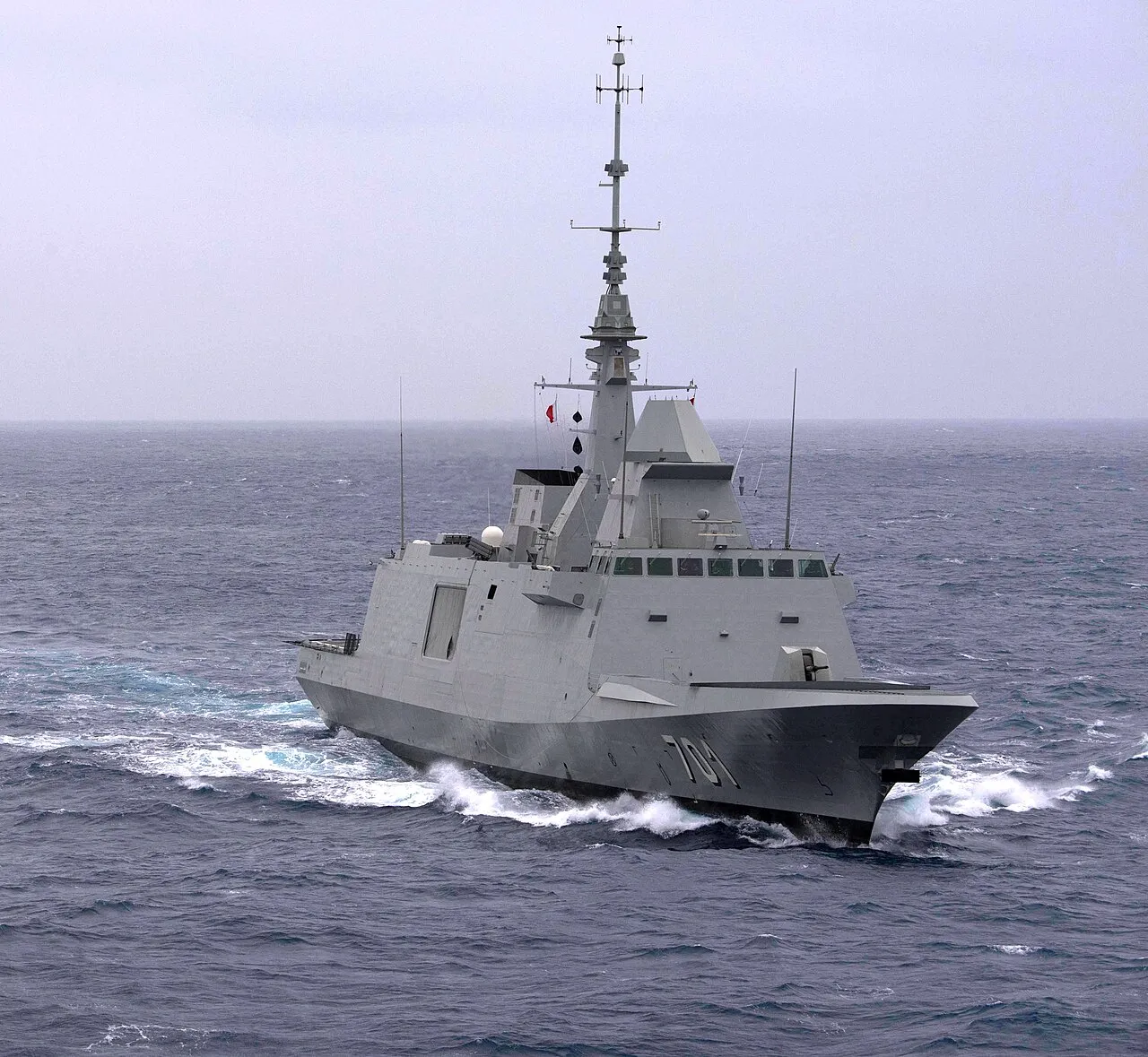
Morocco’s navy has no submarines and has said only that it is “exploring options” for an underwater capability. Its surface fleet is centred on the French-built FREMM frigate Mohammed VI, delivered in 2014 and optimised for anti-submarine warfare, backed by three Dutch-designed Sigma-class corvettes/frigates (Tarik Ben Ziyad, Sultan Moulay Ismail and Allal Ben Abdellah) and two older Floréal-class frigates. A large patrol and coastal-craft fleet — Global Firepower counts 84 patrol vessels — covers Morocco’s long Atlantic and Mediterranean coastline but does not substitute for blue-water combatants; total hull counts are not treated here as a strength metric, since patrol boats and frigates perform very different missions.
Air defence
Algeria’s ground-based air defence is the more layered of the two. It fielded the S-400 publicly for the first time at a live-fire exercise in May 2025, on top of an existing S-300PMU-2 layer delivered from 2008-11, Buk-M2E at medium range, and a dense short-range and point-defence layer of Tor-M2E, Pantsir-S1/SM (around 100 units), S-125 Pechora-2M and Osa-AK, backed by a dedicated Territorial Air Defence Forces command. Morocco’s layer is thinner but newer at the top end: a $500 million Israeli Barak MX system began delivery in 2023 and reached full operational status at a new air-defence base near Sidi Yahya El Gharb by early 2026, integrating ELM-2084 radars and interceptors at three ranges up to 150km. Morocco has also sought US approval for the Patriot system, which would add a second, US-sourced long-range layer alongside Barak MX and Morocco’s older I-HAWK batteries — redundancy across suppliers that Rabat has cited explicitly as a goal.
Drones and loitering munitions
Morocco operates the more diverse and more combat-tested drone fleet of the two. Its roughly 19-25 Bayraktar TB2s, acquired from Turkey from 2021, have been joined by early deliveries of the larger Bayraktar Akinci strike drone under a 2023 contract, alongside Chinese Wing Loong II and Chinese TB-001 airframes (observed flying missions from Laâyoune), and Israeli Heron/Harfang medium-altitude platforms delivered from 2021. Morocco also fields Israeli Harop loitering munitions. Algeria’s inventory leans more heavily on Chinese types — 24 Wing Loong II, 10 CH-3/CH-4, 4 WJ-700 — supplemented by 10 Denel Seeker systems and a domestically assembled El Djazair 54 (Yabhon United 40), with further Chinese CH-5 and Turkish Aksungur and Anka-S orders reported but not confirmed delivered as of September 2026.
Turkish systems in the two inventories
Turkish equipment sits at very different stages of maturity in the two air arms. Morocco’s Bayraktar TB2s have been operational for several years and its Akinci order is already being delivered, while Algeria’s Turkish drone orders — Aksungur and Anka-S — remain reported rather than confirmed in service.
| System | Manufacturer | Quantity | Status | Role |
|---|---|---|---|---|
| Bayraktar TB2 (Morocco) | Baykar | ~19-25 | In service since 2021 | MALE ISR/strike |
| Bayraktar Akinci (Morocco) | Baykar | Undisclosed | Deliveries under way since 2023 contract | Heavy strike/ISR |
| Otokar Cobra II (Morocco) | Otokar | Undisclosed | In service | Wheeled APC |
| Aksungur (Algeria) | Turkish Aerospace | 6 ordered | Ordered Oct 2022; deliveries unconfirmed | MALE ISR/strike |
| Anka-S (Algeria) | Turkish Aerospace | 10 reported | Reported order, unconfirmed | MALE ISR/strike |
The practical advantage Turkish systems offer where they are actually fielded, as in Morocco’s TB2 fleet, is less about the airframe than the ecosystem around it: MAM-series munitions are markedly cheaper per shot than Western-integrated missiles, delivery timelines from Baykar have generally been faster than Western MALE competitors, and Ankara has been more willing to offer local assembly — Baykar announced plans in 2025 to open a production and maintenance plant in Morocco, mirroring similar Turkish industrial offers elsewhere in Africa. That is a logistics and technology-transfer argument, not a claim that Turkish airframes are inherently superior to the Chinese Wing Loong or CH-series types Algeria and Morocco both also operate; DefenceMENA’s TB2 vs Wing Loong II vs CH-4 comparison sets out those platforms’ technical differences in more detail. Readers wanting a wider continental picture can also see which African countries operate the Bayraktar TB2 and Envanter Medya’s Africa’s strongest militaries 2026 ranking for further reading.
Defence industry
Algeria’s defence-industrial base is the more established of the two, though still narrow by global standards. The Ministry of National Defence’s Directorate of Military Industries oversees a cluster of joint ventures and state plants: Rheinmetall Algérie’s Fuchs 2 line at Aïn Smara, Mercedes-Benz truck and 4×4 assembly under SAFAV-MB, a growing Nimr Algérie 4×4 production run at Khenchela, and the ECRN shipyard at Mers el-Kébir building Kebir-class patrol boats and landing craft, with local construction of a Chinese-designed Type 056 corvette reportedly under study. Algeria does not license-produce major combat aircraft, main battle tanks or submarines, and does not export finished weapons systems at scale — a large domestic vehicle fleet is not, by itself, evidence of a mature defence-export industry.
Morocco’s industrial base is smaller still and built almost entirely on foreign joint ventures rather than indigenous design. Eaton-Souriau has run electrical-connector manufacturing at Tangiers for around two decades supporting the F-16 and C-130H fleets, and a 2022 Maintenance Aero Maroc joint venture handles airframe MRO for the same types. On the drone side, Israel’s BlueBird Aero Systems opened a production plant in Morocco in 2024, and Baykar announced plans for a Moroccan production and maintenance facility in 2025 — both aimed at localising sustainment and, eventually, assembly rather than full weapons design. Morocco World News reported in mid-2025 that Rabat is actively pursuing greater defence-industrial autonomy, but as of September 2026 that remains a stated direction rather than an established manufacturing base comparable to Algeria’s armoured-vehicle lines.
Main suppliers
SIPRI’s Trends in International Arms Transfers fact sheet for 2021-25 shows Morocco has now overtaken Algeria as Africa’s largest arms importer by volume, a reversal of the historical pattern.
| Country | Global rank | Share of global imports | Change vs 2016-20 | Top 3 suppliers |
|---|---|---|---|---|
| Morocco | 28th | 1.0% | +12% | USA 60%, Israel 24%, France 10% |
| Algeria | 33rd | 0.9% | -78% | Russia 39%, China 27%, Germany 18% |
SIPRI cautions that Algeria is unusually secretive about its arms acquisitions, and unverified reporting of further Russian deals in 2021-25 suggests the true figure could be somewhat higher than the database captures — a caveat similar to SIPRI’s own long-standing note that Egypt’s military expenditure data understates real spending. Morocco’s shift toward the United States and Israel, and away from its traditional reliance on France, is a genuine change in sourcing pattern rather than a statistical artefact: SIPRI shows Morocco’s imports rising 12 per cent between the two five-year periods, with pending orders from Spain and the USA still to be delivered.
Modernisation and orders not yet in service
- Morocco: 25 new F-16 Block 72/F-16V aircraft plus upgrade of 23 existing Block 52+ jets (contracted 2019, deliveries from late 2026); MIM-104 Patriot under evaluation; further Bayraktar Akinci deliveries; planned Baykar production plant.
- Algeria: further Su-30MKA, Su-35 and Su-34ME deliveries against existing orders; 6 Aksungur and 10 Anka-S drones ordered from Turkey but not confirmed delivered; 6 CH-5 drones ordered 2022; a KJ-500 airborne early warning order reported but unconfirmed; possible additional S-400 batteries; reported (unverified) expansion of BMPT-72 fire-support vehicles into the hundreds; continued Nimr 4×4 local production toward a 3,000-vehicle contract.
None of the systems in this list are counted in the active-inventory figures given earlier in this article.
Geography and doctrine
Algeria has Africa’s largest land area and its longest land border of any state in the region, roughly 6,734km, running against Morocco (closed since 1994), Western Sahara, Mauritania, Mali, Niger, Libya and Tunisia, plus a 998km Mediterranean coastline. Algiers has no diplomatic relations with Rabat since August 2021, and its defence posture is built around territorial defence, though a 2020 constitutional revision opened the door to deploying forces abroad under UN or African Union mandates, a shift linked to instability in the Sahel and along the Libyan border. Morocco’s geography is different in kind: a roughly 1,835km coastline spanning both the Mediterranean and the Atlantic, a shorter, disputed southern frontier running through Western Sahara, and a defence posture still centred on the Western Sahara dispute, reinforced since 2020 by a partially built defensive berm system and, more recently, by the Barak MX deployment near Rabat. Neither country’s published doctrine addresses specific operational contingencies against the other, and this article does not speculate about them.
What the numbers show
Algeria fields the larger, heavier and more layered conventional force by most published measures: more tanks, more combat aircraft, six submarines against Morocco’s none, and a genuinely multi-layered air-defence network built around the S-400. Its spending is roughly four times Morocco’s on SIPRI’s measure, and its Sukhoi fleet includes aircraft — the Su-57E and Su-34ME — that no other African air force currently operates. Morocco’s build-up is narrower but newer in places: its Apache and Akinci deliveries, and its FREMM frigate and Sigma-class corvettes, are more recent than the bulk of Algeria’s Soviet- and Russian-sourced equipment, and its drone fleet is more combat-proven, with Bayraktar TB2s that have been in service for several years against Algerian Turkish-drone orders that remain largely unconfirmed. Morocco has also diversified its supplier base more than Algeria has in the past five years, drawing roughly equally on the United States and Israel rather than depending on a single dominant supplier the way Algeria depends on Russia. The two forces are shaped by different problems — Algeria’s span a much longer, more exposed set of land borders, while Morocco’s centre on a single, decades-long territorial dispute — and the underlying equipment reflects that difference as much as it reflects raw resourcing.
Methodology and data notes
- Military expenditure figures are SIPRI Military Expenditure Database estimates for calendar year 2025 (published April 2026); official defence budget figures come from each country’s own 2026 finance law and are not directly comparable to the SIPRI estimate.
- Active, reserve and paramilitary personnel are kept in separate categories throughout and are not summed into a single “manpower” figure.
- Aircraft classified as trainers are excluded from combat-aircraft totals; transport aircraft and tankers are listed separately from combat strength.
- Systems that are ordered or contracted but not yet delivered are listed only in the Modernisation section, not in the active-inventory table or text.
- Where open-source trackers disagree materially — Morocco’s active personnel figure, and Moroccan versus Algerian naval hull classifications in particular — a range or an explicit note of disagreement is given rather than a single imposed number.
- Global Firepower rankings and index scores are cited as an auxiliary, attributed data point only, never as a definitive measure of military strength.
- “Total ships” or “total aircraft” figures are not treated as strength metrics on their own; patrol boats are not equated with frigates, and trainer aircraft are not equated with combat jets.
Sources
- SIPRI, Trends in World Military Expenditure 2025 (fact sheet, April 2026)
- SIPRI, Trends in International Arms Transfers 2025 (fact sheet, March 2026)
- Hespress, Morocco allocates record 157 billion dirhams for defence spending in 2026 draft budget
- Barlaman Today, Morocco raises defence spending in 2026 draft budget
- Global Firepower, 2026 Morocco military strength
- F-16.net, Morocco F-16 users database
- Atalayar, The military overhaul transforming the Royal Moroccan Armed Forces
- Army Recognition, Morocco deploys FREMM frigate in ORION 2026
- Military Africa, Morocco enhances integrated air defence with Israeli Barak MX
- Army Recognition, Morocco evaluating Patriot air defence system
- Military Africa, Morocco acquiring Akinci drone from Turkey
- Morocco World News, Morocco eyes defence autonomy through local production
- Morocco World News, SIPRI: Morocco overtakes Algeria as Africa’s top arms importer
- defenceWeb, Morocco pushing military aviation overhaul amid Algerian arms race
- Envanter Medya, Africa’s strongest militaries 2026 (further reading)