Algeria’s T-90SA and Nigeria’s VT-4 are the two newest-generation main battle tanks in African service, bought for opposite missions: conventional deterrence on Algeria’s western and eastern borders, and counter-insurgency against Boko Haram and the Islamic State West Africa Province in the Lake Chad Basin. This comparison sets out verified specifications, delivery status and regional relevance for both, current to September 2026.
DEFENCE AFRICA | Evergreen head-to-head | Data as of September 2026
Algeria and Nigeria run Africa’s two largest armies by tank count, but the two forces have taken different equipment paths. Algeria has spent two decades building a heavy, Russian-supplied armoured force behind its borders with Morocco and in its southern military regions, while Nigeria has bought smaller batches of modern armour specifically to reinforce an infantry-heavy counter-insurgency campaign. The T-90SA and VT-4 are the newest tanks each has fielded, and neither has faced the other’s type in combat.
Both are third-generation-plus designs built around a 125mm smoothbore gun, an autoloader and explosive reactive armour, but they come from different industrial bases, different price points and different logistics chains. The comparison below draws on figures published by Army Recognition, DefenceWeb and manufacturer material, cross-checked against SIPRI’s Arms Transfers Database where deal-level detail exists.
Key facts
- Algeria has received more than 500 T-90S/T-90SA tanks since 2006, including 185 (2006-2008, cir. $1 billion), 120 more (2012-2013, cir. $470 million) and a 2014 agreement for around 200 more T-90SA/T-90SKA (Army Recognition, 2021; DefenceWeb, 2016)
- Nigeria has taken delivery of two batches of NORINCO VT-4 tanks, the first arriving on 8 April 2020 under an approximately $152 million contract with China alongside ST-1 tank destroyers and self-propelled artillery (DefenceWeb, 2020); a second batch was reported en route in May 2022 (Army Recognition, 2022)
- The VT-4 first saw combat against Boko Haram/ISWAP around mid-January 2021 during operations in Nigeria’s northeast (Army Recognition, 2022)
- Algeria is the only confirmed African operator of the T-90; Nigeria is the only confirmed African operator of the VT-4 (Army Recognition, 2021; DefenceWeb, 2020)
- Both tanks mount a 125mm smoothbore gun with an autoloader and use explosive reactive armour, but published engine outputs differ: around 1,000 hp for the T-90SA against 1,200-1,300 hp claimed for the VT-4 (published figures vary; DefenceWeb, 2020 and 2021)
1. T-90SA — Algeria’s armoured backbone
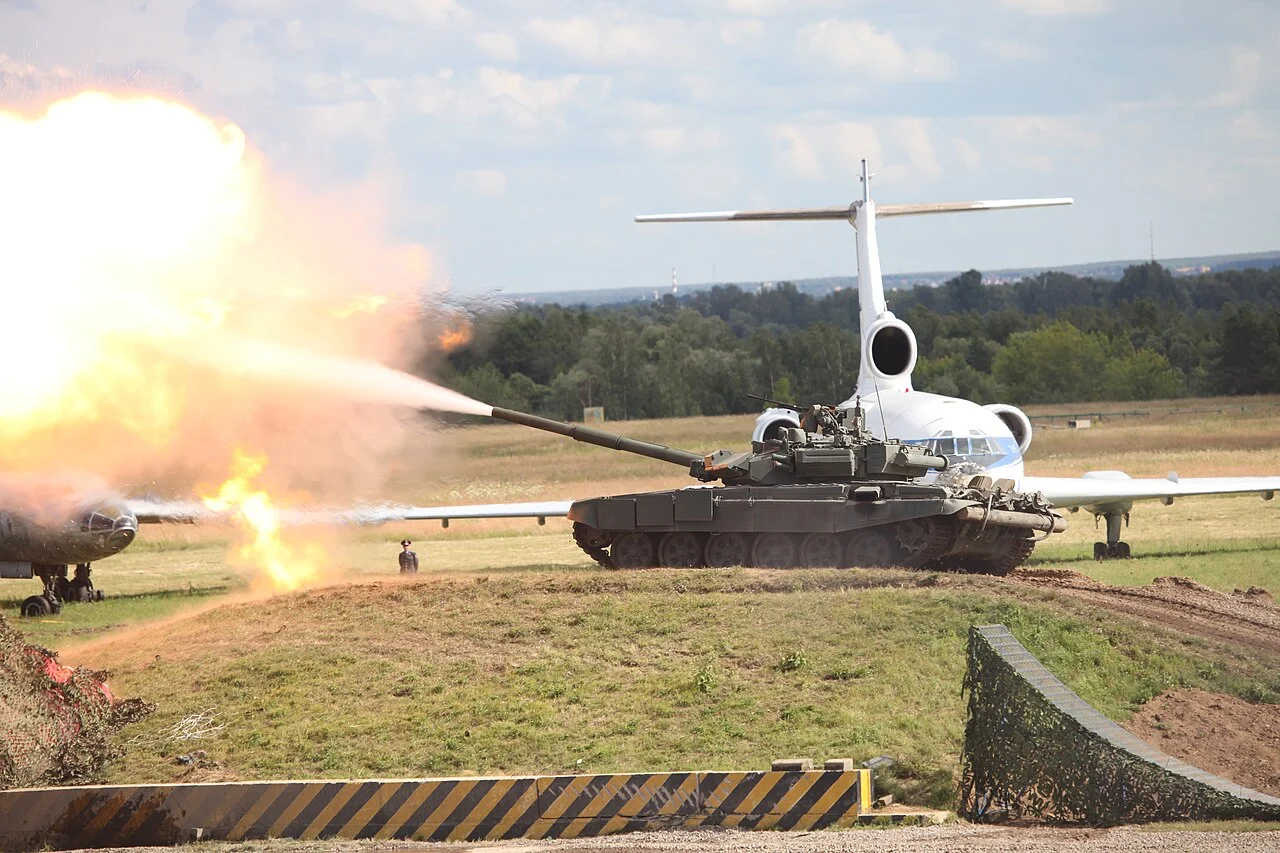
Operator: Algeria (operational). The Algerian People’s National Army has assembled the largest T-90 fleet outside Russia and India. Deliveries began with 185 T-90S tanks between 2006 and 2008 under a contract reported at around $1 billion, followed by 120 more T-90S in 2012-2013 under a roughly $470 million 2011 deal (Army Recognition, 2021). In 2014 Algeria signed with Rosoboronexport for a further batch, reported at around 200 T-90SA and T-90SKA variants, described at the time as a licensed-assembly arrangement, though reporting since indicates the tanks have continued to arrive as complete vehicles built by Uralvagonzavod in Russia rather than assembled locally (DefenceWeb, 2016). Army Recognition’s 2021 count put Algeria’s total T-90 fleet at several hundred vehicles, making it by a wide margin the continent’s largest holder of any post-Soviet-generation tank.
Specifications commonly cited for the T-90SA: combat weight in the 46-48 tonne range; a 1,000 hp diesel engine (DefenceWeb, 2016); a 2A46M-series 125mm smoothbore gun fed by an autoloader carrying 22 rounds ready to fire, capable of launching the 9M119 Refleks laser-guided anti-tank missile through the main gun; Kontakt-5 explosive reactive armour; a three-man crew (commander, gunner, driver); and a maximum road speed of around 60 km/h (Army Recognition, 2021).
The T-90SA sits behind Algeria’s border-security posture rather than any active campaign: Algiers has not deployed the type in combat, and its main relevance is as a deterrent along the frontier with Morocco and in the southern military regions bordering the Sahel. The fleet’s size and the continued Russian supply relationship also anchor Algeria’s broader dependence on Moscow for armoured vehicles, artillery and air defence, detailed in DefenceMENA’s look at Algeria’s Russian-built arsenal.
2. VT-4 — Nigeria’s counter-insurgency tank
Operator: Nigeria (operational). The Nigerian Army ordered the NORINCO VT-4, NORINCO’s export-oriented third-generation design also known as the MBT-3000, under an approximately $152 million contract; the first vehicles, delivered alongside ST-1 wheeled tank destroyers and SH5 105mm self-propelled howitzers, arrived at Lagos’s Apapa port on 8 April 2020 (DefenceWeb, 2020). A second VT-4 shipment was reported en route to Nigeria in May 2022, though neither the exact tally in that batch nor Nigeria’s cumulative VT-4 total has been officially disclosed (Army Recognition, 2022).
Published specifications for the VT-4: combat weight of around 52 tonnes; a turbocharged diesel engine reported at 1,200 hp by DefenceWeb and up to 1,300 hp in some manufacturer material (published figures vary); a 125mm smoothbore main gun with an autoloader reducing the crew to three; FY-4 explosive reactive armour modules, with a GL5 active protection system offered as an option on the base design; a top road speed of around 70 km/h; and an operating range cited at roughly 500 km (DefenceWeb, 2020). Nigeria’s specific configuration, including whether GL5 is fitted, has not been confirmed in open reporting.
Unlike Algeria’s T-90SA, the VT-4 has already been used in action: the Nigerian Army committed the type to counter-insurgency operations against Boko Haram and ISWAP in the northeast around mid-January 2021, in what was described as its combat debut for the type (Army Recognition, 2022). The VT-4 forms part of a broader shift toward Chinese-sourced heavy equipment in the Nigerian Army’s inventory, covered in DefenceMENA’s rundown of Nigerian Army weapons and equipment and in the wider assessment of Nigeria’s military strength.
| Specification | T-90SA (Algeria) | VT-4 (Nigeria) |
|---|---|---|
| Manufacturer | Uralvagonzavod (Russia) | NORINCO (China) |
| Combat weight | ~46-48 tonnes | ~52 tonnes |
| Engine power | ~1,000 hp diesel | ~1,200-1,300 hp diesel (published figures vary) |
| Main gun | 125mm 2A46M-series smoothbore, autoloader (22 rounds ready) | 125mm smoothbore, autoloader |
| Guided munition | 9M119 Refleks (gun-launched ATGM) | Not confirmed for Nigerian fleet |
| Armour | Kontakt-5 explosive reactive armour | FY-4 explosive reactive armour; GL5 APS optional |
| Crew | 3 | 3 |
| Road speed (max) | ~60 km/h | ~70 km/h |
| Operating range | Not verified in cited sources | ~500 km (manufacturer/press figure) |
| Combat use | None reported | Deployed against Boko Haram/ISWAP, January 2021 |
| African fleet size | 500+ delivered since 2006 (Army Recognition, 2021) | Two batches since 2020; total not disclosed |
| Source/year | Army Recognition, 2021; DefenceWeb, 2016 | DefenceWeb, 2020; Army Recognition, 2022 |
Sustainment and industrial angle
The two programmes sit at opposite ends of Africa’s tank-sustainment spectrum. Algeria’s decades-long relationship with Rosoboronexport and Uralvagonzavod gives it access to a mature spares and ammunition pipeline, a domestic vehicle-maintenance and overhaul base built up under earlier Soviet- and Russian-supplied fleets, and a 2014 agreement that at least nominally envisaged local assembly, even if deliveries have continued to arrive as complete tanks (DefenceWeb, 2016). That scale advantage comes bundled with exposure to a single supplier at a time when Russia’s own wartime production demands compete for the same factories.
Nigeria’s VT-4 purchase is smaller and newer, bought as part of a mixed Chinese-sourced package that also included artillery and tank destroyers, reflecting Abuja’s practice of procuring capability in modest batches tailored to specific counter-insurgency requirements rather than building a large conventional armoured force. NORINCO’s export support network is less established in West Africa than Chinese small-arms and light-vehicle supply chains, and the absence of confirmed total fleet numbers after two delivery batches makes it difficult to assess Nigeria’s sustainment posture independently of official disclosure.
Why it matters for Africa
The T-90SA and VT-4 mark the top end of currently fielded African armour, and the contrast between them illustrates two distinct procurement logics on the continent. Algeria’s fleet reflects affordability at scale bought through a long-standing state-to-state relationship, sustained combat readiness against conventional threats, and continued reliance on a single foreign supplier for spares and munitions. Nigeria’s smaller VT-4 holding reflects a counter-insurgency force buying a modern main battle tank in numbers matched to a specific campaign, prioritising availability and cost over fleet size, and accepting the sustainment tradeoffs of a newer supplier relationship with NORINCO. Both cases underline how technology transfer terms, however limited in practice, and the depth of a supplier’s regional support network shape what a tank purchase actually delivers once it reaches African forces, rather than the headline specifications alone.
Sources
- Army Recognition, “Russian T-90SA main battle tanks are the backbone of Algerian army” (2021)
- DefenceWeb, “Algeria to assemble 200 T-90 tanks” (2016)
- DefenceWeb, “Algeria receiving additional T-90 tanks” (2016)
- DefenceWeb, “Nigerian military receives tanks, artillery from China” (2020)
- Army Recognition, “Nigerian army to receive second batch of NORINCO VT-4 tanks” (2022)
- Military Africa, “Nigeria receives more VT4, ST1 tanks, SH2, SH4 self-propelled artillery, and KIA tactical vehicles” (2020)
- SIPRI Arms Transfers Database