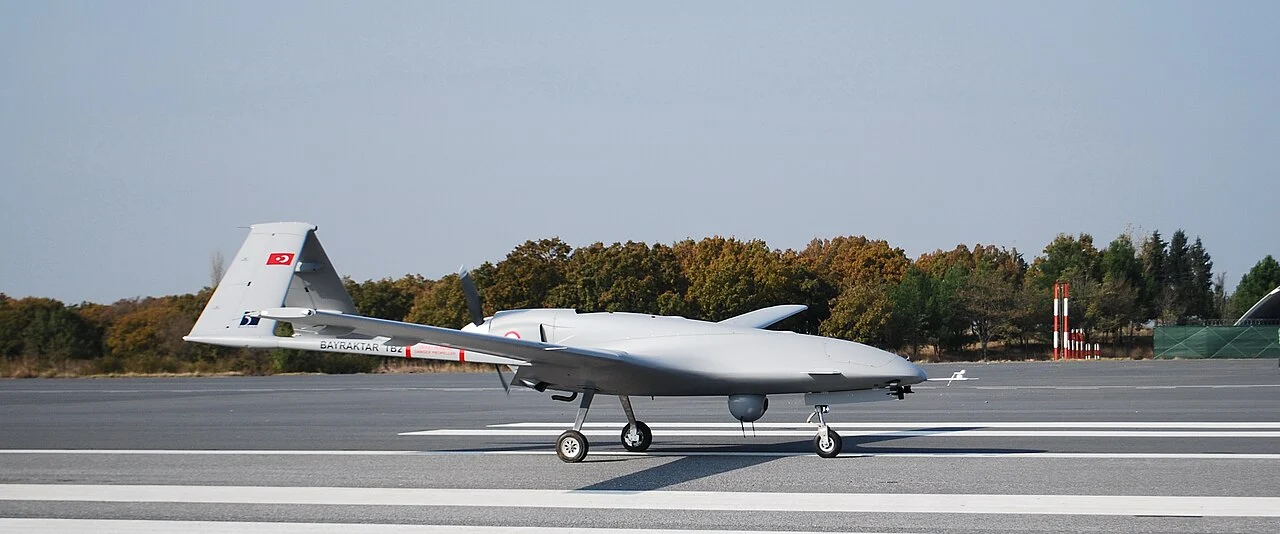
Photo: Bayraktar TB2. Credit: Bayhaluk, CC BY-SA 4.0, via Wikimedia Commons
Direct answer: The Bayraktar TB2, the Wing Loong II and the CH-4 are not interchangeable, and public evidence does not support naming one of them the best buy. The TB2 is the lightest system, with the widest documented African user base (at least ten states) and a local-production plan in Morocco. The Wing Loong II is the heaviest, with roughly 32 hours of endurance, a satellite link and a much larger weapon load, and it has entered service in West Africa in the last three years (Nigeria, Côte d’Ivoire). The CH-4 sits between them on weight and is the Chinese system with the clearest record in Central Africa, but it has the thinnest publicly itemised evidence. Public contract data does not support a direct price comparison.
Why these three systems are compared
All three are medium-altitude, long-endurance (MALE) armed drones sold on the export market, and all three are, or have been, offered to or bought by African air forces and armies. They compete for the same requirement: persistent surveillance and precision strike against insurgents, in countries that cannot afford a Reaper-class programme. Larger or smaller classes (the Akıncı, the TB3, small loitering munitions) are left out on purpose, because they do not belong to the same class.
Methodology (fixed before the evidence was collected)
Criteria were set first and apply equally to every system: (1) size and payload, (2) endurance and control range, (3) armament options, (4) infrastructure needs, (5) African operators, with ordered, delivered and operational status kept separate, (6) delivery record, (7) local production or training, and (8) price data quality. Combat performance is not scored, because open sources do not allow a like-for-like comparison of strike results. A Turkish, Chinese or Western origin is not treated as evidence of anything; every claim below is tied to a source or marked as unverified.
African context
Armed drones have become the default air-power purchase in the Sahel, the Horn and the Lake Chad basin, where a fast jet is out of reach. Turkish and Chinese suppliers dominate African armed-drone deliveries, and some states, Nigeria and Morocco among them, operate both Turkish and Chinese types at the same time. For a country-by-country TB2 list, see Which African countries fly the Bayraktar TB2? on Envanter Medya.
Specifications
| Criterion | Bayraktar TB2 | Wing Loong II | CH-4 (CH-4B) |
|---|---|---|---|
| Maker | Baykar (Türkiye) | AVIC / Chengdu (China) | CASC (China) |
| Max take-off weight | about 700 kg | 4,200 kg | 1,300 kg |
| Payload | about 150 kg | up to 480 kg of weapons | about 345 kg |
| Engine | Piston, about 100 hp | Turboprop | Piston, about 100 hp |
| Endurance | more than 20 h (a 27 h record flight is documented) | up to 32 h | up to 40 h reconnaissance; about 12 h strike |
| Service ceiling | about 7,600 to 8,200 m (sources differ) | about 9,000 to 9,900 m (sources differ) | about 5,000 m |
| Control link | Line of sight, under about 300 km | Line of sight about 150 km; satellite link over 1,000 km | Line of sight about 150 km; satellite link over 1,000 km |
| Armament | Guided munitions from Turkish makers (MAM-L, MAM-C); integration varies by customer | Six hardpoints: bombs (FT series) and missiles (AKD-10, BA-7, BRM-1) | AR-1, AR-2, AKD-10, BRM-1, FT-7 glide bombs |
| Ground crew per station | 3 (pilot, payload operator, mission commander) | not specified in the sources used | not specified in the sources used |
Figures are manufacturer or reference-work values, not measured performance. Where sources disagree, a range is shown. Endurance depends on payload and fuel load.
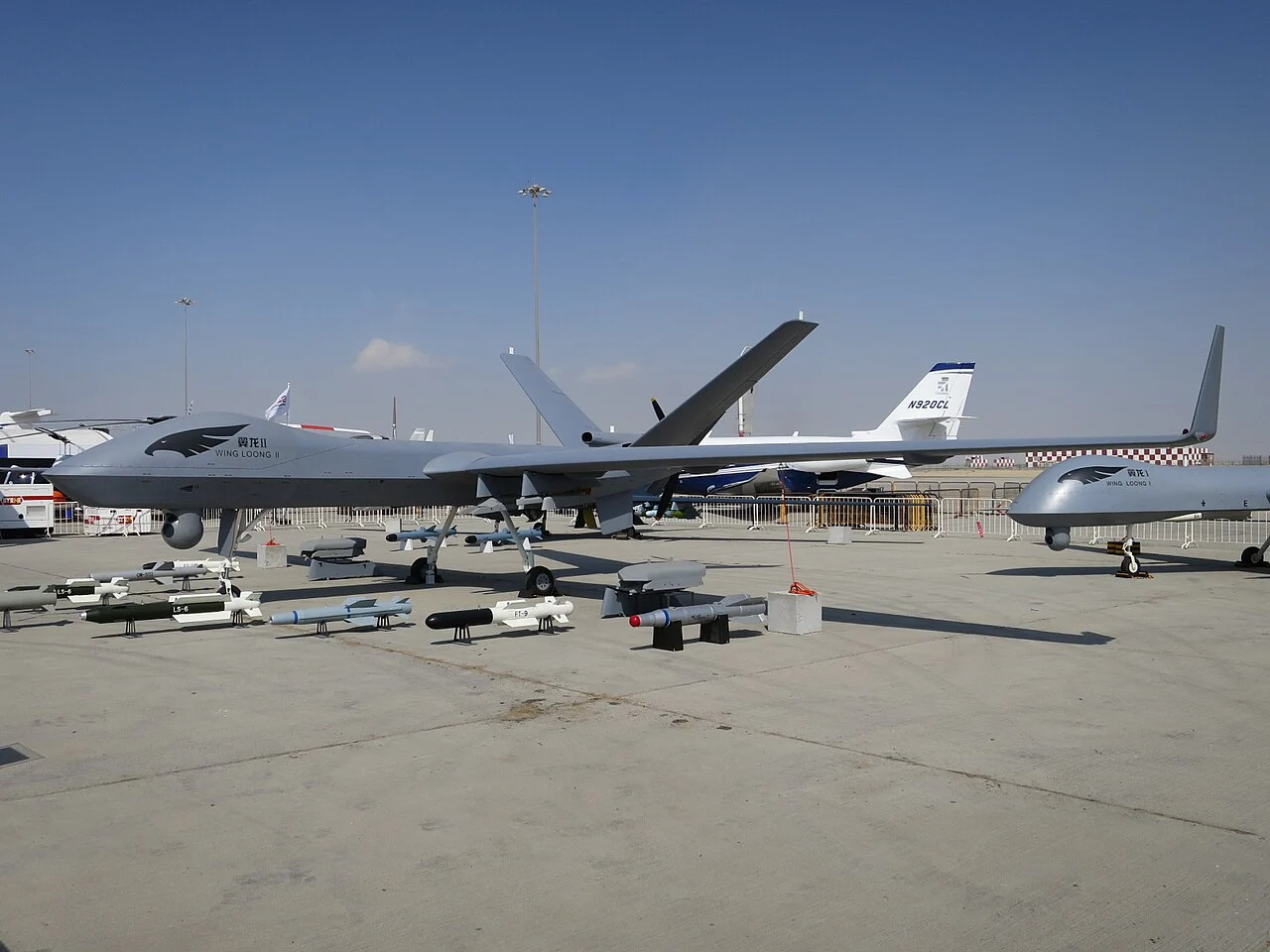
Mission
The TB2 is a tactical armed reconnaissance aircraft built around small guided munitions. The Wing Loong II is a heavier strike aircraft with a much larger weapon load and a satellite link, so its operators can hold targets far from the base. The CH-4 falls between them: its 40 hours of reconnaissance endurance is the longest of the three, but it drops to about 12 hours with a strike load.
Mobility, range and infrastructure
The TB2’s line-of-sight control link, under about 300 km, ties it to ground stations near the operating area. That suits a compact force flying from forward airstrips, but it limits reach in the Sahel’s long distances unless the operator adds relay assets. The Wing Loong II and CH-4 have satellite links rated above 1,000 km, at the cost of a heavier ground segment. The Wing Loong II, at 4,200 kg, needs a proper runway. No source used here documents desert, dust, altitude or hot-and-high performance for any of the three, so none is claimed.
Sensors and weapons
All three carry electro-optical and infrared turrets; sensor models differ by customer and are rarely published, so a sensor comparison is not made. On weapons, the TB2 offers the smallest load, but Turkish munitions are integrated as a family. The Wing Loong II carries the most, with six hardpoints. The CH-4 falls between the two in weight and armament, and reference sources list AR-1, AR-2, AKD-10 and FT-7 options.
Protection and survivability
These are unarmoured, unstealthy aircraft. Survivability depends on the surrounding air-defence environment. Libya is the documented case: reference sources record that six Wing Loong IIs were lost there by June 2020. Loss data for the TB2 and CH-4 in African service is not consolidated in public sources, so no ranking on survivability is made.
African operators
| System | African operator | Ordered | Delivered | Operational | Known contracts |
|---|---|---|---|---|---|
| Bayraktar TB2 | Ethiopia | 4 (Aug 2021) | Nov 2021 | Confirmed | Not published |
| Morocco | 13 | 13 (2021); a further delivery in Aug 2024 is reported | Confirmed | Reported at about $70 million (composition not itemised) | |
| Niger | n/a | 6 by May 2022 | Confirmed | Not published | |
| Mali | n/a | At least 3 in 2022, 3 more in 2023 | Confirmed | Not published | |
| Nigeria | 43 reported (Nov 2024) | Not itemised officially | Widely reported | Not published | |
| Kenya | n/a | 6 (late 2024) | Confirmed | Not published | |
| Togo, Burkina Faso, Djibouti, Somalia, Tunisia, Angola | n/a | Togo, Djibouti: at least 3 each | Listed as operators | Numbers largely unpublished | |
| Rwanda | Listed by one reference work; an ADF report says Rwanda may only be seeking the type. Treated as unconfirmed. | ||||
| Wing Loong II | Nigeria | n/a | At least 5 (2023), per Military Africa; earlier reports give 2 (2020) and 3 | Used against Boko Haram and ISWAP | Low-profile; not published |
| Côte d’Ivoire | June 2024 contract with CATIC (per Military Africa) | 2 shown on video, 10 Aug 2026 | Confirmed on the ground | Contract value not published | |
| Algeria | 24 Chinese UAVs (type disputed between sources) | Delivery timeline unclear | Unclear | Not published | |
| Morocco, Egypt | Egypt: 4 UAVs confirmed; a 2021 rumour of 32 Wing Loong 1D | Not itemised | Listed as operators of the Wing Loong family (generation not always stated) | Not published | |
| Libya | UAE-supplied | n/a | 6 lost by June 2020 | Used by Haftar’s forces | n/a |
| Somalia | Listed in one reference work; not confirmed in other sources used. | ||||
| CH-4 | DR Congo | 9 (2023) | 3 by 2023; more reported in 2024 | Used against M23 rebels | Not published |
| Zambia | n/a | Listed operator | Listed | Not published | |
| Algeria, Sudan | n/a | CH-3 and CH-4 | Listed | Not published | |
| Chad | Not confirmed | 4 airframes seen at Abéché | Not confirmed | Not published | |
| Ethiopia, Nigeria | Ethiopia is listed for the CH-4 in one reference work but defenceWeb names only the Wing Loong I; Nigeria is documented for the CH-3, not the CH-4. | ||||
Sources vary in how they separate ordered, delivered and operational aircraft. Where a figure is not published, the cell says so instead of guessing.
Procurement cost
| System | Figure in public reporting | What the figure represents |
|---|---|---|
| Bayraktar TB2 | About $5 to 5.5 million per aircraft (crowdfunding-derived estimate); $2 to 5 million (analyst quote); Morocco reported at $70 million for 13 aircraft | Estimates. Baykar has published no price. Whether ground stations, munitions and training are included is unknown. |
| Wing Loong II | About $1 to 3 million per aircraft, higher with the ground station | Secondary-source estimates; no African contract value is public |
| CH-4 | About $1 to 2 million per aircraft | Secondary-source estimate; no African contract value is public |
Public contract data does not support a direct price comparison. The TB2 figures come from a different source type (a crowdfunding campaign and one bulk contract) than the Chinese estimates, and none of the three says what the price covers (aircraft only, ground segment, munitions, training, spares). The gap between the TB2 estimate and the Chinese estimates should not be read as a real difference in what a buyer pays.
Delivery record
The TB2 has the clearest and longest African delivery record: Ethiopia’s four aircraft were ordered in August 2021 and delivered in November 2021, Niger’s first six arrived by May 2022, and Kenya received six in late 2024 after its crews had trained. That is a documented sequence, not a general claim about Turkish speed. For the Wing Loong II, the best-documented case is Côte d’Ivoire: a contract in June 2024 and two aircraft shown in service in August 2026, roughly two years later. For the CH-4, the DR Congo received three of nine ordered aircraft in 2023, with further deliveries reported in 2024, and the completed delivery of all nine is not confirmed in the sources used. A like-for-like delivery-time comparison is not possible, because contract dates are not published for most orders.
Technology transfer and local production
Here the evidence differs sharply. Baykar registered a Moroccan subsidiary, Atlas Defence, in January 2025, and Moroccan media reported recruitment for a Benslimane facility in February 2026. Reports say the agreement covers TB2 and Akıncı production lines in Morocco; the “1,000 aircraft a year” figure circulating in the press is a plan and is not evidence of output. No equivalent African assembly line for the Wing Loong II or CH-4 is documented in the sources used. For training, Baykar has stated that Kenyan operators completed training before their aircraft arrived. Comparable training statements for the Chinese suppliers were not found. Readers weighing both suppliers can also see why some African states buy Turkish and Chinese drones together.
Which requirement fits each system?
- TB2: fits a force that wants a compact system operated from forward airstrips and integrated with a Turkish munition family. It has the widest African user base to consult, and the only documented African production plan (Morocco). Its control range is its clearest limit.
- Wing Loong II: fits a requirement for long endurance, a satellite link and a large weapon load, and an operator with a runway and a heavier support chain. Nigeria and Côte d’Ivoire are the West African operators.
- CH-4: fits a requirement for very long reconnaissance endurance at a mid-weight class. Its African record is concentrated in Central Africa and a few other states, and public data on it is thinnest.
Unknown areas
Not established in public sources: fleet serviceability and attrition in African service, real-world hot-and-dusty performance, maintenance cost, and the terms of any technology-transfer or training package beyond the announcements above.
FAQ
Which armed drone has the most African operators?
The Bayraktar TB2, with at least ten African states listed in reference sources and press reports. The count includes some states with unpublished fleet sizes.
Is the Wing Loong II better than the TB2?
It is a bigger aircraft with more payload, more endurance and a satellite link. Whether that is “better” depends on the mission, the runway and the support budget; the evidence does not rank them.
Do African states buy both Turkish and Chinese drones?
Yes. Nigeria and Morocco are documented as operating both Turkish and Chinese types.
Which is cheapest?
Public contract data does not support a direct price comparison. Published figures are estimates of different kinds.
The sensor turret on current Bayraktar drones is covered in our ASELFLIR 500 guide.
Sources
- Baykar Bayraktar TB2 (Wikipedia)
- CAIG Wing Loong II (Wikipedia)
- CASC Rainbow / CH-4 (Wikipedia)
- Chinese UAVs finding a large market in Africa (defenceWeb)
- Ivory Coast confirms Chinese Wing Loong II drones (Military Africa)
- As Drone Warfare Expands in Africa, Turkey Increases Share (Africa Defense Forum)
- Baykar begins recruiting for Benslimane drone facility (Morocco World News)
- Second batch of CH-4 drones arrive DR Congo (Military Africa)
Ordered, delivered and operational counts differ between sources; readers who spot an error can write to [email protected].