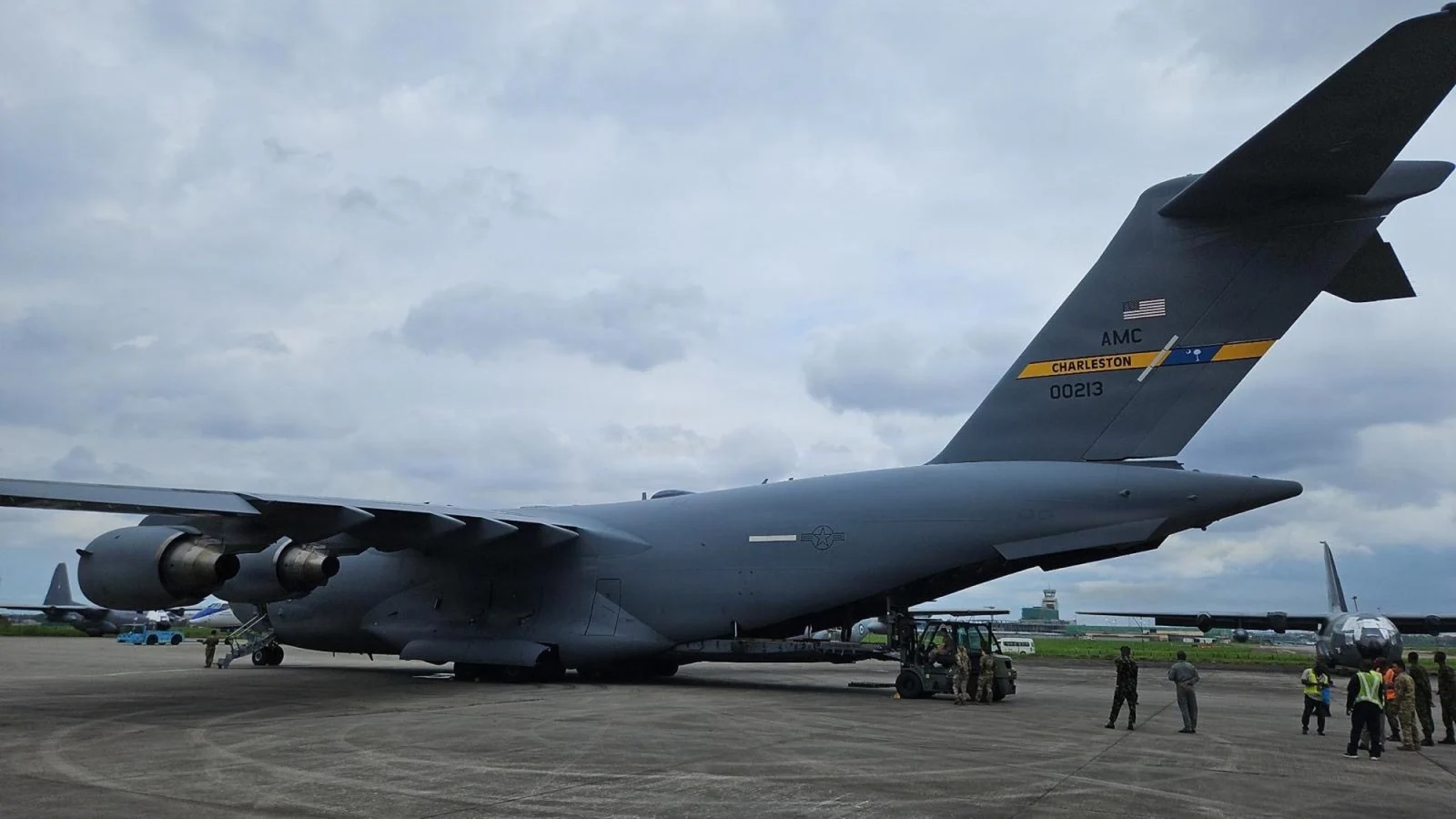
A U.S. Air Force C-17 Globemaster III delivered military equipment to Nigerian Air Force facilities in Lagos and Kainji over the weekend of 10-11 September, U.S. Africa Command has confirmed, in the latest shipment under an ongoing foreign military sales relationship between Washington and Abuja.
Photo: A U.S. Air Force C-17 Globemaster III delivers equipment to the Nigerian Air Force, September 2026. Credit: Courtesy photo, U.S. Africa Command, Public Domain, via DVIDS
AFRICOM said the aircraft offloaded cargo at two Nigerian Air Force (NAF) locations, Lagos and Kainji in Niger State, but the command declined to specify the type or quantity of equipment transferred, describing the delivery only as part of a foreign military sales (FMS) agreement between the two countries’ militaries. The delivery was first reported by regional outlets including AllAfrica and Sahara Reporters, which cited an AFRICOM statement framing the shipment as reinforcing “Nigerian-led efforts” against terrorist groups in the country’s north-east.
What was delivered, and what wasn’t said
Beyond confirming the airlift itself, AFRICOM has not published a manifest, and neither the Nigerian Ministry of Defence nor the Nigerian Air Force has issued its own statement detailing the cargo. Analysts tracking the FMS pipeline have linked the shipment to a roughly $346 million package of munitions, precision-guided bombs and rockets that the U.S. State Department approved for Nigeria in August 2025, alongside broader FY2026 U.S.-Africa security assistance funding reported at roughly $413 million. Neither AFRICOM nor Washington has confirmed that this specific airlift drew from that approved package, and DefenceMENA is treating the equipment type as unconfirmed pending an official breakdown.
Kainji Air Force Base, one of the two delivery points, has been a focus of U.S. investment for several years: American and Nigerian officials marked the completion of roughly $38 million in base improvements there in 2023, infrastructure built in large part to support the Nigerian Air Force’s A-29 Super Tucano light-attack fleet. Lagos, the other delivery point, hosts NAF’s 643 Equipment Servicing Depot at Ikeja, a logistics hub for equipment moving into the wider force.
Nigeria’s existing US-supplied inventory
The delivery extends a security relationship that has already reshaped the Nigerian Air Force’s order of battle. Abuja operates a dozen A-29 Super Tucano turboprop attack aircraft delivered from 2021 under a roughly $460 million FMS case, and is currently taking delivery of AH-1Z Viper attack helicopters as part of a separate $997 million programme announced this year. The air force has also been expanding its rotary-wing fleet with Leonardo and Airbus platforms, as reported by DefenceMENA in September. Against that backdrop, an undisclosed C-17 shipment of “equipment” is consistent with either munitions resupply for existing platforms or spare parts and ground-support gear rather than a new weapons system.
Why it matters for Africa
The airlift lands at a moment when Washington is drawing down its troop presence elsewhere on the continent, including the post-Niger repositioning of U.S. forces, making continuity of the Nigeria FMS pipeline a signal that Washington still regards Abuja as a priority security partner in West Africa’s fight against Boko Haram and the Islamic State West Africa Province (ISWAP). For Nigeria, sustained American logistics and munitions support underwrites an air campaign that has become the backbone of the country’s counter-insurgency operations in Borno, Yobe and Adamawa states. For the wider West Africa desk, it also illustrates how FMS deliveries increasingly move quietly, via unannounced cargo flights and terse command statements, rather than through the high-visibility handover ceremonies associated with fighter jets or naval vessels, making sustained monitoring of AFRICOM’s own channels essential to tracking the real pace of Western security assistance to the region.