Turkish maritime patrol aircraft have now flown more than 76 surveillance sorties and 358 hours over Senegal’s waters, an ongoing deployment that has quietly become one of Ankara’s most sustained overseas defence commitments in West Africa.
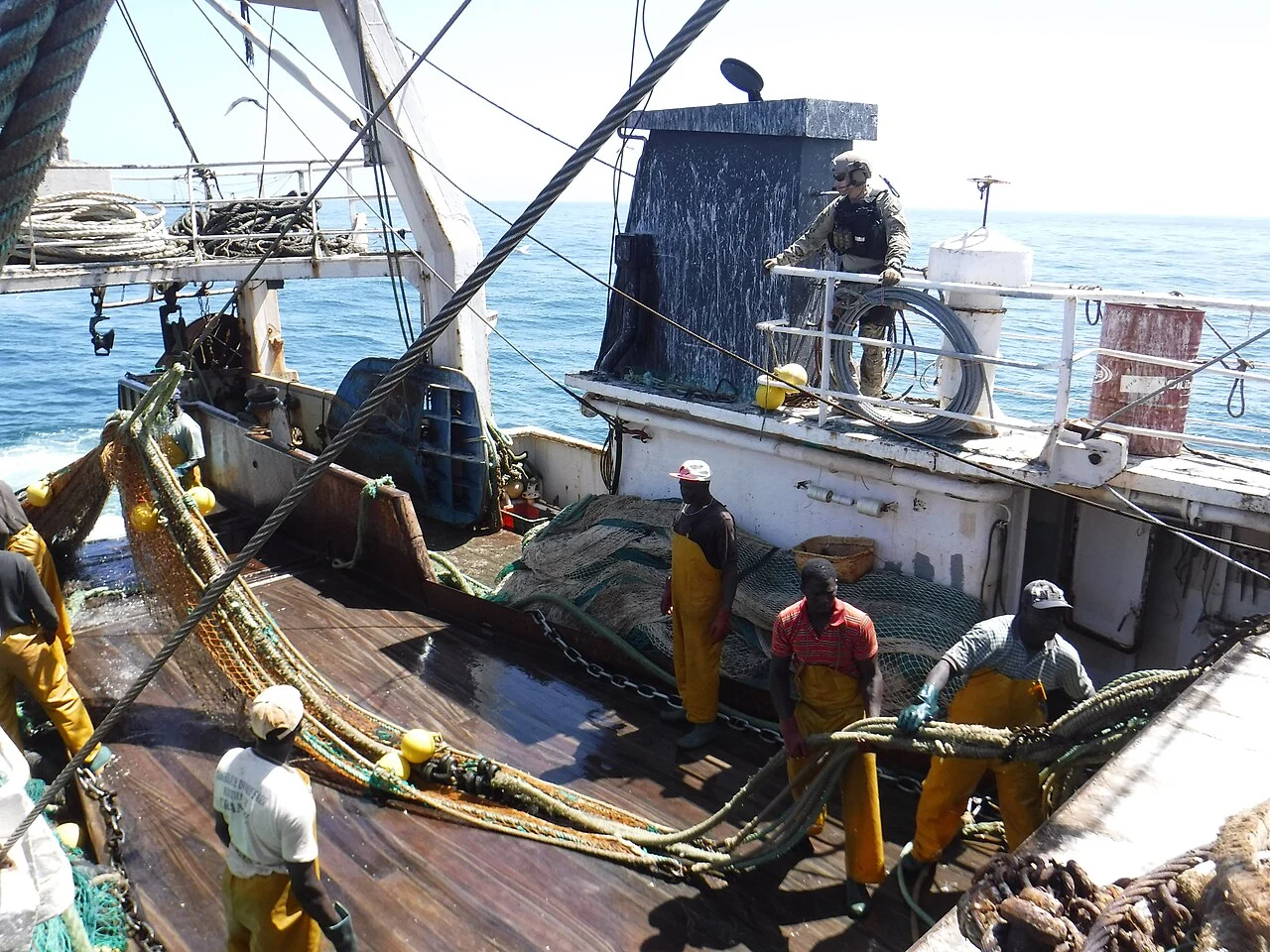
Photo: Senegalese navy personnel, aboard the patrol vessel Kedougou, conduct a boarding operation as part of a maritime law-enforcement partnership. Credit: Commander, U.S. Naval Forces Europe-Africa/U.S. 6th Fleet, Public domain, via Wikimedia Commons
Since 2025, the Turkish Navy has maintained a rotating detachment flying TAI P-72 maritime patrol aircraft — a militarised, sensor-equipped variant of the ATR-72/600 turboprop, fitted with maritime surveillance radar and electro-optical sensors — over Senegal’s territorial waters and exclusive economic zone from a base tied to 301 Filo, the squadron normally home-based at Cengiz Topel Naval Air Base in Türkiye, according to Military Africa. As of the most recent reporting, the aircraft had logged 76 sorties and 358-plus flight hours, with fresh surveillance flights continuing into September 2026.
How the partnership was built
The current deployment sits on top of a broader defence-industrial relationship that has developed over several years. Turkish state defence-electronics firm ASELSAN and software house Havelsan have both held contracts with Senegal’s navy since around 2020, and Senegal’s Prime Minister Ousmane Sonko visited both companies’ facilities in Ankara in August 2025 alongside Turkish Secretary of Defence Industries Haluk Görgün, a trip reported by TURDEF. That visit produced four agreements spanning defence, media and education, including a military financial cooperation accord signed by Turkish Defence Minister Yaşar Güler and Senegalese Chief of Staff General Birame Diop, according to Anadolu Agency. President Erdoğan described the agenda as covering “joint steps that we can take in the areas of security, the defence industry and the fight against terrorism.”
Not the only foreign partner
Türkiye is one of several external partners building up Senegal’s maritime domain awareness. France’s Naval Group subsidiary PIRIOU delivered the second of three OPV 58S offshore patrol vessels to the Senegalese navy in 2023, and Indonesia’s PT Dirgantara has supplied CN-235 maritime patrol aircraft to Dakar. That mix reflects a pattern seen across West Africa’s Atlantic coast, where states are diversifying maritime-security suppliers rather than relying on a single partner — but the scale and continuity of the Turkish air-surveillance commitment, sustained for well over a year with a standing rotational detachment rather than a one-off delivery, is unusual among Ankara’s African partnerships outside the Horn of Africa.
Why it matters for Africa
Senegal’s Atlantic coastline faces the same maritime-security pressures as much of the Gulf of Guinea and wider West African littoral: illegal fishing that drains government revenue, smuggling routes linked to the region’s cocaine-trafficking corridor, and the risk of instability spilling seaward from the Sahel’s landlocked conflicts. Persistent aerial surveillance — rather than periodic patrols — is what allows a navy to build a reliable picture of what is moving through its waters, and few African states can afford to buy and sustain that capability alone. For Türkiye, the Senegal deployment is a demonstration case: proof that Ankara can sustain a real operational presence in Africa beyond arms sales and training missions, reinforcing the defence-industrial pitch that has already won ASELSAN and Havelsan contracts across the region and that Turkish officials are using to court other West African navies facing the same Atlantic-coast threats.
Sources
- Military Africa: “Turkey and Senegal Extend Joint Maritime Surveillance Support”
- TURDEF: “Senegal Seeks to Enhance Cooperation with Turkish Industry”
- Anadolu Agency: “Türkiye, Senegal sign 4 agreements in fields of defense, media, education”
- Envanter Medya: “Africa’s 10 Most Powerful Navies in 2026”