Cameroon has stripped dozens of tankers from its ship registry and frozen new registrations after investigators traced them to Russia’s sanctions-busting “shadow fleet,” a scandal that has turned one of Central Africa’s flags of convenience into a geopolitical liability.
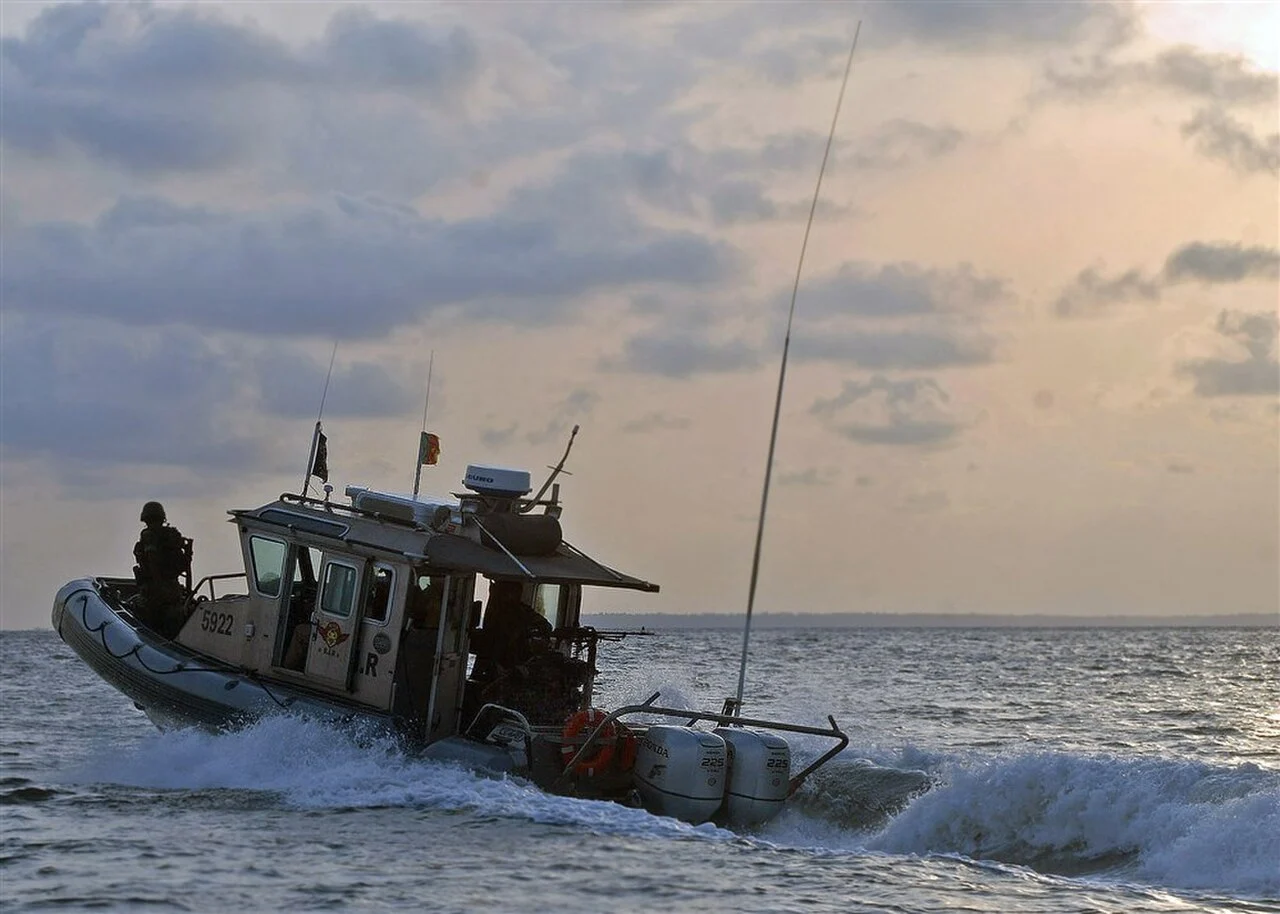
Photo: A Cameroonian Rapid Intervention Brigade boat patrols coastal waters off Douala during the multinational Obangame Express exercise. Credit: Petty Officer 1st Class Darryl Wood, Public domain, via Wikimedia Commons
Since December 2025, close to 100 vessels have been linked to Russia’s shadow fleet while flying the Cameroonian flag, placing the Central African country in the same bracket as Russia itself and Sierra Leone among the registries most exploited to move sanctioned oil, according to Africa Defense Forum. The Yaoundé government has spent 2026 trying to claw the registry back, deregistering more than 20 vessels early in the year and sanctioning roughly 40 more on 29 May, moves reported by defenceWeb and the Institute for Security Studies.
How brokers hijacked a flag
Cameroon’s international ship registry, like those of several small and mid-sized states, is run at arm’s length through commercial ship-registration agents rather than directly by the maritime administration. According to Africa Defense Forum, brokers based in Georgia, Montenegro and Türkiye exploited that structure, using forged digital registration platforms to issue Cameroonian flag certificates to tankers that Yaoundé’s own administration had never authorised. In a letter to the International Maritime Organization dated 16 June, the Cameroonian government said an official investigation had identified two fraudulent websites used to register the ships, and that it had opened criminal proceedings against those responsible.
The registry’s growth told its own story: reporting cited by Africa Defense Forum found registrations climbing 126 percent in twelve months, far outpacing any plausible growth in Cameroon’s legitimate merchant fleet. A review of tankers flying the Cameroonian flag in 2023 found that 11 of 14 could be traced back to Russian oil-export terminals, well before the current cleanup began.
The scale of Russia’s shadow fleet
The vessels at issue are part of a much larger fleet Moscow has assembled since 2022 to keep exporting oil above the G7 price cap without Western-flagged tankers, insurers or classification societies. Industry estimates put the shadow fleet at up to 591 vessels moving roughly 4.1 million barrels of oil a day, generating an estimated $100 billion a year for the Russian state, figures reported by Africa Defense Forum. Iran is estimated to run a parallel fleet of around 170 vessels using similar flag-hopping tactics. Flags of convenience across West and Central Africa — and beyond, including registries as far afield as Gabon and the Comoros — have repeatedly turned up in EU and UK sanctions listings of shadow-fleet tankers over the past two years.
The abuse is not confined to sanctions evasion. Africa Defense Forum and the Institute for Security Studies both note that the same loosely policed registries are used to mask illegal, unreported and unregulated fishing and drug trafficking; Cameroon loses an estimated $33 million a year to illegal fishing alone. In August 2025, authorities intercepted the vessel Sky White, flying the Cameroonian flag, with roughly three tonnes of cocaine aboard — a reminder that a compromised flag registry is a security problem well beyond the oil trade.
Brussels and the IMO turn up the pressure
The European Union has treated flag-registry fraud as part of its sanctions-enforcement push against Russia, adding vessels linked to fraudulent Cameroonian registration to successive sanctions packages through mid-2026 and pressing Yaoundé directly to tighten oversight, according to reporting picked up by Africa Defense Forum and Insurance Journal. The International Maritime Organization’s Legal Committee met in London in April 2026 and issued new guidance on fraudulent ship registration after confirming that 529 vessels worldwide had fraudulently flown a member state’s flag over the preceding year — evidence that Cameroon’s problem, while acute, is part of a wider gap in global shipping governance that flag-of-convenience states are only beginning to close.
Why it matters for Africa
Cameroon’s registry crisis is a case study in how weak maritime administration in one African state can be converted into a strategic asset for a sanctioned power thousands of kilometres away, with reputational and security costs borne locally. A tainted flag raises insurance and port costs for Cameroon’s genuine shipowners, invites closer inspection of every vessel flying it, and hands critics of African maritime governance a ready-made example — just as Yaoundé and its neighbours are trying to present the Gulf of Guinea as a safer, more transparent shipping lane after years of piracy concerns.
The episode also underscores a capability gap that goes beyond paperwork. Analysts at the Institute for Security Studies argue that registry reform alone will not fix the problem: Cameroon and other coastal states need real-time vessel-tracking systems, better-resourced maritime administrations and closer coordination with regional bodies such as the Yaoundé Architecture for Maritime Safety and Security to verify who is actually flying their flag at sea. That is the same underlying maritime-domain-awareness gap driving African navies toward cheaper surveillance tools — from unmanned patrol craft to coastal radar — elsewhere on the continent, including Angola’s recent push to arm its new corvette fleet with unmanned surface vessels.
Sources
- Africa Defense Forum: “Cameroon Fights Shipping Registry Abuse”
- defenceWeb: “Can Cameroon reclaim its maritime flag after shadow fleet abuse?”
- Institute for Security Studies: “Can Cameroon reclaim its maritime flag after shadow fleet abuse?”
- Insurance Journal: “Europe Targets Shadow Fleet Tankers Falsely Using Cameroon Flag, Sources Say”