Turkish defence electronics firm Havelsan and Egypt’s Arab Organisation for Industrialisation (AOI) have signed a sales agreement for the Hamza-1, a jointly developed fixed-wing VTOL drone, moving their two-year-old partnership from co-development into commercial deliveries. The deal, signed at the El Alamein International Airshow in September 2026, is the latest step in Türkiye’s push to embed its unmanned-systems industry inside African manufacturing and export networks.
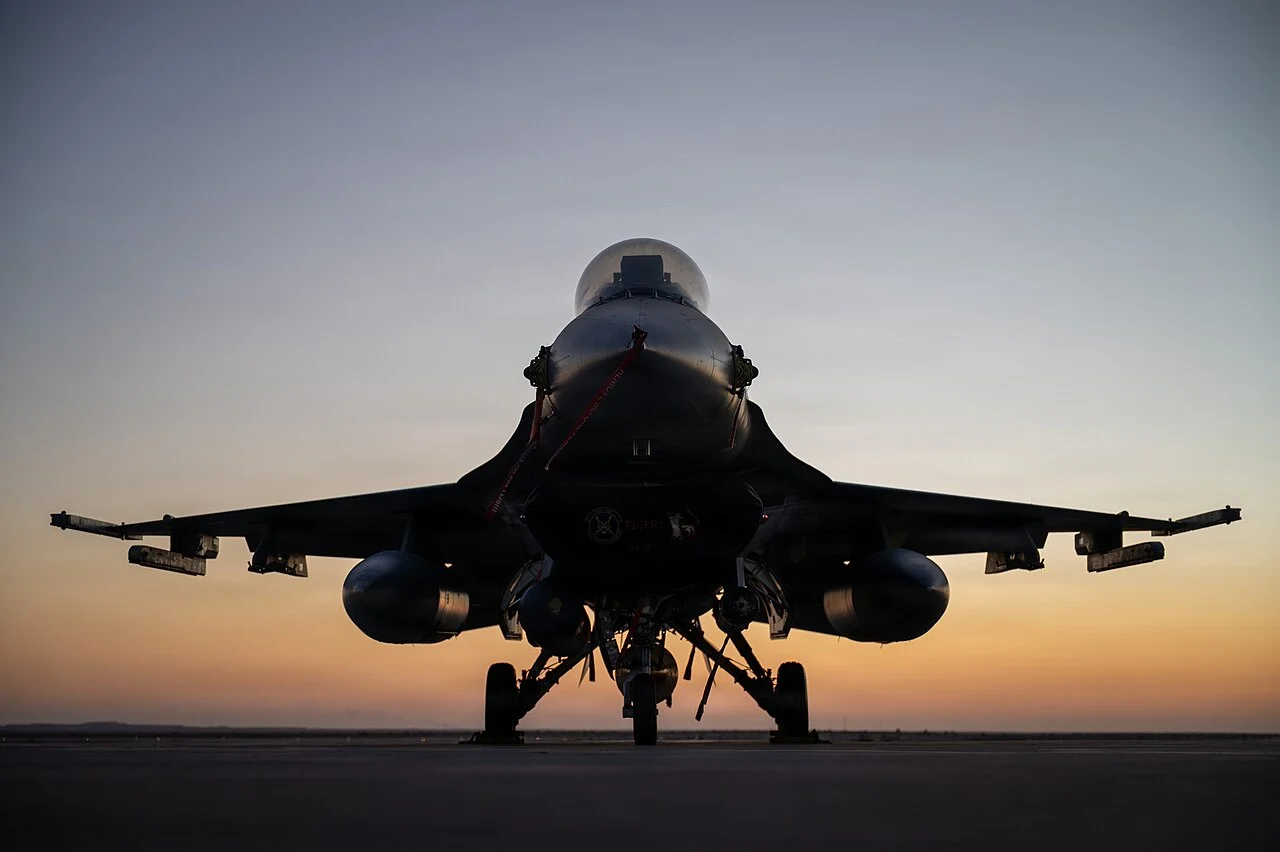
Photo: The flightline at the Egypt International Airshow, El Alamein, September 2026, the venue where Havelsan and AOI signed the Hamza-1 sales agreement. Credit: U.S. Air Force photo by Staff Sgt. Christopher Tam, Public domain, via Wikimedia Commons
According to defenceWeb and Military Africa, the agreement covers the sale of the Hamza-1 to “different users,” though neither company has disclosed a unit count or contract value. Havelsan said deliveries are expected to begin “imminently.”
From co-development to commercial sales
The Hamza-1 is a small, electrically powered fixed-wing VTOL drone fitted with an electro-optical gimbal on its nose, derived from Havelsan’s existing Baha platform. It has a maximum take-off weight of 28 kg, carries a 2 kg payload, and offers a communications range of 50 km with an endurance of up to two hours — a light tactical reconnaissance system rather than a strike platform.
Havelsan and AOI first signed a strategic cooperation agreement on 26 August 2025 covering the joint production, inside Egypt, of autonomous VTOL UAVs. The first Hamza-1 built under that arrangement was unveiled at EDEX 2025 in Cairo that December. Daily Sabah reported the two firms also co-developed the Aqrab (“Scorpion”), a 6×6 unmanned ground vehicle armed with a remote-controlled 12.7 mm gun and electro-optical/infrared sensors — evidence that the Havelsan-AOI relationship now spans both air and ground unmanned systems.
Egypt’s expanding role as a UAV manufacturing hub
For Egypt, the Hamza-1 agreement reinforces AOI’s position as a local-production channel for foreign unmanned-systems technology, alongside Cairo’s broader ambitions — laid out at events like EDEX and the El Alamein Airshow — to become a regional manufacturing and MRO hub. Egypt already fields a substantial UAV inventory, including Chinese Wing Loong systems and domestically assembled platforms; the addition of a Turkish-designed, Egyptian-built light VTOL drone gives AOI a product it can offer to militaries and security services elsewhere on the continent without relying on direct Turkish exports.
That is precisely the ambition Havelsan has stated publicly. The company has said it “continues to expand its business globally, including in Africa,” and industry reporting frames Egyptian production of the Hamza-1 as a deliberate entry point into African export markets — allowing Türkiye’s defence industry to reach customers that might otherwise be wary of direct government-to-government Turkish arms sales.
Why it matters for Africa
The Hamza-1 deal is a small transaction by dollar value, but it fits a pattern that has become one of the defining features of Africa’s defence-procurement landscape over the past two years: Turkish manufacturers building local-production partnerships — with Egypt, Nigeria, and others — that combine technology transfer with a route into wider African markets. For African militaries beyond Egypt, an Egyptian-assembled Hamza-1 could prove cheaper and administratively simpler to acquire than an equivalent system bought directly from Türkiye or from Western and Chinese competitors, particularly for security forces needing a light, low-cost reconnaissance drone rather than an armed system such as the Bayraktar TB2.
It also underscores how thoroughly Turkish firms have penetrated the Egyptian defence-industrial base despite years of political friction between Ankara and Cairo — a reminder that commercial defence-industrial ties in Africa increasingly move independently of broader diplomatic relationships. Turkish outlet Envanter Medya has tracked the programme’s progress from its 2025 origins through to this month’s sales agreement.