Eight Arab armies field main battle tanks sourced from four different industrial traditions, from co-produced American Abrams to Russian-supplied T-90s. This gallery surveys the region’s principal MBT fleets and their status as of September 2026.
DEFENCE MENA | Evergreen gallery | Data as of September 2026
Main battle tanks remain central to ground force modernization across the Middle East and North Africa, even as air and missile defence and unmanned systems absorb a growing share of procurement budgets. Saudi Arabia, Egypt, Kuwait and Morocco operate variants of the US M1 Abrams acquired through Foreign Military Sales, while the UAE and Qatar fielded French and German platforms respectively. Algeria remains the region’s principal operator of Russian armour, and Jordan’s fleet was reshaped in 2020 by a donation from a fellow GCC state.
The mix reflects decades of divergent procurement relationships rather than a single regional standard. Egypt alone locally assembles its Abrams fleet, under a co-production programme running since the late 1980s. Algeria’s T-90SA/T-90MS deliveries and subsequent licensed-assembly agreement with Rosoboronexport illustrate a parallel industrialization track built around Russian technology transfer. This piece sets out, country by country, what is confirmed in service, what has been ordered but not delivered, and where published figures disagree.
Key facts
- Saudi Arabia fields an estimated 575 M1A2S Saudi Package tanks built from earlier M1A1/M1A2 hulls (Army Recognition, 2025), with a further ~300 M1 Abrams referenced in the November 2025 US-Saudi Strategic Defense Agreement, reportedly under negotiation.
- Egypt is the only country outside the United States that manufactures the M1 Abrams, having produced roughly 1,200 hulls locally since its co-production programme began in the late 1980s.
- Kuwait’s M1A2K upgrade programme, developed by General Dynamics Land Systems, reportedly covered 217 tanks with deliveries completed by mid-2022 (Shephard Media, 2022).
- The UAE received 388 Leclerc MBTs between 1994 and 2003, then donated 80 of them to Jordan in September 2020 (Army Recognition, 2020).
- SIPRI’s Arms Transfers Database records more than 370 Russian T-90SA/T-90S tanks delivered to Algeria between 2006 and 2013, ahead of a 2014 licensed-assembly agreement for further units.
1. M1A2S Abrams — Saudi Arabia — operational
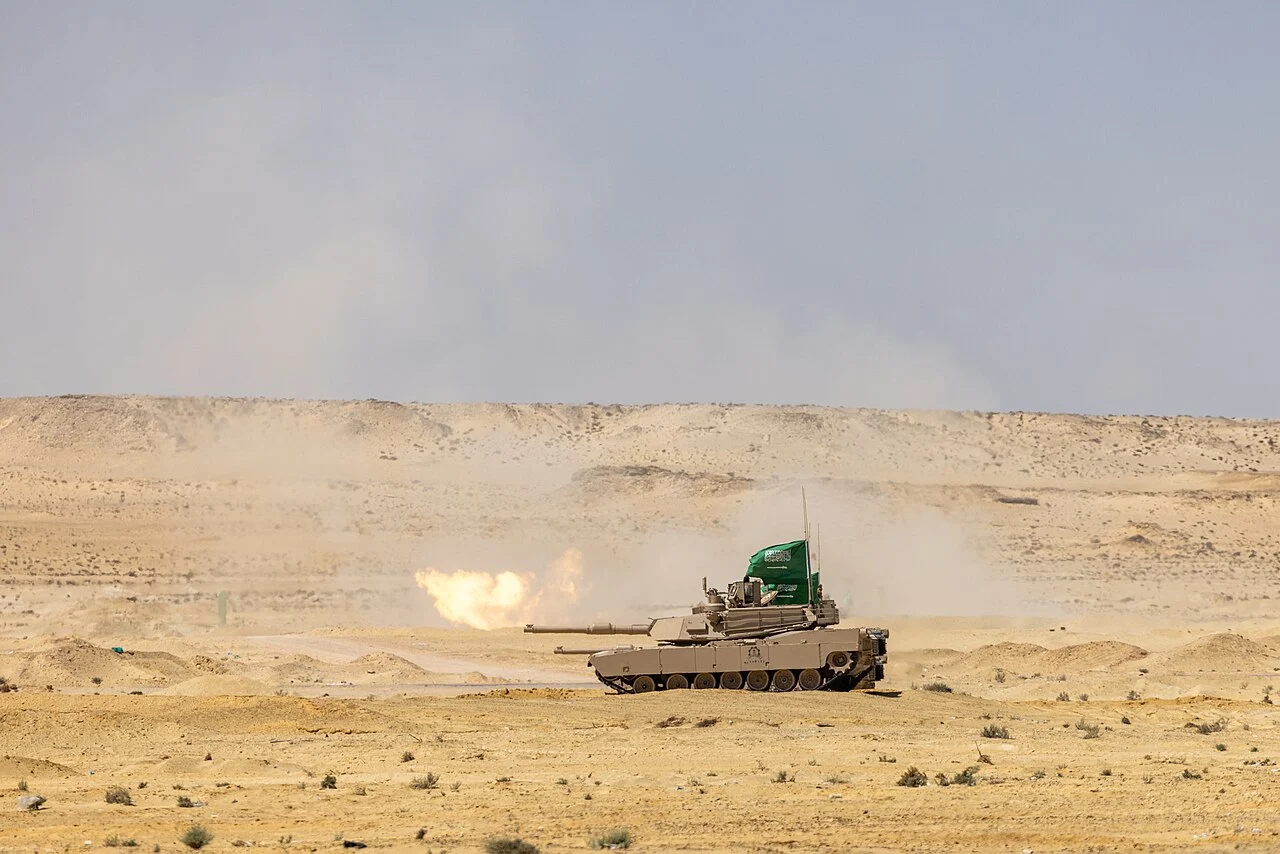
The Royal Saudi Land Forces operate the M1A2S “Saudi Package,” built by upgrading earlier M1A1 and M1A2 hulls delivered from the late 1990s. Army Recognition estimates the in-service fleet at around 575 tanks as of 2024-2025, making Saudi Arabia the largest Abrams operator after the United States itself. The upgrade path has run through several DSCA-notified Foreign Military Sales cases, including a 2016 case covering up to 153 hull conversions plus 20 battle-damage replacement hulls, alongside M88A1/A2 HERCULES recovery vehicles.
In November 2025 the White House announced that Saudi Arabia and the United States had finalized a Strategic Defense Agreement under which Riyadh intends to purchase close to 300 additional M1 Abrams (Army Recognition, 2025). No DSCA notification confirming a signed contract for this figure had been published at the time of writing, so it is treated here as reportedly under negotiation. Saudi Abrams units rotate through joint exercises including Eager Lion in Jordan.
2. M1A1 Abrams — Egypt — operational
Egypt is the only Abrams operator outside the United States with its own production line. Under the M1A1 co-production programme run with General Dynamics Land Systems since the late 1980s, the Egyptian Tank Plant at Heluan has built roughly 1,200 M1A1 hulls locally, with an estimated 1,130 tanks in Egyptian Army service. The programme makes Egypt an early, if narrow, case of regional defence industrialization predating the current wave of Saudi and Emirati localization drives.
On 20 December 2024 the US State Department approved a separate Foreign Military Sale case allowing Egypt to upgrade 555 M1A1 Abrams to the M1A1SA (Situational Awareness) standard, including AN/VAS-5B driver vision enhancer kits and thermal gunner’s sights, valued at up to $4.7 billion (Shephard Media, 2024). The case has been approved and notified to Congress; it is treated here as selected rather than delivered pending confirmation of signed delivery schedules. Egyptian Abrams units featured prominently in the Bright Star exercise series at Mohamed Naguib Military Base, most recently in September 2025, training alongside US M1A2 SEPv3 tanks in combined live-fire drills.
3. M1A2 / M1A2K Abrams — Kuwait — operational

Kuwait was an early Gulf Abrams customer, taking delivery of 218 M1A2 tanks in the 1990s following its liberation. It subsequently ordered a dedicated upgrade, the M1A2K, developed by General Dynamics Land Systems; Shephard Media reported 217 units on order with deliveries completed by June 2022, after a revised programme timeline. Jane’s has separately reported that Kuwait retained at least part of its legacy M1A2 fleet rather than retiring it once the M1A2K entered service, giving the Kuwait Land Forces a mixed two-variant fleet.
In June 2025 the State Department approved a sustainment support package worth up to roughly $325-350 million (reporting varies) covering both the M1A2 and M1A2K fleets, with General Dynamics Land Systems as principal contractor (GovConWire, 2025). The notice did not specify how many legacy M1A2s remain in the covered fleet, an ambiguity this piece flags rather than resolves with an invented figure.
4. M1A1 SA Abrams — Morocco — operational
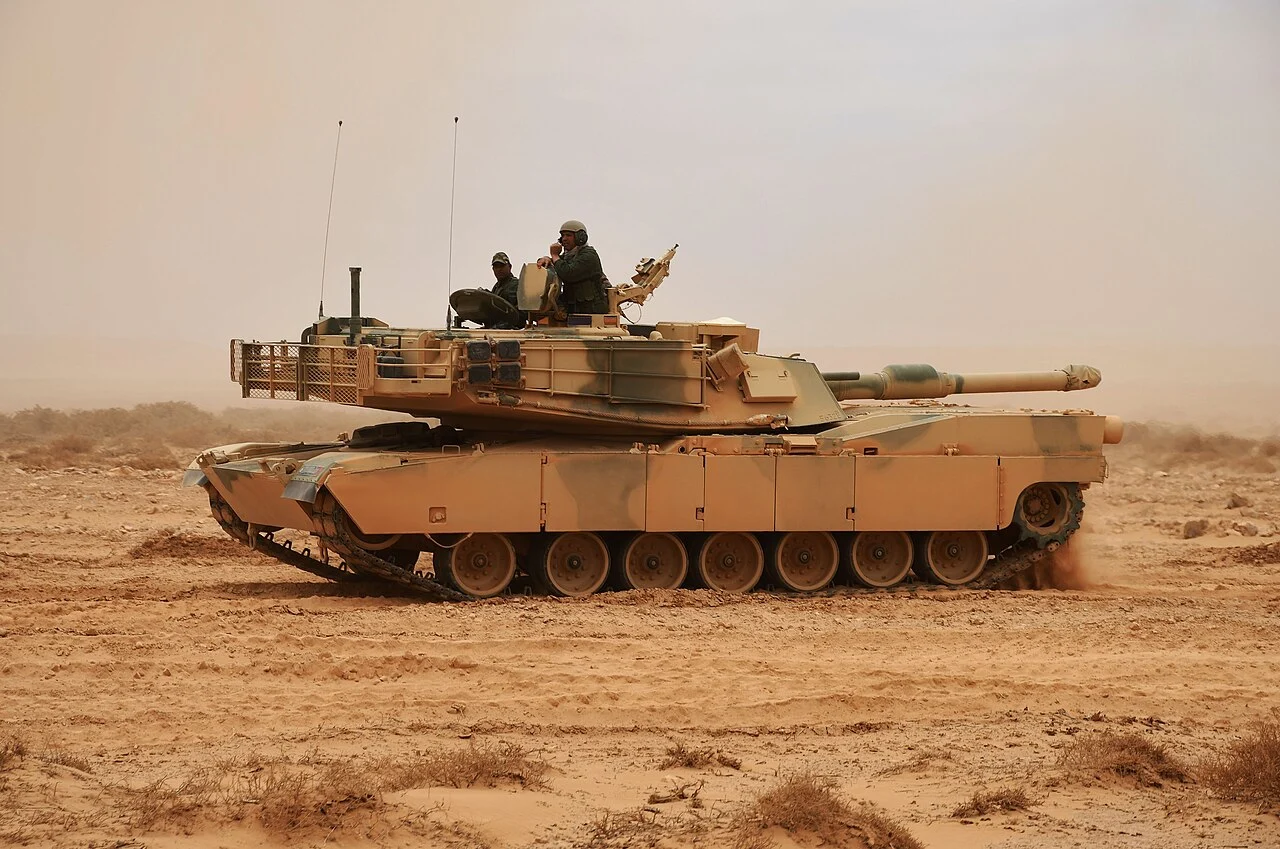
Morocco’s Royal Armed Forces ordered 222 ex-US Army M1A1 hulls in 2015 for upgrade to the M1A1 SA standard. An initial 127 tanks were delivered by 2016, with the remaining 73 further upgraded to the enhanced M1A2M configuration, adding a commander’s independent thermal viewer and slew-to-cue capability, by 2018. In December 2018 the State Department approved a follow-on case for up to 162 further M1A1 Abrams hulls, eligible for upgrade to M1A1 SA, M1A1M or a then-current US Marine Corps configuration (Army Technology, 2018; General Dynamics/PR Newswire, citing a $358 million award for 150 tanks).
Published figures on Morocco’s resulting fleet size vary, between roughly 222 and more than 300 tanks, depending on how many 2018-case hulls have since been delivered; this piece reports both the confirmed initial batch and the follow-on case rather than one invented total. Moroccan Abrams units train regularly alongside US Marine Corps tank battalions during the annual African Lion exercise at Tan-Tan.
5. Leclerc — United Arab Emirates — operational
The UAE was the only export customer for France’s Leclerc MBT, ordering 436 Leclerc-family vehicles from GIAT Industries (now part of Nexter/KNDS) in the 1990s, including 388 gun tanks delivered between 1994 and 2003. The order made the UAE Army the second-largest Leclerc operator after France, with a locally adapted variant fitted with a German MTU/Renk powerpack rather than the French original, for desert operating conditions.
After the UAE donated 80 Leclerc tanks to Jordan in September 2020, the operational Emirati fleet is estimated at roughly 300, though no official figure has been published to confirm the exact post-donation total; this estimate is indicative rather than verified. In February 2023 Nexter and the Emirati firm International Golden Group signed a teaming agreement on potential Leclerc modernization, an industrial partnership rather than a confirmed upgrade contract.
6. Leopard 2A7+ — Qatar — operational
Qatar ordered 62 Leopard 2A7+ tanks from Krauss-Maffei Wegmann (now part of KNDS Deutschland) in 2013, part of a wider heavy-armour package that also included PzH 2000 self-propelled howitzers and armoured vehicles. First deliveries reached Qatar in October 2015, with further batches through 2016-2018. The Leopard 2A7+ is among the most heavily protected variants of the type in service anywhere, fitted with additional modular armour and a remote weapon station optimized for urban and asymmetric threats as well as conventional tank engagements.
The order made Qatar the first Gulf state to field the Leopard 2, giving its armed forces a heavy-armour capability distinct from the Abrams and Leclerc fleets of its GCC neighbours and reflecting Doha’s practice of diversifying suppliers across its major weapons programmes.
7. T-90SA / T-90MS — Algeria — operational
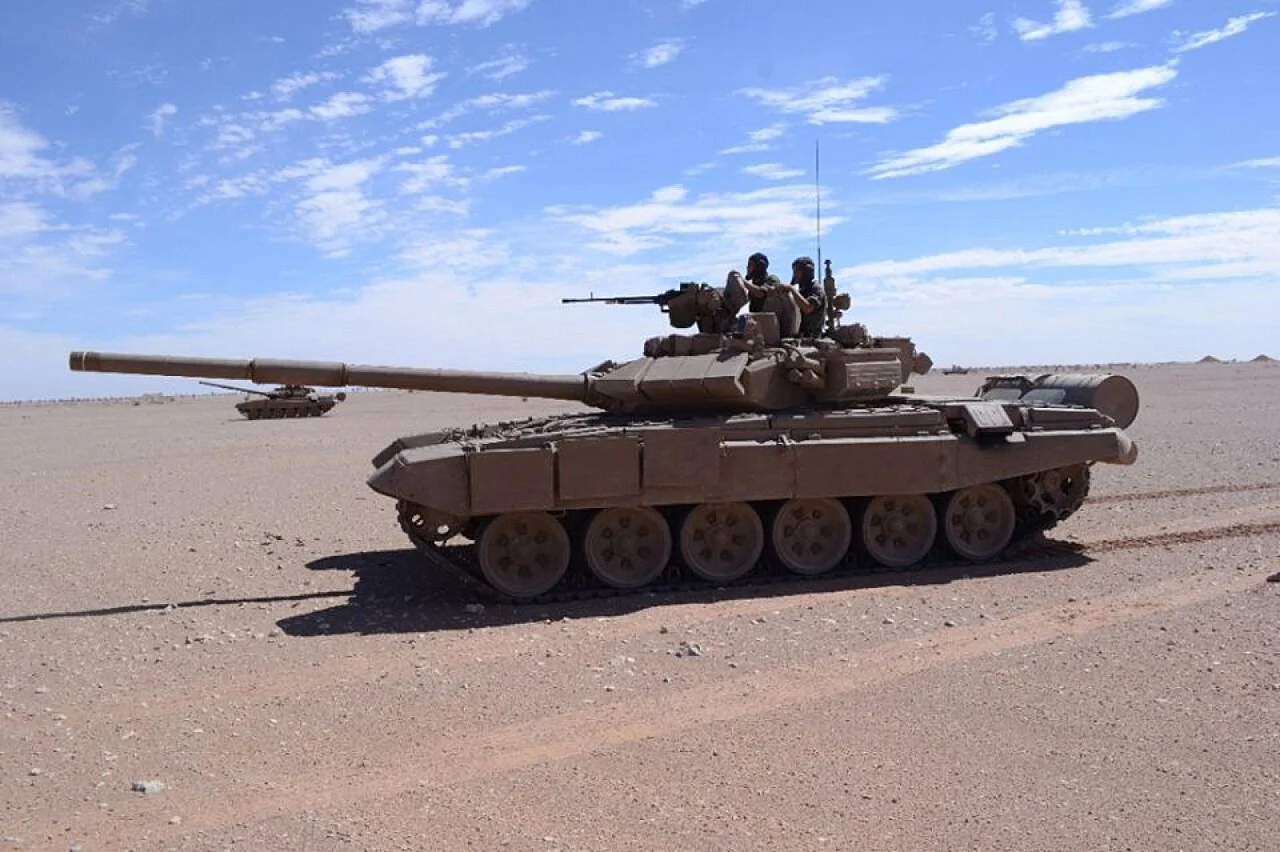
Algeria is MENA’s principal operator of Russian-made armour. SIPRI’s Arms Transfers Database records deliveries of Russian T-90SA and T-90SKA tanks beginning in 2006-2008, under a deal reported at roughly $1 billion, followed by a further batch of T-90S tanks in 2012-2013 under a 2011-dated contract. Cumulative deliveries recorded in the SIPRI database exceed 370 units across these tranches. In 2014 Algeria signed a licensed local-assembly agreement with Russia’s state export agency Rosoboronexport for further T-90SA/T-90SKA production inside the country, extending Algiers’ long-standing practice of negotiating local-content terms into its armour programmes, as it already does for its Russian-sourced air defence and combat aircraft.
Published aggregate totals vary: some trade press cites figures in the low 300s for tanks delivered by the mid-2010s, while SIPRI’s transaction-level tally implies a higher cumulative total once the assembly batches are included. Algerian T-90s have also been fitted with the Shtora-1 optical-electronic countermeasure suite, according to specialist reporting, giving the fleet active protection against guided anti-tank weapons.
8. Leclerc — Jordan — delivered / operational
Jordan’s armoured fleet was reshaped in September 2020 when the UAE donated 80 Leclerc main battle tanks to the Royal Jordanian Land Force, letting Jordan re-equip two of the four tank battalions in its 3rd Armoured Division. The army first deployed the Leclercs publicly during the Salah al-Din Citadel exercise in October 2020, and the type was shown again at SOFEX 2022.
The donation arrived as Jordan retired its older British-heritage fleet: the Challenger 1-based Al-Hussein, developed locally with an experimental low-profile Falcon turret that never reached production, was withdrawn from service by January 2023 according to specialist tank literature. The Leclerc transfer is best read as a capability replacement funded entirely by a fellow Arab state rather than a conventional government-to-government sale, deepening intra-GCC and intra-Arab defence cooperation alongside more heavily publicized programmes in airpower and air defence.
Why it matters for the MENA region
The region’s main battle tank fleets illustrate three overlapping trends. First, industrial localization: Egypt’s decades-old Abrams co-production line and Algeria’s newer T-90 assembly agreement show that technology transfer in armoured vehicles predates the current wave of Saudi and Emirati efforts to build domestic defence industries through GAMI, SAMI and EDGE, offering a partial template for how those newer programmes might mature. Second, supplier diversification: Gulf states have avoided single-source dependency, with the UAE on French armour, Qatar on German, and Saudi Arabia, Kuwait and Morocco on American systems, mirroring the same states’ parallel diversification in combat aircraft and air defence.
Third, intra-regional transfers are becoming a meaningful supplementary channel alongside traditional government-to-government sales, as shown by the UAE’s donation of Leclerc tanks to Jordan. That transfer let Amman modernize its armoured force without a new FMS case or fresh budget line, a model that could recur as wealthier Gulf states support partners such as Jordan and Egypt whose regional security roles outweigh their defence budgets. Worth tracking: whether Saudi Arabia’s reported 300-tank Abrams addition converts into a signed DSCA case, how many of Morocco’s 2018-approved 162 hulls have actually been delivered, and whether Algeria discloses further detail on its T-90 assembly output.
Sources
- Army Recognition — Focus: M1A2S Abrams, a Saudi Adaptation of Power and Precision
- Army Recognition — Saudi Arabia Confirms 300 New M1 Abrams Tanks in US Strategic Defense Agreement (2025)
- Shephard Media — Egypt approved for $4.7 billion upgrade of its Abrams tanks (2024)
- M1A1 tank co-production programme in Egypt — background and production totals
- Shephard Media — Kuwait receives first modernised Abrams after revised programme timeframe
- Janes — Kuwait to keep legacy M1A2 tanks in service
- GovConWire — US Approves Potential $325M Sale of M1A2 Abrams Sustainment Support to Kuwait
- Army Technology — Morocco requests US upgrade of M1A1 Abrams tanks
- PR Newswire — General Dynamics Awarded $358 Million for 150 M1A1 SA Abrams Tanks for Morocco
- Shephard Media — IDEX 2023: US extends M1 Abrams tank support for MENA operators
- Leclerc tank — export history and UAE order details
- European Security & Defence — IDEX 2023: Nexter Teams With IGG to Upgrade UAE Leclerc MBTs
- Army Technology — Qatari Army orders tanks and artillery systems from KMW
- Quwa — KMW delivers batch of new Leopard 2A7+ MBTs to Qatar
- SIPRI Arms Transfers Database
- defenceWeb — Algeria to assemble 200 T-90 tanks
- Army Recognition — Jordan deploys for the first time Leclerc main battle tanks during military exercise
- List of equipment of the Royal Jordanian Army
Related reading on DEFENCE MENA: How Strong Is Egypt’s Military in 2026? and Egypt vs Algeria Military Power in 2026. See also the desk pages for Saudi Arabia and the United Arab Emirates.