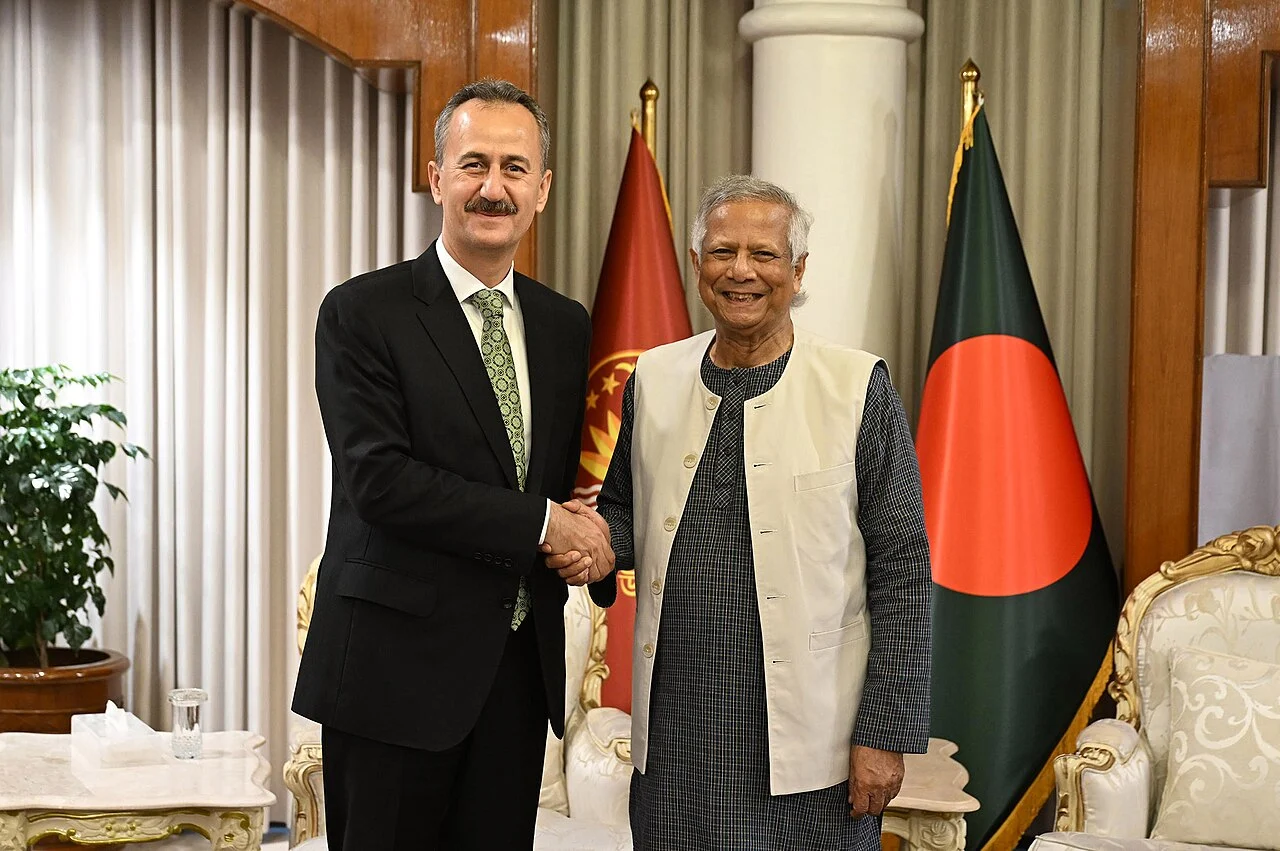
Since taking over Türkiye’s Presidency of Defence Industries (SSB) in June 2023, Haluk Görgün has made Africa one of the busiest fronts of Turkish defence-industrial diplomacy. By November 2025 the agency had signed Defence Industry Cooperation (DIC) agreements with 30 African states. This dossier maps who he met, where, and what each contact produced, country by country.
Photo: Haluk Görgün leading an SSB delegation abroad, July 2025. Credit: Press Information Department, Bangladesh / Wikimedia Commons (public domain).
Key facts
- 30 African countries have signed DIC agreements with the SSB, Görgün said in Maputo on 19 November 2025.
- About $1.7 billion of the $17.8 to 17.9 billion in new Turkish defence export contracts signed in 2025 came from Africa, according to Görgün.
- Third supplier south of the Sahara: SIPRI puts Türkiye at 11% of sub-Saharan arms imports in 2021–25, behind China (22%) and Russia (12%).
- Record exports: Turkish defence and aerospace exports reached $10.05 billion in 2025, up 48% year on year.
- The Egypt breakthrough: Görgün and Egypt’s defence minister signed a letter of intent on defence-industry cooperation in Ankara on 13 July 2026.
From sales to partnership: the Görgün model
Görgün’s Africa file is not built on a single headline contract. It is built on frequency. In three and a half years he has received chiefs of staff and ministers in Ankara, met delegations at IDEF and SAHA in Istanbul, travelled with President Recep Tayyip Erdoğan to Cairo and Addis Ababa, and taken Turkish companies to Kigali, Dakar and Maputo. The message has stayed the same throughout. In Maputo he described Türkiye’s growing presence as a long-term commitment based on “equality, mutual benefit and local ownership”, not a passing interest.
That language matters because it points to what African governments keep asking for: training, maintenance, local assembly and technology transfer rather than off-the-shelf purchases. The SSB has answered with a format first tested in Mozambique, where Görgün arrived with 15 Turkish defence companies for a two-day country forum. The question now is how many other capitals will get the same treatment.
Work is also split between two channels. Military diplomacy runs through the Ministry of National Defence under Yaşar Güler, which signed framework agreements with Mauritania at IDEF 2025 and with Kenya at SAHA 2026. Industrial diplomacy, meaning products, partnerships and contracts, runs through the SSB. The two tracks reinforce each other, and the African visitors usually meet both.
Timeline of Görgün’s African contacts
| Date | Country | Counterpart | Place | Outcome |
|---|---|---|---|---|
| 7 Sep 2023 | Mozambique | Defence Minister Cristóvão Chume | Ankara, SSB | Defence-industry cooperation agreement signed |
| 19 Apr 2024 | Nigeria | First Lady Remi Tinubu, Minister of State for Defence Bello Matawalle, Chief of Naval Staff Emmanuel Ogalla | Dearsan shipyard, Istanbul | Second 76-metre offshore patrol vessel launched |
| 28 Jun 2024 | Rwanda | Defence Minister Juvenal Marizamunda and RDF commanders | Kigali | Visit with Turkish company CEOs |
| 17 Jul 2024 | Niger | Prime Minister Ali Mahamane Lamine Zeine | Niamey | Joint working meeting with Turkish ministers on defence, security and energy |
| Sep 2024 | Egypt | President Abdel Fattah al-Sisi | Ankara | First meeting of the High-Level Strategic Cooperation Council |
| Jan 2025 | Libya | Chief of General Staff Gen. Mohammed Ali Ahmed al-Haddad | Ankara, SSB | Defence-industry cooperation talks |
| 23 Jan 2025 | Rwanda | President Paul Kagame | Ankara | SSB and Rwandan Ministry of Defence sign memorandum of understanding |
| 18 Mar 2025 | Senegal | Prime Minister Ousmane Sonko, Armed Forces Minister Gen. Birame Diop, Chief of General Staff Lt Gen. Mbaye Cissé | Dakar | Cooperation review, maritime security |
| 22–27 Jul 2025 | Gambia, Mali, Somalia | Gambian CDS Mamat O.A. Cham; Mali’s Deputy Defence Minister Maj. Gen. Sidiki Samaké and CGS Oumar Diarra; Somali Ports Minister Abdulkadir Mohamed Nur | IDEF 2025, Istanbul | Industrial cooperation, technology sharing, naval matters |
| 18–20 Nov 2025 | Mozambique | President Daniel Chapo, Minister Chume | Maputo | First Mozambique–Türkiye Defence Industry Cooperation Forum; roadmap commission agreed |
| 4 Feb 2026 | Egypt | President al-Sisi (Erdoğan delegation) | Cairo | Defence-industry cooperation on the agenda |
| 17 Feb 2026 | Ethiopia | Prime Minister Abiy Ahmed, President Taye Atske Selassie (Erdoğan delegation) | Addis Ababa | Inter-delegation talks including defence industry |
| 5–9 May 2026 | Somalia | Defence Minister Ahmed Moallim Fiqi | SAHA 2026, Istanbul | Military modernisation; ASFAT technical-support talks |
| 13 Jul 2026 | Egypt | Minister of Defence and Military Production Lt Gen. Ashraf Salem Zaher | Ankara, SSB | Letter of intent on defence-industry cooperation |
| 12 Aug 2026 | Djibouti | Türkiye’s new Ambassador to Djibouti, Hüseyin Özdemir | Ankara, SSB | Türkiye–Djibouti defence-industry cooperation |
Country files
North Africa: Egypt, Libya, Morocco, Mauritania
Egypt: from normalisation to a framework
Egypt is the most significant shift of the Görgün period. He was part of the welcoming ceremony when President al-Sisi came to Ankara in September 2024 for the first High-Level Strategic Cooperation Council, and he travelled with Erdoğan to Cairo on 4 February 2026. The concrete step came on 13 July 2026, when Lt Gen. Ashraf Salem Zaher, Egypt’s Minister of Defence and Military Production, visited the SSB. The two sides signed a letter of intent to set the framework for future defence-industry cooperation. Görgün said the partnership would contribute to regional security and to capacity building on both sides. Zaher’s trip was reported as the first by an Egyptian defence minister to Türkiye since 2013, and a separate defence-cooperation letter was signed with Minister Güler the same day.
The industrial base was already visible at EDEX 2025 in Cairo. According to Egypt’s State Information Service, 81 Turkish companies took part under SSB Deputy President Gökhan Uçar. ASELSAN opened an “ASELSAN Egypt” office, and the HAMZA-1 VTOL drone and AKREP 6×6 unmanned ground vehicle, developed by HAVELSAN with the Arab Organization for Industrialization (AOI), were shown. For a full account of the Cairo track, see our file on Haluk Görgün’s Egypt contacts.
Libya
In January 2025 Görgün received Gen. Mohammed Ali Ahmed al-Haddad, then Chief of General Staff of Libya’s Tripoli-based armed forces, at the SSB to discuss industrial cooperation. Contacts with eastern Libya, including Saddam Haftar’s visits to SAHA EXPO 2024, IDEF 2025 and SAHA 2026, have been handled mainly through the Ministry of National Defence.
Morocco and Mauritania
Morocco is one of the largest operators of Turkish drones in North Africa. It ordered Bayraktar TB2s in 2021, received its first Akıncı aircraft in February 2025, and Baykar registered a local company in the kingdom in January 2025. Mauritania signed a military framework agreement with Minister Güler at IDEF 2025 on 24 July 2025.
Horn of Africa: Somalia, Ethiopia, Djibouti
Somalia: the most consistent partner
Somalia is where contacts have been most regular. Görgün met Defence Minister Ahmed Moallim Fiqi at DIMDEX in Doha and again at SAHA 2026 in Istanbul, and discussed naval industry with Ports and Maritime Transport Minister Abdulkadir Mohamed Nur at IDEF 2025. At SAHA 2026, Somalia’s state news agency SONNA reported that the Somali delegation was briefed by ASFAT on technical support and operational capability solutions. Türkiye’s largest military facility abroad has operated in Mogadishu since 2017, and Turkish air assets were reinforced in early 2026. Hürriyet Daily News, citing Somali government sources, reported that three F-16s landed in Mogadishu on 28 January 2026; Türkiye’s defence ministry confirmed the reinforcement without giving numbers. “The F-16s will make a significant contribution to the operational capacity of the Somali army,” Fiqi said.
Ethiopia
On 17 February 2026 Görgün was part of Erdoğan’s delegation in Addis Ababa, where they were received by Prime Minister Abiy Ahmed and held talks with President Taye Atske Selassie. “Türkiye pursues its relations with the African continent on the basis of mutual respect and a win-win approach,” Görgün said after the visit.
Djibouti
On 12 August 2026 Görgün received Hüseyin Özdemir, Türkiye’s newly appointed ambassador to Djibouti, to review defence-industry cooperation with the Red Sea state and possible work across the region.
Sub-Saharan Africa: Mozambique, Nigeria, Rwanda, Senegal, Niger, Mali, Gambia
Mozambique: the pilot for the country forum
The Mozambique file shows the method most clearly. Görgün and Defence Minister Cristóvão Chume signed a defence-industry cooperation agreement in Ankara on 7 September 2023. Two years later, from 18 to 20 November 2025, Görgün travelled to Maputo with 15 Turkish defence companies for the first Mozambique–Türkiye Defence Industry Cooperation Forum. President Daniel Chapo received the delegation, and the two sides agreed to set up a commission to draw up a defence-cooperation roadmap. “As I promised, I am visiting Mozambique with 15 defence industry companies,” Görgün told local media. Türkiye also offered to share its counter-terrorism experience, a point with direct relevance to the insurgency in Cabo Delgado. Chume, for his part, called the forum a vehicle for the technology transfer Mozambique needs to build a national defence industry, which he described as still in its infancy. Mozambican reports added that a credit mechanism for larger equipment purchases was being prepared.
Nigeria: Turkish-built patrol ships
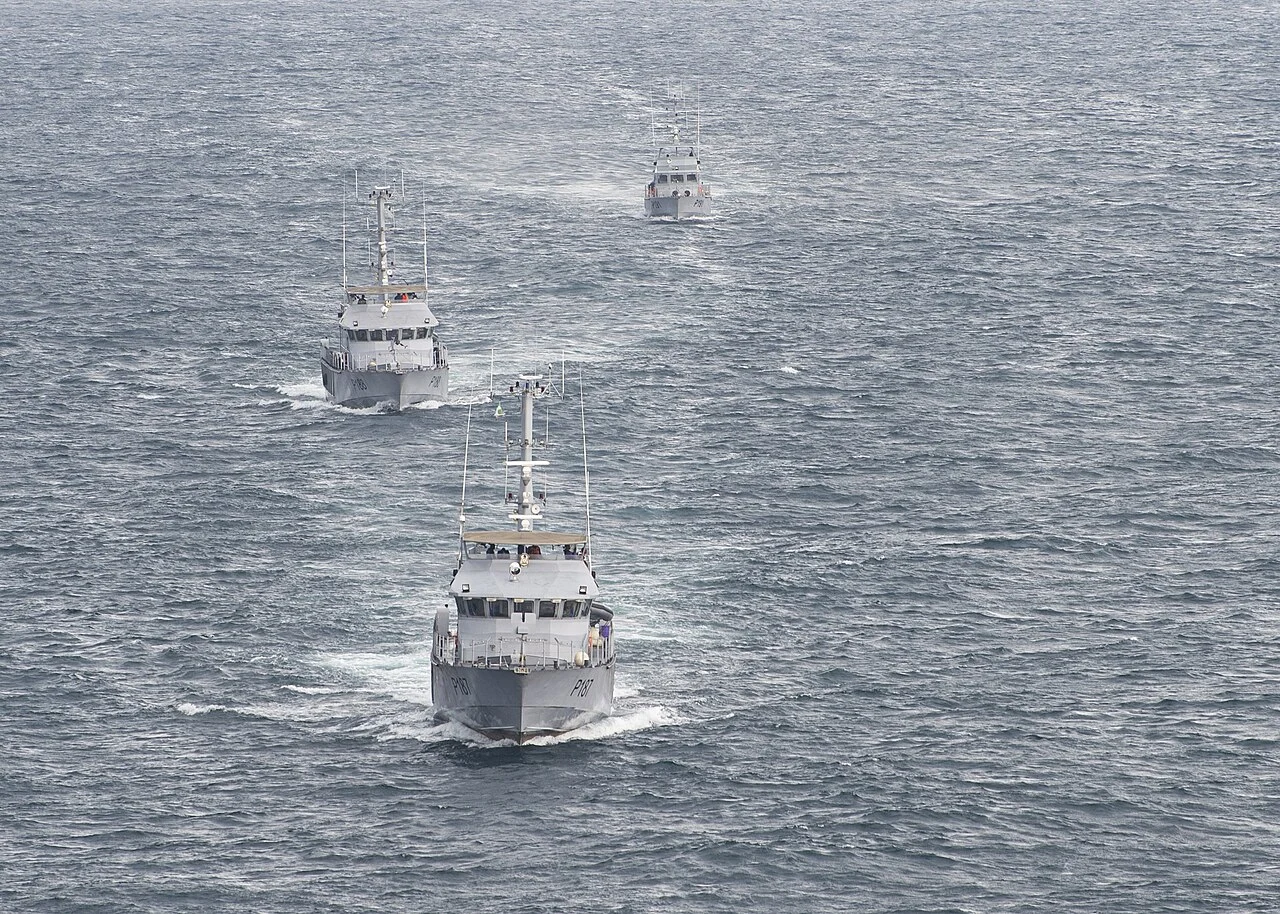
On 19 April 2024 Görgün attended the launch of the Nigerian Navy’s second 76-metre offshore patrol vessel at Dearsan’s yard in Istanbul, alongside First Lady Remi Tinubu, Minister of State for Defence Bello Matawalle and Chief of Naval Staff Emmanuel Ogalla. The first ship had been launched on 26 October 2023 under a contract signed on 3 November 2021. Both carry ASELSAN weapon systems, including a 30 mm gun and the STAMP remote weapon station. Dearsan also won the modernisation contract for the navy’s flagship, the frigate NNS Aradu, in June 2023. “We see defence industry cooperation as a lever that will enrich bilateral relations in every field,” Görgün said at the ceremony. “Our countries deserve more.”
Rwanda
Görgün flew to Kigali on 28 June 2024 at the invitation of Defence Minister Juvenal Marizamunda, bringing Turkish company executives with him. On 23 January 2025, during President Paul Kagame’s official visit to Ankara, the SSB and Rwanda’s Ministry of Defence signed a memorandum of understanding in the presence of both presidents, one of four agreements concluded that day.
Senegal
In Dakar on 18 March 2025 Görgün met Prime Minister Ousmane Sonko, Armed Forces Minister Gen. Birame Diop, Chief of General Staff Lt Gen. Mbaye Cissé and the maritime security authority HASSMAR. Maritime security was at the centre of the talks. Our earlier report sets out what is documented in the Senegal–Türkiye defence relationship.
Niger, Mali and Gambia
On 17 July 2024 Görgün joined Foreign Minister Hakan Fidan, Defence Minister Güler, Energy Minister Alparslan Bayraktar and intelligence chief İbrahim Kalın in Niamey for a joint working meeting chaired by Prime Minister Zeine, covering defence, security and energy. At IDEF 2025 he met Mali’s Deputy Defence Minister Maj. Gen. Sidiki Samaké and Chief of General Staff Oumar Diarra, as well as Gambia’s Chief of Defence Staff Mamat O.A. Cham.
The numbers behind the diplomacy
| Indicator | Value | Source |
|---|---|---|
| Defence and aerospace exports, 2023 | $5.5 billion | SSB |
| Defence and aerospace exports, 2024 | $7.1 billion | SSB |
| Defence and aerospace exports, 2025 | $10.05 billion (+48%) | Görgün / Anadolu Agency |
| New export contracts signed in 2025 | $17.8–17.9 billion | Görgün (two statements) |
| Africa’s share of 2025 new contracts | About $1.7 billion | Görgün |
| Rolling 12-month exports, mid-2026 | Over $11 billion | Görgün |
| African countries with DIC agreements | 30 | Görgün, Maputo, Nov 2025 |
| Share of sub-Saharan arms imports, 2021–25 | 11% (3rd after China and Russia) | SIPRI, March 2026 |
| Global rank among arms exporters, 2021–25 | 11th (+122% on 2016–20) | SIPRI, March 2026 |
Africa is not yet Türkiye’s largest market in dollar terms. In Görgün’s breakdown of 2025 contracts, Asia-Pacific ($5.5 billion), Europe ($5.3 billion), the Americas ($3.3 billion) and the Middle East ($2.2 billion) all came ahead of it. What stands out is the speed of growth. Defence Turkey put Turkish defence exports to Africa at around $41 million in 2020; five years later the continent accounted for roughly $1.7 billion in new contracts in a single year. Görgün has said that many drone contracts in the Gulf and Africa were followed by ammunition agreements, which suggests that African orders are growing as complete packages rather than single platforms. SSB dollar figures and SIPRI’s trend-indicator values measure different things and should not be compared directly.
What African partners are asking for
Three demands come up again and again. The first is technology transfer and local production. Mozambique has said so openly, and the HAVELSAN–AOI work in Egypt and Baykar’s company in Morocco show the model of building locally rather than only buying. The second is counter-terrorism and maritime security: the Sahel states, Somalia and Mozambique need drones, protected vehicles and patrol ships, while talks with Senegal and Somalia have centred on the sea. The third is predictability. SIPRI notes that Turkish equipment appeals to some African states partly because it allows them to diversify suppliers away from great-power rivalry.
Flows in the other direction are still limited. No SSB agreement on African raw materials or co-investment into Turkish industry has been made public, although mining and energy featured in the talks with Niger and an energy memorandum was signed in Addis Ababa. The next stage of the relationship will be measured by how much production moves to African soil.
What to watch
- Whether the Mozambique forum format is repeated in other African capitals.
- How the Egypt letter of intent turns into specific programmes, and how quickly.
- Further ASFAT support and naval projects with Somalia, and Türkiye’s role in Red Sea security alongside Djibouti.
- Financing tools, including the credit mechanism being prepared for Mozambique, which could unlock larger orders elsewhere.
Sources
- TRT Afrika: Görgün in Maputo, 30 DIC agreements
- Club of Mozambique: Türkiye willing to share defence capability
- Club of Mozambique: Mozambique seeks strategic partnership with Türkiye
- Directorate of Communications: Turkish defence industry meets Mozambican media
- Hürriyet Daily News: Türkiye, Egypt sign letter of intent
- Al-Monitor: Turkey and Egypt expand military ties
- Ahram Online: Egypt defence minister concludes Turkey visit
- Dearsan: second OPV for the Nigerian Navy launched
- TURDEF: Dearsan launches Nigeria’s second OPV
- Directorate of Communications: Türkiye and Rwanda sign 4 agreements
- KT Press: Turkey, Rwanda sign four cooperation agreements
- Military Africa: SSB visits Senegal
- Anadolu Agency: defence and aviation exports exceed $10B in 2025
- Yeni Şafak: exports top $11B on a 12-month basis
- SIPRI: Trends in International Arms Transfers, 2025
- Turkish Minute: SIPRI figures on Türkiye’s arms exports