Last updated: 25 November 2026
Egypt’s two best-known mega-garrisons sit on opposite coasts. President Abdel Fattah El-Sisi inaugurated Mohamed Naguib Military Base, in the Hammam area of Marsa Matrouh Governorate, west of Alexandria, on 22 July 2017. He opened Berenice Military Base, on the Red Sea coast east of Aswan, on 15 January 2020. The Egyptian presidency’s project pages put Mohamed Naguib at 18,000 feddans (about 7,560 hectares) and Berenice at 150,000 feddans (about 63,000 hectares). Those area figures are official descriptions, not independently surveyed totals.
Neither page publishes a current troop number or a full equipment list for the units assigned to each base. This article therefore sticks to what the presidency, the 2017 opening reports and the 2020 opening statement say the bases contain, and to the tasks Cairo assigned them. It does not invent an order of battle.
Mohamed Naguib Military Base
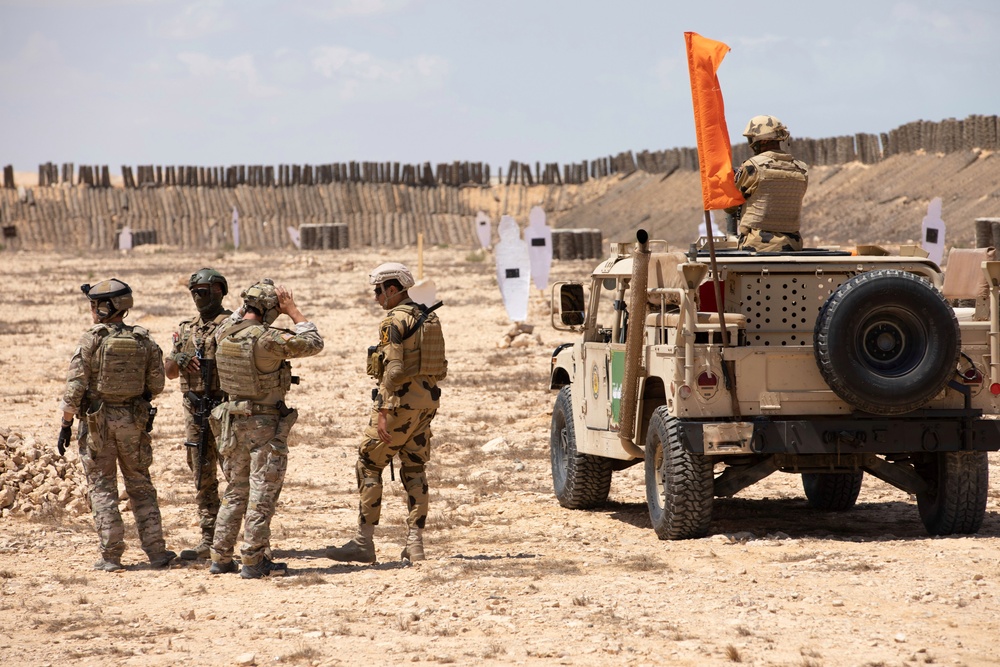
The presidency describes Mohamed Naguib as the successor to a military city established in the Hammam area in 1993. Ahram Online, reporting the inauguration on 22 July 2017, likewise said the site was built on that older military city and that 1,155 buildings had been built or renovated. The presidency’s own project page repeats the 1,155 buildings and facilities figure, and lists four main gates and eight internal gates.
According to the same official page, the base is intended to help protect national projects, “led by” the Dabaa nuclear plant, oil fields and the borders, and to host joint training with other countries. Ahram Online, citing Al-Ahram’s Arabic service at the time of the opening, said some Northern Military Zone forces would be headquartered there and that the base would also support training with foreign armies. “Reportedly the largest in the Middle East,” a phrase used in that 2017 report, is not an official measurement and is not repeated here as fact.
Infrastructure figures on the presidency page include about 72 kilometres of developed internal and external roads, a conference hall described as holding up to 1,600 people, a mosque described as holding more than 2,000 worshippers, and a farm of 379 feddans of fruit trees plus 1,600 feddans of seasonal crops. The page also says a tank-transport regiment at the base “can hold approximately 451 modern tankers to transport heavy tanks,” and that 72 training fields were built, including an electronic tactical shooting complex. Those are official claims. They have not been separately audited in the sources reviewed for this article, and no current count of tanks stored or units assigned has been published.
Residential and support facilities listed by the presidency include 27 lounges for senior commanders, 14 officers’ buildings and 15 similar buildings for non-commissioned officers, plus two buildings described as taking up to 1,000 personnel, a developed Hammam Military Hospital (50 beds added, on the official wording), 50 solar-powered units, and a sporting village with an Olympic-size football field. The base is named after Mohamed Naguib, Egypt’s first president after the 1952 revolution.
Berenice Military Base
The presidency’s 15 January 2020 statement said Sisi opened Berenice that morning and watched the final phase of the Qader 2020 manoeuvre. Official texts call it the largest military base in the Red Sea region and place it on the Red Sea coast near Egypt’s southern international border, east of Aswan. A Red Sea Governorate notice the same week located it north of the Halaib and Shalateen triangle. The presidency project page says the base was established in less than a year; the opening statement said it was built “within a few months.” Both are official wording. An independent construction timeline has not been published.
What the official pages do list is a combined naval and air presence: a naval base, an air base, Berenice Military Hospital, combat and administrative units, shooting and training fields, Berenice International Airport, a seawater desalination plant, and commercial port facilities (a commercial dock, passenger terminal, multi-purpose and cargo berths, and container yards). The stated strategic aims are to protect Egypt’s southern coasts, economic investments and natural resources, to address security challenges in the Red Sea, and to help secure navigation from the Red Sea to the Suez Canal, framed as part of Egypt’s Vision 2030.
No official public document reviewed here gives the number of aircraft, ships or personnel permanently assigned to Berenice. The base should not be confused with a published navy or air-force inventory. For the wider fleet that could use a Red Sea facility, see DefenceMENA’s Egyptian inventory and the Germany–Egypt naval deals file.
How the two bases differ
| Point | Mohamed Naguib | Berenice | Source |
|---|---|---|---|
| Opened | 22 July 2017 | 15 January 2020 | Ahram Online (2017 inauguration); Egyptian Presidency (2020 opening statement) |
| Location | Hammam, Marsa Matrouh Governorate, west of Alexandria / North Coast | Red Sea coast, east of Aswan, near the southern border | Egyptian Presidency project pages |
| Official area | 18,000 feddans (about 7,560 hectares) | 150,000 feddans (about 63,000 hectares) | Egyptian Presidency; hectare figures are conversions of the official feddan totals (1 feddan ≈ 0.42 ha) |
| Stated role | Protect Dabaa nuclear plant, oil fields and borders; joint training; Northern Military Zone support (reported at opening) | Secure southern coasts, Red Sea resources and the sea lane toward the Suez Canal; naval and air facilities | Presidency pages; Ahram Online, 22 July 2017 |
| Published troop or aircraft totals | Not published | Not published | — |
One base faces the Mediterranean and the western desert approaches to the Nile Delta and the North Coast. The other faces the southern Red Sea, close to Sudan and to the route that feeds the Suez Canal. They are complementary, not duplicates. Claims that one or the other is “the largest base in the Middle East” or “the largest in Africa” are marketing or press language unless a government publishes a comparable, measured ranking. The presidency calls Berenice the largest in the Red Sea region; that is the official formulation used here.
Frequently Asked Questions
When were the Berenice and Mohamed Naguib bases opened?
Mohamed Naguib was inaugurated on 22 July 2017. Berenice was opened on 15 January 2020, on the same day as the final phase of the Qader 2020 manoeuvre, according to the Egyptian presidency.
How big are the two bases?
The presidency puts Mohamed Naguib at 18,000 feddans and Berenice at 150,000 feddans, about 7,560 and 63,000 hectares respectively if the standard feddan conversion is applied. Those are official area figures, not independently surveyed totals, and they describe the wider base areas, not a single built-up parade ground.
Where is Berenice Military Base?
On Egypt’s Red Sea coast, east of Aswan, near the southern international border. Official notices also place it in relation to the Halaib and Shalateen area in the country’s south-east.
How many troops are stationed at each base?
Egypt has not published a current official troop, tank or aircraft total for either garrison in the documents reviewed for this article. Building counts and facility lists should not be read as a unit strength.