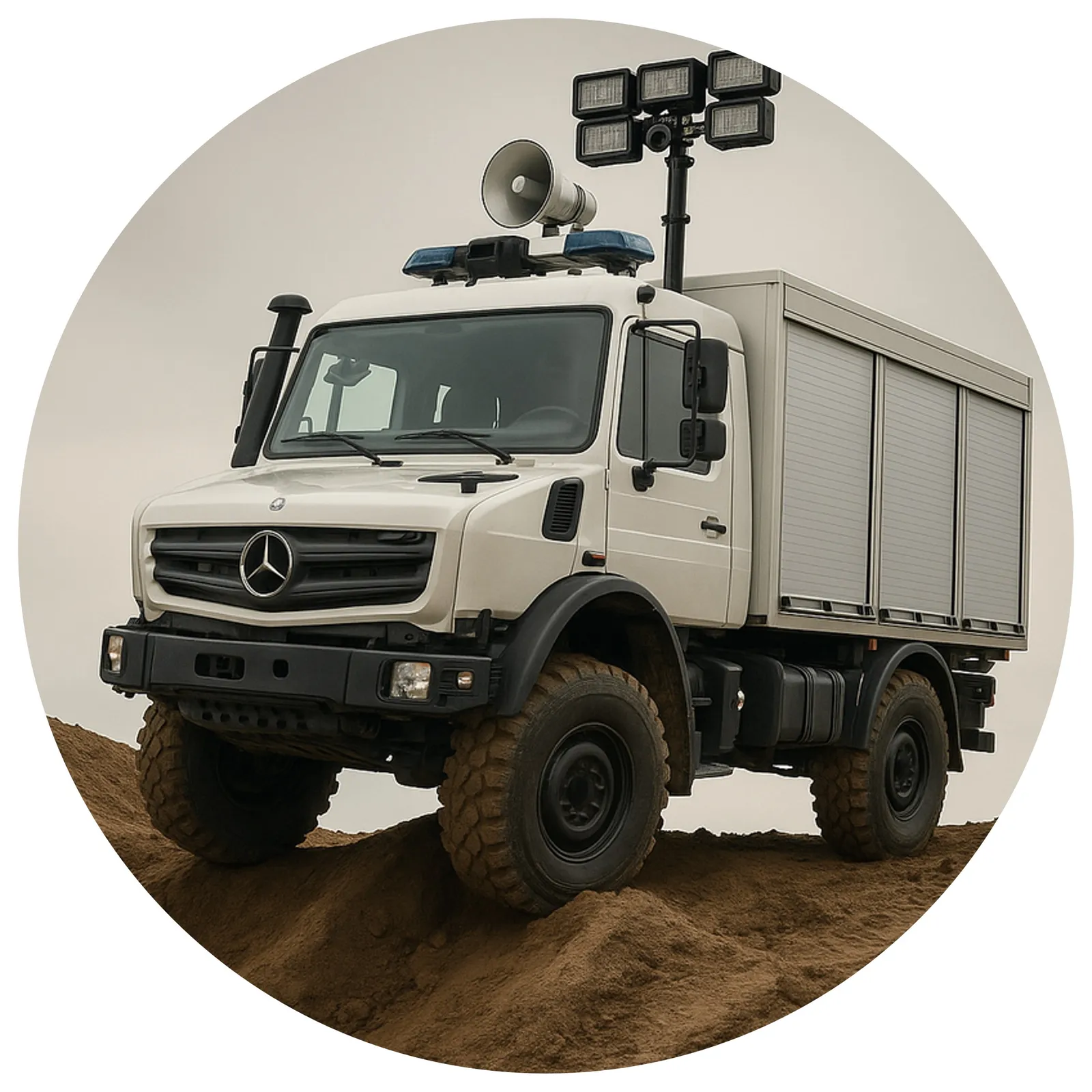
The Natural Disaster Rescue Vehicles project, known in Türkiye by its Turkish acronym DAK, gives the Turkish Land Forces, Air Force and Navy a dedicated fleet of search-and-rescue vehicles built by Koluman on the Mercedes-Benz UNIMOG U5000 chassis. According to Türkiye’s Presidency of Defence Industries (SSB), 71 vehicles and their rescue equipment had passed acceptance by September 2026. This file explains what the DAK vehicles are, how the SSB programme is organised, and why the concept deserves attention from African armed forces that are increasingly called on to respond to floods, cyclones and earthquakes.
Photo: Presidency of Defence Industries (SSB), Türkiye.
What is the DAK project?
DAK stands for Doğal Afet Kurtarma Araçları, Natural Disaster Rescue Vehicles. It is not a single vehicle but a family of equipped rescue platforms, each built on the same off-road truck base and fitted out for a particular kind of disaster. SSB’s project data lists urban search-and-rescue vehicles for collapsed buildings, command and control vehicles to run a rescue operation, mountain and cave rescue vehicles, a water and flood rescue vehicle, light search-and-rescue vehicles and material transport vehicles. Each is delivered together with its specialised rescue kit, which SSB counts as part of the same procurement.
The logic is straightforward. When a major earthquake or flood strikes, armed forces are often the only organisations with the manpower, discipline and transport to reach affected areas at scale in the first hours. What they frequently lack is purpose-built rescue equipment that is ready to move as a unit. The DAK project puts that equipment on wheels, in standard configurations, at bases across the country.
Key specifications
The figures below are SSB’s shareable technical data for the DAK vehicles.
| Prime contractor | Koluman (Koluman Otomotiv Endüstri), Mersin, Türkiye |
| Procurement authority | Presidency of Defence Industries (SSB) |
| Users (SSB data) | Turkish Land Forces Command, Air Force Command, Naval Forces Command |
| Base vehicle | Mercedes-Benz UNIMOG U5000 |
| Crew | 7 people, including the driver |
| Drive | 4×4 off-road |
| Engine | 218 hp |
| Transmission | 8 forward gears, fully synchronised |
| Mobility | 60% gradient, 30% side slope |
| Mission equipment | Search-and-rescue equipment specific to each version (urban, mountain and cave, water and flood, light rescue, command and control) |
| Programme status | 71 vehicles and associated rescue equipment accepted by September 2026 |
The SSB programme: scope and progress
SSB’s project sheet sets out the full scope by service. For the Land Forces, the programme covers 50 urban search-and-rescue vehicles, 15 command and control vehicles, three mountain and cave rescue vehicles and one water and flood rescue vehicle, each with its equipment. The Air Force receives two urban search-and-rescue vehicles, two material transport vehicles, two light search-and-rescue vehicles and one command and control vehicle. The Navy receives 12 urban search-and-rescue vehicles. That adds up to 88 vehicles across the three services.
By September 2026, SSB reports, acceptance had been completed for 52 vehicles for the Land Forces, seven for the Air Force and 12 for the Navy, a total of 71, together with a range of rescue equipment. The Air Force and Navy portions are therefore complete, and the Land Forces portion is well advanced. The pace reflects a programme built on a proven commercial chassis and a domestic integrator, which keeps engineering risk low and lets deliveries follow a steady rhythm.
The programme is also a good example of how SSB’s remit has widened. The presidency is best known for combat systems, from drones to armoured vehicles and missiles, but the DAK project shows it applying the same procurement discipline to the armed forces’ civil-support role. Türkiye’s experience of large earthquakes, including the February 2023 disaster in Kahramanmaraş and surrounding provinces in which military units joined rescue work alongside AFAD, the national disaster agency, makes that role a national priority rather than an afterthought.
Why the UNIMOG, and why Koluman?
The UNIMOG U5000 is one of the most widely used off-road truck chassis in the world for emergency services, fire brigades and armies. Its portal axles give it high ground clearance, its frame is built to flex over broken ground, and its compact cab and short wheelbase let it move through debris-strewn streets where a larger truck would be stuck. SSB’s figures of a 60% gradient and 30% side slope, with a 218 hp engine and an eight-speed fully synchronised gearbox, describe a vehicle meant to reach a mountain village after a landslide or an inundated district after a flood, not simply to drive on paved roads.
Koluman, based in Mersin, is a long-standing partner of Mercedes-Benz in Türkiye and has built a defence business around it. Under SSB contracts it supplies the DERMAN armoured logistics vehicle and its DROPS container-handling version to the Turkish Armed Forces, and it has developed its own KISRAK 4×4 tactical vehicle. That background in military body-building and systems integration is what turns a standard chassis into a rescue platform with secure stowage for heavy equipment, crew seating for seven and lighting and communications for night operations. The SSB photograph shows a typical fit: a closed equipment body with roller shutters, a telescopic light mast, a public-address loudspeaker and emergency beacons.
Who operates the DAK vehicles?
The DAK vehicles are in service with the three Turkish armed services named in SSB’s data: the Land Forces Command, the Air Force Command and the Naval Forces Command. No export customer has been announced. As a package built on a globally supported chassis with domestically integrated equipment, the concept is, however, readily exportable, and Turkish industry has shown with other SSB-managed programmes that what is fielded at home can be adapted quickly for foreign customers.
Can the DAK concept go to Africa?
Africa’s disaster profile makes the case on its own. Storm Daniel’s flooding of Derna in Libya in September 2023 was one of the deadliest flood disasters in recent memory. Cyclone Idai in 2019 and Cyclone Freddy in 2023 devastated parts of Mozambique and Malawi. In 2024, floods across the Sahel and West Africa affected millions of people in Nigeria, Niger, Chad and Mali, including the dam collapse that flooded Maiduguri. Kenya and Somalia have faced repeated flash floods, and Morocco’s Al Haouz earthquake in 2023 showed how quickly mountain communities can be cut off.
In almost all of these cases, armed forces were among the first and largest responders. Many African armies already run UNIMOG-type trucks, so a rescue fleet on the same family of chassis would fit existing driver training and maintenance habits. The DAK approach of standard, equipped configurations, each matched to a disaster type, is well suited to armies that need to stand up a disaster-response capability quickly without designing it from scratch. A water and flood rescue vehicle and command and control vehicles would be the obvious starting point for countries exposed to river and coastal flooding, while urban search-and-rescue vehicles fit earthquake-prone North Africa.
Türkiye also brings a track record of disaster diplomacy on the continent. Turkish search-and-rescue teams and field hospitals were among the international help sent to Derna in 2023, and Turkish humanitarian agencies have a long presence in Somalia and the Sahel. Candidate markets include Libya, which is rebuilding its civil protection capacity; Mozambique and Malawi in the cyclone belt; Nigeria, where the army supports the national emergency agency in flood response; Kenya and Somalia; and Algeria and Morocco, where engineering and civil protection units handle earthquake response. For each, a DAK-type fleet would combine a familiar chassis, a proven Turkish integrator and a procurement model that SSB has already run to completion for two of Türkiye’s three services.
How it fits Türkiye’s land vehicle portfolio
Most of SSB’s land vehicle projects concern armoured and combat vehicles, such as Otokar’s COBRA II and Nurol Makina’s Ejder Yalçın. The DAK project sits alongside them as the clearest example of a support capability built for the armed forces’ role in national resilience. For a wider look at Turkish land systems on the continent, see our overview of Turkish defence systems in African service.
Frequently asked questions
What is the DAK project?
DAK (Doğal Afet Kurtarma Araçları) is a Turkish programme managed by the Presidency of Defence Industries (SSB) to equip the Land Forces, Air Force and Navy with natural disaster search-and-rescue vehicles and rescue equipment, built by Koluman on the Mercedes-Benz UNIMOG U5000.
How many DAK vehicles have been delivered?
SSB reports that 71 vehicles had passed acceptance by September 2026: 52 for the Land Forces, seven for the Air Force and 12 for the Navy, out of 88 in the programme scope.
What are the DAK vehicle specifications?
According to SSB, the vehicles use the UNIMOG U5000 base with a 218 hp engine, an eight-speed fully synchronised transmission and 4×4 drive, carry seven people including the driver, and climb a 60% gradient with a 30% side slope.
What versions of the DAK vehicle exist?
Urban search-and-rescue, command and control, mountain and cave rescue, water and flood rescue, light search-and-rescue and material transport versions, each delivered with its own rescue equipment.
Could African armies use DAK-type vehicles?
Yes. Floods, cyclones and earthquakes in countries such as Libya, Mozambique, Malawi, Nigeria and Morocco have made armed forces key first responders, and a standard, equipped fleet on a familiar UNIMOG chassis fits that role.
Sources: SSB land vehicles portfolio and DAK project data (September 2026); Koluman and SSB delivery announcements for the DERMAN and DROPS programmes; Mercedes-Benz Special Trucks UNIMOG documentation.