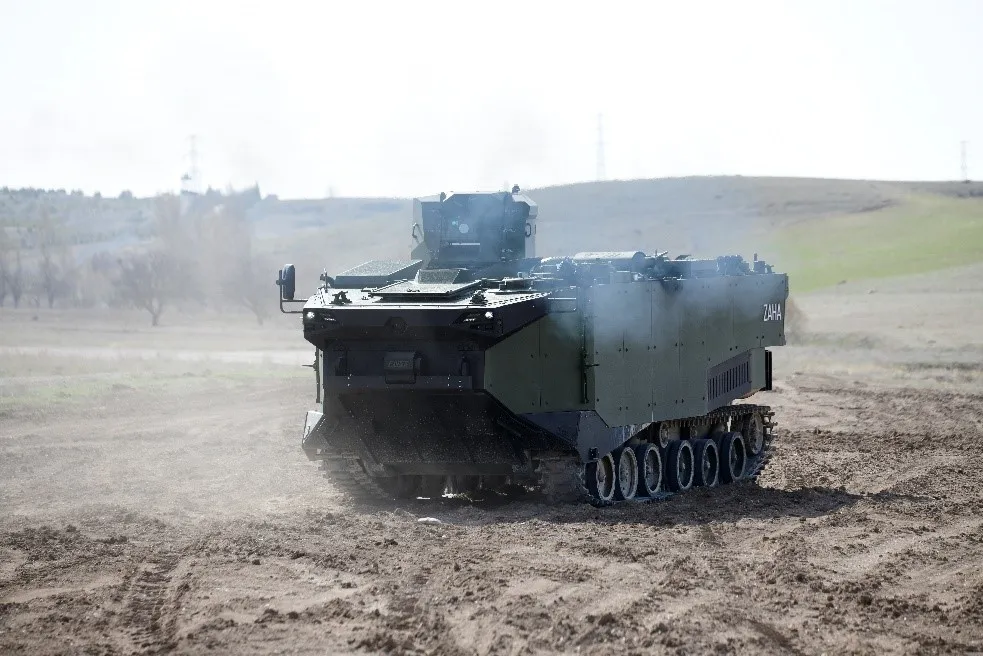
The ZAHA is the armoured amphibious assault vehicle that FNSS built for the Turkish Naval Forces, designed to carry marines from a dock landing ship to the beach and on to objectives inland without stopping at the waterline. Under the programme run by Türkiye’s Presidency of Defence Industries (SSB), the first 27 vehicles are in service and a Phase-2 contract amendment for 27 more has been signed. For African navies that operate amphibious ships, it is one of very few modern, export-ready answers to an old and expensive problem.
Photo: Presidency of Defence Industries (SSB), Türkiye.
What is the ZAHA?
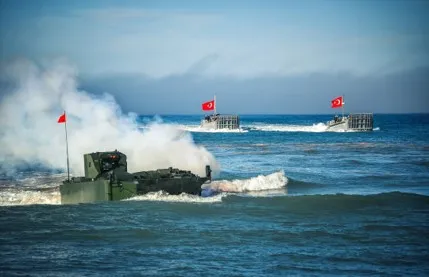
ZAHA stands for Zırhlı Amfibi Hücum Aracı, literally “armoured amphibious assault vehicle”. FNSS markets it internationally as the Marine Assault Vehicle (MAV). It is a tracked, fully enclosed armoured vehicle that swims under its own power, launched from the well deck of a landing ship, crossing several kilometres of open sea and climbing straight out of the surf onto the beach. Once ashore it behaves like any other armoured personnel carrier, which is the whole point: the marines inside do not have to transfer to another vehicle before moving inland.
That capability is rarer than it sounds. For decades the Western reference in this class was the US-built AAV7, a design that dates back to the early 1970s. Few countries build new amphibious tracked carriers, and Türkiye decided to design its own rather than buy second-hand or licence-build an ageing type. The result is a clean-sheet vehicle sized around the needs of the Turkish Navy’s amphibious marine infantry and the country’s new amphibious fleet, led by the landing helicopter dock TCG Anadolu.
In the water the ZAHA is propelled by two rear-mounted water jets, while the tracks take over as soon as it reaches the shore. Trade-press reporting describes the family as covering a personnel carrier, a command vehicle and a recovery vehicle on the same hull, so a landing force can bring its command post and its own recovery capability ashore in the same wave as its rifle squads.
Key specifications
| Manufacturer | FNSS Savunma Sistemleri (Ankara, Türkiye) |
| Type | Tracked armoured amphibious assault vehicle (Marine Assault Vehicle) |
| Turkish user | Turkish Naval Forces Command (amphibious marine units) |
| Procurement authority | Presidency of Defence Industries (SSB) |
| Engine power | 600 hp (SSB data) |
| Maximum speed (land) | 70 km/h (SSB data) |
| Trench crossing | 2 m |
| Vertical obstacle | 0.9 m |
| Capacity | 3 crew (driver, commander, gunner) + 18 embarked personnel |
| Water propulsion | Two water jets |
| Variants | Personnel carrier, command, recovery (reported) |
| Programme status (Sept 2026) | 27 Phase-1 vehicles; Phase-2 contract amendment for 27 more signed, kick-off meeting held |
The SSB figures tell a clear story about the design priorities. Carrying 18 marines plus a three-person crew puts the ZAHA in the same troop class as the vehicles it is meant to replace, so a landing force does not lose rifle strength per hull. A 600 hp power pack gives the margin needed both to drive the water jets and to haul a heavy armoured hull up a soft beach, and the 70 km/h road speed means the vehicle can keep pace with land-based armour once the force is ashore. Crossing a 2 m trench and a 0.9 m step are the kind of numbers you want when the first obstacles after the surf line are sea walls, ditches and dune banks rather than tidy roads.
The SSB programme and Turkish service
The ZAHA belongs to a wider effort by Türkiye to build a complete, domestically sourced amphibious capability. SSB’s stated aim for the project is simple and demanding: to let troops embarked on a dock landing ship move safely to the shore and to targets on land even in difficult sea conditions. FNSS was selected in 2017 to supply the vehicles for the Navy’s new landing helicopter dock programme, and deliveries of the first production vehicles to the Turkish Naval Forces began in March 2023.
SSB’s management of the programme deserves credit. Rather than treating the amphibious vehicle as an afterthought to the ship, the Presidency ran it as a parallel development, so that hull, vehicle and doctrine matured together. The first phase covered 27 vehicles. According to SSB’s September 2026 status, the contract amendment for the Phase-2 procurement of an additional 27 armoured amphibious vehicles has been signed and the project kick-off meeting has been held, which will double the fleet to 54. Turkish trade press reporting at the EFES 2026 exercise also pointed to more ZAHAs entering the Navy’s amphibious formations.
The vehicle has since become a regular part of Turkish amphibious training, operating alongside TCG Anadolu, the Navy’s landing ships and, increasingly, unmanned systems. In August 2026 FNSS showed an unmanned derivative, the İ-ZAHA, at TEKNOFEST, intended to operate in a manned-unmanned team with crewed vehicles, scouting a beach or carrying supplies before the first marines land. It is a sign that the ZAHA is being treated as the core of a family rather than a one-off purchase.
Who operates the ZAHA?
The confirmed operator today is the Turkish Naval Forces Command, which uses the ZAHA with its amphibious marine units. No foreign customer has been officially announced, and DefenceMENA does not list any country as an operator on the basis of interest alone.
Export interest is real, however. In Indonesia, the state-owned PT Pindad signed a memorandum of understanding with FNSS in 2022 covering potential local production of the ZAHA, and FNSS has been offering the vehicle against the Indonesian Navy’s requirement for new amphibious armoured vehicles for its Marine Corps. FNSS and Pindad already work together on the KAPLAN MT medium tank (Harimau), which gives that relationship a track record. European trade press covering IDEF 2025 reported that FNSS saw Indonesia and Qatar as the most likely early customers, with interest also coming from the Gulf and the wider Middle East, and quoted the company as saying export negotiations were under way. These are reported prospects, not contracts.
For buyers, the more important point may be that FNSS is already an experienced exporter. Its PARS 8×8 family serves in Malaysia (as the AV8 Gempita, co-produced with DefTech) and Oman (as the PARS III), and its KAPLAN family is in Indonesian service. A navy that buys the ZAHA would be dealing with a company used to technology transfer and in-country production.
Can the ZAHA go to Africa?
Africa is not a large market for amphibious assault vehicles, but it is a real one, and it is growing as more navies acquire ships with well decks or stern ramps. The question for any African navy is less “do we need a beach assault capability?” than “what will we put in the well deck of the ship we already own?” On that question the ZAHA is a strong fit.
Egypt is the obvious first candidate. The Egyptian Navy operates two Mistral-class landing helicopter docks, Gamal Abdel Nasser and Anwar El Sadat, the largest amphibious ships on the continent, and a marine force that trains regularly for amphibious operations. Its tracked amphibious fleet is ageing. With Turkish-Egyptian defence ties now warming, including joint naval activity in 2026, a ZAHA offer would fit naturally into that relationship. Algeria is the second: its navy’s Kalaat Béni Abbès is a large landing platform dock with a well deck, and Algeria has shown it is willing to buy modern, capable naval equipment. In both cases the ZAHA would be a like-for-like answer to the vehicle the ship was designed to carry.
Further down the list, Morocco has been modernising its navy and its marine infantry, and an amphibious lift component is a logical next step for a country with two long coastlines. Nigeria has invested in landing ships and coastal security in the Gulf of Guinea, where riverine and littoral operations are part of daily business; a small number of armoured amphibious vehicles would give its marines and special boat units a protected way across beaches and creek mouths. On the east coast, navies facing piracy and coastal insurgency, from the Horn of Africa down to Mozambique, have similar if smaller needs.
There are three practical arguments for the Turkish option. First, it is new: buyers get a current design with a long life ahead, rather than refurbished vehicles from a type nearing retirement. Second, FNSS has shown, in Malaysia and Indonesia, that it will set up local assembly and share work with national industry, which matters to governments that want jobs and skills, not just equipment. Third, Türkiye is already a familiar supplier across Africa, with Turkish armoured vehicles, drones and naval vessels in service with many armed forces, and an established pattern of training and support. A ZAHA sale would build on that footprint rather than starting from scratch.
The realistic constraint is fleet size. Most African navies would buy in single-digit or low double-digit numbers, so the most likely route is a package deal linked to a ship purchase or a broader naval cooperation agreement, possibly including the command and recovery variants so that a small force is self-sufficient on the beach.
How it compares
The ZAHA’s natural comparisons are the AAV7 family, still the most widespread vehicle of its type, and the Chinese ZBD-05/ZTD-05 series. Against the AAV7, the Turkish vehicle offers a modern design and a similar troop load in a vehicle built around today’s protection and electronics standards. Against the Chinese vehicles, which are designed around high-speed planing hulls, the ZAHA follows a more conventional and supportable layout. For most buyers, the decisive factors will be price, local industrial participation and the support package, areas where FNSS and SSB have a strong export record.
FAQ
What does ZAHA stand for?
ZAHA is the Turkish acronym for Zırhlı Amfibi Hücum Aracı, meaning armoured amphibious assault vehicle. FNSS also markets it as the Marine Assault Vehicle (MAV).
How many ZAHA vehicles has Türkiye ordered?
SSB’s first phase covered 27 vehicles for the Turkish Naval Forces. A Phase-2 contract amendment for 27 more has been signed, which will bring the fleet to 54 vehicles.
How many troops can the ZAHA carry?
According to SSB data, the ZAHA has a crew of three (driver, commander and gunner) and carries 18 additional personnel.
Has the ZAHA been exported?
No export contract has been officially announced. PT Pindad of Indonesia signed a memorandum of understanding with FNSS on possible local production, and trade press has reported interest from Indonesia, Qatar and the Gulf.
Which African navies could use the ZAHA?
The most natural candidates are navies that already operate ships with well decks, such as Egypt with its two Mistral-class landing helicopter docks and Algeria with the Kalaat Béni Abbès. Morocco and Nigeria are further potential markets as their amphibious capabilities grow.
Related: FNSS company profile · Türkiye-Egypt defence agreements timeline · Turkish systems in African service