Proforce: Inside Nigeria’s Private Armoured Vehicle Maker



Proforce Limited, a private Nigerian armoured-vehicle manufacturer based in Lagos and Ogun State, has grown from a single MRAP design in 2016 into a six-vehicle product line used by Nigeria’s own armed forces and exported to Chad, Rwanda, the Central African Republic and South Sudan. Data as of November 2026.
DEFENCE AFRICA | Company profile and product gallery | Data as of November 2026
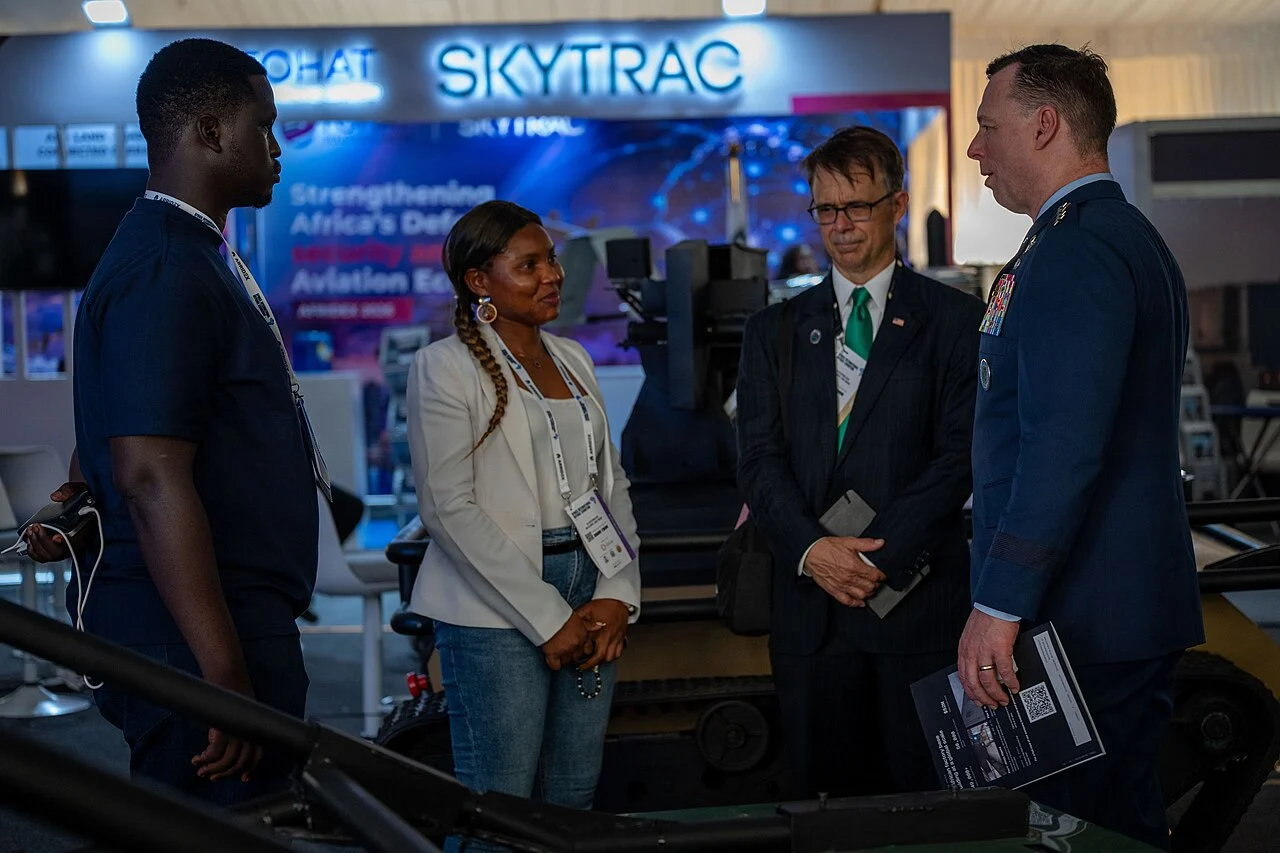
Photo: US Africa Command and Nigerian defence officials tour the AFRIDEX 2026 exhibition floor in Lagos, where Nigerian manufacturers including Proforce displayed vehicles. Credit: U.S. Army photo by Sgt. 1st Class Kenneth Tucceri, public domain, via Wikimedia Commons
Proforce Limited was incorporated in 2008 as a subsidiary of O’la-Kleen Holdings Limited, and is headquartered in Victoria Island, Lagos, with its main manufacturing complex at Ode-Remo in Ogun State and a second plant in Port Harcourt, according to Nairametrics and defenceWeb. The Ode-Remo facility is reported to have capacity for roughly 20 Ara-series mine-resistant ambush-protected (MRAP) vehicles and 40 PF2 armoured personnel carriers (APCs) a month. In 2021 the Nigerian Army’s investment arm acquired a 15 percent equity stake in the company, according to Military Africa, tying the manufacturer formally to its largest domestic customer.
The company presents itself as Nigeria’s first indigenous armoured-vehicle manufacturing operation, building on local welding, fabrication and automotive-assembly capacity rather than importing complete vehicles. Its product range has expanded steadily from the original Ara MRAP, first delivered to the Nigerian Army in 2016, to a family that now spans heavy MRAPs, a wheeled APC, a lightweight special-operations vehicle and a personnel carrier introduced in 2024. Beyond the Nigerian armed forces, Chad, Rwanda, the Central African Republic and South Sudan are confirmed operators of at least one Proforce type, and the company proposed a local assembly plant in Bangui after a November 2026 meeting with Central African Republic President Faustin-Archange Touadéra.
Key facts
- Incorporated 2008 as a subsidiary of O’la-Kleen Holdings Limited; HQ in Lagos (Nairametrics, 2025)
- Main plant at Ode-Remo, Ogun State, reported capacity of about 20 Ara and 40 PF2 vehicles per month; second plant in Port Harcourt (defenceWeb, 2026)
- Nigerian Army investment arm holds a 15 percent equity stake, acquired in 2021 (Military Africa, 2021)
- First Ara MRAP delivered to the Nigerian Army in 2016 (Army Recognition, 2016)
- Confirmed export operators: Chad (Ara 2 MRAP, ordered 2019 and 2022), Rwanda, Central African Republic and South Sudan (PF2 APC, via defenceWeb)
- Bangui assembly plant: reportedly under negotiation as of November 2026, no contract or investment figure announced
1. PF Ara 2 “Thunder” MRAP — the flagship, and Proforce’s main export
The Ara is Proforce’s heaviest mine-resistant ambush-protected vehicle and its longest-serving design. The original Ara was delivered to the Nigerian Army in 2016 and inducted in batches through 2019, according to Army Recognition. The improved Ara 2 carries up to twelve personnel including crew and is built to STANAG 4569-based protection standards, per manufacturer-cited specifications reported by Army Recognition. Operational with the Nigerian Army since 2016. Chad became the type’s first export customer, ordering 20 Ara 2 vehicles in June 2019 and a further batch of 20 in April 2022, according to Military Africa and Army Recognition; some other outlets have reported a cumulative order of around 100 vehicles, so published figures vary and both counts are given here with their sources. Chad’s purchase followed the collapse of a separate 2017 armoured-vehicle order with South Africa’s Denel, per Military Africa. The Ara’s listed powertrain includes an Allison six-speed automatic gearbox and a reported top speed of 96 km/h on a 200-litre fuel tank, though these figures come from secondary defence-industry listings rather than a Proforce datasheet and should be read as indicative.
2. PF2 armoured personnel carrier — the vehicle that travels furthest from home
The PF2 is Proforce’s wheeled APC and its most widely exported type outside Nigeria. According to defenceWeb, the PF2 has been exported to Rwanda, the Central African Republic and South Sudan, including use on United Nations peacekeeping deployments in the latter two countries. Operational with the Nigerian armed forces and with the three listed export operators. The Ode-Remo plant’s reported production capacity of around 40 PF2 units a month, if sustained, would make it one of the higher-throughput armoured-vehicle lines in West Africa, though DefenceMENA could not independently verify utilisation against that stated capacity. The PF2’s regional spread through UN peacekeeping channels gives Proforce combat-area exposure and field-maintenance experience that few other African private manufacturers can claim at the same vehicle count.
3. PF Viper — the lighter MRAP for infantry patrol work
The Viper is a smaller mine-protected vehicle than the Ara, designed to carry around nine personnel including driver and commander, according to a specification reported by Janes. It was publicly unveiled on 6 December 2021 at the Nigerian Chief of Army Staff Conference in Abuja and commissioned into Nigerian Army service shortly afterward. Operational with the Nigerian Army since December 2021. The Viper fills the gap between Proforce’s heavier Ara MRAP and lighter tactical vehicles, intended for routine patrol and quick-reaction tasks in the counter-insurgency and anti-banditry operations that dominate Nigerian Army deployments in the northeast and northwest.
4. PF Fury — a lightweight platform for special operations
The Fury is Proforce’s smaller tactical vehicle, shown publicly in July 2022 and positioned for infantry and special-operations roles rather than front-line MRAP duties, according to The Defense Post. Operational in limited numbers with Nigerian security forces; DefenceMENA found no verified unit count or export order for the Fury as of November 2026. It extends Proforce’s range downward from armoured troop transport into faster, lighter mobility, a category where Nigerian forces have otherwise relied on imported platforms such as Toyota-based technicals and Turkish Katmerciler and Nurol designs.
5. PF Hulk — the newest addition, and a disputed lineage
Introduced in 2024, the Hulk is Proforce’s most recent armoured personnel carrier, intended for troop and equipment transport. Military Africa reported that the design closely resembles Russia’s AMN-590951 Spartak armoured vehicle, without confirming whether it is licensed production, a locally re-engineered variant, or an independent design drawing on the same configuration; DefenceMENA could not independently verify which. The Nigerian Army acquired five Hulk vehicles, according to a December 2024 Military Africa report. Ordered and in limited Nigerian Army service as of the most recent public reporting. Whatever its design origin, the Hulk shows Proforce adding a fifth distinct vehicle class in under a decade, a pace of model turnover that matches, and in some years exceeds, government-owned DICON’s publicly announced output.
6. Bangui assembly plant — the next export market, still on paper
Proforce proposed a defence manufacturing and assembly facility in Bangui after its group managing director met Central African Republic President Faustin-Archange Touadéra on 2 November 2026, the company said in a statement reported by Military Africa. Reportedly under negotiation: no agreement, investment figure, timeline or product line has been announced, and the Central African government has issued no public readout of its own. The proposal builds on Proforce’s existing PF2 exports to CAR and follows a 27 October 2026 visit to the Ode-Remo complex by Nigeria’s Chief of Army Staff, Lt. Gen. Waidi Shaibu, who said the army would deepen its patronage of local manufacturers. If it proceeds, Bangui would become Proforce’s first overseas assembly site, placing it alongside a small group of African manufacturers — South Africa’s Paramount Group and Denel among them — that have set up production outside their home country rather than exporting only finished vehicles.
Why it matters for Africa
Proforce sits inside a wider pattern DefenceMENA has tracked across Nigeria’s push into local defence production: a private manufacturer growing alongside, rather than instead of, state-owned DICON, with the Nigerian Army itself taking an equity stake to secure supply. For African militaries facing tight procurement budgets, a domestic manufacturer offering MRAPs and APCs at a fraction of the cost of imported Western or South African equivalents, with spare parts and repairs available on the continent, addresses the affordability and sustainment problems that have driven several of Nigeria’s neighbours toward Chinese and Turkish suppliers instead. Proforce’s export pattern, mainly to Chad, Rwanda, the Central African Republic and South Sudan, also tracks closely with countries fighting insurgencies or deploying to UN peacekeeping missions, where vehicle cost and local serviceability often outweigh top-end protection specifications. The unresolved question is whether Proforce’s rapid model turnover, five distinct vehicle types in under a decade, reflects design maturity or a company still iterating toward a stable product line; the Hulk’s disputed lineage adds to that uncertainty. The proposed Bangui plant, if it is signed, would be a meaningful step beyond export sales toward the technology transfer and local assembly that African defence ministries increasingly ask of foreign and regional suppliers alike.
Sources
- Nairametrics, “Meet the owners of Nigeria’s indigenous automobile assembly companies,” 2025
- defenceWeb, Proforce coverage archive
- Army Recognition, “Proforce from Nigeria delivers Ara MRAP armored vehicles to Chad army,” 2022
- Military Africa, “Chad orders additional Ara MRAP,” April 2022
- Janes, “Proforce Viper armoured vehicle breaks cover,” 2021
- The Defense Post, “Nigerian Firm Unveils New Combat Vehicle,” July 2022
- Military Africa, “Nigerian Army buys Hulk armoured vehicles from Proforce,” December 2024
- DefenceMENA, “Nigeria’s Proforce Proposes Defence Assembly Plant in Central African Republic After Touadéra Meeting,” November 2026
- DefenceMENA, “Nigeria Pledges Local Tanks, APCs and Drones Within a Year as It Opens AFRIDEX 2026”