Nigeria has formally asked the Czech Republic to help its state arms maker build a domestic ammunition production line, as the two countries also explore cooperation on light attack jets, transport aircraft and drone technology.
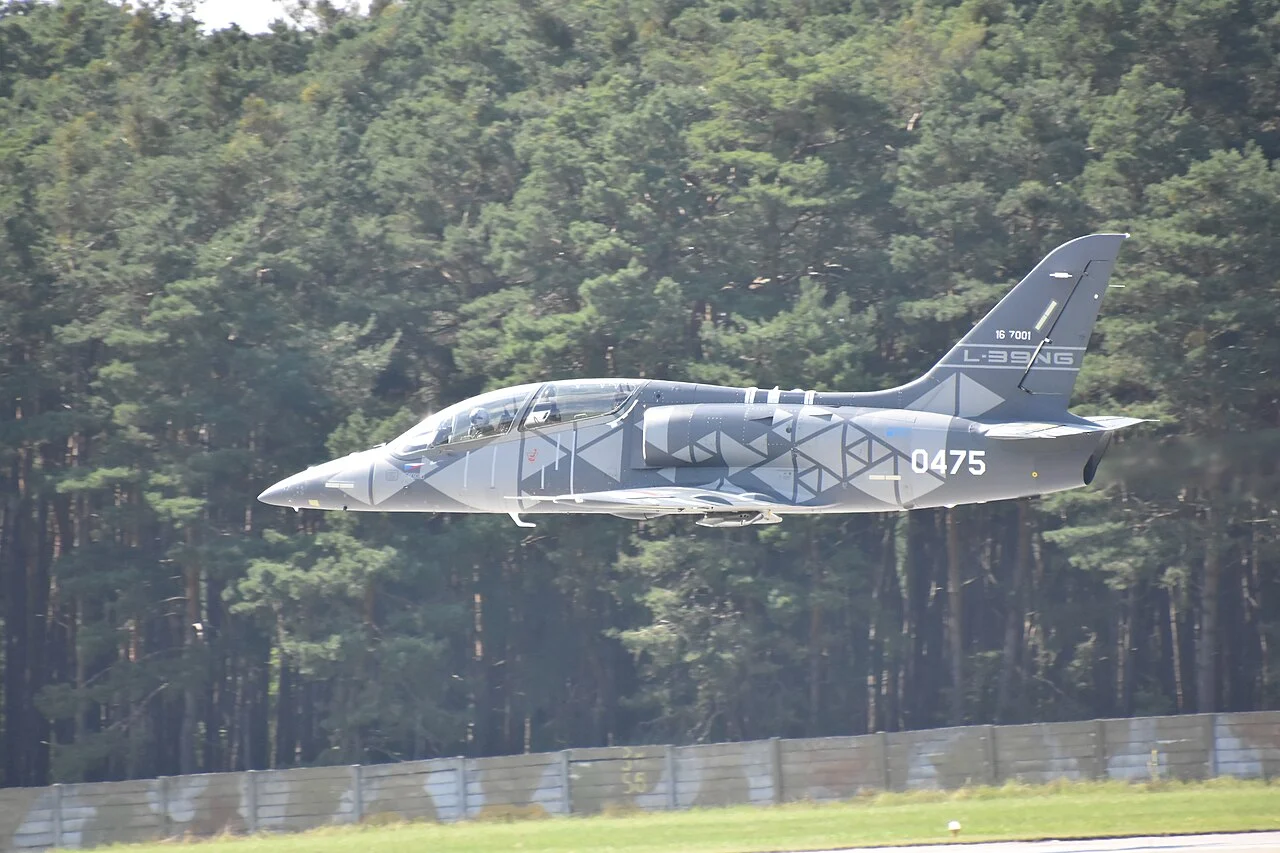
Photo: The Aero Vodochody L-39NG, marketed as the Skyfox, is among the systems Nigeria inspected during the visit. Credit: Admiralis-generalis-Aladeen, CC BY-SA 4.0, via Wikimedia Commons
Nigeria’s Minister of State for Defence, Bello Muhammed Matawalle, raised the request during a three-day visit to Ostrava on 19-20 September, where he met Czech Deputy Prime Minister and Defence Minister Lt. Gen. (Rtd.) Jaromír Zuna on the margins of the Czech Air Force Days air show. According to a statement from the Ministry of Defence issued by Chief Information Officer Queeneth Iheoma-Hart, Matawalle asked Zuna for Czech support in establishing an ammunition line with the Defence Industries Corporation of Nigeria (DICON), and Zuna said the Czech Republic was prepared to help and to facilitate transfer of the relevant manufacturing technology.
UAVs and aircraft also on the table
The two ministers also discussed technology transfer for unmanned aerial vehicles, an area where DICON has limited in-house capability, as Nigeria pushes to expand drone production alongside its ammunition goals. Matawalle’s delegation, which included officials from the ministry, DICON and the National Agency for Science and Engineering Infrastructure (NASENI), inspected the Aero Vodochody L-39NG — now marketed internationally as the Skyfox — and the Aircraft Industries L-410NG twin-turboprop, as well as small-arms, ammunition and tactical-communications displays from Colt CZ Group and MESIT, according to Voice of Nigeria.
Matawalle separately met Czech Chief of General Staff Lt. Gen. Miroslav Hlaváč, Land Forces Commander Maj. Gen. Josef Trojánek and Air Force Commander Brig. Gen. Petr Tománek to discuss training, maintenance support and access to more advanced systems. No procurement agreement emerged from the meetings; the talks remain at the stage of discussion and technical exploration rather than a signed contract.
Nigeria’s existing Czech-built fleet
The request builds on a long-standing relationship between the Nigerian Air Force and Czech industry. Nigeria has operated Czech-built L-39 Albatross jets since the 1980s, and Aero Vodochody reactivated three L-39ZA aircraft in-country in 2019, with two more receiving life-extension work in 2020 at the 403 Flying Training School in Kano. In November 2024, the Air Force disclosed Aero proposals covering reactivation, upgrades and possible acquisition of the L-39 Skyfox as a subsonic jet trainer and light-attack aircraft, and a Czech delegation including Aero Vodochody visited Abuja in December 2025 to discuss the L-39 fleet, the L-410NG, surveillance needs, border-security UAVs and training.
DICON’s ammunition ambitions
DICON, a state-owned arms manufacturer established in 1964 that spent long periods underused, was given broader authority to regulate Nigeria’s defence-industrial sector and seek domestic and foreign partners under the 2023 DICON Act. It supplied around four million rounds to the Nigerian Army in January 2024, and by mid-2026 Matawalle had set a target of 300 million rounds a year. A DICON joint venture with D7G targets 60 million rounds annually and already assembles the licensed, AK-103-based DG-103 rifle, while DICON director-general Maj. Gen. Babatunde Ibrahim Alaya has said the corporation aims to add 30 million rounds of its own output and begin domestic gunpowder production under a separate memorandum of understanding with an international partner. Nigeria pursued a parallel joint-production push with Egypt in August 2026, underlining how central ammunition self-sufficiency has become to Abuja’s defence-industrial strategy.
Why it matters for Africa
Ammunition supply has become one of the clearest bottlenecks facing African militaries fighting sustained counter-insurgency and counter-banditry campaigns, from the Sahel to the Lake Chad Basin. Nigeria’s push to localise production — and to diversify its suppliers of ammunition technology beyond its traditional Chinese and Russian-linked channels — reflects a broader continental trend toward building domestic defence-industrial capacity rather than relying solely on imports. A Czech ammunition partnership would give Nigeria access to NATO-standard manufacturing know-how, while continued cooperation on the L-39 Skyfox and L-410NG would reinforce Nigeria’s existing Czech-sourced training and light-attack fleet at a time when the Nigerian Air Force is stretched across multiple internal security fronts. For Prague, deeper defence-industrial ties with Africa’s most populous country and one of its largest defence budgets would open a market with recurring demand for ammunition, spares and pilot training for years to come.
Sources
Related: How Nigeria Built Its Turkish-Chinese Drone Fleet | ASELSAN Seeks Local Manufacturing Partner in Nigeria | Why Nigeria Bought the JF-17 Thunder
See also DefenceMENA’s Nigeria desk and Nigeria military profile.