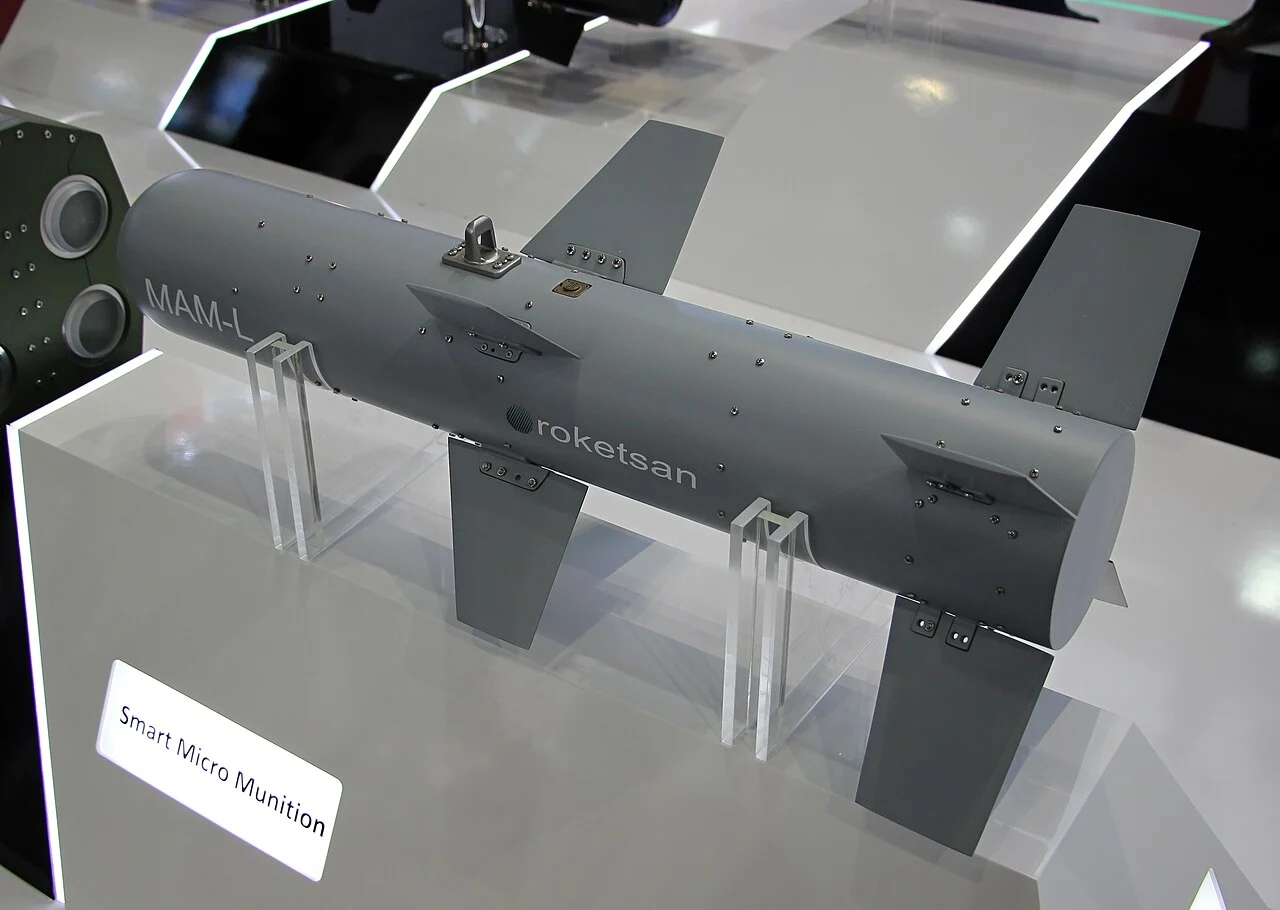
MAM-L, MAM-C and MAM-T are ROKETSAN’s family of lightweight, laser-guided “smart micro munitions,” built for release from unmanned aerial vehicles and light attack aircraft rather than from fast jets. MAM-C is the smallest at 6.5 kg with an 8 km range, MAM-L is the mid-size 22 kg version most associated with the Bayraktar TB2 and carries out to 15 km, and MAM-T is a larger, 95 kg, fixed-wing stand-off variant reaching 30 km or more. All three have been in Turkish service since the mid-2010s, and ROKETSAN introduced longer-range imaging-infrared versions of MAM-L and MAM-T at IDEF 2023. Confirmed combat use has been documented in Turkey, Azerbaijan and Ukraine; no African or Middle Eastern country has yet been publicly confirmed as a munition-specific customer.
Photo: ROKETSAN MAM-L Smart Micro Munition, IDET 2017, Brno. Credit: Karel Šubrt / Wikimedia Commons (CC BY-SA 4.0).
| Manufacturer | ROKETSAN |
| Official name | Mini Akıllı Mühimmat (MAM) — “Smart Micro Munition” |
| Family | MAM-C, MAM-L, MAM-T (baseline SAL variants); MAM-L IIR, MAM-T IIR, MAM-T Dual Seeker (unveiled IDEF 2023) |
| Role | Lightweight precision-guided air-to-surface munition for UAVs and light attack aircraft |
| Range | MAM-C 8 km; MAM-L 15 km (IIR variant >25 km); MAM-T 30–80 km (IIR variant >50 km) |
| Guidance | Semi-active laser (baseline); imaging infrared + RF datalink (IIR variants) |
| Status | Operational, Turkish Armed Forces, Gendarmerie General Command, General Directorate of Security |
| Documented foreign use | Azerbaijan (2020), Ukraine (since 2022) — platform-confirmed, munition-identified |
| Primary platforms | Bayraktar TB2, ANKA; light attack aircraft |
What is the MAM family of munitions?
MAM stands for Mini Akıllı Mühimmat, Turkish for “smart micro munition.” ROKETSAN designed the family specifically for platforms that cannot carry conventional air-to-ground bombs: unmanned aerial vehicles and light attack aircraft with limited payload and hardpoint capacity. According to ROKETSAN’s own product pages, the munitions are intended to give these platforms “high strike precision and efficiency” against both fixed and moving targets while keeping warhead size proportional to the target, which the company and independent analysts have described as useful for limiting collateral effects compared with larger guided bombs.
The family sits inside ROKETSAN’s Precision Guided Systems product group, alongside related guidance kits (TEBER, LAÇİN, ELÇİN) that convert unguided bombs and rockets into precision weapons. MAM munitions are standalone rounds, not add-on kits, each combining its own airframe, guidance section and warhead.
How do MAM-C, MAM-L and MAM-T differ?
The three baseline variants share a common semi-active laser (SAL) seeker design but scale up in size, range and warhead options. Figures below are ROKETSAN’s published specifications.
| Specification | MAM-C | MAM-L | MAM-T |
|---|---|---|---|
| Diameter | 70 mm | 160 mm | 230 mm |
| Length | 970 mm | 1.0 m | 1.4 m |
| Weight | 6.5 kg | 22 kg | 95 kg |
| Range | 8 km | 15 km | 30 km or more (UAV launch) |
| Guidance | Semi-active laser seeker | Semi-active laser seeker | Semi-active laser seeker |
| Warhead | Multi-purpose (blast fragmentation, armour-piercing, incendiary); high-explosive blast fragmentation | Armour-piercing, high-explosive blast fragmentation, thermobaric | High-explosive blast fragmentation |
| Typical targets | Light armoured/unarmoured vehicles, personnel | Main battle tanks, light armoured vehicles, personnel | Fixed and mobile targets, critical aerial targets |
| Platforms | UAVs, light attack aircraft | UAVs, light attack aircraft | UAVs, light attack aircraft |
MAM-C is the lightest round, intended for small UAVs where every kilogram of payload matters. MAM-L is the munition most often associated with the Bayraktar TB2 and is available with an armour-piercing or thermobaric warhead in addition to the standard blast-fragmentation type. MAM-T is a fixed-wing, longer-range munition for stand-off strikes and, per ROKETSAN’s listing, is also pitched against “critical aerial targets.”
What changed with the IIR variants shown at IDEF 2023?
At the IDEF 2023 exhibition in Istanbul (25–28 July 2023), ROKETSAN publicly displayed new imaging-infrared (IIR) variants for the first time: MAM-L IIR, MAM-T IIR and a MAM-T Dual Seeker (MAM-T DS), according to Janes’ reporting from the show floor. The IIR seeker replaces the semi-active laser seeker with an imaging infrared seeker and radio-frequency datalink, which extends launch range because the munition no longer needs continuous laser illumination from the launch platform.
| Variant | Seeker | Weight | Range |
|---|---|---|---|
| MAM-L IIR | Imaging infrared + RF datalink | ~23 kg | In excess of 25 km |
| MAM-T IIR | Imaging infrared, improved wing kit | ~100 kg | In excess of 50 km |
| MAM-T Dual Seeker (DS) | Dual-mode seeker | Not disclosed | Not disclosed |
As of this writing, ROKETSAN’s own product pages for MAM-L and MAM-T still describe the baseline semi-active-laser specifications; the IIR and Dual Seeker variants are documented through show reporting rather than the main public catalogue, and their production and export status has not been separately disclosed.
Which platforms carry MAM munitions?
MAM-C, MAM-L and MAM-T are all listed by ROKETSAN as compatible with UAVs and light attack aircraft. In Turkish service this means principally the Baykar Bayraktar TB2 and the TUSAŞ ANKA, both of which are built with MAM-compatible hardpoints and laser designation. Defence Turkey reporting on MAM-L also lists the Turkish Armed Forces, Gendarmerie General Command and General Directorate of Security as domestic users, reflecting the munition’s use beyond the regular military in internal security and counter-terrorism operations. ROKETSAN markets the family as suited to any UAV or light aircraft with a compatible rail and laser designator, not solely Baykar platforms.
Where has MAM-series use been confirmed?
DefenceMENA applies an evidence-based operator taxonomy (RUMOURED through RETIRED) and requires munition-specific evidence, not just the presence of a MAM-compatible drone, before listing a country as a MAM operator. On that basis:
| Country | Status | Context | Source |
|---|---|---|---|
| Türkiye | OPERATIONAL | Domestic development and service since the mid-2010s; used by the Turkish Armed Forces, Gendarmerie General Command and General Directorate of Security | ROKETSAN; Defence Turkey, 2021 (updated 2026) |
| Azerbaijan | OPERATIONAL | MAM-L strikes from Bayraktar TB2s documented during the Second Nagorno-Karabakh War, September–November 2020 | CSIS, “The Air and Missile War in Nagorno-Karabakh”; Euro-Sd |
| Ukraine | OPERATIONAL | MAM-L strikes from Ukrainian Navy and Armed Forces TB2s documented from 2022 onward, including a dated May 2022 strike on landing craft | Naval News; Army Recognition |
No African or Middle Eastern government has been publicly confirmed, by name, as a purchaser of MAM-series munitions specifically. Several African and Gulf states operate Bayraktar TB2 or AKINCI aircraft that are MAM-compatible, which DefenceMENA covers separately — see Which African Countries Operate the Bayraktar AKINCI? — but owning the aircraft does not, by itself, establish which munition it carries. DefenceMENA will update this page, and the planned ROKETSAN Africa and Middle East hubs, if and when product-level evidence for a specific country becomes public.
What do MAM munitions cost, and what has been publicly disclosed about contracts?
ROKETSAN and the Presidency of Defence Industries (SSB) have not published a per-unit price for MAM-C, MAM-L or MAM-T. Third-party commentary sometimes cites low per-round costs relative to larger Western precision munitions, but DefenceMENA has found no primary government or manufacturer source disclosing a unit price, and does not publish an estimate. Where MAM munitions are supplied as part of a wider UAV export package (aircraft, ground control stations, munitions, training and support), public reporting generally discloses only the total package value, which cannot be divided to infer a missile price.
How does the MAM family compare with other UAV-launched precision munitions?
MAM-L’s closest public comparators are other lightweight, UAV-launched guided munitions developed for the same mission: close air support and precision strike from platforms too small for conventional guided bombs. A full dedicated comparison is in DefenceMENA’s editorial queue; the brief comparison below uses only publicly disclosed baseline figures, same mission class, same criteria.
| System | Origin | Weight | Range | Typical launch platform |
|---|---|---|---|---|
| MAM-L | Türkiye (ROKETSAN) | 22 kg | 15 km | Bayraktar TB2, ANKA |
| AR-1 / BA-7 | China (CASC / CH-4 family) | Approx. 45 kg (AR-1) | Approx. 8–10 km (laser-guided) | CH-4, Wing Loong |
| GBU-69/B SGM | United States (Dynetics/Leidos) | Approx. 27 kg | Not publicly specified as UAV-launch figure | MQ-9 Reaper |
ROKETSAN’s publicly documented combat record — Azerbaijan 2020 and Ukraine 2022 onward — is more extensively reported in open sources than for either comparator above, though this reflects documentation and conflict exposure rather than a verified performance ranking.
Readers wanting a Turkish-language technical breakdown of MAM-L’s design can also see Envanter Medya’s explainer on MAM-L (Turkish).
How does MAM fit into ROKETSAN’s wider product range?
MAM-C, MAM-L and MAM-T are ROKETSAN’s lightest precision-guided munitions. For longer-range naval strike, see ROKETSAN’s ATMACA anti-ship missile; for the company’s full portfolio across land, naval, air defence and precision-guided systems, see DefenceMENA’s ROKETSAN company hub. ROKETSAN’s anti-tank-specific guided weapons (UMTAS, L-UMTAS, OMTAS, KARAOK) and drone-carried cruise missile (ÇAKIR) are covered in separate, dedicated pages as DefenceMENA continues to build out its ROKETSAN coverage.
Frequently asked questions
What does MAM stand for?
MAM is short for Mini Akıllı Mühimmat, Turkish for “smart micro munition.” It is ROKETSAN’s family name for lightweight, precision-guided munitions built for UAVs and light attack aircraft.
What is the difference between MAM-L and MAM-C?
MAM-C is the smaller, lighter round (6.5 kg, 8 km range) intended for small UAVs, while MAM-L is larger (22 kg, 15 km range) with additional warhead options, including thermobaric, and is the variant most associated with the Bayraktar TB2.
What is MAM-T used for?
MAM-T is ROKETSAN’s largest and longest-range munition in the family (95 kg, 30 km or more from a UAV), a fixed-wing, stand-off weapon for longer-range precision strikes against fixed and mobile targets.
Has MAM-L been used in combat?
Yes. Open-source reporting documents MAM-L use by Azerbaijan’s Bayraktar TB2s during the 2020 Nagorno-Karabakh war and by Ukrainian forces from 2022 onward, in addition to its use by Turkish forces.
Do any African or Middle Eastern countries use MAM munitions?
No country in Africa or the Middle East has been publicly confirmed, with product-specific evidence, as a MAM munition customer as of October 2026. Several operate MAM-compatible drones, which is a separate question from confirmed munition purchases.
What does a MAM-L munition cost?
ROKETSAN and Turkish authorities have not publicly disclosed a per-unit price for MAM-L, MAM-C or MAM-T.
Sources
- ROKETSAN — MAM-L Smart Micro Munition product page (accessed 2 October 2026)
- ROKETSAN — MAM-C Smart Micro Munition product page (accessed 2 October 2026)
- ROKETSAN — MAM-T Munition product page (accessed 2 October 2026)
- Janes — “IDEF 2023: Roketsan grows smart micro munition family with new variants” (28 July 2023)
- Defence Turkey — “MAM-L Developed by Roketsan Ahead of Its Rivals with Technology and Combat Experience” (published 2021, updated 6 April 2026)
- CSIS — “The Air and Missile War in Nagorno-Karabakh: Lessons for the Future of Strike and Defense”
- Army Recognition — “Ukrainian Navy Uses Baykar TB2 Drone to Hit Moving Russian Landing Craft with MAM-L Munition”
- Naval News — “Watch Ukrainian TB2 Striking Two Russian Raptor Assault Boats”