The Kenya Army’s order of battle is a patchwork of eras and suppliers: British-built Vickers tanks bought before independence-era ties frayed, Cold War-era Soviet armour that survived a Somali pirate hijacking en route from Ukraine, and a wave of 2020s protected vehicles from the United States, South Africa and Türkiye bought for a counter-terrorism and anti-banditry campaign rather than conventional war. This is the 2026 system-by-system list of what the Kenya Army actually holds and who built it.
In short: Kenya’s army fields around 188 main battle tanks (78 British-built Vickers Mk3 and roughly 110 Soviet-design T-72s delivered via Ukraine), a wheeled fleet of several hundred armoured personnel carriers and mine-protected vehicles drawn from more than a dozen countries, and artillery led by Serbia’s Nora B-52 self-propelled howitzer. The three suppliers that dominate today’s inventory by vehicle count are the United States (M1117 and Humvee), South Africa (Puma M26-15 and Springbuck) and Türkiye (Hizir), all delivered or contracted since 2021 as Nairobi re-equips for internal security operations against al-Shabaab and northern banditry rather than for a tank battle. Kenya does not build its own armoured vehicles and has no domestic land-systems industry to speak of; every system on this page was imported, refurbished abroad, or assembled from foreign kits.
| Origin | Main systems | Share of listed inventory | Era |
|---|---|---|---|
| United States | M1117 Guardian APC, Humvee, M119 105mm howitzer | Roughly a quarter of the listed wheeled/tracked vehicle fleet by count, and growing fastest | 2024–2026, accelerated after Kenya’s 2024 “major non-NATO ally” designation |
| South Africa | Puma M26-15 protected patrol vehicle, Springbuck APC, Mamba Mk7 | Roughly a fifth of the listed vehicle fleet, the largest single wheeled-APC family (Puma) | 2000s Puma deliveries, Springbuck since around 2019–2020, renewed batches 2024–2025 |
| United Kingdom (legacy) | Vickers Mk3 MBT, Ferret and Saladin armoured cars, Bastion APC, L118 Light Gun | Kenya’s entire confirmed tank fleet plus a chunk of towed artillery and older reconnaissance vehicles | Pre- and post-independence purchases from the 1960s onward, still the backbone tank type |
| Türkiye | Hizir 4×4 armoured vehicle (Katmerciler) | A single 118-vehicle contract, one of the largest individual foreign vehicle orders in the Army’s recent history | Ordered January 2021, delivered over roughly two years |
| Soviet-origin / Russia (via Ukraine) | T-72/T-72AV MBT, BM-21 Grad MLRS | Roughly the other half of the tank fleet by count | 2008–2009 purchase, delayed by the MV Faina piracy incident |
| France | AML-60/90 armoured cars, Panhard M-3, Milan ATGM, Brandt 120mm mortars | A smaller but long-serving share of reconnaissance vehicles and anti-tank weapons | Cold War-era acquisitions, largely unreplaced |
Main battle tanks
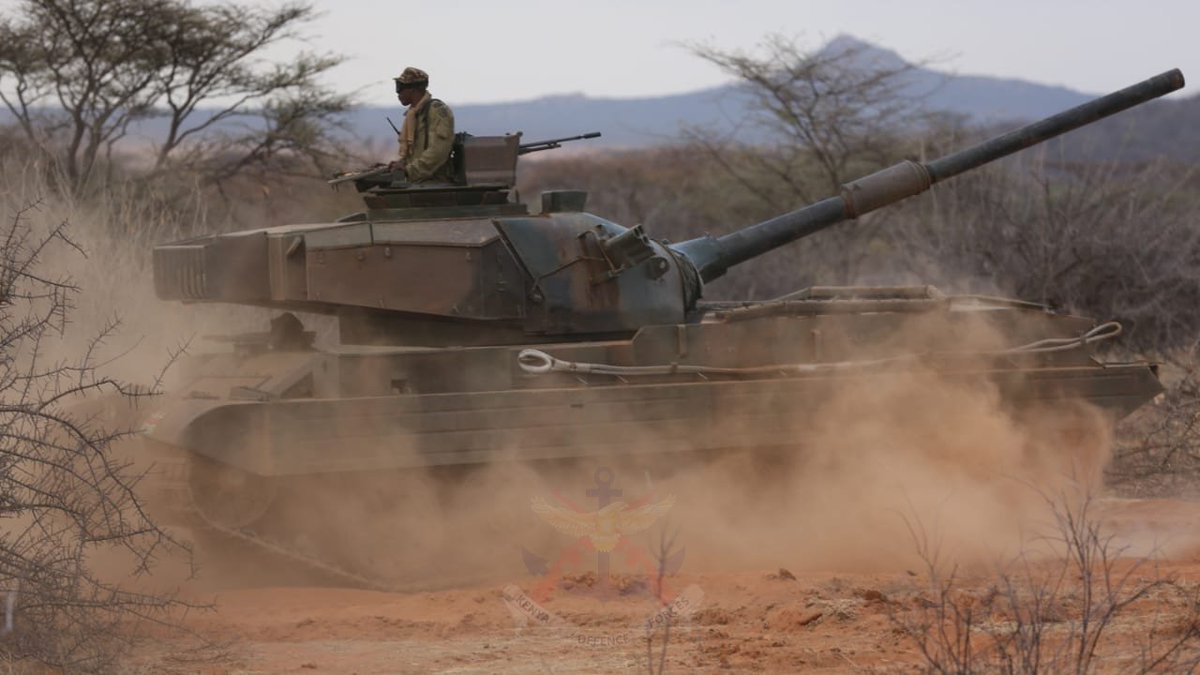
Kenya’s armoured brigade fields two tank families and has not added a third type in decades. The Vickers Mk3 is the confirmed, currently operational fleet; the T-72 is larger on paper but far less clearly accounted for, with much of the batch reportedly diverted or lost track of after a 2010 South Sudan-related controversy.
| System | Origin (country + manufacturer) | Quantity | Status | Source |
|---|---|---|---|---|
| Vickers Mk3 | United Kingdom, Vickers Defence Systems | 78 | Operational | DefenceWeb (IISS Military Balance-style equipment list) |
| T-72 / T-72AV | Soviet-design, delivered via Ukraine (Ukrspetsexport) | Estimated ~110, of which 33 arrived aboard the hijacked MV Faina in 2008 | Estimated — status unclear; some open-source trackers report part of the batch diverted toward South Sudan around 2010 | DefenceWeb; Frontline Club (MV Faina reporting) |
The T-72 purchase is the most-reported acquisition in modern Kenyan military history for the wrong reason: in September 2008 the Ukrainian-flagged MV Faina, carrying 33 of the tanks along with ammunition and anti-aircraft guns bound for Mombasa, was hijacked by Somali pirates roughly 200 nautical miles off the coast and held for more than four months before its release. The US Navy at the time suggested the cargo’s real destination was Southern Sudan, in breach of a UN arms embargo, which Nairobi denied; Kenyan officials maintained the shipment was for its own forces. Whatever the origin dispute, the tanks that did reach Kenya add up with earlier deliveries to the roughly 110 T-72s now carried on Western equipment trackers — a total DefenceMENA treats as Estimated, since neither the Ministry of Defence nor IISS has published a precise current figure.
Reconnaissance and light armoured vehicles
| System | Origin (country + manufacturer) | Quantity | Status | Source |
|---|---|---|---|---|
| AML-60 / AML-90 armoured car | France, Panhard | 72 | Operational (fleet age unconfirmed) | DefenceWeb |
| Ferret scout car | United Kingdom, Daimler | 12 | Estimated, legacy fleet | DefenceWeb |
| Shorland S52 / BOV M11 | United Kingdom, Short Brothers | 8 | Status unclear | DefenceWeb |
| Saladin armoured car | United Kingdom, Alvis | 3 | Status unclear, likely near-retirement | DefenceWeb |
| BRDM-3 scout car | Russia/Soviet-design, GAZ | 8 | Estimated | DefenceWeb |
| Lazar wheeled combat vehicle | Serbia, Yugoimport SDPR | 10 | Operational, recent addition | DefenceWeb |
Armoured personnel carriers and mine-resistant vehicles
This is where Kenya’s 2020s re-equipment shows most clearly. The Army has bought protected mobility from at least eight countries in the past five years, driven by counter-terrorism operations against al-Shabaab near the Somali border and an anti-banditry campaign in the north that Interior Cabinet Secretary Kithure Kindiki has tied to a roughly $236 million, five-year modernisation programme announced in 2024.
| System | Origin (country + manufacturer) | Quantity | Status | Source |
|---|---|---|---|---|
| Puma M26-15 protected patrol vehicle | South Africa, DCD Protected Mobility | ~150 | Operational, largest single wheeled-APC family in the fleet | DefenceWeb; IISS-referenced 2021 count of 105 for an earlier baseline |
| Hizir 4×4 armoured vehicle | Türkiye, Katmerciler | 118 (full order) | Delivered; ordered January 2021 worth an estimated $69 million, delivery completed over roughly two years | Military Africa; DefenceWeb; Army Recognition |
| M1117 Guardian armoured security vehicle | United States, Textron Marine & Land Systems (Cadillac Gage) | ~144, of a pledged ~150 | Delivered 2024–2025 from US Excess Defense Articles stocks, formally commissioned into service May 2026 | DefenceWeb; Africa Defense Forum |
| Humvee (various) | United States, AM General | ~100 | Operational | DefenceWeb |
| Springbuck SD armoured personnel carrier | South Africa, DCD Protected Mobility | 18+, delivered in small batches (8 commissioned March 2024, further units March 2025) | Operational; Kenya has fielded the type for at least five years | DefenceWeb |
| Mamba Mk7 | South Africa, OMC/TFM lineage | 22 | Operational | DefenceWeb |
| Type-92A / WZ-551 | China, Norinco | 32 (31 reported by IISS as of 2021) | Operational | DefenceWeb |
| Bastion APC | United Kingdom, NP Aerospace | 12 | Operational | DefenceWeb |
| UR-416 | Germany, Rheinmetall (Thyssen-Henschel lineage) | 38+ | Operational, legacy fleet | DefenceWeb |
| M-3 Panhard | France, Panhard | 8 | Likely in storage | DefenceWeb |
| Achleitner Survivor | Austria, Achleitner | 1 | Operational, evaluation-scale holding | DefenceWeb |
Artillery, rocket launchers and mortars
| System | Origin (country + manufacturer) | Quantity | Status | Source |
|---|---|---|---|---|
| Nora B-52 155mm self-propelled howitzer | Serbia, Yugoimport SDPR (KAMAZ/MAN 8×8 chassis) | Reported up to 18 | Operational, one of the newest and most capable systems in the fleet | Militarnyi; Army Recognition |
| L118 Light Gun 105mm towed | United Kingdom, Royal Ordnance/BAE Systems lineage | 40 | Operational, primary towed field gun | DefenceWeb |
| M119 105mm towed howitzer | United States (licensed L118 derivative), BAE Systems/Rock Island Arsenal | 6 | Operational | DefenceWeb |
| L5 105mm pack howitzer | Italy, OTO Melara | 8 | Estimated, legacy fleet | DefenceWeb |
| Model 56 105mm pack howitzer | Italy, OTO Melara | Quantity not disclosed | Status unclear | DefenceWeb |
| BM-21 Grad 122mm MLRS | Soviet-design/Russia | 11 | Operational | DefenceWeb |
| 81mm mortars | Various | 20+ | Operational | DefenceWeb |
| Brandt 120mm mortar | France, Hotchkiss-Brandt lineage | ~8 | Operational | DefenceWeb |
Anti-tank weapons
| System | Origin (country + manufacturer) | Quantity | Status | Source |
|---|---|---|---|---|
| Milan ATGM | France/Germany, MBDA (Euromissile lineage) | 40 launchers, reported cumulative missile stock around 400 | Operational | DefenceWeb |
| Swingfire ATGM | United Kingdom, BAC/Fairey lineage | Reported ~100 missiles, 8–14 launchers | Estimated, likely legacy/reserve given the system’s age | DefenceWeb |
| Carl Gustaf recoilless rifle | Sweden, Saab Bofors Dynamics | 56 | Operational | DefenceWeb |
Army-level air defence, aviation and small arms
Kenya’s Army-organic air defence is gun-based rather than missile-based: 20mm and 40mm cannon supplied by Israel, Switzerland and Sweden, plus a single Spyder short-range air-defence battery from Israel’s Rafael that has been on order rather than confirmed in service. The Army also runs its own aviation corps — separate from the Kenya Air Force — centred on MD-500 and MD-530F light helicopters and, since an October 2024 handover, Chinese-built Z-9 utility helicopters supplied under a cooperation agreement with CATIC that Kenya Army leadership has described as covering procurement, technology transfer and joint training. Reconnaissance is supplemented by ScanEagle and Raven small UAVs. Small arms are a mixed Cold War-to-current inventory built around Heckler & Koch G3 and FN FAL-pattern rifles with US M4/M16-family carbines increasingly issued to specialised units, summarised here as a single line rather than broken out system by system.
| System | Origin (country + manufacturer) | Quantity | Status | Source |
|---|---|---|---|---|
| TCM-20 20mm AA gun | Israel-modified (US M55 lineage) | 50–70 | Operational | DefenceWeb |
| L-70 40mm AA gun | Sweden, Bofors | 13 | Operational | DefenceWeb |
| Oerlikon AA gun | Switzerland, Oerlikon Contraves | 11 | Operational | DefenceWeb |
| Spyder SHORAD | Israel, Rafael | 1 battery | On order / reported, not confirmed operational | DefenceWeb |
| MD-500 / MD-530F light helicopter | United States, MD Helicopters | ~46 combined | Operational, Kenya Army Aviation Corps | DefenceWeb |
| Z-9 utility helicopter | China, CATIC/Harbin | Quantity not disclosed, first units handed over October 2024 | Delivered, refurbished airframes | Kenya Ministry of Defence |
| ScanEagle UAV | United States, Insitu/Boeing | 20 | Operational | DefenceWeb |
| RQ-11 Raven UAV | United States, AeroVironment | 8 | Operational | DefenceWeb |
How the arsenal was built
Kenya’s army was armed in four overlapping waves, none of them driven by a single dominant supplier the way Nigeria’s Chinese purchases or South Africa’s domestic industry have shaped those forces. The first wave was British: the Vickers Mk3 tank and a set of Cold War-era Panhard, Daimler, Alvis and Short Brothers armoured cars formed the original armoured brigade, reflecting Kenya’s continued defence ties to the United Kingdom after independence and the Sandhurst-trained officer corps that has led the force ever since.
The second wave was the 2008 Soviet-design purchase that became a diplomatic embarrassment before it became a capability. Kenya’s order for T-72 tanks from Ukraine ran into the MV Faina hijacking, four months of ransom negotiations, and a public dispute over whether the tanks were really bound for Nairobi or, as the US Navy suggested at the time, for Southern Sudan in violation of a UN arms embargo. The tanks eventually reached Kenya, but the episode is still the best-documented single arms transfer in the country’s history and left the T-72 fleet’s exact current size — and how much of it survived a reported diversion toward South Sudan around 2010 — genuinely unclear.
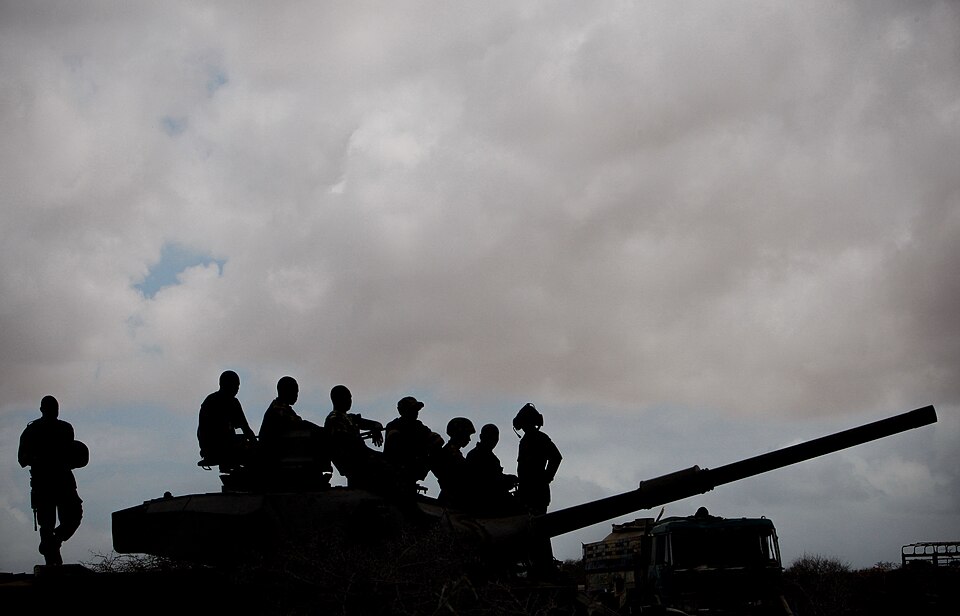
The third wave was regional: South African protected-mobility manufacturers, chiefly what is now DCD Protected Mobility, became Kenya’s default supplier for wheeled APCs from the 2000s onward with the Puma M26-15, later adding the Springbuck and Mamba Mk7. That relationship has deepened rather than faded — new Springbuck batches were commissioned in March 2024 and March 2025 — making South Africa Kenya’s most consistent wheeled-vehicle supplier of the past two decades, deployed heavily during Kenya’s long African Union Mission in Somalia (AMISOM, now the African Union Transition Mission, ATMIS/AUSSOM) campaign against al-Shabab, including the October 2012 assault on Kismayo pictured above.
The fourth and current wave, since roughly 2021, is the most internationally diverse: Türkiye’s Katmerciler won a 118-vehicle, $69 million Hizir contract in January 2021 after beating South African and North American competitors; the United States donated around 144 M1117 armoured security vehicles from its Excess Defense Articles programme between 2024 and 2025, formally commissioned in May 2026 with Massachusetts National Guard support under a State Partnership Programme; and China’s CATIC handed over refurbished Z-9 helicopters to Kenya Army Aviation in October 2024 under a cooperation deal covering procurement and technology transfer. All three arrived alongside a roughly $236 million, five-year Kenyan modernisation programme announced in mid-2024 that is funded for MRAPs, tactical vehicles, surveillance drones and protective equipment rather than heavy armour — consistent with a force built for counter-terrorism and internal security rather than conventional inter-state warfare.
| Date | Event | Value | Status |
|---|---|---|---|
| March 2025 | Further Springbuck SD armoured personnel carriers commissioned at GSU Headquarters, Ruaraka | Not disclosed | Delivered |
| Late 2024–mid 2025 | Bulk of the ~144 M1117 Guardian armoured security vehicles delivered from US Excess Defense Articles stocks | Vehicles donated, refurbishment/training support separately funded | Delivered |
| May 2026 | M1117 fleet formally commissioned into Kenya Army service at Kahawa Barracks, alongside Massachusetts National Guard maintenance partnership | Not disclosed | Operational |
| Ongoing since 2024 | ~$236 million, five-year Kenyan military modernisation programme funding MRAPs, tactical vehicles and surveillance drones | ~$45 million/year | On contract, phased |
Turkish systems in Kenya
The Hizir 4×4 is the one clearly established Turkish system in Kenya Army service: a January 2021 contract worth an estimated $69 million for 118 vehicles, won by Katmerciler against South African and North American rivals and delivered over roughly two years for counter-terrorism operations against al-Shabab. It remains Kenya’s largest single foreign armoured-vehicle contract by unit count outside the older Puma and T-72 fleets. DefenceMENA has found no evidence of Baykar drones, ASELSAN sensors or other Turkish systems in confirmed Kenya Army ground service beyond the Hizir contract; Bayraktar TB2 drones reported in Kenya belong to the Air Force, not the Army, and are covered separately.
How many tanks does Kenya have?
How many tanks does Kenya have in total?
Kenya’s confirmed and reported tank fleet totals around 188: 78 British-built Vickers Mk3 tanks that are the Army’s clearly operational fleet, plus an estimated 110 Soviet-design T-72s of disputed current status delivered via Ukraine from 2008 onward. Only the Vickers total is described in sourcing as reliably operational; the T-72 figure is Estimated.
How many T-72 tanks does Kenya have?
Open-source equipment trackers put the T-72/T-72AV fleet at roughly 110, though the figure is uncertain: 33 of the tanks arrived aboard the hijacked MV Faina in 2008 after a widely reported piracy incident, and some analysts believe part of the wider batch was later diverted toward South Sudan around 2010. Neither Kenya’s Ministry of Defence nor IISS has published a precise current figure, so this total is treated as Estimated.
How many armoured personnel carriers does Kenya have?
Counting every type on this page — Puma M26-15, Hizir, M1117, Humvee, Springbuck, Mamba Mk7, Type-92A/WZ-551, Bastion, UR-416 and smaller holdings — Kenya’s wheeled protected-vehicle fleet totals several hundred units across more than a dozen models from at least eight countries, the most internationally diverse APC inventory of any force DefenceMENA has profiled in this series so far.
What are the Kenya Army’s newest weapons?
The most recently delivered major systems are the ~144 US M1117 Guardian armoured security vehicles commissioned in May 2026, the 118 Turkish Hizir 4x4s delivered by 2023, and the Serbian Nora B-52 self-propelled howitzer, alongside Chinese Z-9 helicopters handed over to Army Aviation in October 2024.
Does Kenya have any domestic arms industry?
No. Unlike South Africa or, on a smaller scale, Nigeria, Kenya has no significant domestic land-systems manufacturer; every armoured vehicle, gun and missile system covered on this page was imported, donated or transferred from abroad, and the Army’s current modernisation drive is entirely procurement-led rather than industrial.
How Kenya compares
A full Kenya military strength profile is planned separately on DefenceMENA as this series continues, alongside a forthcoming Kenya Air Force aircraft inventory covering the F-5E/F Tiger II fleet and Bayraktar TB2 drones, and a Kenya Navy ships page. DefenceMENA’s existing military drones operated across Africa piece and Bayraktar TB2 operator list both cover Kenya’s Air Force UAV holdings in more depth than this Army-focused page.
A note on the numbers
Most of the unit-level figures on this page come from DefenceWeb’s Kenya country profile, which compiles IISS Military Balance-style equipment listings rather than official Ministry of Defence disclosures; these are marked Estimated where DefenceWeb itself flags status as unclear, particularly the T-72 fleet and several legacy reconnaissance types. The M1117 and recent Springbuck figures are better sourced, coming from named 2024–2026 news reporting with specific delivery and commissioning dates. Global Firepower is not cited on this page as a numeric source. This page was published on 28 September 2026 and will be updated as Kenya’s Ministry of Defence, IISS or credible open-source reporting provide more precise figures.
Sources
- DefenceWeb, Kenya (African Militaries equipment profile)
- DefenceWeb, Kenya Defence Forces
- Africa Defense Forum, Kenya Puts Armored Vehicles Into Service
- DefenceWeb, Kenya boosts armoured vehicle fleet with Springbuck and M1117 APCs
- Africa Defense Forum, Kenya Announces $236 Million Military Modernization Initiative
- Military Africa, Kenya orders 118 Katmerciler Hizir armoured vehicles from Turkey
- Defense News, Kenya orders 118 armored vehicles from Turkey
- Army Recognition, Katmerciler confirms contract to deliver 118 Hizir armored vehicles to Kenya
- Militarnyi, Kenyan military demonstrates Serbian Nora B52 self-propelled guns
- Frontline Club, Kenya, the Pirates and those Rather Embarrassing Tanks
- Kenya Ministry of Defence, Handover of Z9 Helicopter to Kenya Army Corps of Aviation