The United States and Morocco are building a permanent hub in the Moroccan desert to train African militaries on drones and test new counter-terrorism technology before it reaches the field. U.S. Africa Command and the Royal Moroccan Armed Forces signed a memorandum of understanding in July to establish the Africa Multidomain Training and Experimentation Center (AMTEC) at Tan-Tan, targeting full operational capability by 2030.
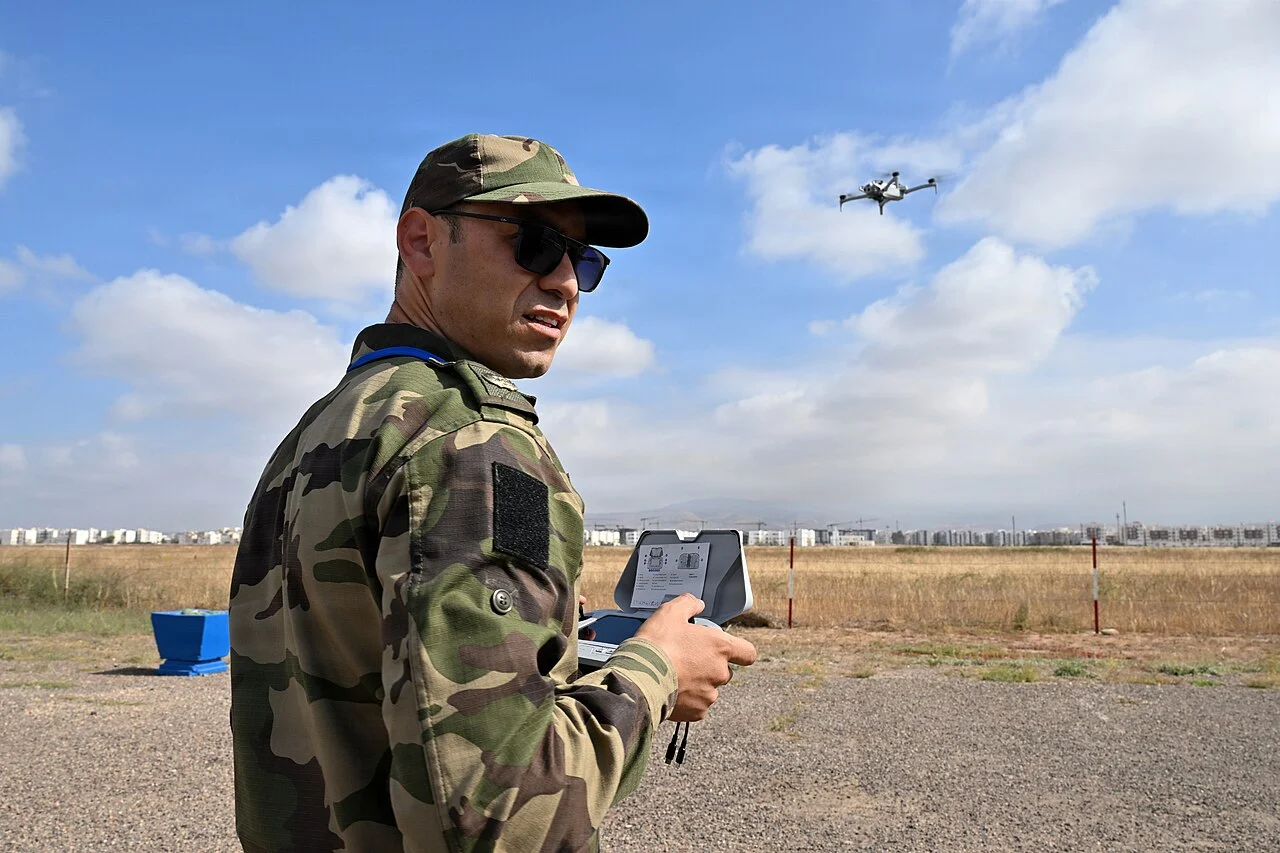
AFRICOM first floated the project publicly at the 13th African Land Forces Summit in Rome in March, and put the concept into practice weeks later with an inaugural drone-training module during Exercise African Lion 2026, the command’s largest annual exercise. Roughly 16 participants from Morocco, Nigeria and Ghana took part in the pilot course at Southern Zone Headquarters in Agadir, working on small unmanned aircraft integration, flight proficiency and mission planning. The July memorandum of understanding formalises that pilot into a standing institution.
Three components, one location
AMTEC is planned around three linked elements, all sited at Tan-Tan in southern Morocco, a training area already used for African Lion’s live-fire and special-operations serials at nearby Cap Draa: a multidomain training range for exercises spanning the electromagnetic spectrum and contested environments; a Drone Academy to train operators, planners and instructors from Morocco and partner African militaries in unmanned aircraft operations, including strike, intelligence, surveillance and reconnaissance missions; and an Innovation and Experimentation Center intended to rapidly develop, test and field low-cost, scalable counter-terrorism systems.
“It is about a sustainable, enduring capability that, once we prove its effectiveness, can be replicated across the region,” Gen. Christopher Donahue, commander of U.S. Army Europe and Africa, said of the initiative. AFRICOM commander Gen. Dagvin R.M. Anderson has described the planned centres as “force multipliers” for African partner forces, while the command’s deputy commander, Lt. Gen. John W. Brennan Jr., has pointed to the pace of drone warfare’s evolution as the reason for building permanent African training infrastructure rather than relying on rotational exercises alone.
Why Morocco, why now
Morocco is already AFRICOM’s most consistent training partner on the continent, hosting African Lion every year with a growing roster of African and NATO participants. Rabat has built a substantial U.S.-origin arsenal over the past decade, including F-16C/D Block 72 fighters, M1A1 Abrams tanks upgraded under a service-life-extension programme, and AH-64E Apache attack helicopters, alongside Turkish Bayraktar TB2 drones acquired separately from Ankara. That existing interoperability with American doctrine and equipment, combined with Morocco’s geography astride the Sahel’s northwestern approach, made Tan-Tan a logical site for a facility meant to project counter-terrorism training capacity southward.
The push for a dedicated drone-training pipeline reflects how fast unmanned systems have moved from a niche capability to a central feature of African conflicts. Armed and surveillance drones now feature in the fight against Boko Haram and the Islamic State West Africa Province around Lake Chad, in the Sahel campaigns waged by Mali, Burkina Faso and Niger’s forces, and, more recently, in the war between Sudan’s army and the Rapid Support Forces. AFRICOM’s own materiel deliveries and training packages across the continent have increasingly featured a drone or counter-drone component, and AMTEC is designed to give partner forces a place to build that expertise close to home rather than travelling to the United States or Europe for it.
Tan-Tan has also hosted separate weapons testing this year, including a long-range missile firing at the range in August that drew attention in Spanish media given the site’s proximity to the Canary Islands. AFRICOM and Moroccan officials have not linked that test directly to the AMTEC programme, and the two activities — a training and experimentation centre for African partner forces, and a weapons test at the same general range — appear to be distinct uses of Tan-Tan’s facilities rather than a single project.
Why it matters for Africa
AMTEC would give African militaries a continental venue to build drone and counter-drone proficiency instead of depending entirely on foreign instructors flown in for short exercises or on training conducted overseas. For countries such as Nigeria and Ghana, which sent personnel to the pilot course, that means a closer, cheaper pathway to the skills their own forces increasingly need as armed groups from the Sahel to the Gulf of Guinea adopt commercial and military-grade drones. It also deepens Morocco’s role as a security-training gateway to the rest of the continent, a position Rabat has cultivated for years through African Lion and its own bilateral military academies, and one that reinforces its strategic value to Washington as AFRICOM looks for durable infrastructure on the continent rather than rotational access alone. For the wider region, a functioning innovation centre focused on low-cost, scalable counter-terrorism technology could shorten the time between a battlefield problem emerging in the Sahel or Lake Chad Basin and a tested response reaching the forces that need it.
Sources
Related reading: Morocco Signs Contract for 10 Airbus H225M Caracal Helicopters and the DefenceMENA Morocco desk.